



A game changer, that’s what they are calling the new generation of drugs that help people lose weight.
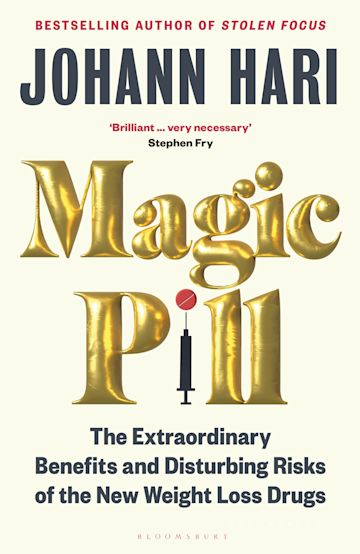
I’m reading Magic Pill: The extraordinary benefits and disturbing risks of the new weight loss drugs by Johann Hari. What an eye-opener this book is.
From some time in the late ’70s something began to change. Obesity began to rise steeply, or as Johann Hari says, it went supersonic. In 21 years obesity in the US almost doubled. Shockingly, more than 70 per cent of Americans are overweight or obese. The trend is rising in the UK and the same for Australia. The World Health Organisation says that obesity has nearly tripled globally since 1975.
Magic Pill is Johann’s investigation into why we are obese, why in many instances we can’t lose the weight, and how these magic drugs like Ozempic work and their side effects. He is on Ozempic himself so has an insider’s view and it is not all pleasantries.
Johann Hari begins by looking to his own family to give him some insight as to why he was obese.
His parents are from very different backgrounds. His mother grew up in the ‘damp tenements of Scotland’. Women of her era had not much to look forward to but ‘marriage, semi-servitude, back-breaking work’. His father grew up on in the crisp air of the Swiss Alps on the family farm. The night they met, his father spoke a handful of English words. After a ‘series of one-night stands’ she fell pregnant. Their first fight was on the day they married. She signed her maiden name on the register. ‘You idiot’, he shouted. ‘F… off’, she yelled back. But I digress.
His father had a childhood of eating what you grew. He became a chef. His mother came from a world of stodge, eating ‘salted, fried carbohydrates’: Scotland being the home of the deep-fried Mars Bar. They were diametrically opposed. As the popularity of pre-packaged and preprocessed food grew so did waistlines. His mother embraced the easy options. Much to his father’s horror Johann shunned his food and embraced his mother’s. His father was ‘enraged’. ‘He will die if he never eats vegatables!’ Of course, Johann became obese.
Johann tells the story of Paul Kenny, a scientist who was curious as to whether the American diet changed the brain. Once someone started eating lots of processed, fatty sugary foods, is it harder to stop?
He ran an experiment with interesting results. His scientific team raised a group of lab rats and fed them a healthy balanced diet. They enjoyed this food, chowing down, stopping when they were full. The rats were a constant healthy weight and content.
He then split them into two groups. Both groups had access to their healthy food all the time. But both were also given the option to eat cheesecake and Snickers bars with some added fried-up bacon. One group had the sugary fatty food for only an hour a day, the other could access it all day.
As soon as the ‘bad’ food arrived they dived straight in. The rats who had only an hour’s exposure would eat until it was gone. The rats who had access all day would eat, then rest, then come back. They topped up all day. The healthy food quickly remained untouched. They became obese and started to have health problems. It was then that the ‘bad food’ was removed and just the healthy food remained.
Whereas before they had the ability to limit what they ate to remain a healthy weight, now having been exposed to this highly processed junk food, they had lost their ability to stop eating when full.
At this point the rats refused to eat. They’d starve rather than dig into their previously yummy food. It wasn’t until ‘they’d starve to death and they had no choice’ that they relented.
Ironically Johann thought about the times his mother was away and his father would prepare salads for him. He would refuse to eat, going to his room crying.
This is a cruel story, and not one I share lightly. But, it highlights what we are doing to ourselves. The suffering that has ensued from processed foods, the ease with which we can access it, the simplicity of preparing it, the lower cost, all these things desperately need to change.
The results of a diet made up of these foods has crept up to become the scourge of more than one generation. It’s akin to being addicted to smoking or alcohol. It’s frightening for those who are swept up in it and for those watching on.
How can we change it? I’m not sure we can. Humans seem incapable of seeing clear doom on the horizon and then changing tack to stop it. Gloomy, I know, but it is true.
Already this book has helped me understand why I might eat in certain ways, what it’s like to be in a situation where you can’t find a way to lose weight and why that is. The self-judgement and guilt you feel by not being able to lose weight. The hope that drugs like Ozempic offer. A miracle for sure. But a miracle with a cost.
Rowena
ABOUT THE AUTHOR
 Johann Hari is the author of three New York Times bestselling books, and the Executive Producer of an Oscar-nominated movie and an eight-part TV series starring Samuel L. Jackson. His books have been translated into 40 languages, and been praised by a broad range of people, from Oprah to Noam Chomsky, from Elton John to Naomi Klein.
Stolen Focus: Why You Can’t Pay Attention was named as one of the three best books of the year by Amazon.com, and it was named as a Book of the Year by the Financial Times, the New York Post, and the Spectator. It was also chosen as ‘Book of the Month’ by Britain’s biggest bookseller, Waterstones, and Australia’s biggest bookseller Dymocks. It won several awards, including being named as ‘Most Important Book of the Year’ at the Non-Essential Book Awards and ‘Best Book of the Year’ at the Porchlight Book Awards. It has been a best-seller on three continents.
Chasing the Scream: the First and Last Days of the War on Drugs was adapted into the Oscar-nominated film ‘The United States Vs Billie Holiday’. It has also been adapted into a documentary series
Johann was born in Glasgow, Scotland, and when he was a year old, his family moved to London, where he grew up and where he has lived for most of his life. His father – a Swiss immigrant – was a bus driver, and his mother was a nurse and later worked in shelters for survivors of domestic violence.
He lives half the year in London, and spends the other half of the year traveling to research his books.


0 Comments