




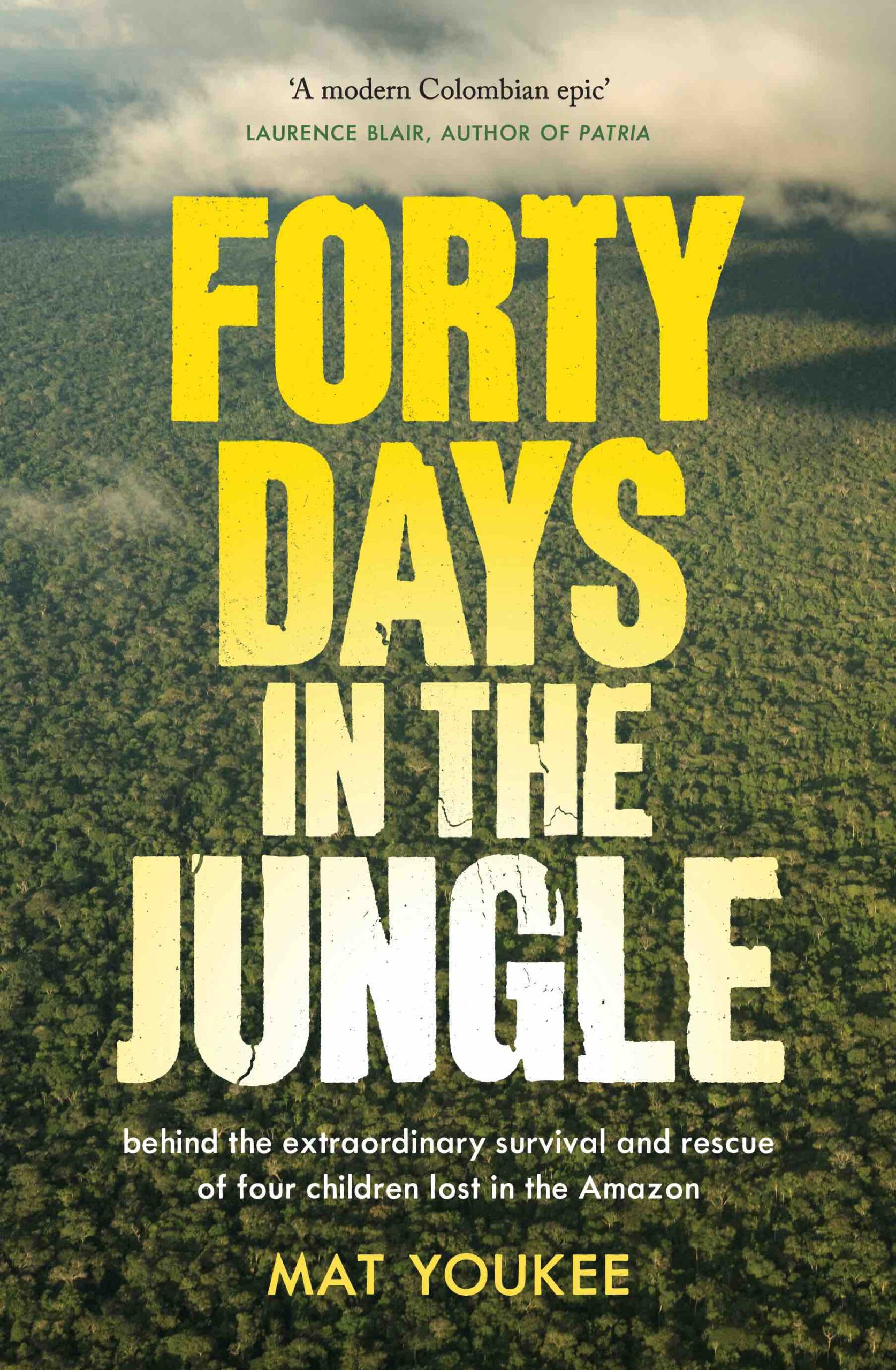
Forty Days in the Jungle by Mat Youkee tells an extraordinary survival story that also reveals the struggles for social justice of the Indigenous people of Colombia and the Amazon.
Read on for an extract …
ABOUT THE BOOK
In June 2023, four Indigenous children were found alive in the Colombian Amazon, 40 days after the light aircraft they had been travelling in crashed into deep jungle, killing the three adults on board. For weeks the Colombian public had been transfixed by clues of the children’s survival, of Indigenous tales of malign forest spirits, and of the unconventional tactics of the huge search team. But most now despaired of ever finding the children.
Thirteen-year-old Lesly Jacobombaire Mucuty never gave up hope.
Forty Days in the Jungle tells the story of how the eldest child kept her siblings safe and fed during their time in the wilderness. It follows the battle-hardened soldiers and the brave Indigenous volunteers who undertook the search operation. And it delves into the Indigenous mythology – the spirits, shamans, and psychedelic potions – that was central to the drama and made it a rescue mission unlike any other.
By investigating the children’s motives for travel, the tragedy of their backstory, and the months that followed their rescue, it also shines a light on the painful history of Colombia’s Amazonian peoples. Lesly and her siblings were survivors before they ever set foot on the plane.
CHAPTER SIX
An Upside-down World
 When Lesly Jacobombaire Mucutuy came to, she felt the weight of her body hanging forward and the pinch of the seatbelt around her waist. She heard the sound of dripping. She opened her eyes.
Below her, the back of the black leather seat was slick with blood. Above, just a few inches from her face, were the mud and leaves of the forest floor. She reached her right hand to her forehead and felt the contours of a long, open gash that stretched along her hairline.
She struggled to make sense of her upside-down world. To her right, a triangle of white metal jutted towards her through the smashed window. It was the trailing edge of the plane’s wing. A few shards of glass protruded from the window frame; beyond them there was only green. If she craned her neck, she could see the roof, caved in like a crushed soda can.
And when she turned to the left, she could see her mother, slumped forward in her seat, one arm dangling towards the ground, her long hair draped over her face. Terrifyingly still.
The dreadful memories began to arrive. Her mother reaching across to tighten her seatbelt. The pilot fighting the controls, yelling panicked orders to the passengers. The hands of the heavy-set man in front of her desperately searching – on the dashboard, on the door frame – for something to brace against. Then the deafening thud and the stomach-churning sudden descent.
“Mama?” she whispered. Then, louder, fear cracking her voice: “Mama?”
But she already knew.
Something in Magdalena’s posture, the terrible inertness of her arm, the way her chin jutted towards the ground, told Lesly that her mother was dead.
Lesly hung there, upside down, staring at her mother. She felt her chest tighten and, above that, her stomach clenched. The first waves of panic and nausea began to course through her body.
Then she heard the muffled, desperate cry of a baby.
From the folds of Magdalena’s body, still cradled by a rigid arm, Cristin’s plump leg emerged.
Lesly struggled with the unfamiliar buckle around her waist. When it surrendered its grip and she fell forwards onto the ground, her left leg remained trailing behind her, and she let out a yelp of agony. Her seat had come off its rail, and her calf was pinned between the metal frame and the floor. She pulled and twisted until her heel eased its way out of the collar of her sneaker and her foot was released. A searing pain spread through her leg.
She crawled towards her mother. Beneath her, next to where she placed her hands, the pilot’s white shirt seemed to glow in the dim light. The back of his head protruded from the mud.
On her knees, Lesly reached out a hand and pulled at Cristin’s ankle. Her eleven-month-old sister slid from her mother’s clutch, gasping and crying. Lesly hugged her tightly to her chest. She looked up. From the back seats of the plane, two small faces looked back, silently.
Lesly got to her feet in the narrow aisle, brushing up against her mother’s body as she did so. Her left leg buckled beneath her, and she grasped the seat for support. Keeping hold of Cristin with one hand, she pulled herself up to sit on the back of the seat she had been traveling in. As she worked to release Soleiny and Tien from their seatbelts, they began to cry. She looked at each child. Soleiny was bruised on her head and her chest, but Tien was unscathed.
… the pilot’s white shirt seemed to glow in the dim light. The back of his head protruded from the mud.
Next to Soleiny’s seat, the rear door of the Cessna hung open, swinging gently on its rear hinge. Lesly went first, lowering herself by her arms as far as she could letting go before landing painfully on the forest floor. She got to her feet and supported her weight against the plane’s wing, reaching up to receive Cristin as Soleiny passed her down.
Once Soleiny and Tien had clambered out of the plane, they retreated a few meters into the forest, in the shadow of the aircraft’s bright blue belly. It was only then that Lesly could fully make sense of what had happened.
The Cessna’s fuselage rose up vertically, as straight as the forest trees, its blue-tipped tail sticking out like a flag on a mast. The cockpit was entirely buried, and the crumpled wings were bent backwards, flush with the forest floor. Ten meters away, a hunk of metal the size of a refrigerator spat and hissed in the damp foliage. It was the Cessna’s engine, knocked free by its collision with the treetops, the anatomy of its pistons and wiring now exposed.
Behind the plane was a thick-trunked palm. Lesly sat with her siblings at the base of the tree. Tien asked her why their mother wouldn’t wake up but Lesly didn’t know what to say. Soleiny stared at the side of Lesly’s face where the blood ran thickly from the wound in her forehead. Lesly knew from her mother that open wounds, in the heat and humidity of the jungle, needed to be treated quickly. But that would require a return to the plane.
She propped open the swinging rear door of the plane with a branch, and hoisted herself up. She remembered that the passengers’ luggage had been stored in the space at the back of the plane. On the side of Tien’s seat, she found a small lever that popped the seat forward. She pulled out the bags and dropped them through the plane door. Behind them, attached to the fuselage, was a small yellow box with a flashing light. Next to it was a black square zippered bag with a red cross that Lesly instantly recognized. She grabbed it.
As she was about to leave, she noticed, on the lowest reaches of the cabin, two plastic bottles of water. She lowered herself to where her mother’s body rested, and retrieved them. She tried to pull her shoe free from under the seat, but it was stuck fast.
By the time she returned to her siblings, Lesly was already formulating a plan.
First, she needed to stem the bleeding. She removed one of the diapers from Cristin’s bag and pressed the absorbent material to her forehead. She held it in place using gauze from the plane’s first-aid kit. Next, she draped a towel over the lower branches of a nearby tree to create shade, and hung up the mosquito net she had found in the luggage. The children crawled inside. Lesly knew that someone would come looking for them. How long that might take, though, was a different matter.
They waited.
The heat rose. From her position, Lesly could see that a swarm of flies had converged around the plane. She understood what it meant, and when Tien became restless and wanted to return to the plane to check on their mother, Lesly held his wrist fast. From the diaper bag, she removed Cristin’s bottle and one of the sachets of Klim powered milk that lay alongside it. She emptied half the sachet into the bottle and poured in some water. Cristin grasped the bottle with both hands and began to suck greedily.
Then Lesly retrieved the pair of copuazú fruits that her mother had packed the night before. They were brown and hairy, each the size of a papaya, but once she removed the outer skin, the flesh below was white and succulent. There were dozens of large seeds inside, each encased in a film of flesh. She gave a seed each to Soleiny and Tien and then took one herself. It tasted like chocolate.
For two days and two nights, the children remained in the shelter. The rain fell in sheets. At night, when the temperature dropped and their damp clothes pressed against their skins, the children huddled together for warmth. Lesly lay on her back ,with Cristin on her chest to keep her out of contact with the cold forest floor. They ate the second copuazú, and finished the last of the water.
On the third day, Lesly awoke to the sound of rustling coming from the plane. Without waking her siblings, she slipped out from under the mosquito net and limped in a wide arc around to the left-hand side of the plane.
A vulture, with jet-black wings and a head of grey, wrinkled skin was poking its way around the base of the plane. Lesly hated vultures. The swarm of flies had grown, and she smelled the sour odor of decay for the first time. Soon, she knew, the jaguars would come.
As she returned to the shelter, she understood she had a decision to make. They had waited two full days, but no help had arrived. She couldn’t be sure that the planes she had heard were looking for them, or whether anyone was coming for them at all. They couldn’t stay next to the Cessna, with the smell of the dead growing stronger.
Lesly resolved that they had to try to find a village. La Chorrera, Araracuara, and the other riverside settlements she knew were always next to water. She remembered the pilot’s panicked words into the radio handset. I’m going to find a river. She had seen, over the shoulder of the man in the cockpit, the brown coils of a river through the windshield.
Lesly looked at the position of the plane. Even nose-deep in the jungle, it was clear the direction it had been traveling in. She looked at the thick forest ahead of her, and felt the dim heat of the sun on her face. They would walk east.

ABOUT THE AUTHOR
Mat Youkee has lived in Colombia since 2010, working as a freelance journalist and professional investigator. He has covered Indigenous-rights issues in Colombia, Panama, Chile, and Argentina for The Guardian. His reporting has also appeared in The Economist, The Telegraph, the Financial Times, Americas Quarterly, Foreign Policy, and other local and international publications.

0 Comments