




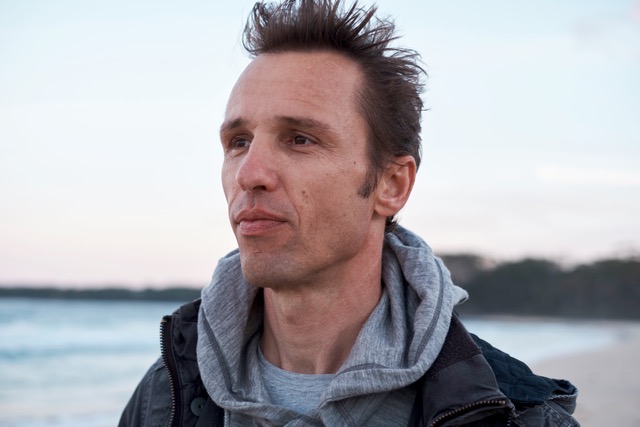
Markus Zusak is the international bestselling author of six novels, including The Book Thief – one of the most loved books of the 21st century and a New York Times bestseller for more than a decade.
His latest book is a memoir that tells the story of the chaos and love that four-legged family can bring.
 ABOUT THE BOOK
 ABOUT THE BOOK
There’s a madman dog beside me, and the hounds of memory ahead of us. It’s love and beasts and wild mistakes, and regret, but never to change things…
What happens when the Zusaks open their family home to three big, wild, pound-hardened dogs – Reuben, a wolf at your door with a hacksaw; Archer, blond, beautiful, deadly; and the rancorously smiling Frosty, who walks like a rolling thunderstorm?
The answer can only be chaos: there are street fights, park fights, public shamings, property trashing, bodily injuries, stomach pumping, purest comedy, shocking tragedy, and carnage that needs to be seen to be believed … not to mention the odd police visit at some ungodly hour of the morning.
There is a reckoning of shortcomings and failure, a strengthening of will, but most important of all, an explosion of love – and the joy and recognition of family.
From one of the world’s great storytellers comes a tender, motley and exquisitely written memoir about the human need for both connection and disorder; a love letter to the animals who bring hilarity and beauty – but also the visceral truth of the natural world – straight to our doors and into our lives, and change us forever.
**********
A KNACK FOR FINDING PROBLEM DOGS
That night in November, 2009, Mika was scanning the internet for abandoned dogs. My obvious advice for anyone approaching those animal websites is that whatever you do, if you’re only fifty per cent sure, don’t look. Once you’ve looked, you’re gone. You might as well start buying the food, the leads, the beds, the toys, and finding your nearest vet. The more intelligent among you might also start looking up pet insurance.
When Mika called out that she’d found us a dog, the dilemma was immediately twofold. First, God love her as I do, she’s good at knowing what she wants. Second, she has a knack for finding problem dogs – the ones no-one else can handle.
A small but significant backstory is that we met each other overseas. It was the first time I’d ever been travelling, and Mika was beautiful confidence. For years, she’d often gone back to Poland, where she was born, and where she lived until she was six.
We’re in 1998 at this time.
She told me about her dog.
Tyja.
(Pronounced Teeya.)
A Rottweiler German Shepherd cross. Of all the combinations! And Tyja’s command of her surrounds, and her abilities in the art of ferocity, let’s say, were the stuff of suburban legend.
When people went to Mika’s parents’ house in Edensor Park and dared to enter the backyard, they first had to survive the Tyja test – one hell of an examination. Apparently, the dog would circle you. If she liked you she’d give you a warning look, then nonchalantly wander away. If she didn’t like you, she’d growl and bare her teeth. A clear and present directive. — Get your arse back inside.
After which, she’d follow you to the door, and once behind it again, if you gambled on reaching out your hand, she’d thunder into the security screen.
As for me?
What do you do when you meet a beautiful girl on your first trip away and fall completely, maddeningly in love, and you’re coming back home before she is? You agree to take some of her clothes home, risking drugs and hidden firearms, and last days in Bangkok or Singapore.
Having passed the customs challenge with flying colours, I arrived home and called her mum and dad, arranging delivery, and, by default, to meet the legendary dog.
To be honest, I wasn’t overly worried, even if I should have been. I’d subscribed from a young age to the idea that if you didn’t show fear to a dog and took a common-sense approach, you’d be okay ninety-nine per cent of the time . . . although from everything I’d been told, Tyja was a one-percenter.
Like most car trips in Sydney, Mika’s place was forty-five minutes to an hour away, and I was more than an hour early. I didn’t park directly outside the house, but further down the cul-de-sac. When I walked up the driveway, I saw Tyja behind the gate, where she barked and showcased her teeth. This dog was here for business. I rang the doorbell nervously, for many more reasons than one.
When I went inside, Mika’s mum and dad were very welcoming, a house with slate and light. We talked for a while, about travelling, and Mika, and I tentatively ate the fruit they’d brought out, till they asked the inevitable question.
Did I want to go out and meet Tyja?
Now, what was I going to say?
Look, I really love your daughter, but I don’t have the guts to meet your ferocious dog?
I don’t think so.
This was a time to prove myself. For both physical and mental fortitude.
When we opened the flyscreen, Tyja was further away, around the side of the house. For whatever reason, I was a stride or two ahead, and when Tyja saw me, she stopped. She studied me from a distance for scarcely more than a second, then she dug her ample paws into the ground and came careering in my direction. Big and black and muscular and gold, she launched herself through the air. She hit me – and started licking. She crowded against my legs the way only a dog can do, and she snuffed and pawed and continued. She licked my forearms and hands, those teeth both felt and suggested, but with excitement rather than terror. She lay down and flopped on her back. I crouched and rubbed her stomach.
To this day, Mika’s mum, Halina, says she thought I was about to die. That sight, of Tyja mid-air, claws open. She’d never seen that dog react to anyone like that, but to be fair, I’m not deluded. I’m sure it was all in the scent. She could probably smell Mika from the laundry bag the moment I walked up the driveway.
Still, from that day onwards, Tyja and I were tight – and as the story goes, when I left the house that afternoon, Halina rang Mika in Warsaw, and said, ‘I just met your future husband.’
Both Halina and Tyja were right.
Up in that very future, the night Mika called across the hallway, Tyja had been gone for quite some time, but a similar dog was looming.
‘Come and have a look,’ she said, leaning in at the dog on screen. I told her I’d be there soon, that I was finishing reading through a chapter. It wasn’t necessarily the plan, but later, when I came to bed, Mika was already asleep.
I was forced to look in the morning, though, when she shoved her laptop on the table. I was caught off guard in the kitchen, and there he was, in front of me.
This dog was something else.
He was brindle and dark and wild-looking. One of his earth-coloured ears was flopped irresistibly forward. Four months old and pouting. Black lips and disarming eyes. You could see he was half hyena-like, but loaded with mottle and character. He had fifty-two grades of brown.
‘Oh, shit,’ I said.
ABOUT THE AUTHOR
 Markus Zusak is the international bestselling author of six novels, including The Book Thief and most recently, Bridge of Clay. His work is translated into more than forty languages, and has spent more than a decade on the New York Times bestseller list, establishing Zusak as one of the most successful authors to come out of Australia.
All of Zusak’s books – including earlier titles, The Underdog, Fighting Ruben Wolfe, When Dogs Cry (also titled Getting the Girl), The Messenger (or I am the Messenger) – have been awarded numerous honours around the world, ranging from literary prizes to readers choice awards to prizes voted on by booksellers.
In 2013, The Book Thief was made into a major motion picture, and in 2018 was voted one of America’s all-time favourite books, achieving 14th position on the PBS Great American Read. Also in 2018, Bridge of Clay was selected as a best book of the year in publications ranging from Entertainment Weekly to the Wall Street Journal.
Markus Zusak grew up in Sydney, Australia, and still lives there with his wife and two children.



0 Comments