



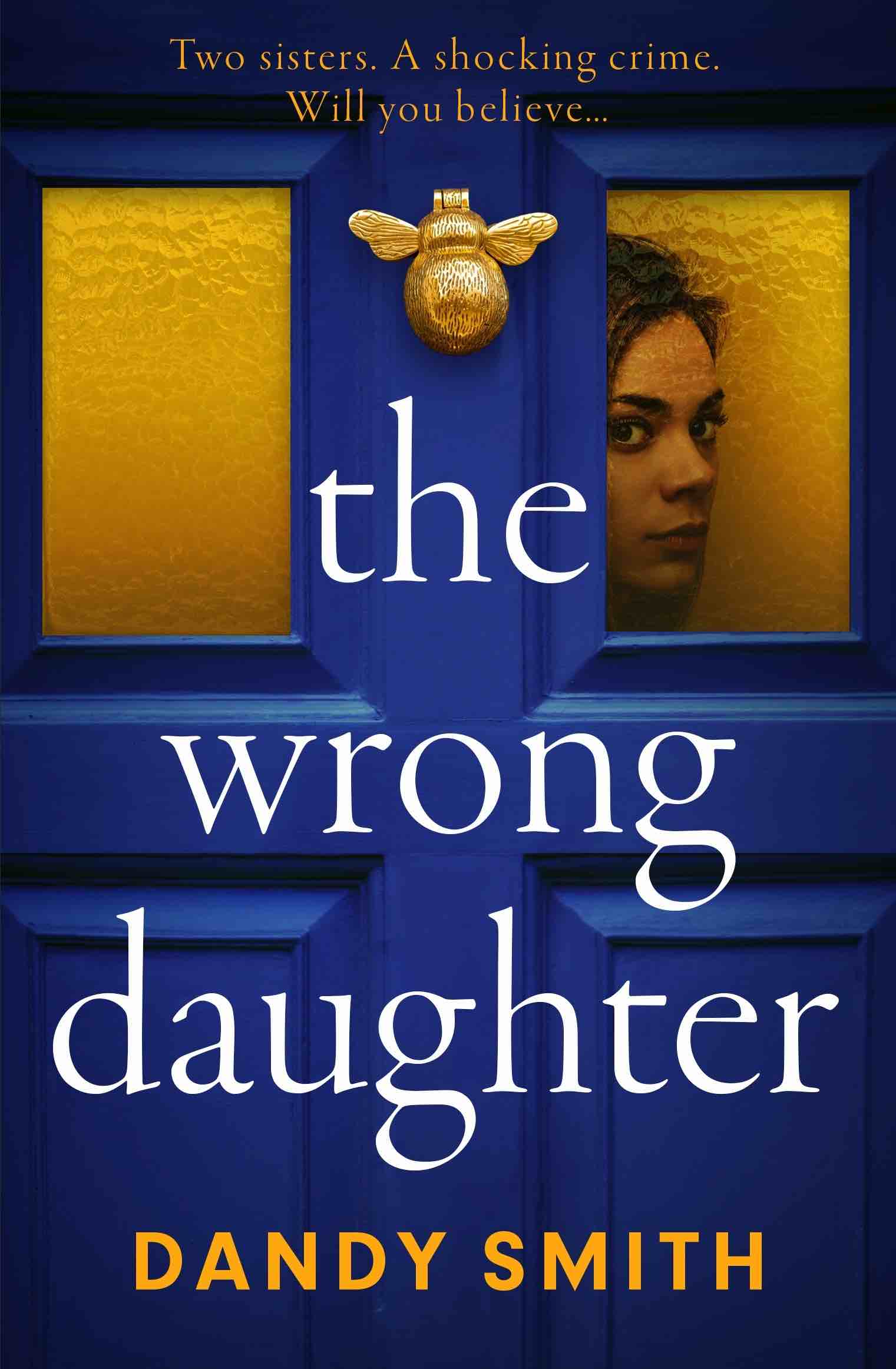
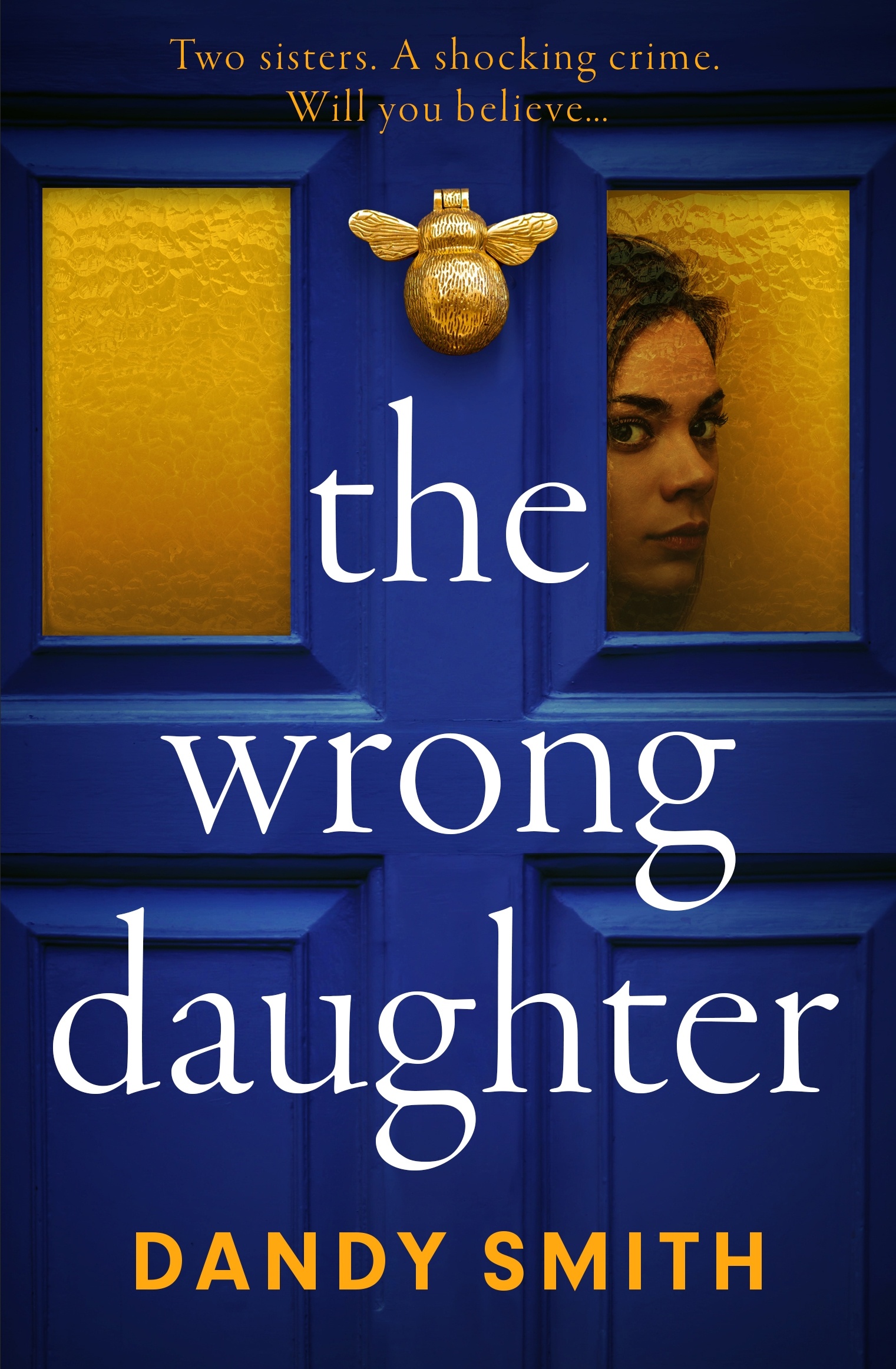
Read on for an extract from Dandy Smith’s latest thriller, The Wrong Daughter.
ABOUT THE BOOK
 The phone starts vibrating in my hand. It’s my father. He never calls. Pulse racing, I sit up in bed and answer. ‘Caitlin,’ he says. ‘You need to come to the house. Right now. It’s Olivia. She’s back.’
On the night when Caitlin and Olivia’s parents leave them to go to a dinner party, both girls are full of excitement about finally being old enough to stay home alone.
What they don’t see is the figure watching them through the open window. Who, after the girls have fallen asleep, will turn the handle of the unlocked back door.
When their parents return, they will find Olivia’s bed empty. Their eldest daughter gone. Never to return. Until now.
But is the woman who claims to be Olivia all she seems? Is everything Caitlin said she saw that night the whole truth?
Their family have dreamed of this moment, but both sisters are keeping more than one secret. What price will they all pay if they end up believing the wrong daughter?
Perfect for fans of Claire Douglas, B A Paris and Lisa Jewell.
**********
Prologue
They are sisters. They are aged ten and thirteen years old. They are home alone. Neither girl notices the man who watches them from the woods behind their house.
The eldest, Olivia, is in charge while their parents are out. There is money for pizza on the kitchen counter and a list of emergency phone numbers pinned to the fridge. Olivia doesn’t even glance at them; Blossom Hill House is in Stonemill, an idyllic market town in the heart of Somerset, a place where people feel safe enough to leave their doors unlocked.
At six in the evening, the girls slip on their shoes. Despite instructions to be in bed by nine, Olivia has decided she will let Caitlin stay up half an hour later and, as she takes her sister’s hand and walks out into the summer sunshine, her parents’ warnings to stay inside are blown from her mind like dandelion clocks.
The girls close the navy-blue front door with the brass-bee knocker, but do not lock it. Caitlin glances up, missing the pretty pink petals that drift down from the cherry blossom tree in their garden during spring. They turn right out of the gate, then left onto the road that leads to the farm shop. They use the pizza money to buy sandwiches; thick, crusty bread, smoked ham and strong cheese. Next door, at the bakery, they buy rich, dark chocolate brownies and icy bottles of lemonade. They leave with their haul and race to the wildflower meadow. Here, among baby-blue forget-me-nots and bright bursts of yellow buttercups, they while away hours on sun-warmed grass. The summer stretches out before them, a blank canvas, waiting to be painted with possibility and adventure.
Olivia turns her face to the sky and loosens her thick, golden braid. She combs her fingers through her hair until it falls in a flaxen cascade down her back. Caitlin picks at a lock of her own hair; dark brown and, in her opinion, boring compared to the sunset glory of her sister’s. Noticing the derisive look on Caitlin’s face, Olivia says, ‘Your hair is so shiny; fox red when the light hits it, Kitty-Cate.’
She beams at Olivia, catching the compliment and clutching it hard to her chest.
The girls sit and make daisy-chain jewellery. They polish off the last of their now sun-warmed picnic and drink the last of their lemonade. In the balmy glow of the evening light, Olivia performs a perfect cartwheel across the meadow. She is all long, tanned limbs and flawless symmetry. She offers to teach Caitlin. Caitlin who is clumsy and uncoordinated and afraid of failure. Caitlin fibs, feigning a sore ankle because she knows she will never be able to imitate Olivia’s effortless poise. She lives contentedly in the long shadow of her sister. Not in the sense that she is loved any less by their parents because the girls are adored equally. Rather, Olivia is older, she was the first to talk and walk and cartwheel. Caitlin is forever following a little way behind. She’s happy, safe in the shadow of her sister.
The girls lie on the grass and gaze up at the milk-white clouds in the endless blue sky – they point out shapes they see: a leaping hare, a witch’s hat, a ballet slipper. If they knew of the horrors of tonight, or the savage reality of tomorrow, they would want to pause time, to burrow down into this warm, July afternoon. In this moment, they are young and carefree, their futures as organic and as wild as the meadow around them. And though they don’t yet know it, this is the very last perfect afternoon the sisters will share.
The girls walk the long way home, breathing in the fresh smell of cut grass and listening to the far-off sound of an ice-cream van. They pass Florence’s house. The willowy girl with her inky, Parisian bob, sits in her bedroom window, staring out apathetically, her head on her knees. She had detention today, on the last day of school, for rolling her skirt too short. Olivia and Florence are best friends. They are the queen bees of Southfield School for Girls. They have the kind of easy, effortless friendship Caitlin craves. When Florence notices the Arden sisters lingering at her front gate, she brightens, removing her MP3 player headphones. She waves but stays quiet in case her mother is lurking nearby. The sisters wave back. Later, Florence will be asked over and over by the police what time, exactly, she saw the girls pass by her house. Her answer will change and change again because she isn’t sure. For the rest of her life, she will pay close attention to the time.
At home, the girls wear matching cotton pyjamas. They settle down on the large sofa in front of the TV, a bucket of popcorn between them. They are oblivious to the stranger that lurks in their back garden, watching them.
Later, Caitlin goes upstairs to use the bathroom and stops at the door of her sister’s bedroom. Inside Olivia’s room, Caitlin notices a forest-green diary on the dressing table. She picks it up. She can tell from the soft velvet and the gold bee embroidered on the front that it is expensive. Nothing like the flimsy diaries from the old stationery shop in town. Caitlin is about to open it to the first page when her sister appears in the doorway.
Fear flares in Caitlin’s chest – a flame threatening to lick up her throat and out of her mouth on a fevered scream.
Olivia halts, eyes narrowing as she catches Caitlin. She isn’t angry; Olivia doesn’t get angry. She is confidence and compassion. Determination and sugar. Wordlessly, she holds out her hand, palm up. Cheeks flaming and guilt swirling in Caitlin’s stomach along with the picnic and popcorn, she relinquishes the diary, but works up the courage to ask where it came from.
‘It’s not a diary, it’s a journal,’ corrects Olivia because diaries are for girls. Journals are for young women. ‘A boy gave it to me,’ she elaborates, carefully placing it back on her dressing table. ‘The boy on the bus.’
This doesn’t surprise Caitlin. On occasion, as Olivia walks home from the bus stop after school, she will duck into the florist on Honeysuckle Avenue and buy a small bunch of flowers for their mother. Sometimes, because she is beautiful, she is given them for free. A lesson Caitlin has learned early on, is that beautiful people are often gifted beautiful things. Like flowers. Or journals.
‘He told me to write it all down,’ says Olivia. Caitlin wrinkles her nose. ‘Write what down?’ ‘All of it.’
She asks who the boy is.
‘Just a boy.’ Olivia’s smile is secretive. ‘Just the boy on the bus.’
After, the police will search for The Boy on the Bus. They will never find him. But they will look.
In bed, as sleep tugs at her, Caitlin wishes for a journal of her own. One exactly like Olivia’s. She does not hear the excited pant of the man’s breath at the unlocked French doors downstairs, or smell his cologne as he slips silently into the house. She drifts off.
Moments later, Caitlin jolts awake, ripped too abruptly from her dreams. The night is deepest black and all around her. She can’t be certain what had woken her. She sits up in bed and listens.
Silence.
She knows something is wrong. It is an instinct she cannot fathom but it is as real to her as the heart that canters in her chest. Slowly, silently, she slips from her bed and pads across the hardwood floor. She stands statue-still by the door. It is open half a foot. Though her bedroom is plunged into blackness, the moonlight shut out by the heavy curtains, there is a high, round, stained-glass window on the landing which casts the space beyond her room in an eerie silver glow.
She holds her breath and listens. Beneath the sound of blood rushing in her ears, she hears her sister’s bedroom door yawning open down the hall. Caitlin’s fingers curl around the cool, brass knob but another instinct stops her from opening the door wider. Heavy, even footsteps cut through the quiet. They do not belong to her sister. Caitlin does not move. Does not make a sound. Does not blink as her sister drifts into view. And then so does a figure – tall and broad – too tall and too broad to be anything other than a man. Horror is a roaring inferno in Caitlin’s gut. She cannot see his face; it is obscured by a Venetian mask with a long nose and furrowed brow. It is grotesque and surreal, like something from the circus. It’s only as he guides Olivia to the top of the stairs that the knife pressed to her sister’s throat catches the moonlight.
Fear flares in Caitlin’s chest – a flame threatening to lick up her throat and out of her mouth on a fevered scream. Momentarily, the knife disappears into his black shoulder bag. The masked man curls a gloved hand around the back of Olivia’s neck and turns her slightly. She is facing Caitlin’s bedroom door. Olivia looks up. Their gazes lock. Taking advantage of his lapse in focus, Olivia lifts a trembling finger and presses it to her lips, willing her sister to stay silent. Caitlin’s own hands fly to her mouth, containing the scream that has surged like bile. In muted dread, she watches the man produce a second Venetian mask from the bag and place it over Olivia’s face. It is patterned, dark green and gold, just like the journal. The knife back to her throat, Olivia is led away, down the stairs. Caitlin thinks of the setting sun, sinking beneath the horizon. Disappearing into the dark.
Moments later, she hears the back door open and then shut. She feels the finality of it in her blood. She stands a while longer, replaying the image of her sister pressing a finger to her lips. She isn’t sure how long she is paralysed in the doorway before the spell is finally broken and she shrinks back into the shattered safety of her bedroom. Beneath the covers of her bed, she cowers, shaking like an abandoned dog.
She is alone.
She doesn’t really understand what alone is. But she will. In the coming months and years, she will come to understand alone all too well.
It is hours before their parents return. They are merry, their night a whirlwind of red wine and rich food and good conversation. It is almost one in the morning when they stumble up the stairs to check on their girls. Even though Olivia’s room is furthest, it’s her room their mother looks in on first. She is unconcerned to find the bed empty, convinced her daughters are tucked up together, limbs intertwined, in Caitlin’s room.
She checks. What she finds is her youngest, and only her youngest; pale and quaking. Caitlin’s tale of a masked man with a long nose, of a knife, of a secret journal and The Boy on the Bus, of a setting sun and Olivia being stolen away into the night, is garbled and too fast. If it weren’t for the empty bed of her first born, their mother would not believe it.
What comes after is a blur of noise and artificial light and the police crowding their house, skittering all over like ants. Olivia is gone. Her journal is gone, too. Their father promises Caitlin that Olivia will return. That her mother will stop making those broken, animal noises. That everything will be alright. Caitlin doesn’t reply. She doesn’t reply because she knows the truth, she feels it in each beat of her heart, in every breath, even in the bright red of her blood: her sister is never coming home.
 ABOUT THE AUTHOR
Dandy Smith lives in the Somerset market town of Frome with her husband and two cocker spaniels.
She has an undergraduate and master’s degree in Creative Writing from Bath Spa University and enjoys all things aerial fitness, true-crime and Gilmore Girls.
Follow Dandy Smith on Instagram


0 Comments