




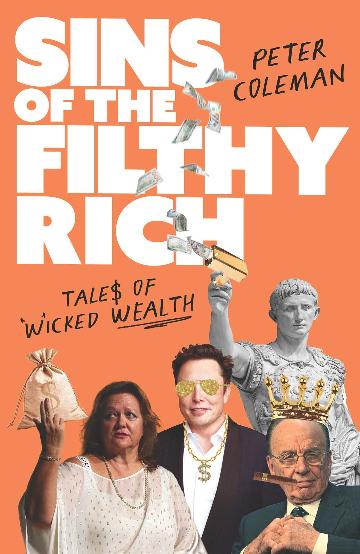
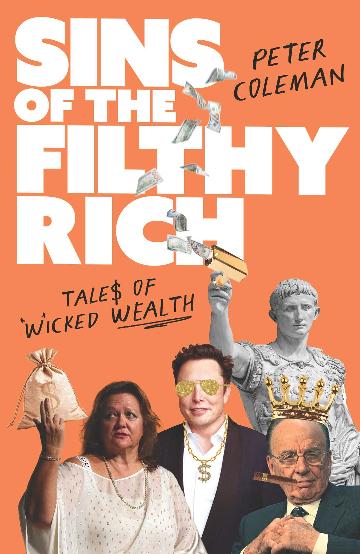
From Emperor Commodus to Rupert Murdoch, Count Dracula to Kim Kardashian, Genghis Khan to Gina Rinehart, Sins of the Filthy Rich explores how the mega wealthy have exploited, indulged and misbehaved appallingly throughout history.
Read on for an extract …
**********
Sloth
The Royal Stool
King Henry VII ruled England from 1485 until his death in 1509. He was the founder of the Tudor dynasty and is credited with ending the War of the Roses. He also introduced one of the oddest (and shittiest) jobs in the history of British monarchy: the Groom of the Stool.
The chief purpose of this position was to manage the monarch’s poop. The groom was responsible for the king’s personal portable toilet, known as a ‘close-stool’: a box-shaped wooden seat with an opening at the top and a pewter chamber pot inside. The royal ‘stools’ were typically upholstered with velvet (because comfort is key). Historian Tracy Borman explains that the groom oversaw the ‘maintenance and transport’ of the close-stool ‘to other palaces as required’. Most importantly, the groom was responsible for setting up the king’s stool and standing at the ready for the monarch’s post-bowel movement ablutions. Their duties were outlined in this instructional poem from the 15th-century Book of Nurture by John Russell:
See the privy-house for easement be fair, sweet, and clean;
And that the boards thereupon be covered with cloth fair in green;
And the hole himself, look there no board be seen;
Thereon a fair cushion, the ordure no man to vex.
Look there be blanket, cotton, or linen to wipe the nether end,
And ever he calls, wait ready and prompt,
Basin and ewer, and on your shoulder a towel.
 The basin, ewer and towel were for washing the king’s hands, while the ‘blanket, cotton, or linen’ were for wiping the royal rump. There is some historical debate over whether the groom was directly responsible for wiping the king’s bottom or whether he simply handed him the ‘cloth’. Personally, I’m convinced arse-wiping was part of the gig. If you’re lazy and indulgent enough to have a full-time toilet attendant, you’re going to make them wipe. (God forbid His Majesty’s fingers should be soiled by accident!) It was also the groom’s job to clean up after the ‘royal visit’. He was required to inspect the monarch’s faecal matter before disposing of it to ensure the king was in good health. (I have no idea what qualified as a ‘healthy poop’ in the 16th century, and I wasn’t interested in finding out.)
Readers may be astounded to learn that the Groom of the Stool was a highly sought-after position. Why, you ask? For the love of God, why?!
For one thing, the Groom of the Stool was granted a one-of-a-kind golden key to symbolise his special access to the king’s private quarters. Borman explains that such access was considered a genuine privilege, only reserved for the most elite royal attendants:
In order to ensure [King Henry VIII’s] comfort, as well as to display his magnificence even in this most private of rooms, a series of close-stools were crafted for him. Made from pewter, they were covered in embroidered velvet, stuffed with swans’ down and studded with gilt nails. When Henry went on progress, similarly luxurious close-stools would be constructed at each house that he stayed in and reserved for his sole use. This reinforced both the status of the king and the extreme privacy with which he expected to carry out his evacuations. It also reinforced the status of the groom of the stool as the only person privileged enough to attend his sovereign during these times.
If you were a Tudor-era royal attendant, the groom’s golden key was like having the ticket to Willy Wonka’s chocolate factory!
There were additional duties in the job description that elevated the groom’s status. As Borman points out, several important administrative tasks fell under the groom’s remit:
He was responsible for those items of the king’s jewels and plate that were in daily use, as well as of his linen and the furnishings and equipment of his private apartments in general. The groom was also ex officio keeper of the privy purse, which gave him responsibility for the financial management of the royal household, and he had a number of important secretarial tasks.
Such higher-level duties transformed the role from a ‘pile of shit’ into a more palatable ‘shit sandwich’.
But what made the position most desirable was the significant amount of time the groom got to spend with the king. ‘The groom was ideally placed to talk to the king about things,’ historian Steven Gunn explained to HowStuffWorks. ‘And that included asking the king for things for himself or for others. This presumably explains why Henry VII’s Groom of the Stool, Hugh Denys, was paid pensions and given gifts by those who wanted to be in the king’s favour and was able to spend such money buying land.’ Gunn also cited the example of William Compton, who was Henry VIII’s first Groom of the Stool. The king gave Compton ‘land grants, land leases and offices … that brought him in maybe £2,000 a year, equal to the income of a leading nobleman or one of the richer bishops’. The groom would consult with the king on everything from palace gossip to foreign affairs.
Historian Lucy Worsley argues that the grooms of King James I and King Charles I may have played a part in instigating the 17th-century English Civil War. King George III even promoted his groom John Stuart to the role of prime minister! The Groom of the Stool was the most powerful and influential lavatory attendant in all of Christendom. Members of the royal court were understandably eager not to piss them off lest they find themselves in the proverbial outhouse.
The last Tudor-era Groom of the Stool was Sir Michael Stanhope who served King Edward VI. When Queen Elizabeth I took the throne in 1558, the role was ‘discontinued’. Royal women generally went number two by themselves, which is hardly surprising. Hiring a personal poop manager requires a level of indolence and immodesty typically reserved for men. Granted, this is a sweeping gender stereotype, and we should permit that some women would love to receive such a service. I’d hazard that a few Real Housewives would lap up the opportunity to have a ‘groom’ on standby in their Versace-wallpapered ensuites.
King James I ‘reactivated’ the role after he took the English crown in 1603, although it was no longer a ‘full-time’ position. The role was primarily focused on taking care of the monarch’s domestic needs and became progressively less poop-focused as the use of close-stools fell out of fashion. The name of the position also changed to Groom of the Stole, referring to the groom’s responsibility for the king’s clothing. The role was discontinued forever by King Edward VII after he ascended to the throne in 1901. Edward was much more interested in having women ‘take care’ of him in the bedroom than having men ‘take care’ of him in the bathroom.
**********
 ABOUT THE AUTHOR
 ABOUT THE AUTHOR
Dr Peter Coleman is an Australian author whose titles include Australia’s Most Bizarre Crimes, Dark Arts and Crafts and Weekends with Matt – all published by Affirm Press.
Peter has a Ph.D. in cultural studies from Monash University. His primary reason for getting a Ph.D. was to call himself ‘Dr’ on flights and get upgraded to Business class. To date, no upgrade has been forthcoming.
He works as a consultant in the not-for profit sector, but can’t be bothered explaining what that involves.
His interests include the French philosopher Simone Weil and Below Deck: Down Under.
Peter has been married to his husband Mike for over 20 years. Their marriage is yet to lead to the downfall of society, but he still holds out hope.


0 Comments