


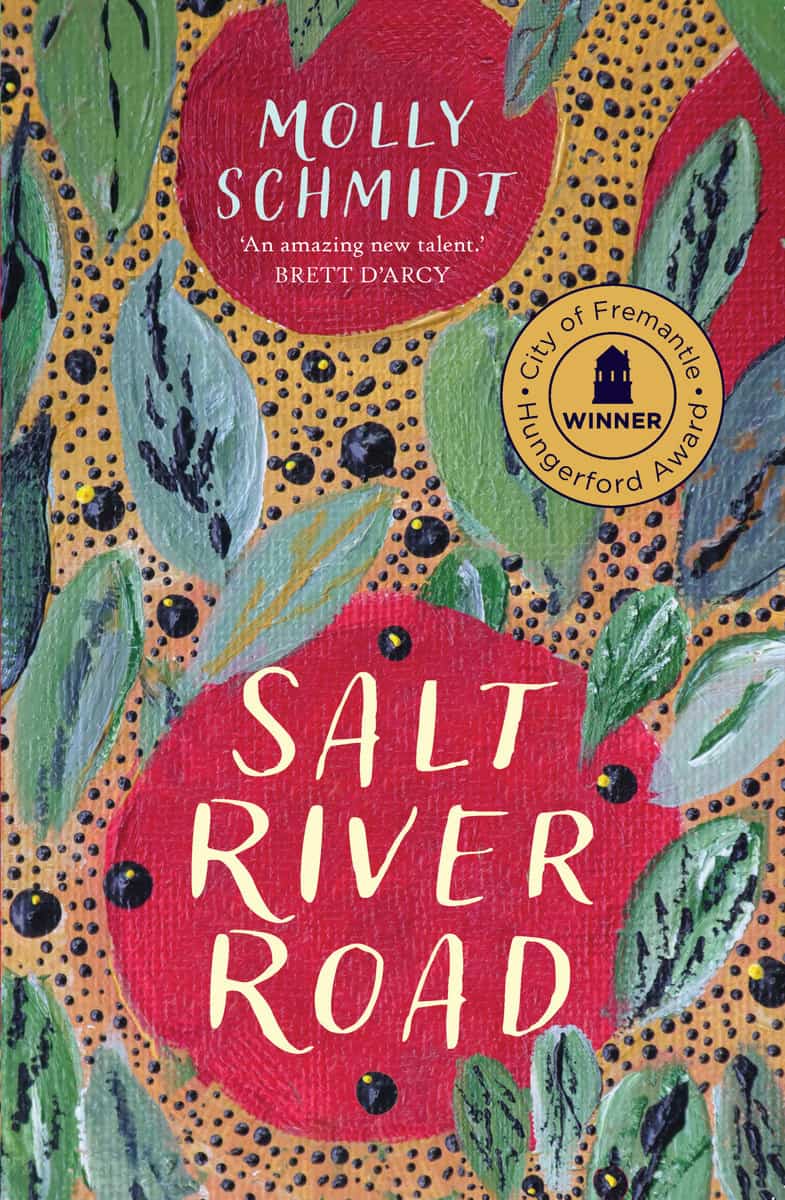
MOLLY SCHMIDT was the winner of the 2022 City of Fremantle Hungerford Award for Salt River Road, a compelling coming-of-age novel about grief and healing set in a small town in the 1970s.
ABOUT THE BOOK
In the aftermath of their mother’s death, the Tetley siblings’ lives are falling apart. Left to fend for themselves as their family farm goes to ruins, Rose sets out to escape the grief and mess of home. When she meets Noongar Elders Patsy and Herbert, she finds herself drawn into a home where she has the chance to discover the strength of community, and to heal a wound her family has carried for a generation.
Salt River Road is a poignant exploration of healing and resilience, small-town racism and the power of human connection.
READ AN EXTRACT
Rose
I don’t remember sleeping. Only the moment the sun rose, and there we were, crammed into the lounge room, aching eyeballs and throbbing heads, cups of tea gone cold. An empty bottle of Nonna’s limoncello on the coffee table, a plate of shortbread biscuits decorated with glacé cherries beside it, crumbs in the folds of the couch.
‘Merry Christmas,’ says Joe.
No one responds.
Alby pads over to the window, looks out into the garden. ‘I forgot to leave carrots for the reindeer.’
Nonna reaches out, draws him to her. Speaks in Italian. She does that when she’s upset. Like she can’t translate her grief.
Steve pushes himself upright, goes to unpack the cars. Comes back with armfuls of food, some of it spoiled from the heat. Plates of fish, jars of tomato sauce, bowls of olives. Boxes of vegetables, loaves of bread. Aunt Lisa throws her arms in the air, runs laps around the kitchen, trying to save what would have been our Christmas feast.
Dad disappears down the hallway, closes the bedroom door.
There’s no Christmas tree.
A few presents sit on the mantle, brought down from Perth. Grandpa hands one to Alby, who shakes his head, places it carefully back down.
I lock myself in the bathroom, splash cold water over my face. Sit on the edge of the bathtub, stick the heels of my hands into my sore eyes. Time has stopped. I might be in there for days, or just minutes. When I come out, the door to the kitchen is closed. I sit cross-legged in the hallway, watching through the knothole in the door.
Dad wants to bury you on the farm. Under one of the ancient eucalypts you loved to sit beneath with a book. Or scatter your ashes in your garden. I can hear his voice at the table, not much more than a whisper, as the others rise and fall above. Grandpa isn’t having a bar of it and he’s getting pretty mean. He’s wearing a polo shirt with the collar ironed, ready for business. Hands clasped and moustache set in a firm line. Dad’s still got his jammies on and he’s running his hand through his hair. His face has wrinkles where once there were smile lines. Every now and then Aunt Lisa walks past the knothole, like she’s stepping on and off set.
‘Let her be in her garden,’ Dad is saying. ‘It’s all I ask.’
We did up the garden after your first diagnosis. With the diagnosis came a note, in your handwriting, stuck to the fridge.
Less have to, more want to.
Us—in the garden. The years you were raising us kids, the flowers had wilted and drooped, the weeds and grass growing wild and tall. We went to the nursery in Albany, walked along the aisles smelling mint, rosemary and thyme, softly stroking the leaves of furry lamb’s ear. I stepped my feet in your boot prints, sometimes I rode in the trolley. You made friends with one of the gardeners, Peter, who must have noticed the way you picked things up and gently put them back down. Mainly we were dreaming, not buying. Doctors are expensive. One day Peter came out with a tray of plants, and some packets of seeds. He lifted a bag of soil onto your empty trolley.
‘You’ll be needing this.’ He laid his gift carefully on top. He wheeled the trolley out to the car, even though you tried to stop him, shaking your head, laughing. Peter gave us a long list of specific planting instructions.
‘You let me know which ones are your favourite,’ he said to me with a wink.
You cried on the way home.
The next day when I got home from school, you were in the garden with dirt up your forearms and peppered across your cheeks.
‘I need a helper,’ you called, straw sunhat falling over your eyes.
We planted daisies and lavender, sunflowers, poppies and cornflowers. That was the first year our old rosebush blossomed, thriving in the fresh soil we dug around its roots. The flower was a deep red, Papa Meilland, it was called. I would talk to it on my way up the driveway to the bus each day, ‘Good morning, Papa M.’ In the afternoon, ‘How nice you are, Papa M.’ One day I came home from school and the deep red flower was gone. I was heartbroken. Papa M’s petals had fallen all over the grass and you took me outside to collect them in a hat. You made them into potpourri by drying them out and adding cinnamon sticks and aniseed stars, then you put everything in a little silk bag.
‘Even death can be beautiful,’ you told me.
Nothing about yours is.
A bang hushes the voices at the table and I smack my head on the door handle in shock. Out the window I see Frank on the driveway. He’s throwing pinecones on the roof. They land like gunshots and the hot tin cracks and creaks. There’s a shout from inside after the first one hits, but no one comes out.
Bang.
Bang.
Bang.
The banging is what it sounds like in my own head. Temples pounding, almost aching for an explosion, a release. Eventually, Steve marches out there and shouts at him.
‘Get in here.’
In here, they’ve moved on to talking about the funeral. I keep watching the shitstorm through the knothole. Dad, Nonna, Grandpa, Aunt Lisa, Uncle Nic, Steve, Joe. They’re crowded round the table and Dad’s still speaking softly, gazing into the fruit bowl like the apricots might know what to do with your body.
ABOUT THE AUTHOR
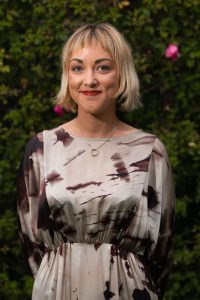 Molly Schmidt is a writer and journalist from the coastal town of Albany, Western Australia. An only child, she grew up roaming paddocks and climbing paperbark trees on Menang Noongar country.
Storytelling has been part of Molly’s world since she could speak. When she was ten years old, her father lost his battle with terminal cancer. Molly began writing to process this loss, and through written word has found healing, growth and her life path.
Throughout both her journalism career and novel writing practice, Molly is passionate about producing stories that are inclusive of all members of her community. While writing Salt River Road, she collaborated with Noongar Elders from Albany, with the goal of producing a novel that actively pursues reconciliation between non-Aboriginal and Aboriginal peoples.
Molly completed a thesis on the topic at Curtin University in 2021, supervised by Professor Kim Scott and Dr Brett D’Arcy, for which she received First Class Honours.
Salt River Road, is the recipient of the 2022 City of Fremantle Hungerford Award. By day, Molly works as a radio producer and journalist for the ABC, where her passion for storytelling is put to good use. Drawn to the coast, Molly now lives in Fremantle where she enjoys free time wandering the beach and local coffee shops with her dog, Rupi.

0 Comments