




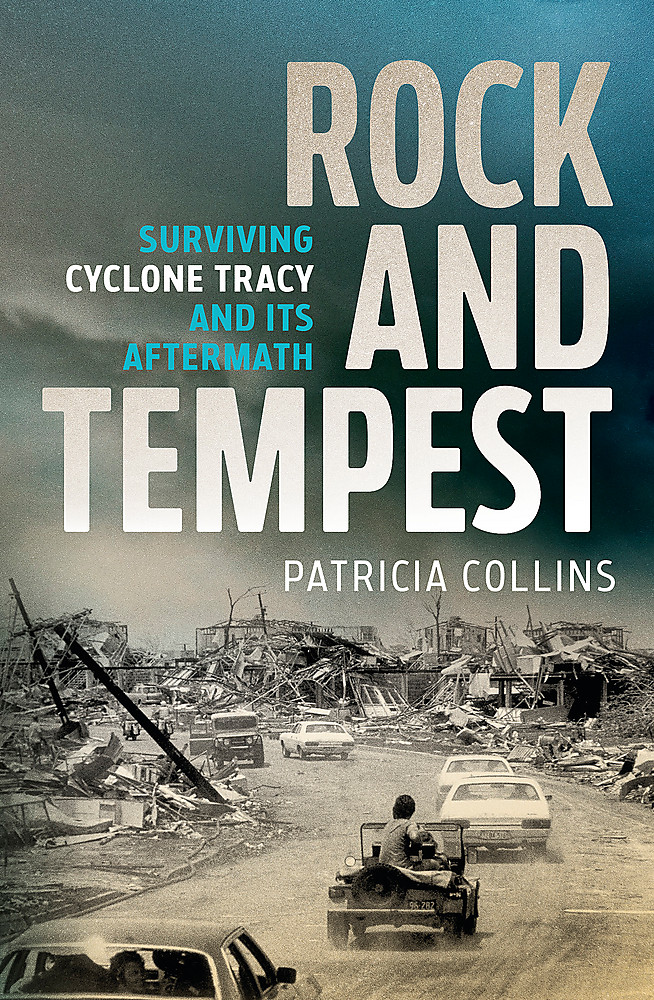
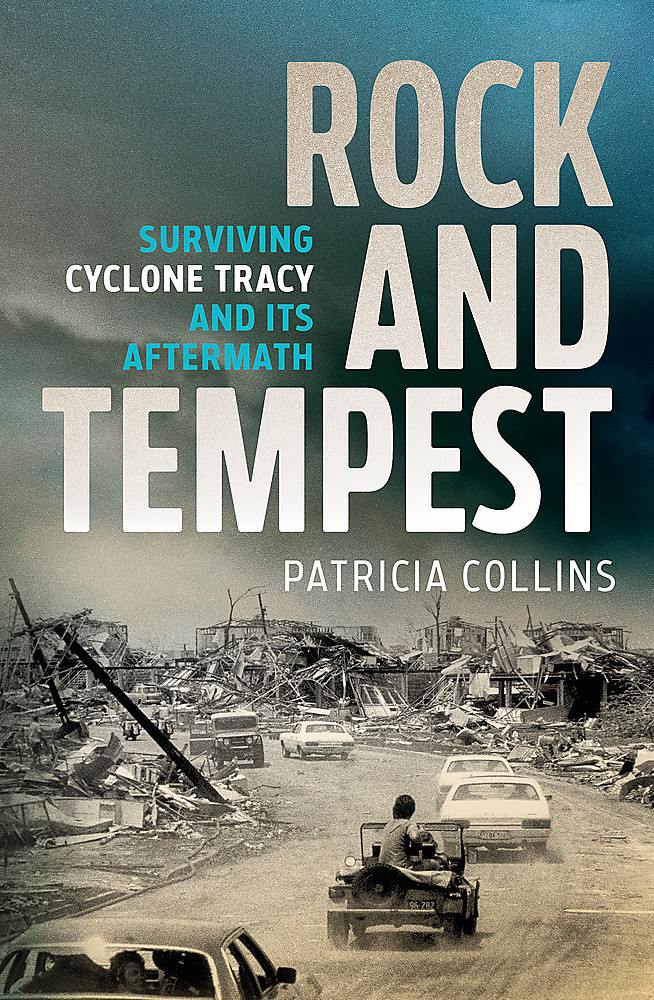
When Cyclone Tracy flattened Darwin on Christmas Day 1974, it was the worst natural disaster Australians had ever experienced.
In Rock and Tempest we read first-person accounts of terror and uncertainty as well as courage and survival.
We were fortunate that the eye took around 30 minutes to pass over Coonawarra, giving many of us the opportunity to seek safer shelter and prepare for the cyclone to hit from the opposite direction. After spending hours alone in my wardrobe in the Wrans quarters, I was relieved to be in the company of other Wrans, sailors and families at the mess. There was some distress and anxiety, but I don’t remember any panic.
Another Wran and I were in the galley of the junior sailors mess, gathering first-aid gear, when the eye abruptly passed. On hearing the first warning roar of the approaching eyewall of the cyclone, we dropped to the floor and flattened ourselves against cupboards. The windows of the galley exploded inward above us, and glass and debris were blasted across the room. The noise and force of the rain and wind was absolutely terrifying.
I don’t know how long we crouched there, too scared to move, but we eventually crawled to the corner of the galley, then made a dash to the servery door and emerged into the comparative safety of the mess. My nerves jangled, and I was unable to settle.
*********************************
When the eye finished its transit, Carolyn Spencer was being driven from HMAS Coonawarra to the RAAF Base with her mother, a Wran sick bay attendant and her dog Mandy. She says:
We had to stop and take shelter in the car beside a building. The wind and rain were stronger, the sound of the wind was like a jet plane. Galvanised iron had smashed all the windows in the car, but fortunately we had blankets to protect us, and Mandy lay at my feet. There were two people sheltering in the building and they asked if they could get into the station wagon as well, and even though we had six people in the car to weigh it down, it was still rocking.
The rainfall was torrential with winds officially recorded at 217 km/h, although unofficial estimates placed them as high as 300 km/h. Houses and other buildings disintegrated under the onslaught, accompanied by the sounds of flying debris and breaking glass. All services – communications, power, water and sewerage – were severed. The WRANS log of events ends: ‘0430. All communications lost. Emergency power available. No knowledge of lost.’
 The substantial stone buildings of Naval Headquarters, where NOCNA Captain Eric Johnston was working, were almost levelled. NOCNA and his three staff members had a communications link established with his four patrol boats and with Canberra, but this link was lost as the operations room was destroyed at about thirty minutes after midnight on 25 December.
In the first Eric Johnston Lecture, delivered at the State Reference Library of the Northern Territory in Darwin on 7 July 1986, Johnston stated:
By 0430 the building had been destroyed and my three staff and I were buried. Three of us managed to dig ourselves out and take refuge in the centre cell, which also acted as the Naval Headquarters bar. To my intense delight, not only did I have a packet of cigarettes, which were not touched by water, but the cell bar fridge, although without power, contained some still-cold beer. I say without equivocation that the cigarettes and two beers I consumed are the best I have tasted in my life.
One sailor remained trapped in the headquarters until first light, when NOCNA and the other staff members managed to dig him out unhurt.
ABOUT THE AUTHOR
atricia Collins was a Wran (the women’s branch of the RAN) stationed in Darwin at the time of Cyclone Tracy. She wrote a brief account of her experiences during Tracy and the clean-up for her son when he was a teenager and interested in what had happened. The essay was submitted by a third party to the editor of the magazine Australian Warship and was subsequently published with her permission in Issue 24 in 2005. Patricia then turned it into a book and brought in experiences from many of those she served with during that time. Rock and Tempest is her first book.


0 Comments