



Milk. It’s in our coffee, on our cereal. It’s there in almond form, or made from oats or soy, and is as lauded as the ‘perfect’ food or lambasted as not fit for human consumption and a toxic planet killer, depending on who you trust.
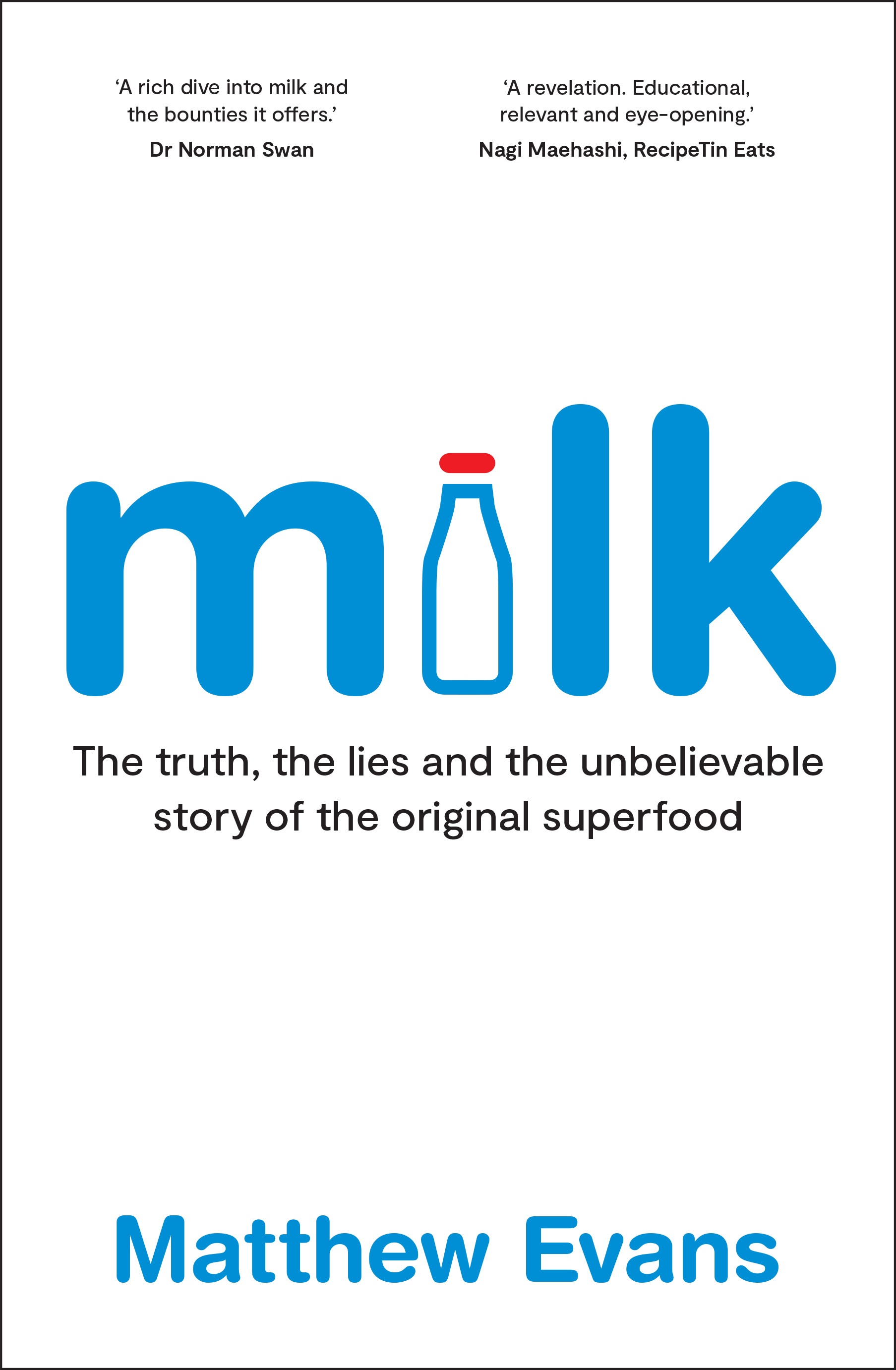
In MATTHEW EVANS’ new book Milk: The truth, the lies and the unbelievable story of the original superfood he celebrates this incredible superfood. From milking cockroaches to the wonders of colostrum this book is a fascinating discovery tour exploring the science, history and politics of milk.
The Devil’s Drink
I’ve been peering into the pouch of a devil. A real-life devil. A Tasmanian devil boasting 42 razor-sharp teeth that will replenish themselves as they’re worn down over her lifetime. Teeth designed for tearing apart flesh and grinding skulls. She has the fiendish, bone-chilling cry of something possessed, can smell the scent of her prey from a kilometre away, and puts out a dense, pungent stench to ward off threats. Tensed, balled up and made of muscle and might, if we lost our grip on her, we’d lose a finger. Or a hand.
I’m here because I’m more interested in her teats than her teeth. Milk brought me here, to risk the wrath of a devil, because what comes from the impossibly small teats of a Tasmanian devil has astounding properties that we are only just beginning to comprehend. The milk with which a devil suckles her young is life-giving, but also a killer. It is known to kill golden staph (Staphylococcus aureus) – the world’s worst superbug, an antibiotic-resistant bacterium that plagues our hospitals. Her milk can fight yeast infections such as candida. A devil’s milk is also believed to kill vancomycinresistant enterococcus, another of the dastardly microbes that are increasingly hard to treat with traditional antibiotics.
 I’m out here on a dawn raid peering into a devil’s pouch because I want to understand milk in all its complexity. Far from the stuff on a supermarket shelf, far from the liquid that sustained our son when he was first born, milk is way more wondrous than we’ve ever imagined. To understand milk, we need to see it where it’s naturally made – from the Southern Ocean to the hills of Tibet, from the massive indoor cow’s milk dairies of Saudi Arabia, to a moss-fringed gully in southern Tasmania. So, I was looking at devils because you have to know the animal, at some level, to understand their milk.
And to be honest, to understand milk, it would be good to have a firm idea of what it actually is. The problem is, we don’t even really have a definition for milk that experts in the field can agree on. This evolutionary masterpiece may come from a nipple. Or not. It may be white. Or not. There’s ‘milk’ from penguins, cockroaches, spiders, soybeans and rice. But mostly it’s made by mammals, who take their name from the mammary gland that produces the milk, along with the subfamily of mammals, the marsupials, whose young are suckled in pouches.
Devils are the iconic Tasmanian native marsupial. After the extinction of another marsupial carnivore, the thylacine (Tasmanian tiger) in the mid-20th century, Tasmanian devils became the largest apex predator on our land. I’ve long been fascinated by our nocturnal visitors; they wake me from my bed at home. I hear their throaty, rasping, high-pitched growls carrying across the valley and into my bedroom as they fight over carrion. Relative to their body size, their compact jaws have the most crushing force of any animal, able to chomp through bone (553 newtons, if that’s the kind of thing you like to know). They’re the world’s largest marsupial carnivore, whose Latin name, Sarcophilus (creepily close to the death bed sarcophagus we know from Egypt), means ‘meat loving’.
Once common here, the Tasmanian devil is now considered endangered, plagued by a facial tumour that reduced their population by nearly 90% over 10 years in the early 2000s. I went trapping with Elise Ringwaldt from the University of Tasmania, who is helping to understand their plight. Today, along with other health measures, we want to see how many babies each female devil is suckling. I’m fascinated by devils for lots of reasons, not least the amazing qualities of their milk. I’m also intrigued by their method of raising young, which, as with all mammals – including us – is intrinsically tied to their milk.
A mother devil mates in early autumn with multiple partners, with copulation taking up to five days with each partner. In early April, after just three weeks pregnancy, she gives birth, releasing from one of her three vaginas up to 30 young, each about the size of a rice grain and weighing about 0.2 grams – so small that five of them weigh as much as a paperclip. These babies, essentially little more than foetuses, must all frantically climb up her fur, through all the incumbent hazards of the outside world, and into her rear-facing pouch, where they will find only four teats. In an example of Darwinian theory in real time, the 30 barely formed joeys compete for the tiniest of nipples, and only the fastest survive.
Over the next few months, those that won that race never leave the teat, clinging on like pegs as their mother fights and feeds at night, and hides in her den during the day. The milk they drink could well be death to golden staph, but it’s life to them. Devil milk’s ability to kill pathogens could well be to do with the joeys’ early exposure to all kinds of microbes, some of them deadly.
Getting to the teat is paramount in a more basic sense, too. Elise points out that a devil’s teat is like a substitute umbilical cord. All the siblings that don’t make it to a teat die of starvation. There is nothing we – a supposedly clever species of bipeds that has travelled into space, and worked out how to split the atom – can do to save those babies if they don’t get mum’s milk. By six weeks, the joeys are jelly bean-sized.
They’ll stay attached to the teats for 100 days. During that time, their transformation from a rice grain-sized baby devil into a thriving adolescent is entirely the result of devil milk. By the time they unlatch from their mum’s teats, devil babies will have hair, and teeth, and a robust immune system. They’ll also be 1000 times heavier than they were at birth, tipping the scales at 200 grams (7 oz).
Milk makes devils. It provides all of the nutrients needed to produce a mini-devil, complete with claws, eyes that can see in the dark, a biofluorescent coat that glows blue in the dark (yes, seriously) – and many other things we can’t yet measure. What we do know is that all marsupial milk is incredible, given how the babies are born so little formed.
*********
Remarkably, despite the tiny size of their joeys, Tasmanian devils don’t give birth to the smallest babies of any mammal. That honour goes to the honey possum, whose babies are a miniscule 0.004 grams each at birth, meaning it takes 15 of them to make up the size of a grain of rice. Again, they become a possum, a grown possum, through milk and nothing more. How is this possible? What makes milk so good at its job? For that, we’ll need to look beyond the usual. Beyond cows and goats and humans. But we’ll also delve deep into the milks we do drink, from breast to camel to almond and oat. I’ll explore why we have such a deep connection to milk, both emotional and cultural. To me, milk is a substance of precious beauty, whose mysteries we are only just beginning to unravel, and whose attributes we’ve often taken for granted.
For a start, we used to think milk was sterile when it arrived from a healthy mother. We now know it is laced with beneficial bacteria that help inoculate the newborn baby’s immune system. Milk also has things in it that aren’t digestible by the babies it’s designed to feed, and now we are starting to understand why. What’s in a mother’s milk is affected by her mood, her diet, and her own gut health, and is exquisitely tailored to her baby’s age, immune status and more. And the milk produced during the later stages of breastfeeding is nothing compared to that first day’s miracle: colostrum. •
ABOUT THE AUTHOR
Matthew Evans is a former chef and food critic turned Tasmanian smallholder.
He fattens pigs, milks a cow, tends a garden and writes about food from his office overlooking the silver birches atop his cottage on Puggle Farm, in the gorgeous Huon Valley.
Matthew is the author of nine books on food, including the authoritative Real Food Companion, his autobiography Never Order Chicken on a Monday, and recently, Not Just Jam. He writes regularly for Feast magazine, and spends much of his week setting up another 70 acre piece of land as a mixed farm under the name Fat Pig Farm. Matthew attends markets and food festivals, sometimes in his hot red 1980s Fat Pig food van, specialising in old and rare breed pork.
Matthew’s other project is A Common Ground, an artisan Tasmanian foodstore he co-owns with Nick Haddow, which also specialises in regional produce events.
Matthew is a strong believer in Real Food; food where the provenance is known and the producer valued. He believes in home cooking, using the seasons and your geography as the guide. It is his hope that more and more people will try to grow their own food (just start with parsley and go from there), or know exactly where their produce is coming from.
Follow Matthew Evans on Instagram


0 Comments