




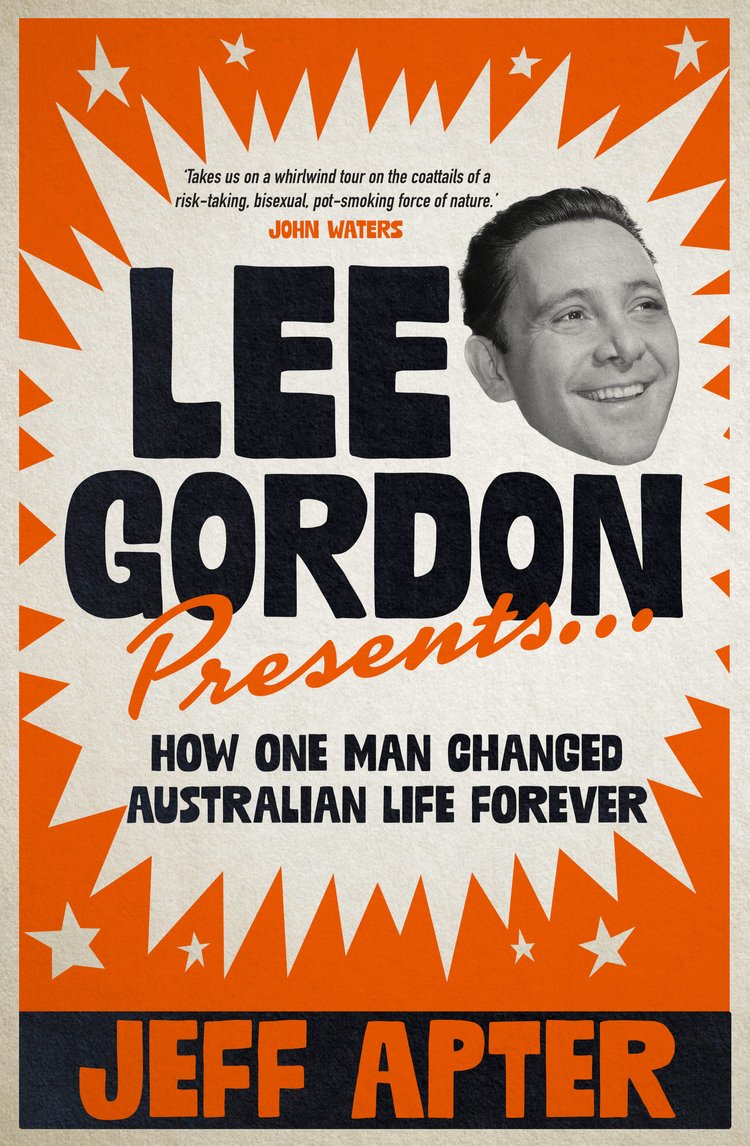
JEFF APTER has written more than 30 biographies, many of them bestsellers, and his work has been published all around the world.
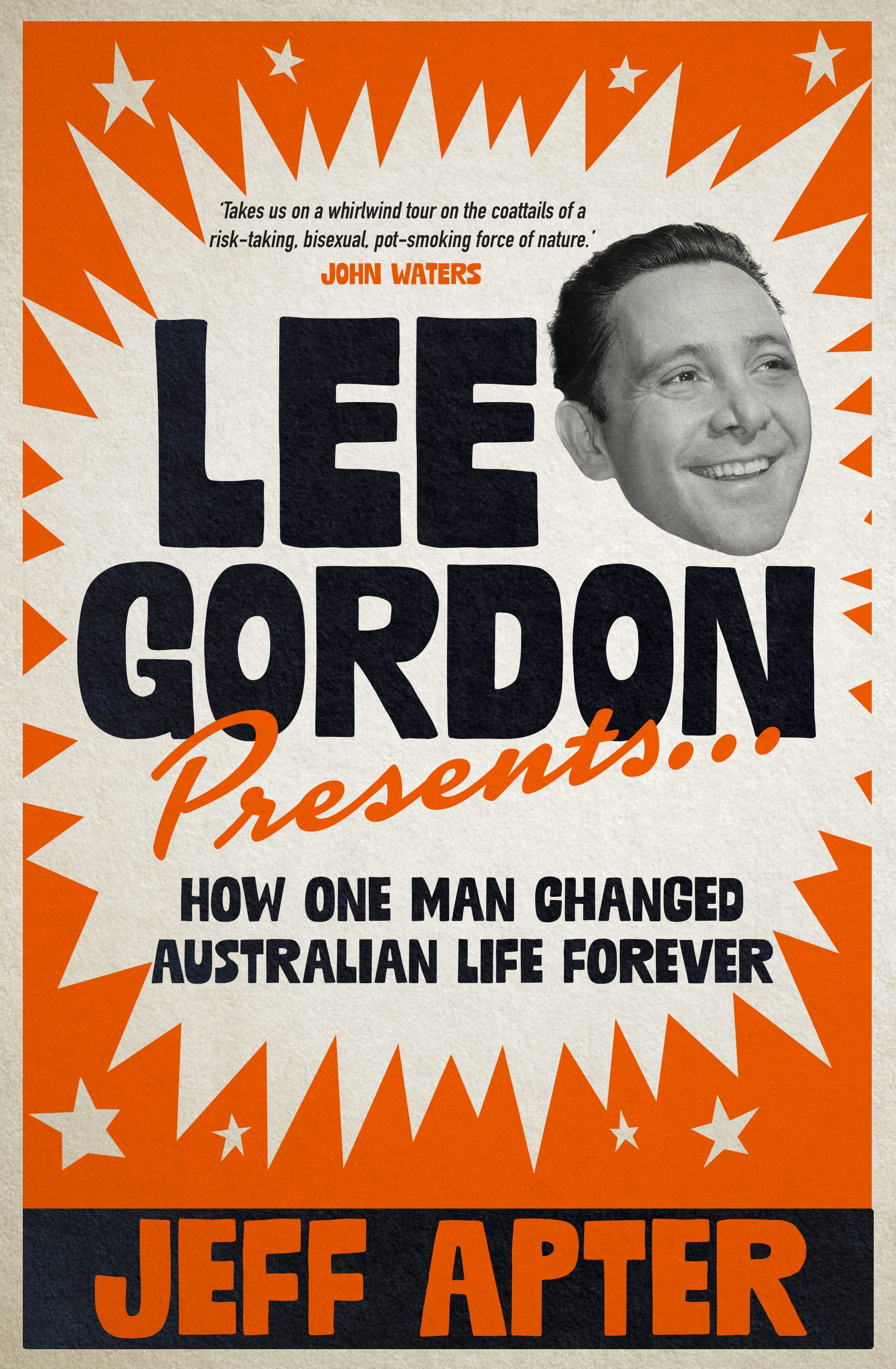
In his latest book, Lee Gordon presents …, he shares the life of Lee Gordon, a pioneer in Australia’s entertainment industry.
 ABOUT THE BOOK
Post-war Australia didn’t know what to make of promoter Lee Gordon. To some he was a typical Yank: crass, loud and outspoken, focused on just one thing – making money. But to others, such as rocker Johnny O’Keefe, Lee Gordon was a mentor, a guru and a lifeline to the big time. One thing is undeniable: without Lee Gordon, there would be no billion-dollar entertainment industry in Australia today; and names like Michael Gudinski, Harry M Miller and Michael Chugg would mean little. Gordon was a true original, who lived fast and hard, spent big – he had a private bank vault – and died far too young, just as he had predicted.
When Lee Gordon arrived in Sydney in September 1953, the only place Australians could see international stars like Frank Sinatra and Bob Hope was on the big screen. But over the next 10 years, Gordon would promote tours for almost 500 international acts, everyone from Sinatra (a close friend) to Sammy Davis Jr, Liberace to Bill Haley, Buddy Holly to shock comic Lenny Bruce. Thanks to Gordon, Aussies grew accustomed to seeing showbiz legends up close, in person, rather than simply staring at them on a cinema screen. Gordon also opened Australia’s first drive-in restaurant, introduced local audiences to the Roller Derby and ran discotheques and strip clubs.
By the time Gordon died in mysterious circumstances, alone in London, in 1963 – aged just 40 – he’d not only established the entertainment industry in Australia, but also changed the country’s culture forever.
**********
Prologue
Hawaiian Village Hotel, Honolulu, Hawaii, August 1959
IF LEE GORDON was an angler, Elvis Presley was his big fish, his Moby Dick. In the six years since he’d touched down in Australia, Gordon, an expat American with a mysterious past, had blazed a trail, promoting high-profile concert tours by a cavalcade of stars, the type of acts that Australians had never seen close up before. Gordon had brought hundreds of big names to Australia – jazz greats Ella Fitzgerald and Louis ‘Satchmo’ Armstrong, comic team (and film stars) Abbott and Costello, as well as rock and rollers Buddy Holly and Bill Haley. He’d introduced Australian audiences to a strange phenomenon known as the roller derby. He’d even staged an Australian tour by Frank Sinatra, a personal friend, whom Gordon had first met twelve years before. Gordon had made, and lost, a fortune.
But to bring Elvis Presley to Australia would be Lee Gordon’s finest achievement. And it would also be an incredible coup. Apart from a few singalongs while serving Uncle Sam in Germany, where he was still stationed, the man nicknamed ‘Elvis the Pelvis’ had never performed outside North America. And it was Gordon’s big chance to become the first promoter to change that. He had the inside running; he’d already promoted two short American tours by Presley. Gordon had secured the first, in April 1957, with the benefit of a suitcase containing US$100,000 in cash, a gift from Gordon to Presley’s manager Tom Parker. Lee Gordon knew how to grease wheels. To secure the second tour, Gordon’s gift had been a kangaroo – a wallaby, in fact – that wasn’t such a hit. (‘It’s like a big rat!’ shouted Elvis, who wanted nothing to do with the jet-lagged marsupial.)
Now it was August 1959 and once again, via his remarkable powers of persuasion, Gordon was in a room with Parker, trying to negotiate a deal for a Presley Australian tour. They were staying in Honolulu at the Hawaiian Village, a hotel owned by the very wealthy and seriously connected Henry Kaiser, also a friend of Frank Sinatra. Gordon was hoping to set up a once-in-a-lifetime deal, yet again aided by a bag containing enough money to win over Presley’s manager, the man known as the Colonel.
Though worlds apart in matters of style and demeanour, Gordon saw a lot of himself in Parker. The Colonel was a former dog catcher, a gruff man with a past that was just as mysterious as that of Lee Gordon. Was he really a colonel? Was he even an American? No one knew for sure, just as no one was absolutely sure about Gordon’s background. But how could fellow hustler Gordon not admire a man who once boasted about selling 900 pairs of army surplus binoculars at a 10 per cent mark-up at an Elvis show, even though they didn’t work properly? ‘But they looked good,’ chuckled Parker. Fair enough.
Both men were gamblers: Parker on the tables of Las Vegas,
Gordon as the high-flying promoter of what he called his Big Shows, which had made him a celebrity in his adopted home of Sydney. Successful Big Shows had netted Gordon hundreds of thousands of dollars, while his flops caused even bigger losses. Regardless of the bottom line, Gordon thrived on the risks involved. He functioned at his best when debtors were knocking down his door, and right now the Big Show bank balance was deep in the red. ‘When the chips were down and the shows were going badly,’ explained Gordon’s Big Show colleague Max Moore, ‘he became inspired, working like a man possessed. It sounds strange, but he was an unusual man.’
Looking on in Honolulu was Eddie Sherman, a reporter from The Honolulu Advertiser. Lee Gordon may have lacked little in the ego department – ‘He was quite an egomaniac,’ said Max Moore – but he didn’t enjoy being interviewed. He’d much rather have been piecing together his next tour, working on a bold new marketing strategy or mixing it up with the rich and famous. But he did reveal a few things to Sherman. Gordon told him that he’d just divorced his fourth wife. (Not quite true.) He had plans to buy an Australian radio station, open a drive-in restaurant and build hotels.
‘And I’ve offered the Colonel US$300,000 for Elvis to tour Australia,’ Gordon said matter-of-factly. ‘I’m pretty sure he’ll go for it. This is the largest offer ever made.’
It was triple the amount Gordon had paid Frank Sinatra for his 1955 Australian tour. He’d sweetened the Presley deal – if that was even possible – with a pair of kangaroo-skin cowboy boots, a gift for the Colonel.
Sherman was impressed by Gordon, describing him as a combination of Academy Award–winning producer Mike Todd and circus impresario P.T. Barnum. Sherman made his readers aware that Gordon had promoted about 40 international shows in Australia and that his company, Big Show Pty Ltd, had taken in some US$4 million in just a few years. These were huge numbers, big business. ‘Everything he touches turns to gold,’ wrote Sherman.
But despite Gordon’s assurances that the Elvis tour was going to happen – he even set a date of June 1960 when he spoke with the Sydney press, declaring that ‘I’m going to put him out at the Showground’, where he anticipated a crowd of 150,000 – it was never destined to be. For once his Midas touch didn’t work. Though Parker was tempted by the rivers of gold that were being offered by Gordon – and he loved the boots – he was never going to let Elvis, his ‘boy’, play shows outside of North America. He called Gordon soon after the promoter returned to Sydney.
‘Thanks,’ Parker growled down the telephone line, ‘but no thanks.’
The Colonel’s explanation was that Elvis’s ‘window’ – his time between Hollywood commitments – was just too narrow. And he had a series of movies in the works; he simply didn’t have the time. But that wasn’t the whole truth. Parker was more worried about some awkward details of his own life being disclosed if he left the US.
Gordon was left with little more than a necktie, a gift from Parker. Even though he was more an open-necked-shirt kind of guy, Gordon kept the tie as a memento, a reminder of Elvis Presley, the one that got away. The only one that got away.
1.
‘I was a sixteen-year-old kid organising a one-night stand in a hick town.’
WHEN LEE GORDON alighted from the first-class cabin of Pan Am flight PA182 on 30 September 1953, he told Mascot immigration officials that, yes, he was Lee Lazar Gordon from Detroit, Michigan, and that he’d been born on 8 March 1923. On the Alien Certificate Form that he completed on arrival, Gordon left the ‘Previous Name (if any)’ space blank.
However, there was a second, less likely version of his life story that he freely shared with Sydney accountant Alan Heffernan, who’d become Gordon’s capo, his 2IC, working closely with him during the heyday of the ‘Big Shows’ from the mid-1950s to the early 1960s. He told Heffernan that his real name was actually Leon Lazar Gevorshner and that he’d been born in Florida’s Coral Gables six years earlier than recorded, in 1917.
 Gordon also told Heffernan that his Polish-born father, Louis, had committed suicide amid the chaos of the Wall Street Crash of 1929 and that his mother Jeanette remarried, to a Detroit man named Merrick. It was then, Gordon said to Heffernan, that he changed his name to Lee Gordon. To muddy the waters just a little more, on all his travel documentation, Gordon would refer to Jeanette by her family name, which was Lopate. No mention of Gordon or Merrick.
When his father died, as Gordon continued to tell Heffernan, the only thing he inherited from him was his asthma, which he said enabled him to avoid service during World War II (although the real cause was high blood pressure and diabetes). Gordon also confided to Heffernan (and others) that his father’s death was a signifier: he believed that he, too, wasn’t destined to stick around for long. Gordon sensed that there was a dark cloud hovering over him and that was why he chose to live life in top gear. ‘Lee knew he was going to drop off early,’ said Harry M. Miller, who was a fledgling promoter in awe of Gordon when they first met.
If people thought Gordon had two names, and was hiding some kind of secret life, that was perfectly fine with him. He made a point of never letting the facts interfere with a good story, and he understood the value of hype even before the term existed. Regardless of his real name, to his future Australian employees – even to Elvis Presley – he was known as Mr Gordon, or simply Lee to a select few. Occasionally, under their breath, some people referred to him as ‘that crazy American’. Frank Sinatra chose to call him ‘Charlie’.
One thing was clear: Gordon wasn’t destined for the spotlight, unlike the famous acts he would one day promote. As a young man, his features were painfully normal. His conservatively cut hair was brown, as were his eyes, and he didn’t grow to be especially imposing – he stood five foot nine inches (175 centimetres) tall as an adult – while his overall appearance was best described as average, even bland. He had small but distinguishable scars on his upper lip and his nose, and a nose job sometime during the 1950s only slightly improved his features. But while Gordon would never be a star, he certainly helped hundreds of other stars shine very brightly; the biggest names in showbiz gravitated to him, like bees to nectar. And everyone made bags of money in the process.
***
Michigan’s Highland Park High School was not known as a breeding ground for future entrepreneurs such as Lee Gordon. Its core business was educating the children of employees of the nearby Ford motor plant, which had been pumping out thousands of Model Ts since the early 1900s. Designed by prolific industrial architect Albert Kahn, the 240,000-square-metre plant was nicknamed ‘the Crystal Palace’ because to first-time visitors it looked as though it was made of glass. At its peak, some 70,000 workers were employed there.
Most of Lee Gordon’s Highland Park classmates were destined to finish school and end up employed at the plant. An automobile repair lab had even been added to the school campus in 1927, as if to remind many of the 3000 students of their immediate future. But Lee Gordon had no intentions of further lining the pockets of Henry Ford.
While still at school, Gordon had promoted his first show, in 1939. It was a jazz concert staged at an ice rink in the city of Muskegon, on the shore of Lake Michigan. The show itself was forgettable, but on the day, Gordon made his first important connection when he met a press agent and first-rate hustler named Benn F. Reyes. Of all the colourful identities Lee Gordon met during his short life, Reyes was perhaps the most influential. A reporter described Reyes as ‘short, dark and handsome, a miniature of wrestler Chief Little Wolf ’. He was also a man who, over time, would nurture relationships with some of the biggest names in entertainment and prove to be a hell of a guru for Gordon. A native of San Francisco, 24-year-old Reyes talked a big game.
‘I started as a kid doing special exploitation for movies, see,’ Reyes explained in an interview, outlining how he would bring a bit of Hollywood when he staged big events in small towns, ‘searchlights and all’. He would boast to a reporter that his first major break came when he was employed by the publicity director for San Francisco’s Golden Gate International Exposition, also staged in 1939. Why did he get the job? Because, in Reyes’ words, he ‘had a reputation of being a hot shot press agent’ and the task the director had in mind was ‘a special job’ that only he could handle. His task was to sell a million $1 entry tickets. And quickly.
Reyes organised a telephone campaign among his friends, asking everyone he knew to overload the local exchange with calls enquiring about the Expo – exactly the kind of move that Lee Gordon would one day employ. Reyes’ strategy worked perfectly and the next day the local newspapers were full of reports about the problems with the San Francisco phone system – and every report seemed to mention the exposition Reyes was promoting. As he explained, it made people conscious of the event. Brand recognition was crucial – and Reyes sold his tickets. Telephone campaigns would become an important part of Lee Gordon’s strategies to flog product.
In the type of outrageous stunt that Lee Gordon would one day emulate, Reyes once devised a plan to return the humble horse ‘to the consciousness of the people’ after he read that they were no longer allowed to cross the San Francisco Bay Bridge. Reyes found a willing accomplice to dress as a cowboy and ride his steed across the bridge, as cars swerved around him, beeping their horns, the drivers yelling insults. ‘He was a little crazy,’
Reyes once devised a plan to return the humble horse ‘to the consciousness of the people’
Reyes explained of his friend. About halfway across the bridge, the rider and his mount were stopped by police, who tied the horse to their car and instructed the cowboy to walk the six miles to the police station, where he was jailed. The story was all over the newspapers the next day. It was another media victory for Reyes – as was the time he arranged a Lady Godiva-type stunt in San Francisco, much to the surprise of onlookers, which culminated in the horse bolting with its nude rider clinging on for dear life and the police giving chase down Market Street, the city’s main drag. ‘It was an awful mess,’ Reyes chuckled.
Reyes’ Lady Godiva re-enactment came during his two years spent working closely with a firebrand named Sally Rand. She was the legendary ‘fan dancer’ of San Francisco, the star of Sally Rand’s Nude Ranch, which was based in the city’s Music Box burlesque hall. When asked about her controversial, trailblazing career, the oft-arrested Rand summed herself up simply by stating: ‘I’m a girl from the Ozarks who likes going barefooted . . . up to the chin.’
For such a young man, Reyes kept some impressive company. Lee Gordon couldn’t have found a better mentor on that chilly day in Muskegon.
***
While Reyes headed to the Pacific to serve as a combat cameraman in the US Air Force during World War II – he saw action in the Philippines and then in Japan, flying over Hiroshima and Nagasaki days after the cities were flattened – Lee Gordon headed south, to the University of Miami. The campus was based in Coral Gables, where Gordon may have been born, depending on which version of events he was favouring at the time. The university’s alumni included lawyer Vincent Bugliosi, who prosecuted mass murderer Charles Manson, as well as numerous district court judges and state attorneys and, later, entertainers such as Dwayne ‘The Rock’ Johnson and Latina crossover star Gloria Estefan.
Lee Gordon was a highly gifted student, without doubt – a big man on campus. He graduated with a Bachelor of Business Administration degree and a cum laude distinction in June 1944, smiling boyishly from the pages of the university’s Ibis yearbook. An award-winning member of the Alpha Kappa Psi fraternity, he was also on the Dean’s Honors List for the spring semester in 1941-42. That honour was granted to only 47 students for receiving a B-plus or better average during that period. He enrolled in graduate law school in 1945 but opted to go into business soon after.
Gordon continued to promote shows while he studied, although not with any great success. He worked briefly with a travelling carnival company operating out of Tampa, Florida, known as Royal American Shows, promoting a performance of Shakespeare in the Round. Curiously, one of Royal American Shows’ former employees was Tom Parker (not yet calling himself the Colonel), a seasoned ‘carny’ whose main task while with the company was selling toffee apples. By the time Parker left Royal American in 1938, he had a solid grasp of how things worked in America’s south and Midwest, knowledge that would prove to be crucial when he began managing Elvis Presley. Sally Rand, the fan dancer/ provocateur who worked closely with Gordon’s friend Benn Reyes, also performed in some of Royal American’s shows.
I was a 16-year-old kid organising a one- night stand in a hick town.’
As for Gordon, while still studying he tried to arrange performances by swing band greats Benny Goodman and Glenn Miller. Gordon’s approach showed that he still had plenty to learn: he simply dialled up the Music Corporation of America (MCA) office in Chicago and asked, ‘I’d like to book Benny Goodman.’ When told that wasn’t possible, Gordon didn’t give up. ‘Well then,’ he said, completely unfazed, ‘I’d like to book Glenn Miller, please.’ Neither came through. Further down the road, Gordon would laugh at his naivete. ‘I was a 16-year-old kid organising a one- night stand in a hick town.’
The one act that Gordon did manage to promote during this time was Theodore Salvatore Fiorito. Using the stage name Ted Fio Rito, he was a composer, orchestra leader and keyboardist who’d built an audience via his radio appearances in the 1920s and 1930s, along with recordings made for various record labels. Future Hollywood starlet Betty Grable had been one of several vocalists in the Fio Rito’s orchestra. But Gordon had no idea how to promote Fio Rito. In fact, Gordon admitted that he had little idea who he was, and the returns from the show barely covered the cost of his call to MCA in Chicago.
***
By the mid-1940s, now having left university, Gordon took the first of many unexpected career moves. While Benn Reyes had returned to civilian life, spruiking the dirt-track-racer-cum-marketing pioneer Earl ‘Madman’ Muntz, Gordon headed south of the border – way south of the border, all the way to Lima, Peru. His trip was inspired by a magazine story he’d read about the South American country of some 8 million people. Peru, under the leadership of president Manuel Prado Ugarteche, was enjoying a period of relative calm that was known as the Democratic Spring (despite the occasional border skirmish with Ecuadorian forces). Peru had remained neutral during World War II, although it leaned towards the Allies.
However, building a business in Lima proved to be a huge challenge for an American such as Gordon, as he’d discover during his short time in the Peruvian capital. As Gordon would one day tell a reporter from The Honolulu Advertiser, Peru simply wasn’t the right place for him. ‘Besides,’ said Gordon, ‘I couldn’t speak the language very well.’ The only act of note that Gordon promoted during his time there was Spanish-born bandleader Xavier Cugat, a prominent figure in the globalisation of Latin music.
After just eight months in South America, Gordon was moving on again, this time to Havana, Cuba. With president Ramón Grau San Martín enjoying a second term at the helm, the country was flourishing; Havana, the capital, was being promoted as the Paris of the Caribbean, a playground for pleasure seekers. There’d been numerous luxury nightclubs, casinos and mansions built in Havana during the 1930s to cater to the tastes of tourists and wealthy locals – Havana boasted the third-largest middle class in the Southern Hemisphere – and when Gordon arrived, the city generated more income than Las Vegas, Nevada. Gambling and corruption were rife, and, not surprisingly, figures in US organised crime such as Meyer Lansky and Santo Trafficante Jr would follow the money and expand their operations to Havana. As would Charles ‘Lucky’ Luciano.
Looking out over the city from its site atop Taganana Hill was the Hotel Nacional de Cuba, an eight-storey Spanish-style sprawl of some 45,000 square metres in total. Opened in 1930, the Hotel Nacional was operated by Chicago developer Arnold Kirkeby as part of his Kirkeby Hotels chain. And the Hotel Nacional would be the site for Lee Gordon’s next step up the entrepreneurial ladder, with a little help from the Mob.
***
Italian-born ‘Lucky’ Luciano, whose career in the underworld began as part of the Five Points Gang, a brutal early-twentieth- century New York City street crew, now resided at the Hotel Nacional. Luciano had recently been sprung from Sing Sing prison, where he’d been serving a 30-to-50-year stretch for being the kingpin of a massive prostitution ring. His sentence had been commuted in exchange for intelligence he provided to the US Navy during World War II. Upon his release he’d been deported to Italy in early 1946, but did a swift U-turn and secretly arrived in Cuba in October 1946. He duly set up base in the elegant Hotel Nacional. Frank Sinatra, the 31-year-old pride of Hoboken, New Jersey, arrived in Cuba in mid-February 1947, and met with Luciano. Sinatra was accompanied by three mobsters – brothers Charles, Rocco and Joseph Fischetti, cousins of Al Capone – and was carrying US$1 million in cash, seed money for new Mafia operations in Havana. Sinatra, of course, spent much of his life denying that he had any Mob connections, although his visit to Havana was mentioned in an FBI report and in a column by reporter Robert Ruark. Under the headline ‘Sinatra’s Vacation’, he wrote: ‘I am frankly puzzled as to why Frank Sinatra . . . chooses to spend his vacation in the company of notorious, convicted vice operators . . . the likes of Lucky Luciano.’
It was during Sinatra’s four-day visit that Lee Gordon made a hugely important connection, his first big break. Now a few months into his time in Havana, Gordon had set up a small import–export business flying flowers and cigars to the USA, using local airlines as his couriers. (‘It was a pioneering operation,’ observed Bruce Smee in his profile of Gordon.) The International Air Transport Association (IATA), a trade conglomerate of more than 50 airlines from 30 different countries, was conveniently based in Havana and Gordon took full advantage.
Gordon managed to swing an introduction to Sinatra at the Nacional during his Havana visit, with a little help from Luciano, who Gordon had met at the hotel. Gordon one day recalled how he watched as Sinatra posed for photos ‘with his gangster friends’ who were in Havana. As Gordon later informed his friend Benn Reyes, he talked a good game during his brief meet and greet with Sinatra. ‘He was in terrific spirits,’ said Gordon, who firmly believed that he’d made an impression on the singer ‘that could be of assistance in future dealings’.
Gordon made vague overtures to Sinatra about having him appear at the Nacional, even though it’s unlikely that Gordon was responsible for bookings at the hotel. Sinatra was currently earning close to US$100,000 per week on the strength of his live performances, which even in cashed-up Havana was a hefty payday. Sinatra pointed out to Gordon that the powerful New York– based agency MCA handled all his live bookings. ‘Maybe some other time, Charlie,’ Sinatra told Gordon, before boarding a flight back to the USA.
Ol’ Blue Eyes had no idea how prescient his comment would be.
ABOUT THE AUTHOR
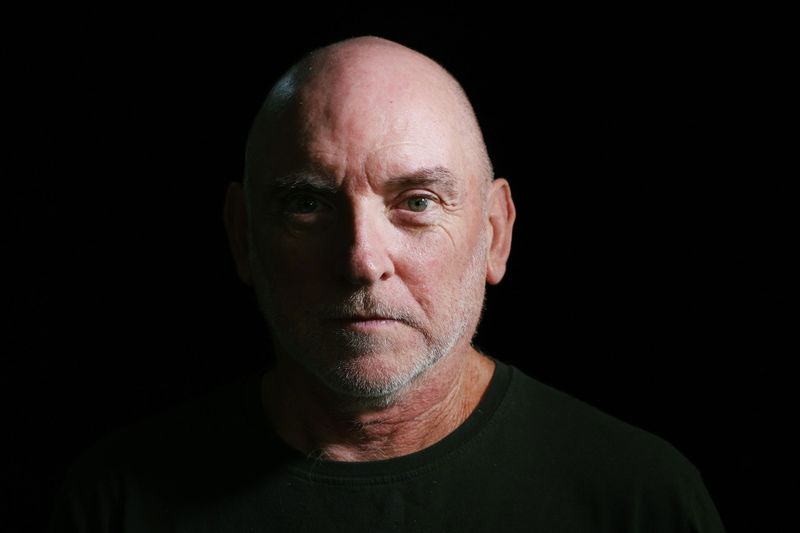
I’m a writer, working amidst the splendour that is Wollongong on the NSW south coast of Australia. Inspired by Jerry Hopkins’ engrossing bio of the Doors, No One Here Gets Out Alive, I began tapping away at the keyboard in the late 1980s. At last count, I’ve written 30 books, either as author, co-writer or ghostwriter; my work’s been published all around the world.(Hello Finland! And yes, Bulgaria, I’m talking about you.)
My specialist subject – I use the term warily – is music. I’ve written biographies of such talented and sometimes tormented souls as Daniel Johns, Jeff Buckley, the Finn brothers, Jon English, Marc Hunter, Johnny O’Keefe and the three Young siblings, Angus, Malcolm and George. I’ve been fortunate enough to work with ARIA Hall of Famers Kasey Chambers and Richard Clapton. I’ve also helped with books from Mark Evans (the former AC/DC bassist), Cold Chisel manager Rod Willis and Michael Browning (AC/DC’s first manager). Away from music I’ve worked with cricketer Michael Slater, soccer hero Tim Cahill and Paul Warren, the former captain of the Australian Invictus Games team.
I started out as a magazine writer, spending four years on staff at Australian Rolling Stone. I’ve encountered interesting characters up close over the years, everyone from Aretha Franklin to Helen Reddy, the Rolling Stones to Bob Dylan.

0 Comments