



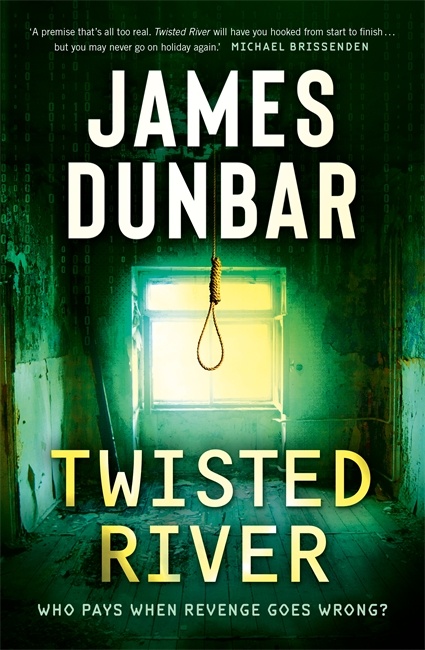
JAMES DUNBAR’s Twisted River is full of sinister twists and turns, dark humour and a cast of supporting characters from society’s shadowy fringes.
Read on for an extract …
ABOUT THE BOOK
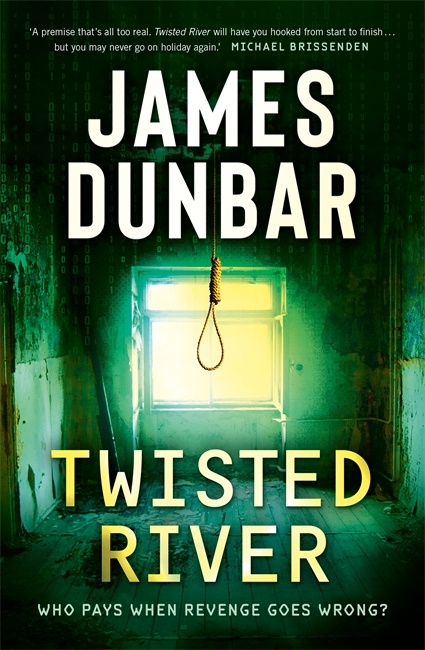 It’s not only the guilty who have something to hide.
When charity worker Cate and website designer Rory, a married couple in their thirties, return from their European holiday, they make a nightmare discovery. Their credit cards have been cancelled, their bank account has been emptied, and their phones and internet have been cut off. Their home in the New South Wales coastal town of Kiama has been rented out as a holiday let, and their dog and pet-sitter have disappeared. Meanwhile, Cate’s work colleagues have received copies of her handwritten resignation letter, posted from Paris, filled with insults and lurid allegations.
The pain isn’t over yet, not by a long shot. Someone has set out to destroy Cate and Rory Porter’s lives – and their anonymous enemy’s motivations are a mystery.
As the harassment ramps up, some likely suspects emerge. Is it the anti-vax campaigners who have already targeted them over Rory’s website for dog owners? Or maybe a pro-Russian activist who objects to Cate’s work with Ukrainian refugees?
To make matters worse, the local police seem suspicious of their allegations. Cate and Rory quickly realise the only way to reclaim their lives – and their beloved poodle cross, Iris – is to find their tormentor themselves. And it isn’t long before things turn dangerous. Deadly dangerous.
**********
CHAPTER 1
Nine hours earlier
Going with the flow of disembarking passengers at Sydney International Airport, Rory Porter feels sick. It’s not the airline breakfast, which is never great regardless of which carrier you fly with. It’s not the bumpier than usual descent; he’s endured worse and suffered no ill effects. No, this deepening unease was first felt back in Paris when their emails stopped working and their computer log-ins didn’t log in. Since then, this feeling, not exactly panic, more a low-burn anxiety, has been gnawing at Rory’s gut. It has a name: dread. And it’s not a feeling you want to combine with international travel. Would he look nervous passing through all the check-in and security scans? Would the tension in his neck and jaw mark him out for special attention? Rory has known this combination of fear and experience before, although it’s been so long, it hits him like an angry word from an old friend.
Maybe he’s overreacting. He’ll soon know; certainty awaits at the end of the long walk from the plane, down the airbridge, into the bleakly clean, endless corridors of the terminal.
He joins the converging rivers of grim determination, shoulder to shoulder with other travellers who are doubtless calculating the time it will take to get their passports checked by a machine; ‘click here if you are carrying a deadly disease and wish to be deported before you have even arrived’. Then they’ll add however long it will take to choose 2.25 litres of duty-free alcohol, times two if you are travelling with a friend or mutual enabler. Any well-travelled drunk’s spouse will know this ritual well, where the need to drink less alcohol after an indulgent holiday meets the lure of a bargain.
Then there’s the self-serve immigration gates and the queues forming behind unseasoned travellers who didn’t know you needed a pre-check ticket, or an Australian passport, or to take your hat and glasses off. Subtract all that from the time it takes for your luggage to spill out on to the carousel, and you still have to wait for your bags.
Rory is worried. In the jostling queue for the first-step immi- gration machine, he’s in front of a stocky man dressed in a full matching tracksuit, which would make him look like a member of the Australian national football team if he wasn’t a bit too old and way too fat. The man seems to be trying to edge past, as if he has a more urgent need to get to the empty, static luggage carousel, nudging his holdall along the floor with his foot until it passes Rory’s carry-on bag. Rory turns around and stares, thinking about his current predicament.
Although the knitted brows and narrowed eyes of his thinking face combine into an expression that would pass for suppressed rage on any other human, Rory’s actual angry face is almost blank: cold, expressionless and still, like a grim emoji. But his involuntary glower does the trick and the wannabe Socceroo takes half a step back. Then, having been rewarded with the slip of paper that will allow him to access an automatic passport control gate – wasn’t it quicker when they had humans armed with rubber stamps and supercilious stares? – Rory now turns to the question of whether his and Cate’s credit cards, which stopped working in Saigon, will be revived by being back on Australian soil.
He grabs a bottle of overpriced Japanese whiskey as a token purchase in the unavoidable duty-free shop and looks over at Cate, who is stabbing angrily at the screen of her mobile phone, as if more violent prodding will dispatch its signals farther and faster. This is not a good sign. The burning bubble in Rory’s gut twists and surges like the blob in a lava lamp. They’d been about to leave Paris when incoming emails had dried up and outgoing messages bounced back or refused to leave their laptops. The hours most travellers spend in Charles de Gaulle Airport lounges, hoovering down tiny croissants and free wine, he and Cate had wasted on unanswered lost password requests to their internet providers, website hosts and email platforms. Then they arrived in Saigon to discover their overnight hotel booking had been cancelled, leading to, among other hassles, the non-arrival of the promised car transfer from the airport.
Cate, the eternal optimist, said there must have been a glitch in a system somewhere, all for their own good. One little password misidentified and there had been a domino effect as, one by one, all the things they depended on from the cyberverse had been shut down and closed off to them. All it took, she said, was one failed log-in and an overzealous system puts you into quarantine. ‘The internet doesn’t trust us,’ she’d added. ‘We can fix it when we get home.’
Rory knows it’s more than that. He’d checked his phone as soon as the plane landed. He thought they might get a signal as soon as they were on terra firma but had known in his heart that they wouldn’t.
‘Nothing?’ he mouths as she looks up from her screen. She shrugs and shakes her head.
The cashier at the end of the duty-free pay queue coughs theatrically. ‘Excuse me,’ she says, pointing at the screen on the credit card reader, which announces, Transaction Failed.
Before Rory can feign surprise, the machine zips out a slip of paper that confirms the non-payment and adds an accusatory Invalid Credit Card.
‘Here we go!’ he mumbles, beckoning Cate over.
The cashier looks at the queue that is lengthening impatiently behind Rory and sighs, then forces a smile.
‘What’s up?’ Cate says, joining Rory at the checkout. She sees the warning signals. A brief tightening of the jaw, the slightest flaring of the nostrils, an almost imperceptible narrowing of the eyes, followed by a deep breath in through his nose and a long slow exhale through clenched teeth. Anger has been quelled in his well-practised routine.
‘The card is invalid,’ the cashier says.
Cate nods ‘no worries’ but the cashier’s already strained smile is fading fast. Cate reaches in her uber-fake designer bag, purchased for a lot less than the real thing but still at a rip-off price from a street market in Florence. She passes another credit card over the terminal and it responds with the same refusal.
‘Have you been using the cards overseas?’ the sales assistant asks. ‘Only a dozen times every day for the past six weeks,’ Cate says. ‘Well, there you go, then,’ the checkout woman says, a tilt of her head emphasising the obviousness of her conclusion. ‘Maybe the banks spotted some suspicious transactions and closed them
down, to be on the safe side.’
‘That’s what I thought,’ Cate says as she waves the bottle away.
The woman doesn’t look at her as she places the spirits on a side shelf and says, a little too loudly, ‘Next, please!’
‘Think of this as a boost to your plan to drink less,’ Cate says to Rory as they walk towards the immigration gates.
‘Just when I need it more,’ he replies. ‘Heard from Celine yet?’ ‘No phone service,’ Cate says. ‘No texts or emails.’
‘There must be coverage. It’s a fucking airport.’
‘Oh, there’s coverage, but no service. Just a message from the phone company telling me to contact them – number provided, which I can’t call because there’s no service.’
‘Excuse me,’ she says, pointing at the screen on the credit card reader, which announces, Transaction Failed.
‘Try using their app. It might connect via the airport wifi.’ Cate silently chides herself and makes the call, her side of which descends into a series of confused, irritated and occasionally outraged responses.
‘No, I can’t give you another f . . . credit card number,’ she finally says into the phone, glares at it, and ends the call. Rory looks at her.
‘My mobile has been cancelled. And we owe a shitload on overseas calls and data.’ She pauses, gathering her breath. ‘You were supposed to set up that global thing.’
‘Global roaming,’ he says. ‘I did.’
‘Well, it was switched off and now we owe a ton of money and I have no phone.’
Rory pulls his own phone out of his bag. Turns it off and on and waits till its screen comes back to life. He taps a few keys. ‘Hmm,’ he says, suspicions confirmed.
Before they left, they’d declined, albeit half-heartedly, when their dog-sitter Celine had said she’d pick them up in their own car when they got back.
‘We can take the train,’ they’d protested unconvincingly, in unison. The twenty-minute ride to Sydney’s Central Station followed by two hours–plus travelling south to their home in the small seaside town of Kiama made logistical sense, but not so much for people who were pre-exhausted by a long flight.
‘Three hours in the train after twenty-four hours in a plane,’ Celine had scolded in her alluringly persuasive French accent. ‘C’est foux . . . crazy, non?’
Rory and Cate had conceded with relieved smiles that it was, indeed, foux.
Later, standing in the short-term pick-up area for an hour after collecting their bags – nowhere near first off – Rory and Cate have rehearsed every excuse on Celine’s behalf, including the simple fact that she wouldn’t have received their reminder emails, telling her when they were arriving. She could be waiting at home now, wondering if they’d decided to extend their trip.
***
This is not our car. There are front seats, back seats, but then the back is open and empty. Sleen usually makes me ride out there when she’s driving but now she’s gone away and locked me in here. Locked inside. I don’t like this. I don’t like her but I won’t bark too much because that makes her angry. Angrier. Sleen is angry a lot. Sniff through the gap at the top of the window. Is that . . .
Rory? Rory and Cate? Okay, now I’m going to bark.
***
There’s no reason Rory and Cate should notice the young woman sitting on a bench near the café outside Sydney Airport Arrivals, even though her eyes are fixed firmly on them as they wrestle their suitcases back through the doors to the Arrivals concourse. For a start, she’s wearing a baseball cap and sunglasses, which may be obscuring her features but attract no undue attention; they’re almost a uniform as the recently landed adjust to the Australian sun. Even if her features weren’t hidden, they probably wouldn’t recognise her. Her hair is short and blonde rather than long and black. Her face is different too. She looks like just another girl, waiting for someone or something, watching the world go by on a streaky early morning.
She jumps to her feet as they turn towards the airport terminal and follows, cautiously, at a distance, curious to see what they do next. They stop and look at their wallets. She can’t stop too. That would be too obvious. They turn and now they are walking back, directly towards her. They look sad and confused. This is a challenge, a real test. She forces herself to relax but they barely notice her, beyond manoeuvring their suitcases to let her pass.
She smiles to herself as she strolls. If they’d kept going, like her, they would have been able to hear the distant sound of a dog barking from inside an old crew-cab ute.
Her ute. Their dog.
 ABOUT THE AUTHOR
 ABOUT THE AUTHOR
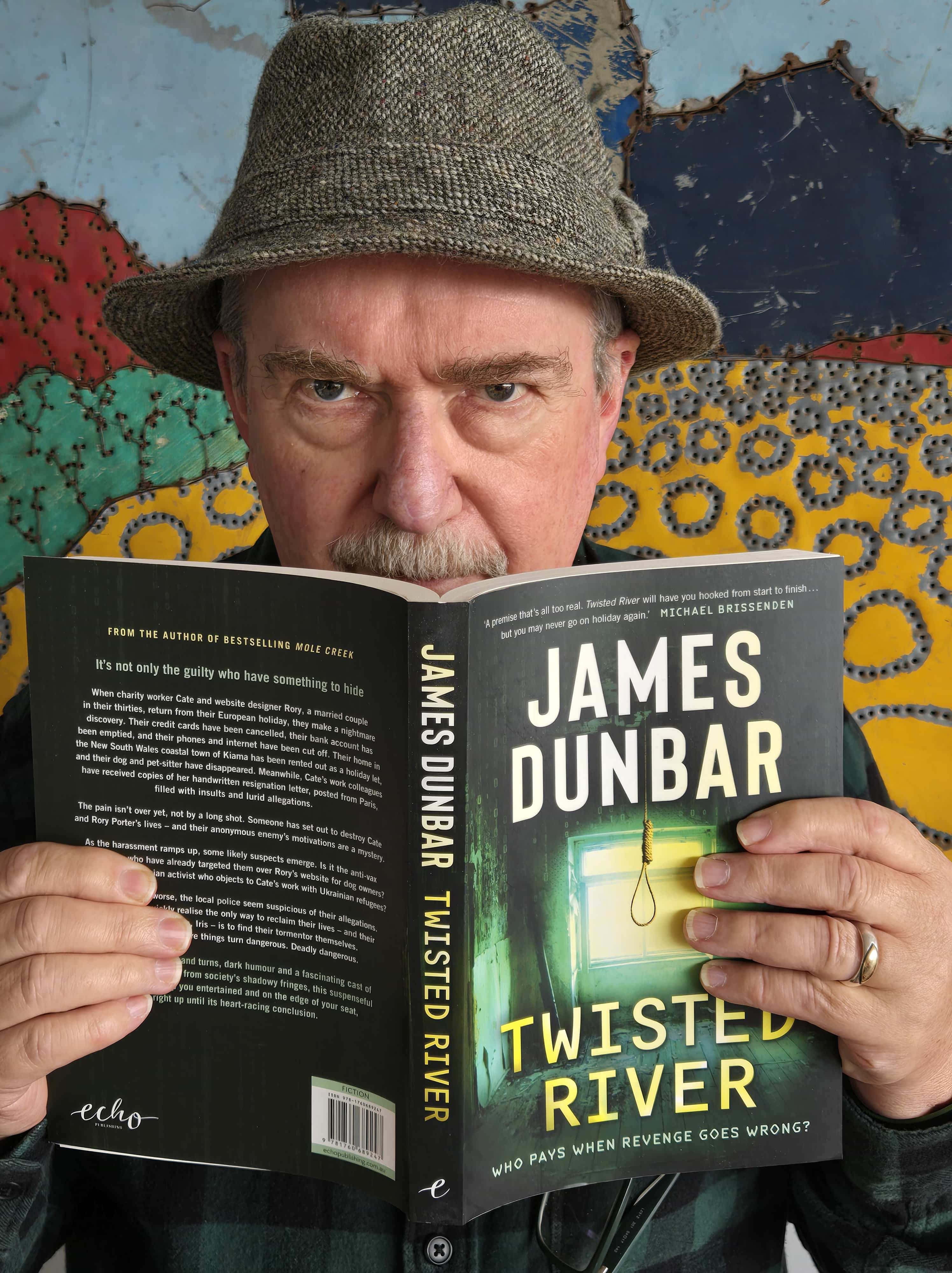
A relatively new name on the Australian Crime writing scene, James Dunbar Thomson has been writing for TV, newspapers and magazines under the name Jimmy Thomson for several decades.
As Jimmy Thomson, he is the author of two crime ‘caper’ novels and two true-crime memoirs, as well as several books about Australian army engineers (sappers) during the Vietnam War.
James Dunbar’s first venture into serious crime thrillers – Mole Creek (2024) was shortlisted for the Danger Award for Best Crime Fiction in 2024, he has now turned to crime thriller writing with a vengeance, with Twisted River (2025) and the upcoming Blood Moon (2026)
0 Comments