




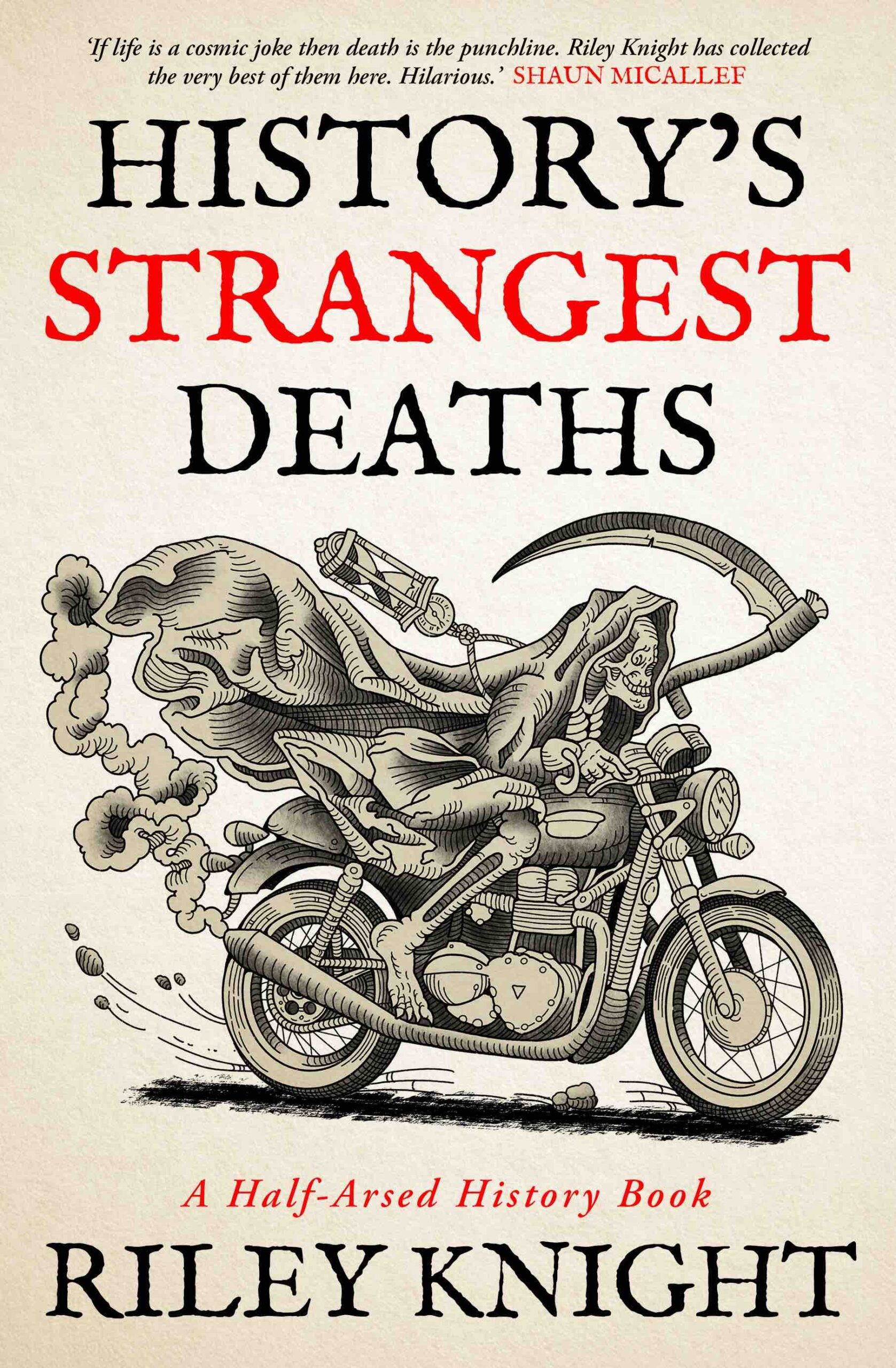
History’s Strangest Deaths, the debut book from Riley Knight, host of the popular podcast Half-Arsed History, highlights the many and varied ways that people have met their end over the years, from the foolish to the absurd.
Read on for an extract …
**********
ABOUT THE BOOK
From a classical Greek playwright killed by a tortoise dropping out of the sky to an ancient Chinese duke falling into a toilet; from a Viking raider bitten by a severed head to a lawyer shooting himself to prove a legal point; from two French kings killed by door frames to two British parliamentarians who were killed by turnips—there are countless amusing, farcical, absurd, and ultimately very strange deaths from across history. History’s Strangest Deaths offers 50 of the best of them, spanning thousands of years of history to recent times.
Many people are supremely unimaginative in death, embracing the tired old cliché of dying peacefully in their sleep surrounded by loved ones. History’s Strangest Deaths has tracked down those select few who have instead made their mark in the history books by exiting this world in thrillingly unconventional ways.
**********
Pyrrhus of Epirus
Killed by a Roof Tile, 272 bce
You may have heard of the term ‘Pyrrhic victory’: a triumph that costs so much to achieve it might as well have been a defeat. One of the most famous examples of a Pyrrhic victory is the poorly named Battle of Bunker Hill,1 which took place in the opening stages of the American Revolutionary War. Technically, the British defeated the rebels and captured the Boston Peninsula, but the battle was still a disaster for them. They had far more casualties, including a huge number of officers, and learned the sharp lesson that these upstart colonists weren’t to be underestimated.
- To the everlasting delight of historical pedants and ‘well, actually’ enthusiasts everywhere, the Battle of Bunker Hill didn’t take place on Bunker Hill: it was instead fought on nearby Breed’s Hill.
Why do we call victories like these ‘Pyrrhic’? To answer that, we have to go back more than 2,000 years, to an ancient Greek king called Pyrrhus of Epirus. Pyrrhus spent much of his monarchical career fighting more or less anyone and anything, and while he won plenty of battles, some of these victories came at an extremely steep cost.
Pyrrhus took the throne of Epirus in 307 bce, when he was just a young boy. Unfortunately for him, he was ousted as king before long, replaced by a usurper named Neoptolemus II in 302 bce. However, in what proved to be a very good move for his career, Pyrrhus married the stepdaughter of the powerful Ptolemy I Soter, the first ruler of Ptolemaic Egypt, and Ptolemy I was generous enough to restore Pyrrhus to his throne as co-king with Neoptolemus II, whom Pyrrhus promptly had assassinated. Sometimes the simplest solution is the best. Back in charge of his kingdom in his own right, Pyrrhus went from strength to strength. He established Epirus as a formidable regional power, winning many traditional, non-Pyrrhic victories against other Greek kingdoms that stood against him. But then, in 282 bce, he went to war with the Roman Republic, and this is when the Pyrrhic victories started to come in thick and fast.
Pyrrhus accepted an invitation from Tarentum, a Greek city on the Italian peninsula, to help defend them from the Romans. Pyrrhus was happy to have some new people to fight, as he’d more or less run out of targets in the Greek world, and so he loaded tens of thousands of troops onto a fleet of ships and sailed them over to Tarentum, kicking off the Pyrrhic War.
The two major battles of the Pyrrhic War were the Battle of Heraclea and the Battle of Asculum, and these battles ended up becoming very famous indeed. Pyrrhus was heavily outnumbered in the Battle of Heraclea, which saw 35,000 men under his command face off against a much larger Roman army of 45,000. However, Pyrrhus demonstrated his tactical brilliance to overcome the larger Roman force, although in doing so his army took enormous losses.
Similarly, during the Battle of Asculum, Pyrrhus was able to carry the day against the Romans; however, despite emerging victorious, his forces were almost completely wiped out. Pyrrhus was there, getting stuck in himself, fighting shoulder to shoulder with his men, leading them on to victory—but this triumph came at an immense cost.
The Romans could replenish their dead and wounded with fresh troops thanks to their home-ground advantage and proximity to Rome, whereas the Greek losses were felt more keenly as soldiers couldn’t be so easily replaced from across the Ionian Sea. This led to a famous quote after the Battle of Asculum: according to the ancient Greek historian Plutarch,2 Pyrrhus was supposed to have said, ‘If we are victorious in one more battle with the Romans, we shall be utterly ruined.’
- The same ancient Greek historian who was good enough to let us know about Mithridates being sentenced to ‘the boats’.
It wasn’t long after these two victories, therefore, that Pyrrhus threw in the towel and withdrew from the Italian peninsula without having made any real gains, despite winning 100 per cent of the battles he fought there. It was this disastrous string of victories that gave rise to the term ‘Pyrrhic victory’.
You might think that this isn’t the sort of thing you’d want as your historical legacy; it’s a real piece of bad luck for Pyrrhus, remembered for being so bad at winning that he had to retreat after doing it! All things considered, though, he would probably be glad to find out he’s remembered for that, rather than being remembered for how he died. Pyrrhus continued to fight more wars after his ill-fated campaign against the Romans. He fought Carthaginians in Sicily for a while, then eventually returned to the other side of the Ionian Sea and got back to his core competency of fighting other Greeks. It was in one such fight he finally met his end, during an invasion of the Peloponnesian Peninsula in 272 bce.
Pyrrhus laid siege to Sparta, then marched on to the nearby city of Argos, breaching its walls. As already established, Pyrrhus liked to be in the thick of things, fighting alongside the soldiers he commanded— however, this time, he wouldn’t emerge from the battlefield alive. During the hand-to-hand fighting on the streets of Argos, Pyrrhus was wounded by a man with a spear. He rounded on his attacker, intent upon avenging the blow, not knowing that the time of his death was finally upon him.
At this point you might be thinking, alright, an ancient Greek king being killed by a spearman during a street battle – there’s nothing particularly strange about that. How did this guy manage to make it into this book?
Well, it wasn’t the spearman who killed Pyrrhus. Rather, it was the mother of the spearman, who, seeing the danger her son was in from this furious Epirote king, chucked a roof tile at him. Her aim was true, the roof tile came down on Pyrrhus’s head, and Pyrrhus collapsed to the ground. The blow from the tile itself may have killed him immediately, but if it didn’t, the subsequent decapitation that took place while he lay there prone certainly did.
So, overall, Pyrrhus should be glad that the term bearing his name is ‘Pyrrhic victory’ and not ‘Pyrrhic defeat’—which could be used to describe being killed by an angry mum with a knack for improvised weaponry.

ABOUT THE AUTHOR
Riley Knight is the host of Half-Arsed History, a weekly podcast highlighting absurd and entertaining stories from history. Born in Melbourne, Victoria, Riley became a primary school teacher after finishing his mostly-useless Arts degree, and began Half-Arsed History as a hobby while teaching grade three. The podcast has only grown since then, with millions of downloads across the world, live shows across Australia, and now its very own book.
After spending almost a decade living in Europe, Riley now lives on the Sunshine Coast in Queensland, and consistently produces three episodes of Half-Arsed History every week (except when the cricket is on, at which time he produces them inconsistently). He likes historically-themed video games, running, and – rather obviously – books.


0 Comments