





The members of the Australian battalion of Gull Force endured some of the harshest prisoner-of-war conditions of any Australian during the Second World War.
In February 1942, on the remote island of Ambon in Indonesia, 1131 Australian soldiers were preparing for invasion by Japanese forces. Outnumbered and ill-equipped, theirs was an impossible mission. After their defeat, over 200 Australians were massacred. The survivors faced three-and-a-half years of harsh work, beatings, disease and starvation on Ambon and the Chinese island of Hainan. Along with the brutal conditions came a crisis of leadership, with Australian officers accused of devising their own systems of punishment and handing men over to the Japanese. The prisoners on Ambon were tormented by two catastrophic raids by ‘friendly’ Allied air forces. Over 800 survived to endure years of captivity; only 302 returned home.
Acclaimed historian Joan Beaumont tells the full story of this tragedy and its aftermath in Gull Force: Australian POWs on Ambon and Hainan, 1941-45. A powerful account of suffering, death, endurance and memory, the story of Gull Force is one that must not be forgotten.
Read on for an extract …
Remembering Gull Force
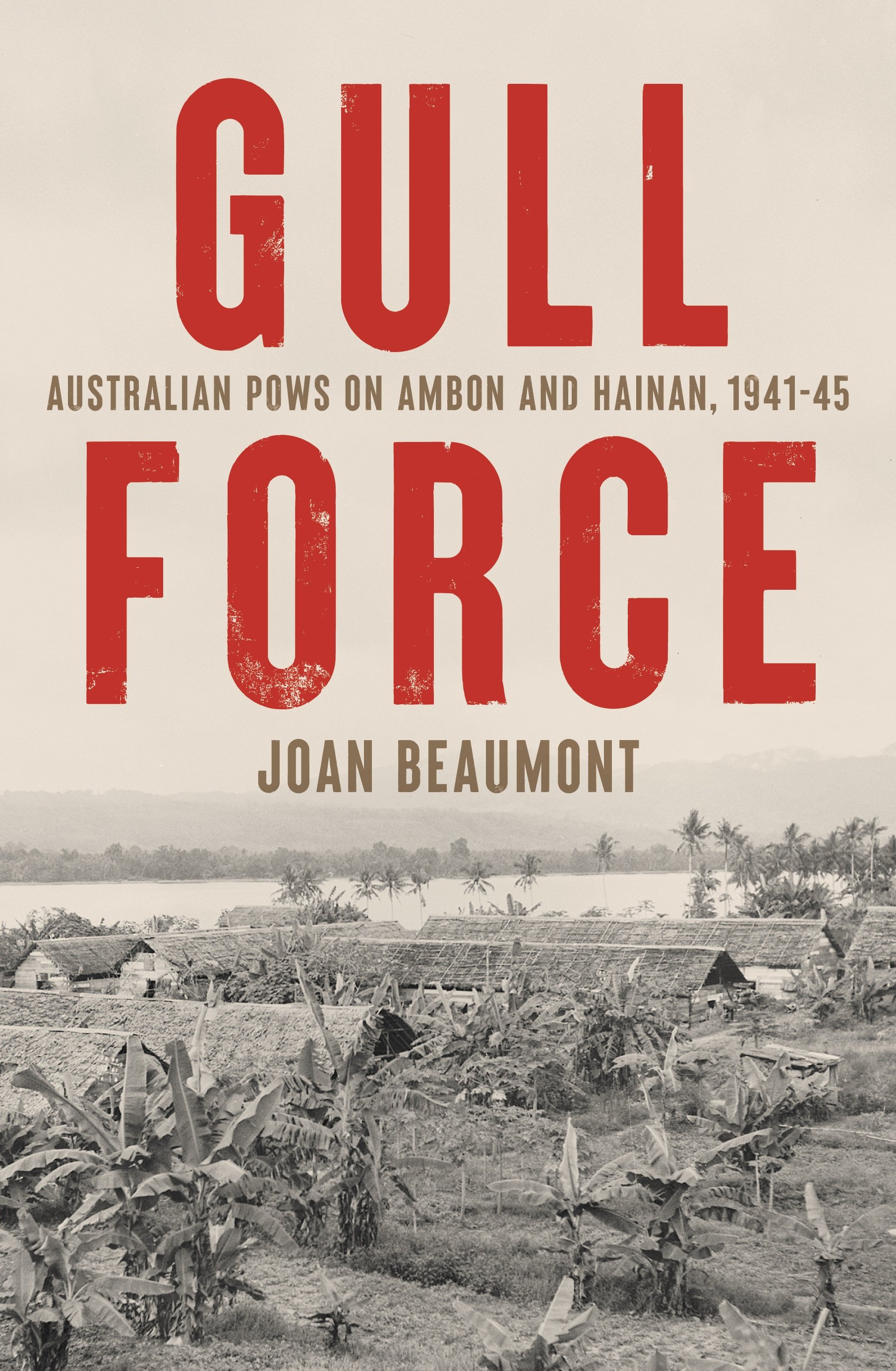 The story of Gull Force has been told before: first, in the official history of the Second World War and then in several works by survivors and historians from the 1980s on.9 This book is a revision and updating of my own Gull Force: Survival and Leadership in Captivity 1941–1945, published in 1988 and reprinted in 1990 when a commercial film about the war crimes trials relating to Ambon, Blood Oath, was released.
But despite these publications, and many years of investment in sites of memory on Ambon by veterans and their families, Gull Force’s tragedy has attracted less attention than other Australian experiences of captivity. Sandakan has been featured in a dramatic gallery display in the Australian
War Memorial for some decades, while Hellfire Pass on the Thailand–Burma railway became, in the late 1990s, the site of an official Australian memorial museum.1
Why is this so? What is it about the national commemoration of war that continues to render Ambon and Hainan less visible? The reasons are complex, as are all the processes of memory formation that elevate one episode of the past over another in the public sphere. But the ambiguity in Gull Force’s case surely arises from the unsettling elements of its experience of war and captivity.
This was almost a litany of disaster from the start. Gull Force was sent by Australian military authorities in December 1941 to the remote island of Ambon as part of an ill-conceived strategy to assist the Dutch colonial forces stationed there. Like other battalion-sized forces sent to Dutch Timor and New Britain, Gull Force had no chance of effective resistance, but when its commanding officer, Lieutenant-Colonel LN (Len) Roach, predicted this in January 1942, he was summarily sacked. Australia’s military leaders in Melbourne gave no consideration to evacuating Gull Force.
When the Japanese attacked, on the night of 30–31 January 1942, the defenders of Ambon were overwhelmed in a matter of days. Gull Force suffered relatively few (54) battle deaths, but in the next two to three weeks, some 229 Australians, who had been assigned to defend the strategic airstrip at Laha, were massacred by the Japanese. Several small groups of Australians (52 in all) managed to escape in the weeks that followed; and, with the help of the Ambonese and a good dose of luck, made their way by island-hopping back to Australia. But the remaining 795 members of Gull Force remained prisoners of war. By the war’s end, only 300 were alive.
An attempt to understand Gull Force’s experience of captivity was especially challenging because of its isolation. Most Allied prisoners captured in the Asia-Pacific region moved several times during their internment in response to the demands of the Japanese for labour within their conquered territories and homeland.
Prisoners were shipped or trucked from Java to Singapore, from Singapore to Burma, and from Thailand to Japan, to name only some of the more common journeys. During these travels their original formations were often broken up and they encountered prisoners from other Australian units and other armies. Gull Force, in contrast, remained a discrete force, although it was divided into two cohorts in October 1942 when one-third went to Hainan. These Australians were imprisoned with Dutch and a handful of American prisoners, but they fraternised very little outside their own national group.
Arguably, this might have been an advantage. All the literature on the sociology of prisoners of war suggests that group solidarity and social cohesion are vitally important in a situation where the struggle for survival is acute. Yet, the isolation of Gull Force became a liability. The prison camps on Ambon and Hainan were closed communities, with all the stresses of enforced intimacy of any prison life.
Yes, they were free, for the most part, from the hazards that other prisoners of war experienced when moving around the region – being transported in crowded cattle trucks or being crammed into ‘hell ships’ that were vulnerable to Allied submarine attack – but they suffered the profound tedium of being confined in one or two locations. In the case of Hainan, this environment was depressingly unattractive. The outlets for the inevitable personal and social tensions were few and the cohesion of the group came under immense strain.
The remaining 795 members of Gull Force remained prisoners of war. By the war’s end, only 300 were alive.
To add to this, Gull Force experienced a crisis of leadership. In a case of misdirected aggression, the other ranks initially blamed their rapid defeat on their own officers, rather than the high command in far-off Melbourne that had sent them ill-equipped to Ambon. When discipline frayed, the response of the commanding officer who replaced Roach, Major WJR (Jack) Scott, was seen as autocratic and authoritarian. Then, on 15 February 1943, an Allied air attack on Tan Tui camp in Ambon killed some of the most able officers, as they rushed to extinguish a fire in a munitions dump established within the prison camp by the Japanese.
Over the next two years, the surviving officers confronted disciplinary issues that threatened the collective good, such as stealing, and ultimately resorted to installing a controversial cage for interning Australian offenders. On Hainan, meanwhile, Scott, who led the part of Gull Force that left Ambon in October 1942, became alienated from the other prisoners. His solution to disciplinary breaches was to hand men over to the Japanese for punishment.
When one prisoner was seriously beaten in October 1944, the ranks mutinied, establishing their own ‘vigilance committee’ to deal with stealing in the camp. Certain of Scott’s fellow officers considered divesting him of his authority by declaring him insane.
None of this story sits easily with the values of the Anzac legend into which the men of Gull Force had been socialised.
This is not to indict Gull Force. None of us has experienced the hunger, physical exhaustion, illness and mental anguish that these prisoners of war endured. We cannot condemn those who found the stresses of captivity intolerable and who acted in ways which, in retrospect, seem less than admirable.
An attempt to understand ‘There but for the grace of God go I.’ In such a profoundly traumatic situation, individual reputations suffered, and it is impossible, when retelling their story, to avoid disclosures that may be painful. But it is not the purpose of this history to condemn – or glorify – the Australians whose story it tells. Rather, it is an attempt to understand.

ABOUT THE AUTHOR
Joan Beaumont is Professor Emerita at the Strategic and Defence Studies Centre, Australian National University. She is one of Australia’s pre-eminent scholars on Australian prisoners of war and is the author of Broken Nation: Australians in the Great War, the critically acclaimed account of Australia’s experience of the First World War, which was joint winner of the Prime Minister’s Literary Award for Australian History and winner of the NSW Premier’s Prize for Australian History.
She is also the author of Australia’s Great Depression: How a Nation Shattered by the Great War Survived the Worst Economic Crisis It Has Ever Faced and co-editor with Allison Cadzow of Serving Our Country: Indigenous Australians, War, Defence and Citizenship.

0 Comments