



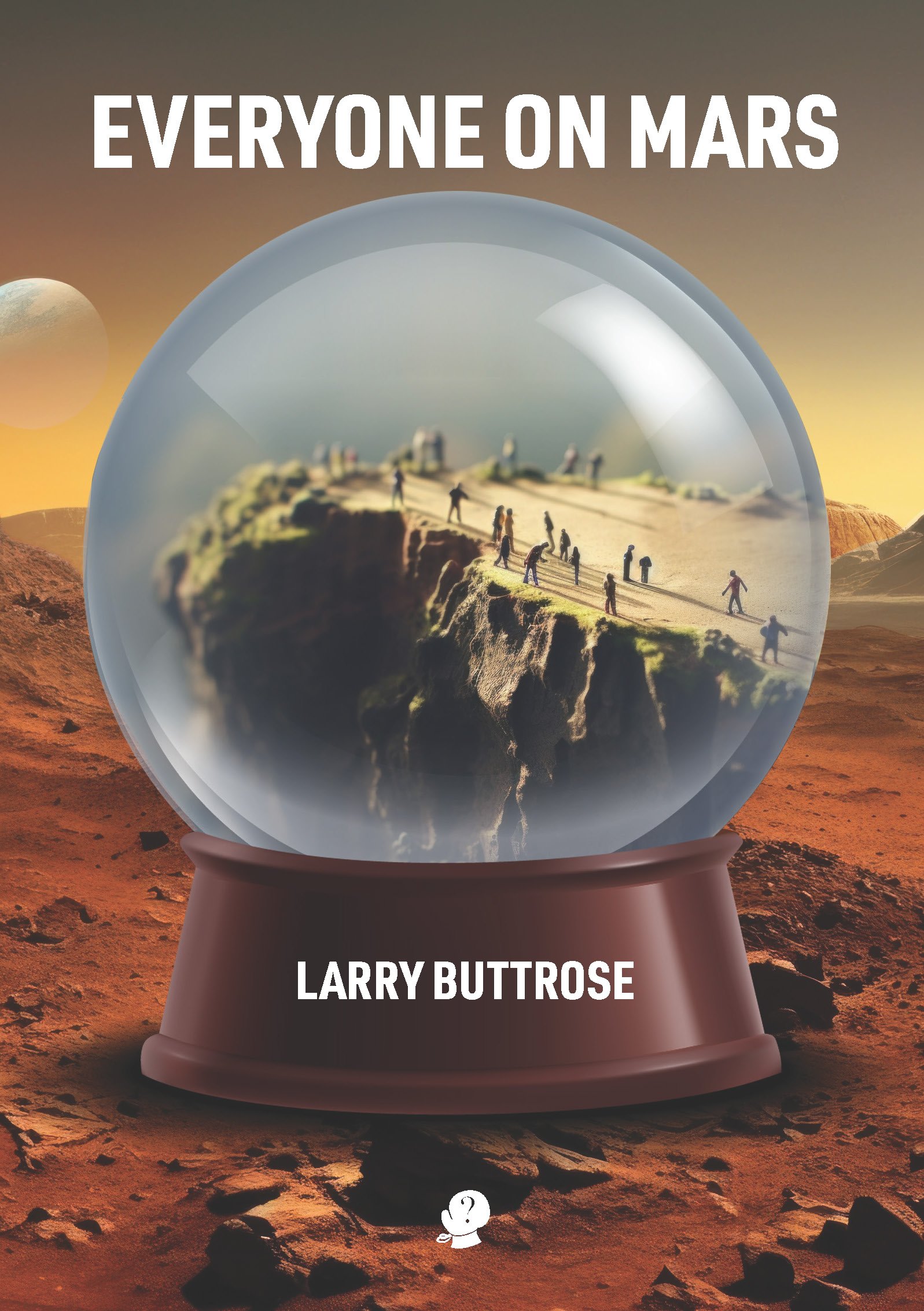
Everyone On Mars is a collection of short fiction based around an imagining of the impact – personal, interpersonal, psychological and existential – of our forthcoming colonisation of Mars. It interweaves threads of the isolation, loss and alienation of living on inhospitable Mars, if with a nascent love of its cold, harsh beauty, as humanity truly becomes a bi-planetary species.
Read on for an extract …
Writer in Residence
 The books had been a problem. But she had insisted. Four months with- out her Woolf and Joyce, Allende and Plath, Dostoyevsky and Marquez were not possible. They weren’t fancy editions, most were mass-market paperbacks, which made it all the more difficult to explain to them. Electronic books are not authentic books, she said. They argued they were the same thing, just text stored in a different way. No, she said. The medium truly is the message. Electronic books are as ineffable as the ideas they come from: they lack the authority and truth of print stamped into paper, something you can touch and hold and that will never alter.
Turn the gadget off and where are the e-books? But a real book, silent and motionless as a cat on a shelf, is a thing of beauty. Novels, stories, poems are wellsprings of our human wisdom and delight, she told them. When you hold a copy of To The Lighthouse, that’s what you feel. It’s not to do with the intellect: it is life between two covers. But they’re heavy, they argued, they’ll take up room. So it came down to how heavy and how many, and she had packed her few dozen non-negotiable books, the ones she ran her fingers down now, and the spines shivered.
She flicked back through her manuscript over coffee. Something nagged about Carlos. Could he really be that offhand about his mother’s diagnosis, just because Julia had never liked her? Was he that suggestible, guileless and cruel? That wasn’t his whole story but it was part of it. She sipped and wondered if there was enough of the mother in the second chapter, and of Julia’s secret girlfriend in the third, and whether it was too much that they were caught up in political treachery too. She drank down the rest of the coffee. God, how had she come to write such dross?
Yet it was the kind of thing her publisher said her readers wanted, and from meeting them at festivals, she knew it was true. She glanced up at her little shelf of books. She was yet to write one she could even hope to place near them, and after her early grit, fire and phosphorescence, probably never would now. She’d had the freedom back then. Past the shelf was her window and her eye was drawn as ever to the distant range in all its hazy orange-red, then to the smooth-topped little hill that overlooked the colony, and now to the black rocks in the dirt just outside. Martian hills, Martian rocks. Mars. She was really on Mars.
He could not believe he was going to meet her. He might have fantasised back on Earth, but here of all places it was really going to happen. ‘Mila Avila,’ he said out loud to himself. Mila. Avila. He entered her domus with circumspection and found her in the greenhouse amid sprung rows of carrots and beets. She was sitting on a trail chair, looking at what he wasn’t sure.
‘Oh. Sorry.’
She looked up. ‘What for?’
‘Interrupting you.’
‘From what?’
‘Whatever you were doing.
‘I wasn’t doing anything.’
‘I’m Jason Forno. We have an appointment.’
She didn’t move. ‘Thank you for being on time.’ He fidgeted a little and looked around. ‘I like your snake plants … Sansevieria,’ he said, pointing to the pair of potted ornamentals on stands. ‘Beautiful, aren’t they? And they seem to like the decontam.’
‘I’m still surprised any non-edibles are allowed on Mars.’
‘Yeah, well, “mental wellness” is big here.’
‘And I’m still trying to get my head around eating anything grown here… wondering how decontaminated the decontam is anyway.’
‘It works pretty well. I love snake plants even if we can’t eat them. They’re so wilful, determined. Hardy, don’t need too much water.’
‘What do you do here?’
‘Maintenance,’ he said. ‘Mining robotics.’
‘I didn’t know there was mining.’
‘There’s some.’
‘For what.’
‘Different things.’
‘For here? Or Earth?
‘For Earth it’d have to be just about as precious and small as diamonds to make it worthwhile getting back there. No, it’s really for here. Construction, you name it, everything.’ ‘Do you enjoy it?’ ‘Every day I wonder how I got here doing this. I just want to write now. That’s all I want to do. All I ever really have.’ ‘Half of humanity wants to write. It’s another thing to do it. So what have you brought me? A draft? I haven’t seen anything from you.’
‘I really just wanted to talk to you about how you work. I’ve read all your books. I’m a huge fan.’ ‘Please don’t say that. Coffee? Tea?’
‘Coffee, please.’
She got up. From her books he’d imagined her taller.
‘You’re American,’ she said.
‘From Indiana, the Hoosier state. Indianapolis. Like Kurt Vonnegut … Bokonon. Poo-tee-weet. Insanity is contagious.’
‘You know I’m from Cuba. We could almost be enemies.’
‘Even weirder at this distance, isn’t it.’
She shrugged and led him into the kitchen alcove and opened a fresh jar of coffee.
‘I’ve been writing in my head all my life,’ he said. ‘But when I finish it, the story I’m writing now will be my first completed work.’
‘As someone said, it takes you your whole life to learn to write, and then you die.’
He grinned. ‘Lucky I’m starting early then.’
‘Milk with your coffee? I don’t know if I have any.’ ‘That’s OK.’
She started making it and he wandered over towards her shelf. ‘Books,’ he marvelled. ‘Real books.’
‘Yes.’
‘May I touch them?’
‘Not yet.’
By far the hardest part was the reading. Presumably the idea of a writer in residence was for the ‘wellness’ – she could barely think such a disgusting word – of the colonists. And to give the visiting writers vistas and moments of a lifetime. She had been out two or three times ‘suited up’ in the surface vehicles that tracked the wastes around ElonGate. It reminded her of the Atacama in Chile, or Sturt’s Stony Desert in Australia. From the rum-sweated grime of Havana to the trash cans and bums sleeping by her door on Canal Street, here was the glory of a clean, cold and dry nothingness. If life had ever been here, it was long gone, leaving an empty place of such majesty it wailed.
She read diligently through the stories on her screen as a deal was a deal and she considered it a point of honour to acquit. Many were love letters to the blue and green planet they missed, with romantic portraits of thinly veiled lovers and spouses back home, and sentimental ones of mothers and fathers, even pets. Others depicted life on Mars as a drudgery, if in words it was drudgery to read. She had asked for a work profile of the colonists and it came back that most were scientists and engineers, maintenance workers, medical staff, computer wonks and bio and botanical geeks. There were machinists and emergency crews, and the carers and teachers of the first native-born Martian humans. There were the drivers and pilots, some she presumed must work in the Closed Module, about whom little was ever said. She was intrigued to know there were miners here too, who it seemed must be categorised under the blanket term “technicians”.
The day she saw Jason Forno’s story appear on her screen, from its opening sentence she knew it was very different from all the others. It was about a young man dispatched by his company to work on Mars, who decided there had to be more to life than the sum of his shifts. As she read on, a kind of existentialist Martian rebel began to emerge, a young man who in his down time chose not to drink beers in the Mess, but who went off alone into the wastes, scaling hills, exploring ravines and crannies, and testing as he does so the limit of his oxygen supply. Once he had arrived back on his very last breath. ‘It was exhilarating, it made it feel real.’ But ever more disillusioned, soon the unnamed character starts engaging in meaningless antisocial acts. He scratches obscene graffiti on distant rocks and spells out ‘Fuck Mars’ in a giant, painstaking arrangement of stones, among other petty and rather silly acts. As time goes by he engages in minor vandalism, breaking a canteen coffee machine and dropping delicate equipment accidentally on purpose.
No-one puts one and one together. But after shorting a generator he realises he’s going too far, from simple pointlessness to being a danger to others. He decides then to act on something that’s been simmering in his back-brain. He suits up and treks to the top of the nearest hill, the smooth-topped one with the panoramic view of the grid of the colony and the space port beyond. The temperature has fallen to nearly minus 70 Celsius overnight but is now an almost balmy 3 Celsius outside his suit.
‘He stood looking down over ElonGate, contemplating the thriving little settlement on the plain, and all humanity had achieved here, making its species truly bi-planetary. And yet for what, he thought. Just another planet to mess up as badly as our beautiful cripple, the Earth? Was that all? People on Earth had asked themselves for millennia “Why am I here?” Surely that same question must whisper, rise and boom down the canyons of Mars.
‘By a complex set of hacks and overrides, he was able to remove his helmet. The cold was deep and intense, and made him feel very alert. ‘One, two, three…’ and he inhaled. He knew it was nearly all carbon dioxide with almost no oxygen and he had only a few seconds until he blacked out, and his heart broke on this meaningless outcrop of rock. But he had never felt more alive. He breathed out and in again, pain- fully. ‘Four, five, six … seven …’ Perhaps he could go on, he suddenly thought. Perhaps he could breathe here, after all. Perhaps he was already transmuting into a Martian.
‘Then he felt the daggers inside and his consciousness was suddenly fading, and knew he had perhaps two seconds to get his helmet back on. He fumbled with it.’
The story ended there.
She knew well which hill and scaled it as quickly as she could. She glimpsed the shape on the ground at the summit and knew what it was. His bared head protruded from his suit as he lay on his back by the discarded helmet on the pebbles and sand, wide eyes staring up toward the stars, and he was smiling.
After all the recovery arrangements and officialdom had been dealt with, she returned to her domus and sat for a long time in the greenhouse looking at what he had told her were called snake plants. She saw now how wondrous were these ever upward probing tendrils of green. She felt they were the real reason humans were there. Sitting on her trail chair nursing a brandy, she took out an envelope with her name hand-written on it, ‘Mila Avila’, with a curlicue beneath it. The paper felt alive in her fingertips. Shaking a little, she opened the note inside and read.
‘Dear Ms Avila. It was my profound privilege and pleasure to meet you. I hope I learnt how to write in my lifetime, at least a little. It would be a waste otherwise, don’t you think? And may I touch your books now, please? They are the most beautiful things I’ve ever seen. Even more beautiful than you, who would never think in such terms, but you are, along with every word you have ever written. Sincerely, Jason Forno.’
**********
ABOUT THE AUTHOR
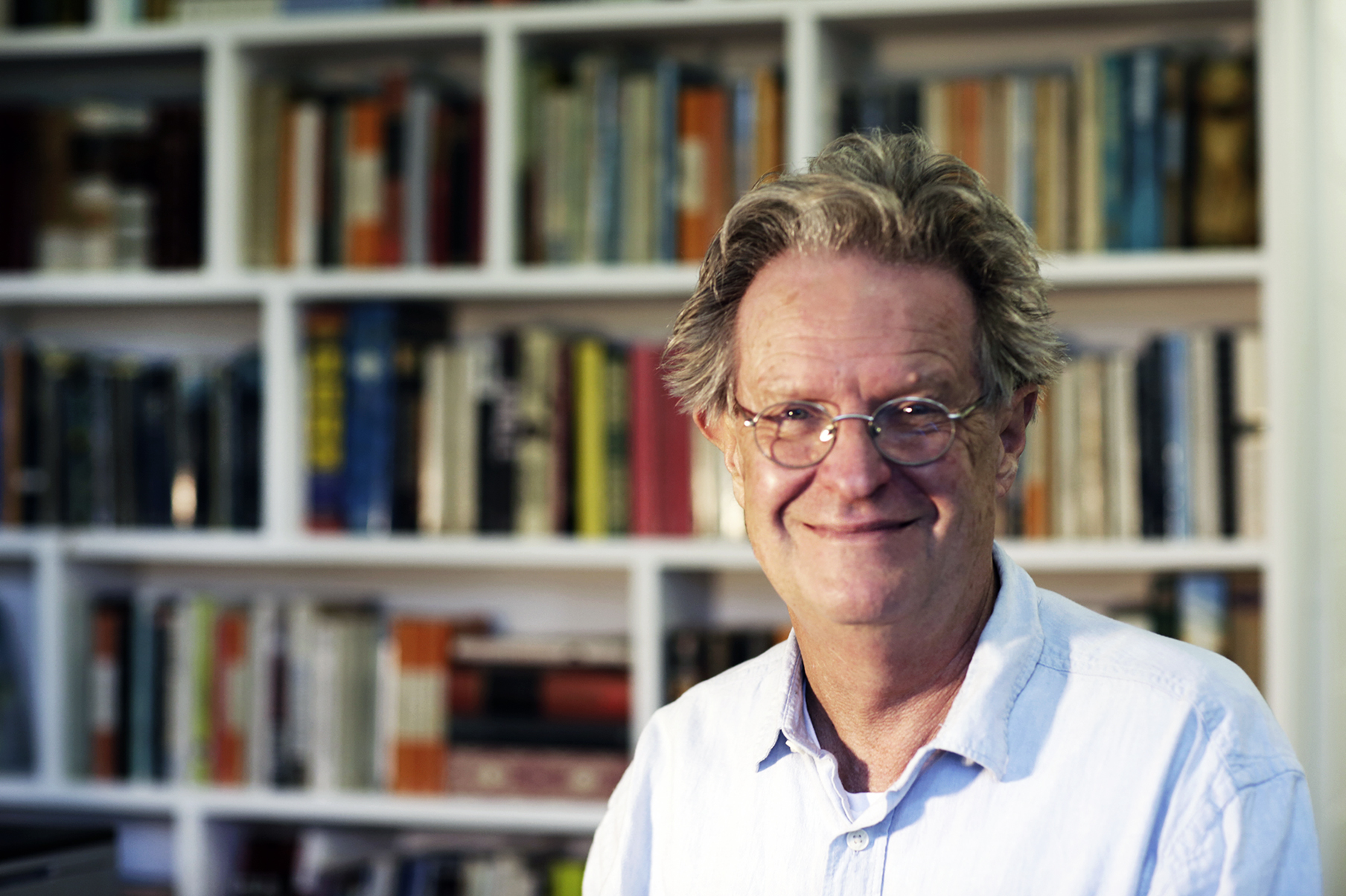
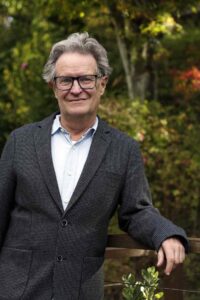
Larry Buttrose is a poet, novelist, dramatist and journalist. His fiction includes the novels The Maze of the Muse, and Sweet Sentence. His nonfiction works include Dead Famous: Deaths of the Famous and Famous Deaths; Tales of the Popes; and the international bestseller A Long Way Home, adapted to the acclaimed film, Lion. He lives in Sydney.
Follow Larry Buttrose on X / Twitter

0 Comments