



JOHN GILLARD’s Creative Writer’s Sourcebook is a fascinating guide to the style and technique of the world’s great writers.
Read on for an extract…
ABOUT THE BOOK
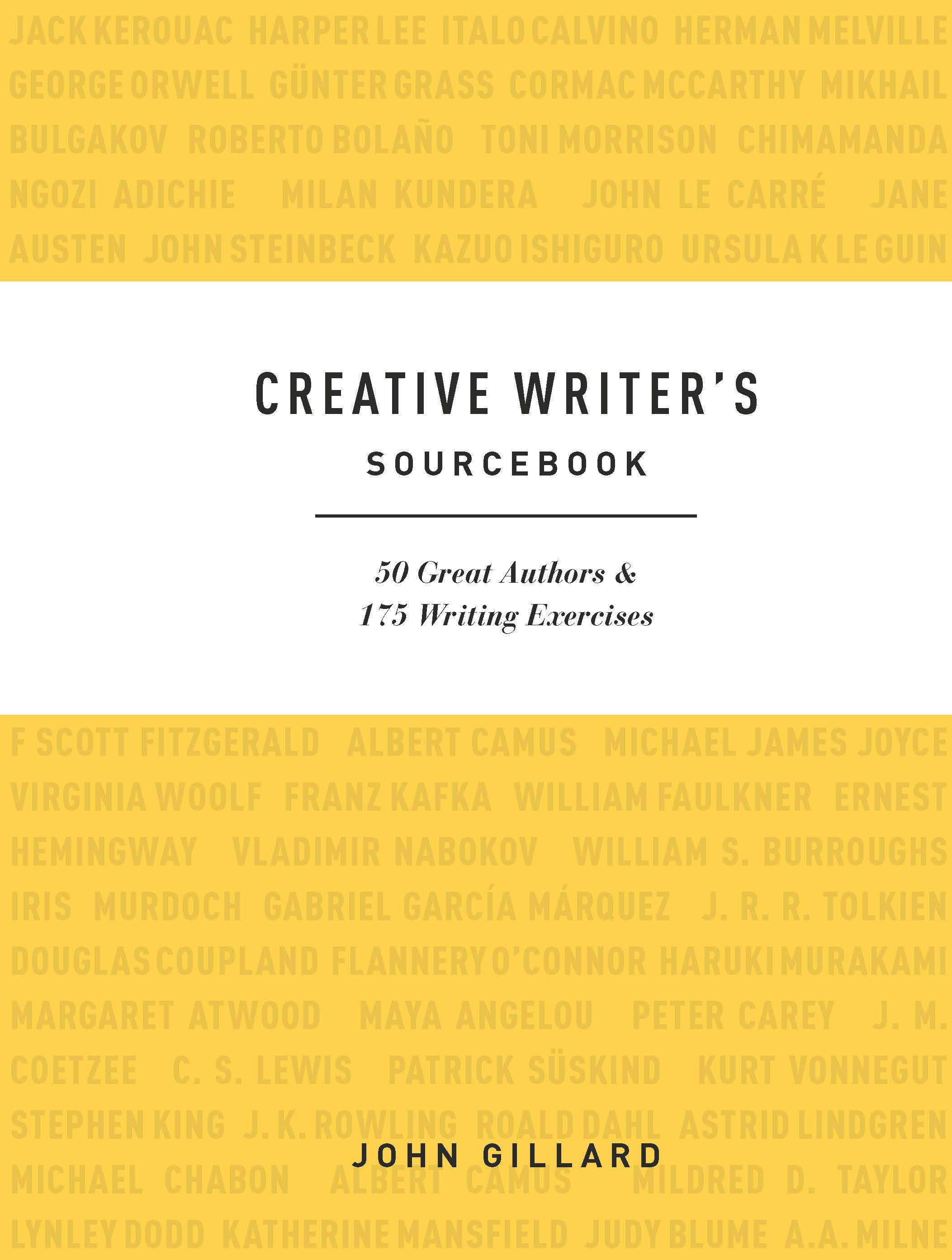 Explore the style and technique of the world’s greatest writers in this compendium to be treasured by literature lovers.
From Katherine Mansfield to Toni Morrison, discover 50 celebrated writers and the literary techniques that set them apart. Each author profile includes details of the writer’s career and key works, followed by an in-depth exploration of their unique style, and several writing exercises based on this. Spanning over 100 years of literature, and several genres, featured writers include:
- Harper Lee – acclaimed American author of southern gothic fiction including To Kill a Mockingbird.
- Lynley Dodd – much-loved New Zealand author of the Hairy Maclary and Friends series for children.
- Gabriel García Márquez – Colombian author of works including One Hundred Years of Solitude, known for his exceptional, genre-defining use of magical realism.
The collection contains 175 writing exercises and prompts based on the techniques and works of the featured writers. They provide instruction on different aspects of writing, from perfecting dialogue and characterisation to experimenting with structure and language. Learn from the greats and expand your writing repertoire as you play with perspective à la Virginia Woolf and craft an opening line worthy of Franz Kafka.
The perfect reference for aspiring fiction writers and literature buffs alike!
EXTRACT
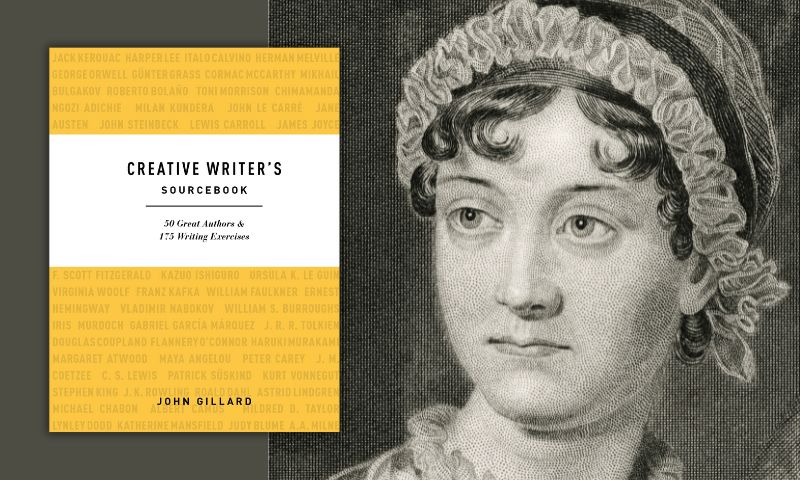
JANE AUSTEN
BORN: December 16, 1775
DIED: July 18, 1817
NATIONALITY: English
KEY WORK: Pride and Prejudice
Austen mirrors sentiment with pace. In Pride and Prejudice (1813), the pace of Mr Darcy’s marriage proposal is reflected in sentence length: ‘In vain have I struggled. It will not do. My feelings will not be repressed. You must allow me to tell you how ardently I admire and love you.’ When his prejudice overtakes his tenderness, it is delivered at speed in a single, clause-filled sentence: ‘His sense of her inferiority – of its being a degradation – of the family obstacles which judgment had always opposed to inclination, were dwelt on with a warmth which seemed due to the consequence he was wounding …’
Jane Austen wrote at a time when the modern novel was still in its infancy. She parodied the sentimental and romantic novels that came before, and became an important voice in the move toward realism. Her works were published anonymously. Instead of her name were the words ‘By A Lady.’
Wit and Satire
Austen’s six novels focus on the rich and privileged class of English society. She explores the human side of the social rules and conventions of the time. Central to her stories is the dependence of women on marriage for economic security and social standing, and how love can find its way into their lives despite the restrictions. She writes with wit and satire. The title of her first novel Sense and Sensibility (1811) is a playful nod to the ‘novels of sensibility’ that came before. They were heavily focused on building emotion through plot and characters. Austen parodied this approach, while drawing out the reality of the human experience.
Austen’s plots are often driven by mistruths and misunderstandings. Authenticity is drawn out of the main protagonists as the plot develops. Dialogue brings out the negative side in characters, or their pleasant dialogue hides a darker side. Real sentiments are often revealed through letters such as Mr Darcy’s honest and open letter to Elizabeth. In Persuasion (1817) this is key to the dénouement. Wentworth sits in a pub penning a letter to Anne. When Anne also arrives, Wentworth overhears her revealing her views on love to a friend. The verse in Wentworth’s letter is beautiful and powerful: ‘You pierce my soul. I am half agony, half hope … I have loved none but you.’ Austen shows that although class consciousness and social rules can suppress emotions, true feelings will find a way through: ‘Seldom, very seldom does complete truth belong to any human disclosure; seldom can it happen that something is not a little disguised, or a little mistaken; but where, as in this case, though the conduct is mistaken, the feelings are not’ (Emma; 1815).
A Truth Universally Acknowledged
Austen often uses the passive voice, which is largely frowned upon in modern literature. In Austen’s work this lends itself to the deference of the person to the societal conventions of the day. The opening line to Pride and Prejudice is a perfect example: ‘It is a truth universally acknowledged, that a single man in possession of a good fortune, must be in want of a wife.’ Here, later in the novel, character traits passively lead the sentence such is the importance they are given in society: ‘My feelings are not puffed about with every attempt to move them. My temper would perhaps be called resentful. My good opinion once lost, is lost forever.’
In every novel the characters and their interactions drive the plot. The inner workings of the main protagonists are challenged and go through huge development. Austen opens with the social conventions and prescribed thoughts, only to have the characters break them down. Early in Pride and Prejudice we are introduced to the notion that dancing is seen as helping to fall in love. In other words, to simply find a suitor. This is how love is gauged. ‘To be fond of dancing was a certain step towards falling in love.’ By the end of the novel Elizabeth sees past all the pride and prejudice she has felt, past the social conventions, and falls truly in love with Mr Darcy: ‘Do not consider me now as an elegant female, intending to play you, but as a rational creature, speaking the truth from her heart.’ She sees that judgment can cloud our true selves and true feelings, a universal human experience: ‘Till this moment I never knew myself.’
‘I hate to hear you talk about all women as if they were fine ladies instead of rational creatures. None of us want to be in calm waters all our lives.’ – Jane Austen, Persuasion
JANE AUSTEN
EXERCISES
IRONY
The tone of Austen’s work is often ironic and satirical. She has a cutting wit that she uses to parody social conventions and character types. In Pride and Prejudice, Elizabeth shows her prejudice toward Darcy and men in general with ironic, witty contempt: ‘One cannot be always laughing at a man without now and then stumbling on something witty.’ Irony often comes from setting up a particular idea and then flipping it with a cutting comment. Elizabeth starts by saying she laughs at men, but the implication is there is no wit in the interaction. More a façade. She flips this idea, though, by saying she stumbles upon it occasionally; a back-handed compliment, or irony. In a single, short interaction between Elizabeth and her father, irony and humour are used to convey his opinion and character, and so, too, her mother: ‘An unhappy alternative is before you, Elizabeth. From this day you must be a stranger to one of your parents. Your mother will never see you again if you do not marry Mr. Collins, and I will never see you again if you do.’
Exercise: Write some ironic and satirical lines to describe modern-day social conventions. You could present the lines from the perspective of a character conveying their thoughts, or dialogue between two or more people.
FREE INDIRECT SPEECH
Austen developed the technique of free indirect speech, whereby a third-person narrative weaves in the thoughts and speech of a character. This brings the reader directly into the psyche of the character while retaining the structural flow and observation of the omniscient narrator. In Pride and Prejudice the action is reported while giving the reader an insight into Mr Bingley’s inner thoughts: ‘… everybody had been most kind and attentive to him, there had been no formality, no stiffness, he had soon felt acquainted with all the room; and as to Miss Bennet, he could not conceive an angel more beautiful.”
Exercise: Write some free indirect speech, either with a number of short examples or a longer narrative. Begin with a standard, third-person narrator introducing a character, and then have the narrator bring in the inner thoughts of the character.
CHARACTER COUNTERPARTS
Austen amplifies the characteristics of the main protagonists by placing them close to supporting characters who have contrasting values, personalities, and character development. They are parodies of themselves, such as Mrs Bennett, who remains emotional, vulgar, and obsessed with finding a suitor for her daughters, while Elizabeth evolves and matures through the course of the story.
Exercise: Create a character profile that contrasts with the main protagonist. In what way are they close to the main character and what are their major characteristics? What is stopping them from developing, while the main character follows a major arc? You could follow up by doing the same thing for a main character as a contrast.
ABOUT THE AUTHOR
John Gillard is a writer and illustrator has written widely on the subject of creative writing, and has helped many people ignite and enhance their writing skills. Some of his titles include Flash Fiction: The Very Short Story Starter, Just Write One Thing Today, and Fiction Writer’s Notebook.
Follow John Gillard on Instagram here

0 Comments