



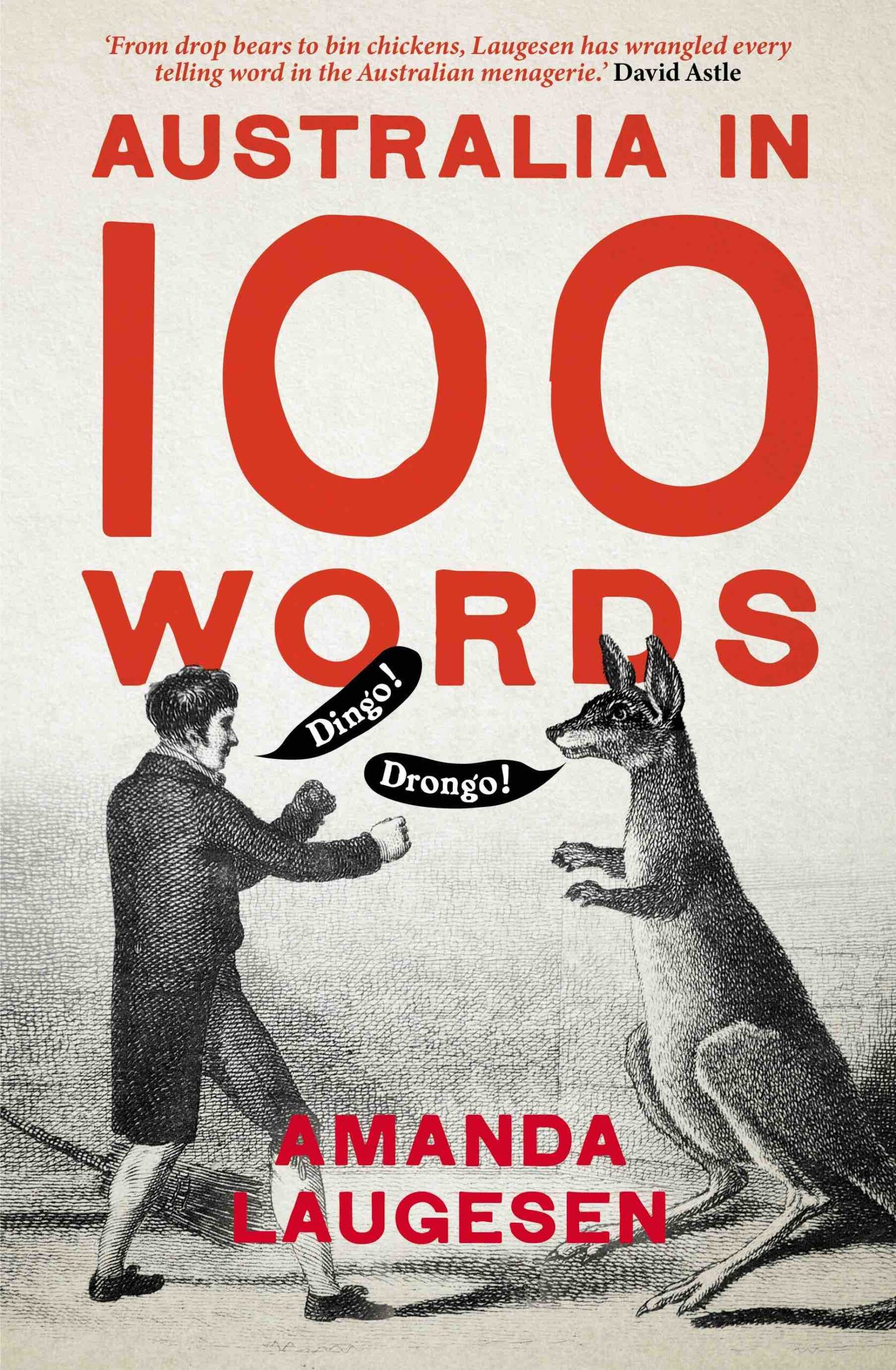
Bonzer. Arvo. Tucker. Sickie. Pash. Illywhacker.
There are plenty of words to choose from to tell the story of Australia – from iconic Australianisms like mateship, fair dinkum, and bogan to drop bears, budgie smugglers, and bin chickens.
And while you aren’t likely to hear crikey, cobber, or wowser walking down the street, you will hear no worries, mate, and yeah nah. Words underpin myths and stereotypes of Australian identity; they have also obscured harsh realities and inequalities. Together, these words shine a spotlight on our culture, past and present.
Historian and Director of the Australian National Dictionary Centre Amanda Laugesen brings us an innovative linguistic history of Australia.
Read on for an extract.
**********
Harold Holt
- Rhyming slang for ‘to bolt’.
- Rhyming slang for ‘salt’.
Rhyming slang has a long history in English, and in the past was identified with the East End of London. Well- known British examples include frog and toad ‘road’ and trouble and strife ‘wife’. Curiously, rhyming slang did not establish itself as a mainstream feature of many varieties of English. American English, for example, does not include many such terms. But Australian English has retained and expanded on the vocabulary of rhyming slang. And while it might even be considered a dated feature of British English, Australians continue to generate new rhyming slang terms, suggesting that it still has life.
How does it work? The idea is that the rhyming slang term is a substitute for another word, with the term usually having two parts, although sometimes shortened to just one (for example, Barry Crocker is rhyming slang for ‘shocker’, but someone might say ‘I’m having a Barry’). Many rhyming slang terms are taken from the names of well-known people, but this is not always the case. For example, two rhyming slang terms that many Australians would be familiar with are dog’s eye and dead horse, slang for ‘meat pie’ and ‘sauce’.
But many rhyming slang terms come from people’s names, and Australian English has generated a lot of these. One name that most Australians know, and which has lent itself to not one but two rhyming slang senses, is Harold Holt, Australia’s 17th prime minister. Holt was in office from 26 January 1966 until 17 December 1967. He disappeared while swimming off Port Nepean in Victoria, and it is assumed that he was caught in a rip and drowned. His body was never found. However, various conspiracy theories have circulated ever since, including that he had been picked up by a submarine and defected to China. These mysterious circumstances might have given rise to the first sense of Harold Holt meaning ‘bolt’. It is often used in the form ‘to do a Harold Holt’ or ‘to do a Harold’. Not long after the appearance of the ‘bolt’ sense, the ‘salt’ sense emerged, and entered the Australian vernacular.
Many other names appear in Australian rhyming slang. Some of the people’s names these terms play on may now be unknown to most. For example, Jimmy Britt is the name of an American boxer who toured Australia during the First World War; his name is used for the rhyming slang term Jimmy Britts ‘the shits’. Adrian Quist was an Australian tennis player who gave his name to the rhyming slang for ‘pissed’. Johnny Bliss was a rugby league player whose name is used as rhyming slang for ‘piss’. Boxer Lionel Rose became rhyming slang for ‘nose’. Rhyming slang is popular in sporting circles, especially rugby league and AFL, and so unsurprisingly the names of rugby players have often been adopted for rhyming slang. Recent additions include Mal Meninga ‘finger’ and Gary Ablett ‘tablet’. Non-specific rhyming names also appear, such as Jimmy Dancer ‘cancer’, Joe Dunn ‘one’, and Joe Blake ‘snake’. Place names also sometimes feature, such as Kembla Grange ‘change’ and Botany Bay ‘run away’. Other rhyming slang terms, not related to names, include babbling brook ‘cook’, septic tank ‘Yank’ (and sometimes abbreviated to seppo), and gum tree ‘knee’. This creative and humorous aspect of Australian English continues to evolve: recent additions include no Dalai lamas ‘no dramas’ and Ash Barty (tennis player) ‘party’.
ABOUT THE AUTHOR
 Associate Professor Amanda Laugesen is Director of the Australian National Dictionary Centre, ANU. She completed her PhD in the History Program at the ANU in 2000, and subsequently worked as a research editor at the Australian National Dictionary Centre, ANU, as well as undertaking teaching in the History Department. She produced two lexical monographs for Oxford University Press (Convict Words: the Language of the Australian Convict Era and Diggerspeak: the Language of Australians at War) while working at the ANDC, as well as working on a number of other projects relating to the history of Australian English. Amanda was appointed as a Lecturer in History at the University of Southern Queensland in 2004, and Lecturer in History and American Studies at Flinders University in 2006. She has extensive teaching experience in US, Australian, and World History. Since taking over as Director of the ANDC, she has co-edited many Oxford Australian dictionaries, including the Australian Pocket Oxford Dictionary and the Australian Concise Oxford Dictionary. She was Managing Editor of the second edition of the Australian National Dictionary (2016) and is now chief editor.
Amanda’s research includes numerous books and articles in the areas of historical memory, the history of reading, libraries and publishing, cultural history (with a particular interest in the cultural history of war), the history of Australian English, and lexicography. Her books include Boredom is the Enemy: the Intellectual and Imaginative Worlds of Australian Soldiers in the Great War and Beyond (2012), Taking Books to the World: American Publishers and the Cultural Cold War (2017), and Rooted: An Australian History of Bad Language (2020). Her current research areas include: cultural history of Australian English and slang; cultural history of war and veterans; and the history of the cultural Cold War.



0 Comments