



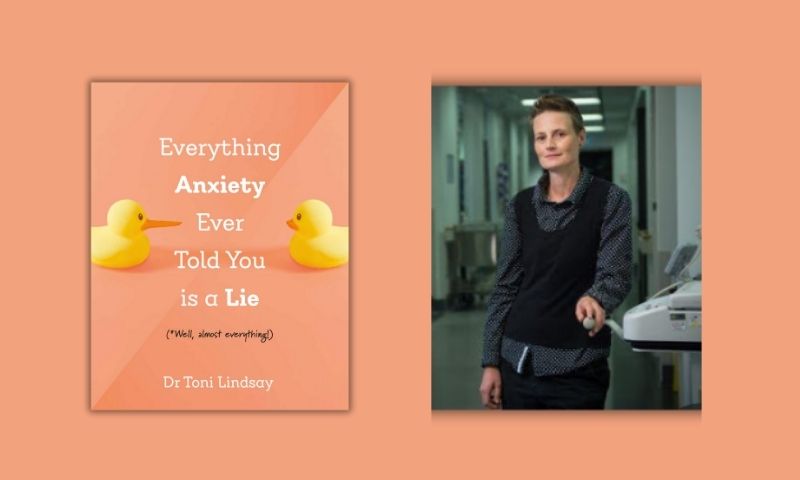
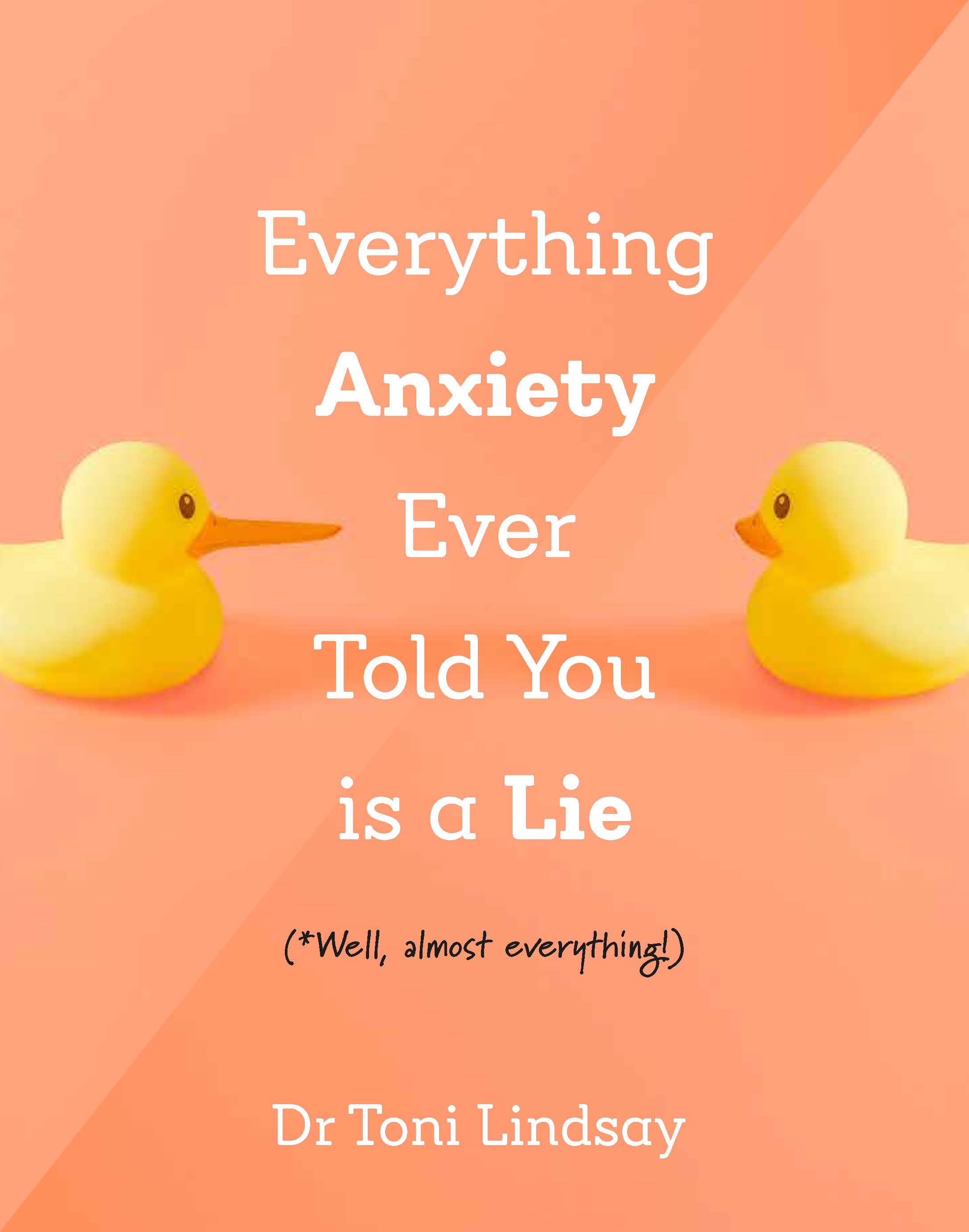
DR TONI LINDSAY’S Everything Anxiety Ever Told You Is a Lie is practical and therapeutic guide to managing anxiety, written specifically for those aged 14–25 by a psychologist with over 15 years of experience working with adolescents and young adults.
We caught up with Dr Toni to ask about what inspired her book.
You’ve specialised as a clinical psychologist for 15 years, and written books about dealing with cancer. What inspired you to write a book about anxiety now?
 There are a couple of things which lead to this book – firstly, I have noticed over time that anxiety is showing up more and more, not just in my clinic room – where many more people are coming with a history of anxiety being present in their lives, but also in the people around me – colleagues, friends and in the world generally. The events of the past couple of years, and the ongoing global uncertainty presents us with a bunch of challenges, and anxiety is often what arrives in the face of difficult situations. The second thing that jumped out at me was the number of people who have spoken to me, either as young people themselves, or their parents, teachers, school counsellors and others about the difficulties in accessing support and information to help young people manage anxiety. It is the combination of these things which lead me to start thinking about how we can support the people who might not bump into a psychologist or other counselling support, but for whom anxiety is present in their lives.
What drew you to specialise in adolescent and young adult anxiety?
I now spend most of my clinical time working with people under the age of 30 – these folks are usually living with cancer (either their own, or someone in their families) and I have been in this space for a long time. But before coming into cancer, I had worked with young people for many years in different settings. I love working with young people – they bring such openness and curiosity into the counselling room, but also lots of humour and resilience, even in the face of really difficult things. Most of the time when I meet people, they are wanting to ‘get rid’ of the feelings of anxiety that are showing up, because they are so difficult and unpleasant. And because of how we are wired, we assume that fighting with it is the only way – but I absolutely love working with people to help them recognise that learning to work with the anxiety and build a different relationship with it can be a game changer.
Your book is written in such an easy-going style, almost like a friend writing to a friend. What was the process for presenting the information like this?
Thankyou for saying that! I think that sometimes information about serious stuff like anxiety can be communicated about in ways that make people more fearful about it. In my clinic room, I bump into really full on and scary stuff all the time – but the people I meet in my room aren’t always in that space. And, it wouldn’t be helpful for us to be in this space all the time. Instead, allowing a lightness to come to some of this work actually means that you can do more. I also know, that most of the important stuff that happens in therapy is about relationships – between the therapist and the young person, but also between the young person and their anxiety. Obviously, it’s a bit harder to capture this on the page than if we were talking, but I want people to feel like there is a connection – both to what I am saying as an author, but also to the content, so that they are able to carry that forward with them, like a conversation that they might have with someone about the things that are difficult.
Your concept of addressing and accepting anxiety instead of fighting it is motivating and useful. How did you decide upon the different aspects to be included in the book?
That is directly thanks to the young people that I have worked with over the years – there are somethings that land more naturally than others, and over time I have seen how people process things and the way that they can apply them. With anxiety and young people, often the most helpful stuff is around getting them to recognise when it is showing up (as often people aren’t able to connect with the headspace stuff, they just feel it in their bodies) and the way that they are thinking about their anxiety. From there, we can apply some of the other things that we talk about in the book. People will be drawn to some pieces over others, so in the book, I have tried to present ideas from a few different angles.
Your approach of naming the different thoughts in your head was especially effective i.e., Panic Guy, Anxiety Guy, Procrastination Guy etc. Is this something you use in the clinic that has proven helpful and if so, why does it work so well?
This is such a powerful tool – and echoes a little bit of what I mentioned in the last question. If we can see and recognise how the anxiety (and all of the other guys) are showing up, then it allows us to work with them. We can then have conversations and engage in a way that is hard to do if we are just thinking about them as thoughts. It also means that we can each have our own versions of this – for some people, they describe mini versions of themselves, some people see them as cartoons or as words and for some they are completely different creatures. As a therapist, it is really powerful to be able to say to someone ‘Ah, it looks like the Anxiety Guy has just entered the room’ and for you both to then be able to work out what to do with that.
In your chapter about Perfectionism, you divulge your writing technique of setting yourself a goal of 3000 words a day. Did you come across Perfectionism Guy or Procrastination Guy at any point while writing your book? And if so, how did you push through it?
Absolutely! For me, Procrastination Guy is a much bigger presence than Perfectionism Guy. I can predict that they will turn up reliably about 1000 words in, and sometimes even earlier. These Guys are a bit funny though – sometimes, they are pretty quiet, and I am almost waiting for them, but then on other days, from the first word they rock up and are telling me how rubbish the work is, and that no-one will ever get value from it. The way that I have learned to manage these Guys (and there are others when I am writing – The Imposter Guy, The Not Good Enough Guy etc) is to simply notice that they have turned up, and to thank them (‘Ah, Imposter, there you are! I have been waiting for you!’) and then keep writing anyway. And if I don’t get 3000 words done for the day, that’s okay too. The process of sitting down consistently is more important than the outcome on any one day.
You use a lot of interesting analogies and metaphors throughout the book such as anxiety being like waves, the tug of war, the broken clock, layers like an onion, or the cavewomen and the tiger. Why are analogies and metaphors so effective when discussing anxiety?
Anxiety for most of us is a complex entity, and it can be a mystery as to why it arrives and when. As humans we are wired to story – it has been how our history and lessons have been passed from person to person for as long as we have existed, but it also allows us to build understanding of complex things, like anxiety. Using analogy and metaphor is an extension of this, and it can allow people to access information through both thought and feeling, but it also means that we remember and process the information in a different way. In the context of anxiety, this also means that people will be able to use that information from the metaphor/analogy and then apply it to different situations where the context might be different. This is particularly important in working with anxiety, as tends to adapt and change readily, and so being able to be flexible in holding and applying story works particularly well.
You discuss positive self-talk and learning to be compassionate or kind about ourselves aka the Kind Guy. How would someone find the balance of doing this without feeling arrogant or having a false sense of confidence when doing so?
It’s funny isn’t it? Often our brain will provide us with stories about what it means to be kind to itself, and this is one of them – that if we are connected with the part of our selves where we say we are doing well (or even okay) we will have that other Guy show up to say ‘Hey mate, don’t get too far ahead of yourself’ or ‘Whoa, you need to knock yourself down a few pegs’. I would say, just notice that Guy, thank him for showing up, and then continue to listen to what the Kind Guy is saying. That Kind Guy, well, they have a lot to add. BTW, although we are all fearful of becoming arrogant and unlikable if we connect too much with The Kind Guy, I have never met anyone where that is the case. If you are worrying about it, it is very unlikely to happen.
What is the most surprising thing you learned while writing this book?
That’s a hard one to answer! I think I was surprised at how many ways that Anxiety Guy can show up for us – I have always known that Anxiety is a bit of a chameleon, but sitting and putting it all on paper made it really jump out at me! No wonder we can get overwhelmed! Hopefully, the book will be able to help people in getting to know, and manage all these Anxiety folk better.
ABOUT THE AUTHOR
Dr Toni Lindsay is a qualified clinical psychologist who has been working with both adults and adolescents for over 10 years. She works at Chris O’Brien Lifehouse in the Oncology and Haematology departments and has a special interest in the care of adolescents and young adults with cancer. She is an AHPRA approved supervisor and works predominately from an Acceptance and Commitment Therapy framework. Her first book was titled Cancer, Sex, Drugs and Death (Australian Academic Press, 2017) and focused on the psychological management of young people with cancer. More recent titles include The Cancer Companion and The Certainty Myth, published by Exisle Publishing.
During more than 15 years spent working clinically with adolescents and young adults (primarily in the health context) Dr Lindsay has developed a unique perspective and understanding of the challenges of managing anxiety. She was inspired to write Everything Anxiety Ever Told You Is a Lie after hearing from so many of her young cancer patients that there is nothing out there that speaks to them on the subject. She observes, ‘Through my clinical practice with young people, anxiety is showing up more and more frequently. It is now rare that I will meet a young person who has not identified that anxiety has been a concern for them in the past.’

0 Comments