


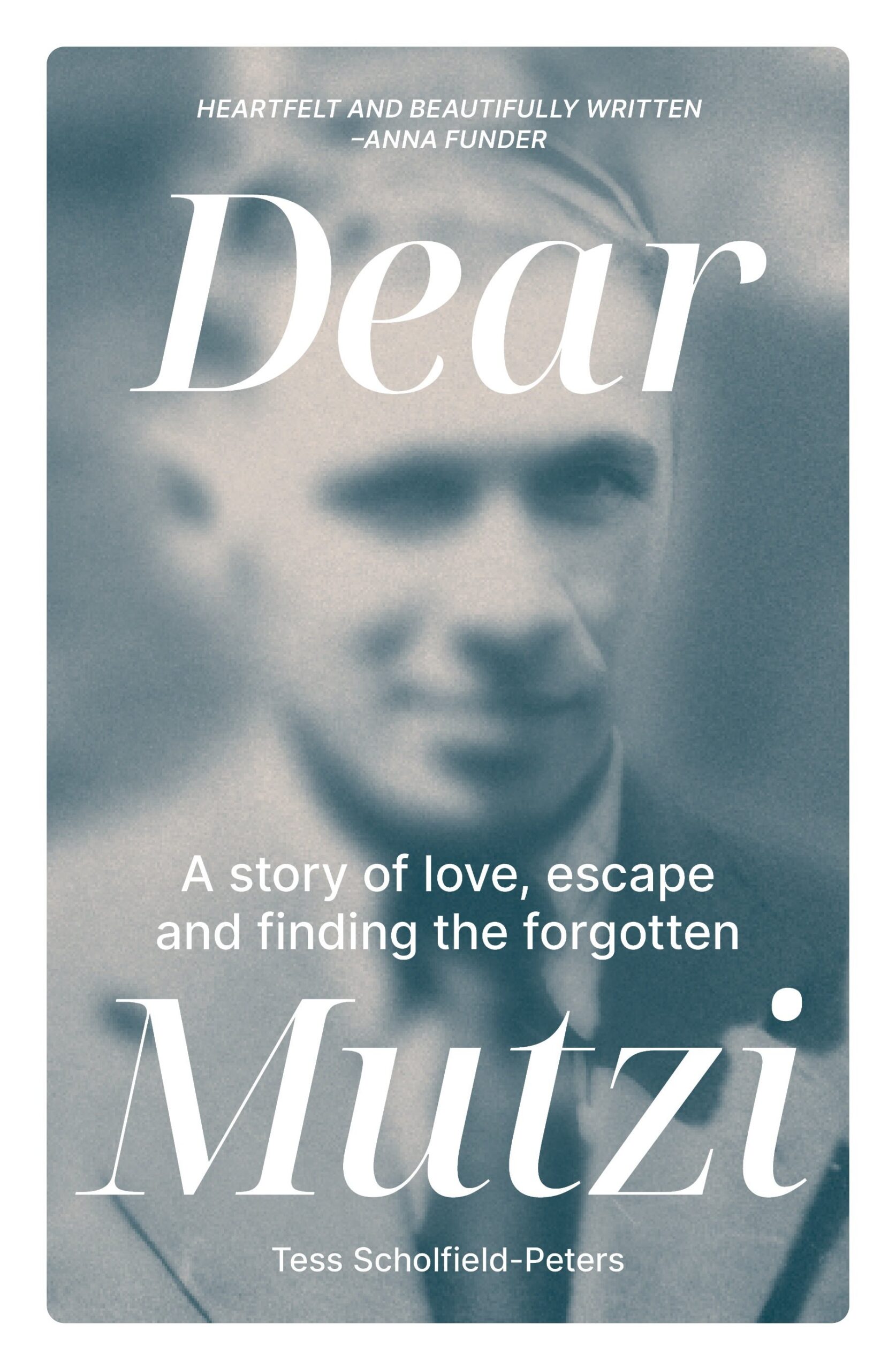
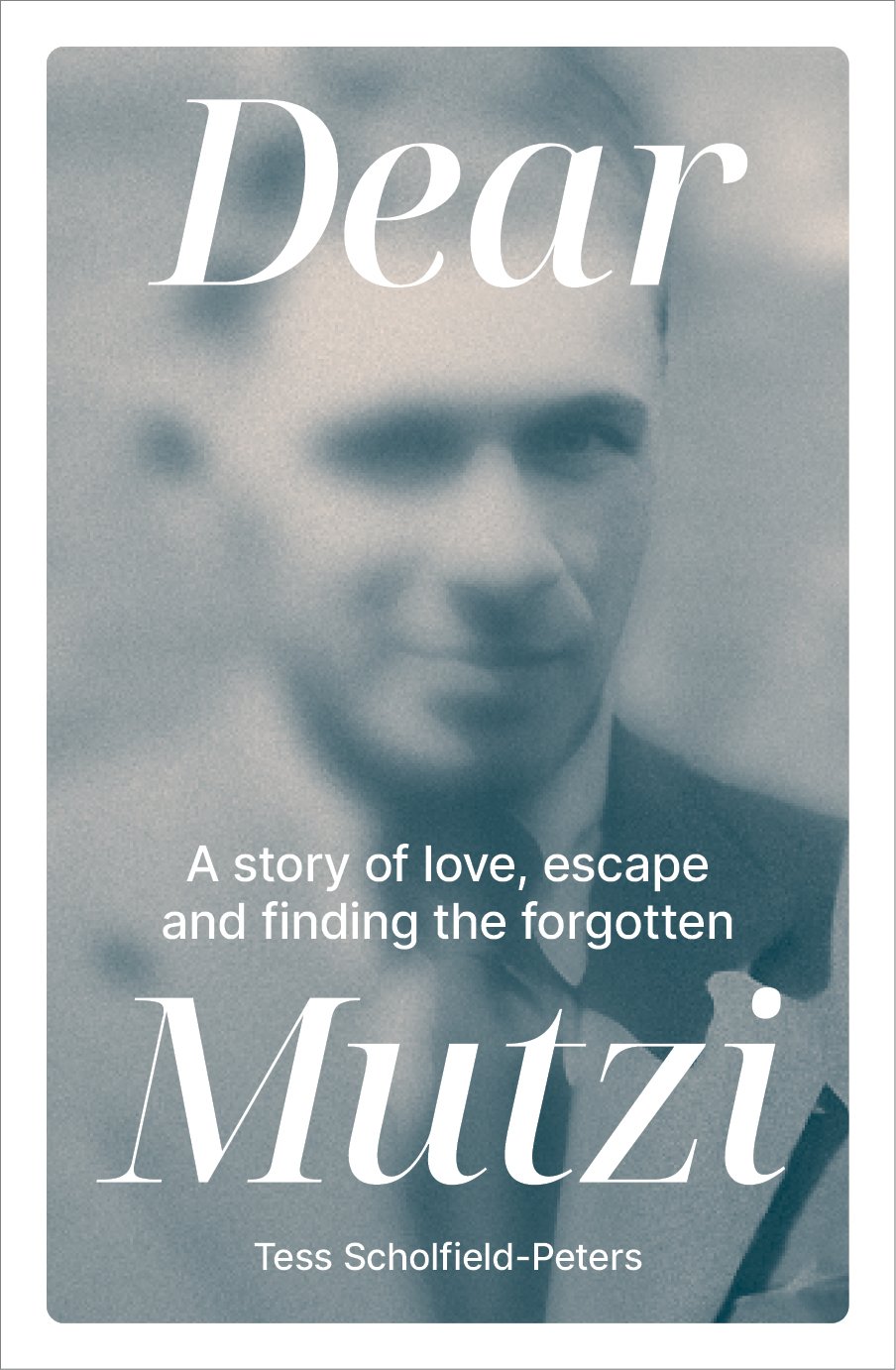
Harry Peters – formerly Hermann Ludwig Pollnow, known to his family as Mutzi – was born in Berlin in 1920. As a teenager, he fled Nazi Germany and landed in rural Australia. Harry’s parents, Max and Edith, stayed and perished in Nazi camps.
This story, of forced migration, assimilation, loss, resilience and determination despite the odds, is one that has been lived countless times throughout history and continues to be a common human experience. Harry’s particular experience also tells the history of refugee farmers in rural Australia and migrant labour companies during World War II.
In Dear Mutzi, Scholfield-Peters tells her grandfather’s story with three intertwining threads: a sketched-out history based on Harry’s testimony and documentary history; her engagement with this personal history from a third-generation perspective; and the present story of Harry’s growing infirmities and eventual death in early 2021 at age 100.
Through the hybrid narrative non-fiction form, Scholfield-Peters investigates her family history and seeks to share an ethical historical account of Harry’s life. This work necessarily skirts the edges of fiction and non-fiction, as Scholfield-Peters weaves her deep research with Harry’s recollections and imagines the unknown details.
Read on for an extract …
**********
As warmer months approach, I return to Mum’s house to help her sort through decades’ worth of accumulated stuff in preparation for her move. It’s the house I spent my late childhood and teen years in, and when I walk through the front door and down the hall the walls are porous with the smell and feel of those times. The old wooden floorboards, the lingering air of Mum’s percolated coffee and toast from this morning, the sweet scent of jasmine from the backyard. These home smells have a transportive quality that allows me, for a moment, to convene with my young self and retrace her steps. I walk through the living room to the bright open kitchen where Mum sits reading the newspaper, the radio tuned to classical. We hug, she puts another pot of coffee on. I stand on the weathered wooden deck looking out over the small backyard. Next door’s gumtree sways slowly in the late afternoon breeze. I inhale the strong smell of the blooming jasmine growing up one side of the shed in the far corner of the yard. The coffee pot gurgles and sputters and Mum pours it into two ceramic mugs. We sit together at the dining table.
‘We need to sort through the study,’ she says.
‘I know, I’m sorry. Most of the stuff is mine.’ When I moved out, I left a trail of books, photo albums, random folders full of half-finished stories and forgotten notes, bags of orphaned phone cords and skeletons of old mobile phones. The kind of stuff that is guarded from being thrown out by an invisible force—procrastination, maybe, or sentimentality. The pantry’s insides are strewn across the kitchen bench; newspaper-covered glasses and vases sit in rows on the floor; the fridge has been cleared of magnets, flyers, photos, and is now a blank, clean silver. Slowly the whole house will be hollowed out until there’s nothing left that is familiar, nothing but those memories in the walls.
I step into the study, open the blinds and window, let the afternoon in. Beneath the window is a stack of unopened heavy cardboard boxes that belong to Harry. They were bequeathed to Mum when he and Lynn moved down to Kiama and have sat in this room untouched ever since. I lift one and move it to the floor in the centre of the room.
‘What’s in here? Rocks?’ I say as I rip through the tape and prise the box open. It’s full to the brim with old books, pages musty and coloured by time. A Brief History of the Third Reich; Bertolt Brecht’s Berlin; The Weimar Years; Jewish High Society in Old Regime Berlin; Holocaust. I push the box to the side and grab another. This one isn’t as heavy. I open it and find a thick stack of manila folders, loose sheets of paper and newspaper cuttings. I pick up the first manila folder, which someone has labelled Holocaust in pink highlighter, underlined twice. Inside the folder is a collection of photocopied newspaper articles, some copied two or three times each. I scan the first one. It’s from the late 1990s and is written by a Sydney resident who used to work in the Auschwitz crematorium. It’s titled ‘Auschwitz: truth too painful to believe’. The author was a political prisoner and his job was to install electricity in the four gas chambers and, later, fix and reinstall broken wires and cables that were ripped apart by people while they were being gassed. Why would Harry photocopy this article three times? Perhaps he knew the author, but Harry was never at Auschwitz so this is unlikely. The article is sickening, I feel a wave of queasiness as I read. There is something deeply jarring about the everyday electrical maintenance required in a gas chamber. Maybe Harry thought so too. I read that this man gave his testimony at the Nuremberg Trials. The article is written in response to the denialism of a German-born Australian and renowned Holocaust revisionist, Fredrick Toben.
Mum enters the study holding her coffee mug and leans against the desk. She asks me what I’ve found.
‘God, Mum, look at this. Have you heard of Fredrick Toben?’
‘Isn’t he that Nazi from Adelaide?’
‘Yeah, that’s him. This article is horrific.’ I pass it to her to read.
‘Don’t, Tess. I can’t read that stuff. It’s too awful.’
I put the article back with the others.
‘Did Harry ever speak to you about Buchenwald?’
Mum pauses, thinking. ‘No, not that I can remember. Mum always told us not to bring it up. I suppose he saw no need to speak to his kids about it.’
‘Did you ever ask?’
‘No.’
I continue sifting through the boxes. Among the cuttings is an article about Harry’s relative Ilse Rosenthal-Schneider, who was a student of Albert Einstein’s. I recently watched a television series that dramatised Einstein’s life, and here was a real person, a relative of Harry’s, who was taught by him. So often this history feels far away when really it’s deceptively close, hidden in plain sight.
After dinner, Mum’s phone rings. We look at each other; it’s late for someone to call.
‘Hi, Lynn,’ says Mum. ‘Is everything okay?’
I hear Lynn’s muffled voice but can’t catch what she’s saying. I watch Mum’s face fall.
‘Oh dear,’ Mum says. She glances at me. ‘Oh dear. Should
I come now?’
Mum eventually hangs up the phone. ‘Dad’s in hospital.
He had bad stomach pains, so Lynn called the ambulance. They’re keeping him overnight. I said we would go down tomorrow.’
‘Of course,’ I reply.
‘Poor Dad,’ Mum says. Her face is pained.
Neither Mum nor I sleep well. I can’t turn my mind off.
I am distracted by encroaching thoughts of Harry distressed, disoriented in a strange hospital ward. I worry for Lynn, that the weight of this will be too much for her to bear.
Morning comes quickly, imperceptibly. My room is filled with grey light. Somewhere close by, a lawn mower rips through the calm air. I get up. Mum is already in the kitchen drinking a coffee and holding her phone, texting. I can tell she is steeped in worry. We leave for the South Coast almost immediately.
We take the route through Menai. The road is shadowed on either side by tall, spindly forest. The car hums. Out of the silence, Mum begins to speak.
‘I keep thinking about this memory. I’m always reminded
of it when I drive near Mount Ousley: the fog. I hate driving through fog.’
‘My memory, it’s all gone. I’m going mad.’
She pauses.
‘We were at the snow one year, at Charlotte Pass. I was cross-country skiing with Dad, and all of a sudden a whiteout came over us. Just descended in seconds and, honestly, you couldn’t see a centimetre in front of you. Of course, I began to cry and scream out for Dad. I was only young then, maybe 12 or 13. It is really the most terrifying thing, to have your eyes wide open and only see white. Anyway, I didn’t know we were on the edge of a huge drop. They didn’t rope off cliffs in those days like they do now. Suddenly, I felt a hand grab me and pull me backwards. It was Dad, of course. And I remember he was so calm, while I was so distraught.’
She chuckled. ‘It was like nothing had happened, like he could see perfectly clearly through the white. Nothing terrified him. Nothing.’
We arrive at the hospital midmorning. We sign in and are shown to the ward. Lynn has been there all night. Harry is sitting quietly in his bed, a cannula in his right arm, nodding in and out of sleep. Relief fills me, and Mum too, to see that he is calm. Lynn gets up and hugs Mum and me, says thanks for coming.
Lynn says he is being kept in under observation, but he should be okay and he’ll be discharged tomorrow. Mum and I pull up two chairs and sit next to him, while Lynn goes out to get some air.
In the ward there’s no television, no distraction, nothing. We sit next to Harry for a few hours. He falls asleep and wakes again twice. Mum says to the nurse when she comes to check on him that he’ll be fine: he’s spent his whole life working in hospitals.
‘You okay, Dad?’ says Mum.
He looks at her with a forlorn gaze. ‘I’m finished, you know.’
‘What do you mean?’
‘My memory, it’s all gone. I’m going mad.’
Mum pauses and glances at me. ‘You’re not going mad. You’ve got an infection and you’re here to get some treatment, but you’ll be home soon.’
‘Where are my parents?’ he asks.
Mum pauses again. ‘They’re dead, Dad. They died a long time ago.’
‘Are there any Germans here?’
‘In this hospital? I don’t think so.’
‘The Nazis … are they here?’
‘No, Dad. No Nazis here.’
We stay at the hospital all day. I watch as patients leave and arrive, as nurses finish up and begin shifts. The constant beeping of machines and monitors is enough to send anyone mad. Late afternoon eventually seeps in through the far window, soft gold. Mum offers to stay the night but Lynn assures her that she’ll be fine. She will stay until Harry goes to sleep, then go back to the flat to feed Charlie and get some rest herself.
‘Bye, Dad, we’ll see you soon.’
‘Where are you going?’
‘Home, back to Sydney.’
‘You don’t live here?’
‘No, and neither do you. You’re just visiting until you feel better.’
‘Okay.’ He nods.
‘Bye, Harry.’ I lean down and kiss his cheek. ‘See you soon.’
Mum and I are exhausted on the drive home. Hospital wards deplete all energy; it is eaten up by worry and static helplessness. Individually, we are hoping that tomorrow will be better, that Harry will wake and feel like himself again, but of this hope neither Mum nor I are confident.
**********
 ABOUT THE AUTHOR
 ABOUT THE AUTHOR
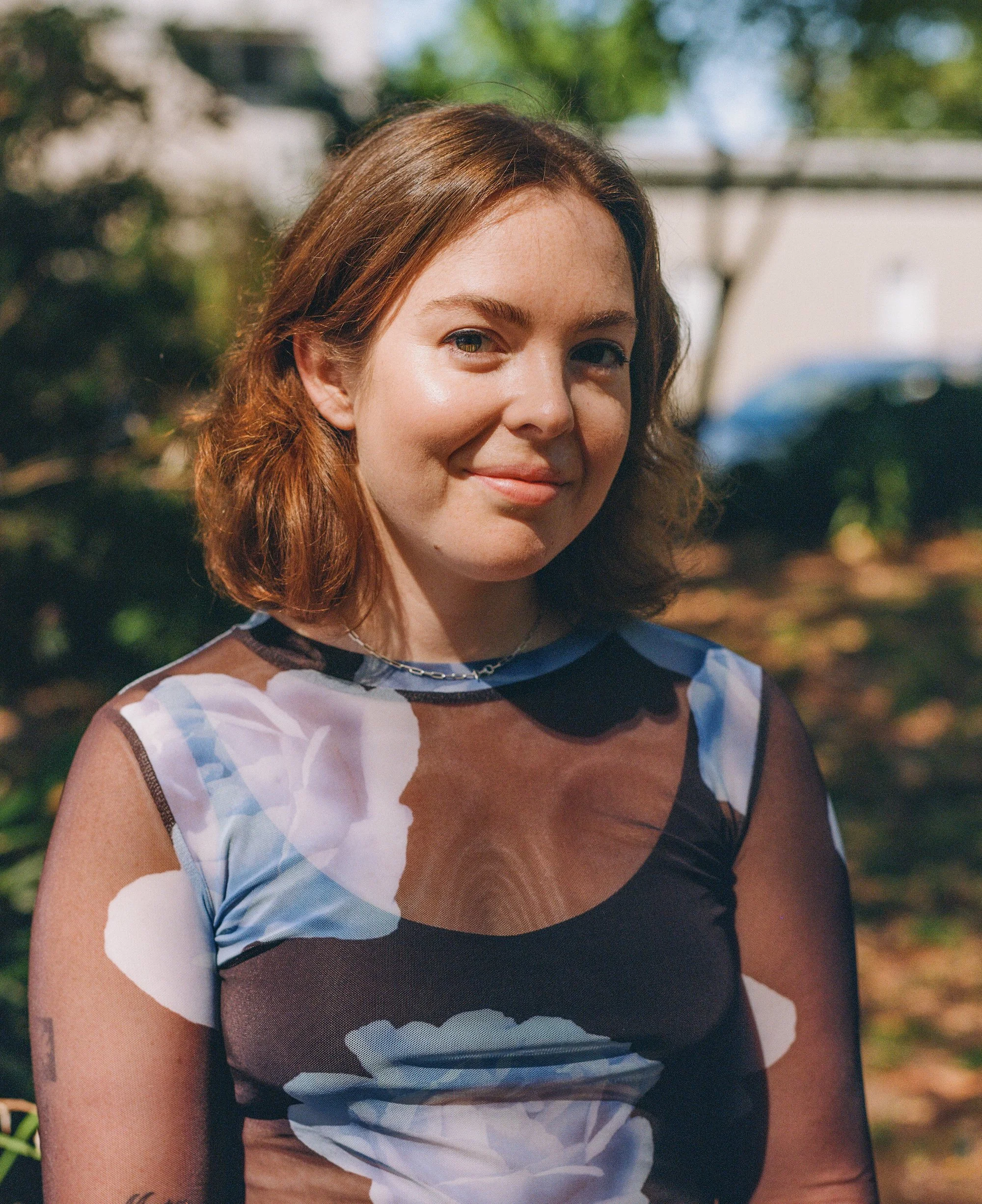
Tess Scholfield-Peters is a Sydney-Eora based writer and academic currently based at the University of Technology Sydney, where she teaches across the Creative Writing programs. Tess began her writing career in community journalism, helping to start the independent legacy newspaper Urban Village based out of Surry Hills. She completed her Honours in Creative Writing at UTS and began her Doctorate in Creative Arts the following year. Her research is focused on life writing, creative non-fiction, Holocaust studies, memory and empathy studies.
In 2020 Tess won the International Association of Literary Journalism Studies Norman H. Sims Prize for Best Student Research Paper, for her hybrid essay ‘I can hear them, I can see them; the power of the epistolary ‘virtual presence’ in long form narrative’. In 2022 Tess was a National Library of Australia Summer Scholar. She worked for six weeks at the National Library in their special collections for her research project ‘From Berlin to the Bush: Jewish Youth in Rural Australia 1939’. In 2023 Tess received a commendation for her entry in the Australian Association of Creative Writing Programs / University of Western Australia Press First Chapter Prize for the first chapter of her unpublished manuscript. In June 2024 her first book Dear Mutzi was published (NLA Publishing).
Other interests include long blacks, multi-day hikes with no reception and anything pasta related.

0 Comments