


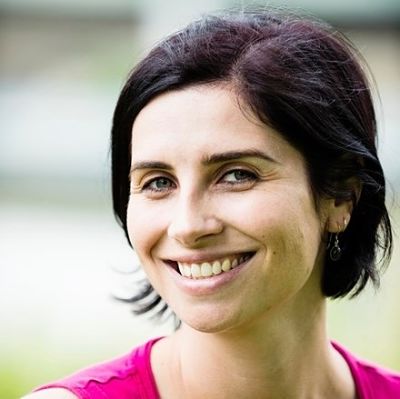
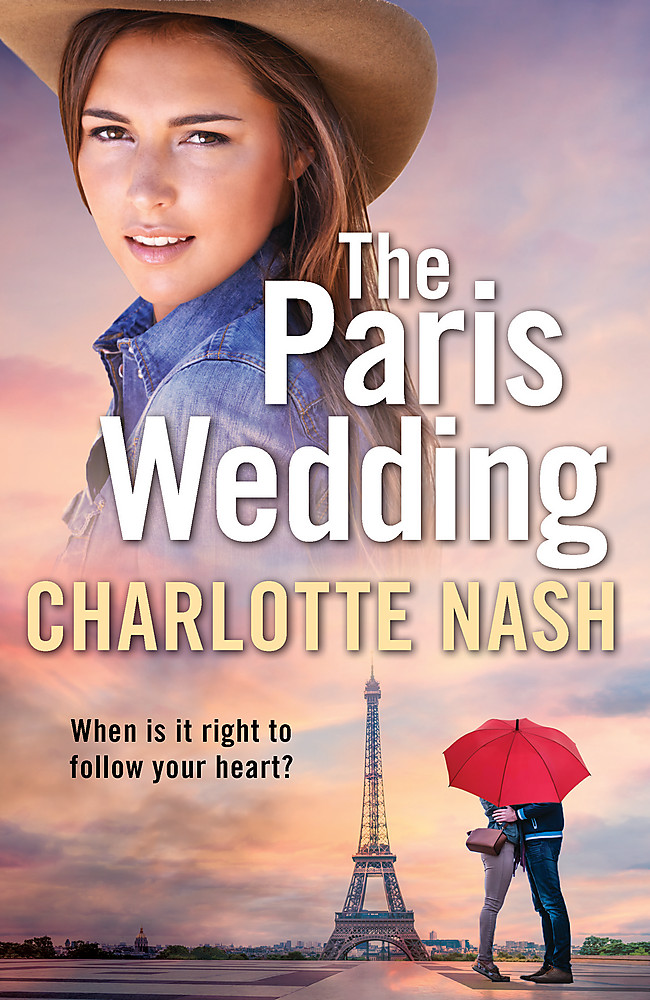
Spec-fic and romance writer CHARLOTTE NASH had careers in medicine and engineering before committing to her writing talents. Her latest novel, The Paris Wedding, follows Rachael, a woman who gave up the love of her life so she could remain on the family property to care for her sick mother. A decade later, she’s invited to the wedding of her old love and his fiance – in Paris. Here Charlotte tells us about her awful introduction to the City of Light and the strangest worlds she’s ever created as a speculative fiction writer.
The Paris Wedding begins in rural NSW then shifts to Paris. What about the city of light and love beguiled you enough to use it as a setting?
It actually wasn’t ‘love at first sight’. I first went to Paris as a backpacker in my early twenties. It was dead of winter – cold, dark, wet, and I was sick with flu. I had a tiny Lonely Planet map and a long layover, and I couldn’t even find Notre Dame! I didn’t have fond memories. But over the years, everyone I met LOVED Paris. And then I eventually saw Midnight in Paris (writers + time travel + delightful characters) and I began to think, you know, I should try it again. When I first had the idea for my story, I used Paris as the icon of love: representing how far the protagonist’s ex had moved on. But to write her character, I needed to go and experience Paris again, to see what she would see. This time, it was Spring, and beautiful, and Notre Dame was not only found but an unexpectedly moving experience. I travelled with my husband and our one-year-old, and being there with the people I loved made it wonderful. Paris amplifies, I think, and I understood the icon status. I hope that new found fondness translates into the main character in the book (I saved my old cynicism for a different character!).
Many of your novels, including The Paris Wedding, depict the day-to-day struggles that exist within small rural communities. What is it about this lifestyle that you find so appealing to write about?
Rural settings evoke a primalness that the city, with its comforts, can’t match. The elements, the tight social circles, our fragilities and flaws (but also our toughness), the thinness of our veil of control – those things are all front and centre. I also love writing characteristic landscapes that have a personality all of their own. It’s not that cities don’t have unique personalities, but a rural community concentrates the struggles we all have, and then adds some. For pure storytelling reasons, they’re also fantastic places to drop characters out of their comfort zone.
In your other life, you write speculative fiction; what’s the strangest world or story you’ve ever created?
I’ve written a story where fairy-tale creatures were an invasive species (‘The Edge’). And one set in a chilly future New York where a steam demon controls the heat, and its minions are very nasty clockwork rats (“Alchemy and Ice”). But I’d probably give the award to a story where a mysterious woman turns out to be a Greek goddess made cyborg by Hephaestus, the smith god (“The Ghost of Hephaestus”). There’s an evil Lord Kelvin (is there any other kind?), a phoenix, and seeing the past through the ether. That one was certainly strange.
Can you tell us about the main character in The Paris Wedding, Rachael? Do you think readers will relate to her?
Rachael really embodies self-sacrifice – she’s given up ten years of her young life to care for her sick mother, and lost her love in the process (because he, Matthew, moves away to university in Sydney). Not all of us have the experience of such a grand gesture for those we love, but I think many of us are familiar with unrequited love. And when the story opens, that’s where Rachael is – still in love with Matthew, even though he’s long gone and marrying someone else. Rachael is also in an uncertain time – her old way of life has just ended with the death of her mother, and she doesn’t know what to do. I think many of us have felt that anxiety of not knowing what way to turn, sometimes for years, and many of us have experienced a loss that set us reeling. I hope those aspects will make Rachael relatable.
You have previously had careers in both engineering and medicine. How and why did you transition from these careers to being a novelist?
It was gradual, and at first, accidental. I did decide quite deliberately that I wanted to write, but I intended to be a technical writer to use my specialist knowledge in both those fields. However, when I went back to uni to upskill, I landed in a creative writing class. I had the epiphany that people actually wrote books professionally. That was ten years ago, and I’ve been writing ever since.
‘I’m looking at how our brains actually process a story so that a writer can best craft the story to work with our mental processes, rather than against them.’
At first, worked full-time in my former careers and wrote on the side. Then I stepped into technical writing, and wrote on the side. These days, I have a “portfolio career” based around writing that includes teaching. I may include tech writing again one day, but at the moment my son is too small and because contract jobs come up at reasonably short notice, the care logistics are impossible. As to having a career as a novelist … actually publishing a book took me over five years and at least four different manuscripts. It was a matter of sticking at it, learning, and repeating, and I was fortunate to have some amazing mentors to shine the light ahead.
Can you tell us what you’re working on as part of your PhD in Creative Writing?
I’m studying how brain science can help creative writers in their craft. My specific project is looking at the scientific information that you often find in science fiction, but the idea also applies to worldbuilding that you’d find in fantasy, or really any fictional work. In brief, scientific information can be particularly problematic because it’s often abstract, unfamiliar, or otherwise difficult to relate to. I’m looking at how our brains actually process a story so that a writer can best craft the story to work with our mental processes, rather than against them. The idea is to understand how those difficult parts of a story can be more engaging or immersive, and hopefully the techniques could apply to science writing and education, too.

Which books and writers have most influenced your writing?
In my romantic fiction, Jilly Cooper was always a favourite of mine, and I always have her descriptions in my mind when I’m writing characters and places. I often re-listen to Liane Moriarty and Georgette Heyer audiobooks when I’m editing because I love how crisp and precise their observations are. I’ll also mention my writing buddy, Rebekah Turner, because I love her wry wit and imagination. All those styles are vastly different from each other, but they all speak to me and are in my mind. I will also credit Diana Gabaldon and J R Ward, whose books I enjoyed so much I wanted to write a book of my own.
On the spec-fic side, Michael Crichton was hugely influential in me being a reader at all, let alone writing. Later in life, I discovered Neal Stephenson and have experimented with a much more bombastic style, because his work showed me you could do that. I also remain in utter awe of Ted Chiang who writes such beautifully crafted stories.
0 Comments