



One Medicine is the concept whereby human and animal healthcare advances hand in hand with vets, doctors and researchers collaborating to ensure that all humans and animals benefit from equal and sustainable medical progress, but not at the expense of an animal’s life.
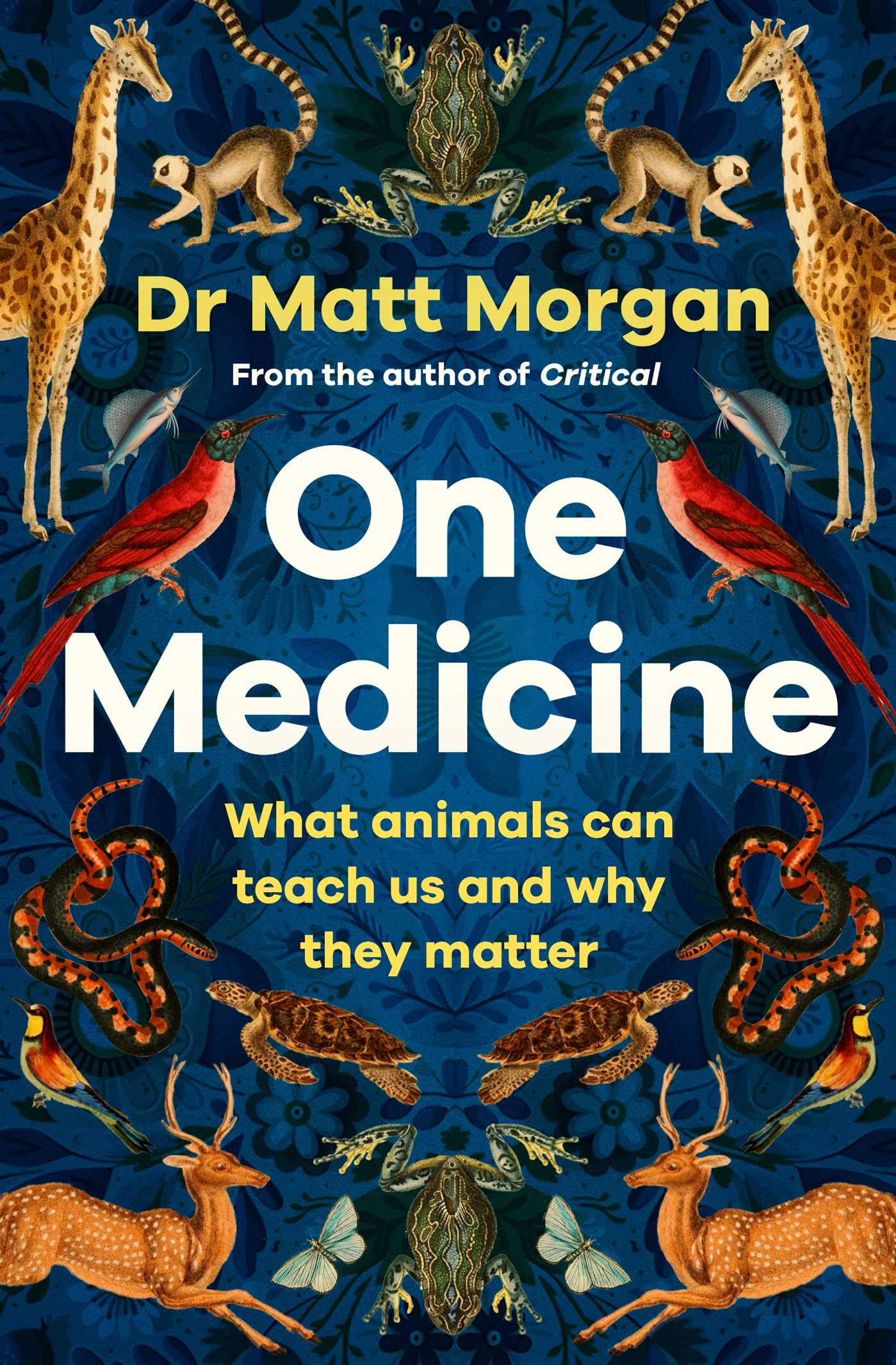
In DR MATT MORGAN’s new book, One Medicine, he investigates how animal science can teach us about human medicine. He tells us about his inspiration for a journey that spanned continents, species and millennia.
It all started when Barry choked on a Hobnob. He suffered a cardiac arrest after the oat biscuit went into his lungs instead of his stomach and ended up in my intensive care unit. I nearly came to a similar fate that same morning. It was a rare hot Welsh summer day and I had inhaled countless flies during my bike ride along the river to work. Had I ridden into a bee, I too may have been battling for my life.
As we tried to save Barry’s life, a flock of birds flew past the hospital window next to his bed. Why don’t those birds die? I thought. Although not known for their love of biscuits, birds continually inhale things that could block their lungs as they fly forwards. How do they survive? I wondered. And so, my obsession with what animals can teach us about human medicine was born – from a simple Hobnob.
Barry survived and so did my enthusiasm for the subject.
Then the questions really started. Every day in intensive care, I meet people at the brink of life. When I try to understand their disease and think of treatments, I now see animals. How does a giraffe breathe and can it help us treat asthma? Why do kangaroos have three vaginas and can it help couples having IVF? Why do koalas eat shit and should I feed it to my own children? How can an ant help stop the pandemic? Is this strange? Yes, I suppose so. But using solutions nature invented millions of years ago to solve 21st-century problems shouldn’t be that strange.
And so began my quest. Along the way, I would uncover an age-old relationship between humans and animals. It would take me to places far away and places under my nose that I never knew existed. My journey would be rudely interrupted by a viral pandemic that would underline how human and animal medicine can, and must, be brought closer together. Made one. One Medicine.
Where better to start this journey than with the original fusion between human and animal – the work of Charles Darwin. His pioneering journey on HMS Beagle rocked the worlds of medicine, of science and of life itself. With my tickets booked, my bags packed and my fear of open water pushed to the back of my mind, I was ready to travel to the Galápagos Islands to meet 200-year-old turtles that could teach us about ageing and sea iguanas that help save drowning children. It was March 2020 and with my passport in my bag and hope in my pocket, it was time to go. And then … I should have been thousands of miles away in the Galápagos Islands, mirroring the footsteps of Darwin in the Ecuadorian sunshine. Instead, I was underground, in a bible-black Welsh cave, with a man called George.
George did have a beard as strong as Darwin’s, though, and was able to look into the distant past just like him.
The rude arrival of COVID-19 just a week before my trip stole day-to-day life from millions, including me. Over the next two years, the pandemic would bring darkness to my colleagues in the intensive care unit working at the coalface of medicine. Our faces would become coated in the dust of death.
With my travel plans cancelled and my diary filled with extra night shifts, I swapped my plane tickets for a crawl into an underground cave just a few miles from my childhood home in South Wales. In reflected torchlight, my feet touched the ground exactly where another human had stood 20,000 years before. Our distant cousin had reached out their hand clutching a piece of flint and scraped on to the wall in front of me something important to them.
Something they wanted to tell the world. Something that mattered. A picture of an animal.
And now 20000 years later, in the midst of a viral pandemic brought about by the twisted relationship between humans and animals, I stood in that same place, staring at that same sketch – a beautiful reindeer with giant antlers, scraped into the rock deep inside the rugged Welsh coastline. It was some of the oldest cave art in the world, discovered by my archaeologist guide, Dr George Nash. He told me how the artist, likely a child using their right hand, had a deep understanding of the non-human animals they lived alongside.
Twelve hours later, I stood in one of the world’s most advanced places in healthcare. And although I was no longer underground using a torch, I still used the deep understanding passed on from non-human animals to help save the lives of humans.
While the Galápagos Islands remained out of reach, I could visit Charles Darwin’s English countryside home. Driving through the unusually warm British summer, I passed tiny villages with comedy names like Pratt’s Bottom, before arriving at a grand, ivy-covered house. Darwin spent 40 years living here with his wife and 10 children, writing books that changed the world.
Inside the house, a small wooden cupboard under the staircase was filled not with boy wizards but tennis rackets.
Above hung the only drawing from his 1859 book, On the Origin of Species: a branching tree, sketched in ink, tracing our distant family tree. Two simple words annotated the sketch – ‘I think’. On the wall opposite was a map of the Galápagos Islands.
Walking through the manicured gardens, surrounded by beech, walnut and cherry trees, I found Darwin’s ‘thinking path’. This quarter of a mile track is where he would stroll and think and discover. It is where his books were written on the paper inside his head. It is also where Darwin developed angina before dying in his bedroom overlooking a mulberry tree. Listening to the birds, bees and aeroplanes as I walked, I saw horses and cows and a cricket match being played. It was an idyllic walk aside from the intrusive thoughts of Barry choking on a biscuit, the giraffe’s neck and kangaroos’ vaginas.
Although On the Origin of Species remains Darwin’s most famous work thanks to it revolutionising our understanding of life, his second book, The Descent of Man, transformed the world once again in 1871. Darwin demonstrated that the difference between humans and animals is not one of kind, but only degree. In it he said: ‘The love of all living creatures is the most notable attribute of man.’ Yet, our relationship with animals seems broken. The most time we spend with animals is when they are on our plate. We eat them and experiment on them. We keep them in conditions that destroys not only their wellbeing but human health and the environment. We blame them for pandemics and kill them for medicines that do not work.
But what if our relationship is merely cracked and not yet broken? What if individual humans are the problem and not humanity? And what if, by repairing our bonds, our shared lives can become better entwined, more beautiful and more noble?
This book hopes to fill these cracks with gold. To make the whole more beautiful. Each chapter will focus on creatures that live on The Land, The Air or The Sea. Then we will step below to The Underland, looking at death and everlasting life. Could listening to animals help us manage loss or even live for ever? Could it change the world for the better?
As another Welsh writer once said: ‘We shall begin at the beginning.’ Spinning the world on its axis, we will now first dive down under from the English countryside to Australia.
Here we will see how the kangaroo’s three vaginas can help us better understand the beginnings of human life. Join me on a journey to understand the lives and bodies of non-human animals. I want you to meet the patients I treat, tiptoeing along the shoreline between life and death.
I want to share the science, the stories and the ethics of how we can save the lives of humans through understanding the lives of animals.
ABOUT THE AUTHOR
Dr Matt Morgan is an intensive care doctor, researcher and author. His open letter addressed to patients during the COVID pandemic has been read by over half a million people worldwide and viewed over three million times after featuring on Channel 4.
His first book Critical has been translated into six languages and featured in The Times. He has spoken to large audiences at some of the largest book festivals in the world including Hay and Ubud.
As a regular writer for the internationally acclaimed British Medical Journal, his article ‘A letter from the ICU’ is one of their most popular ever opinion articles, read by over 130,000 people. Since narrating the highly rated audiobook of Critical, he has spoken on several popular podcasts and radio programmes including The Today Program on BBC Radio 4 and international talk shows.
He has appeared on several television programs including Sky News, CNN, ITV, The BBC, The Jeremy Vine Show and international channels. He was nominated for the 2020 Royal Society David Attenborough Prize for public engagement in science. He currently lives between Perth, Australia and Cardiff with his family.


0 Comments