


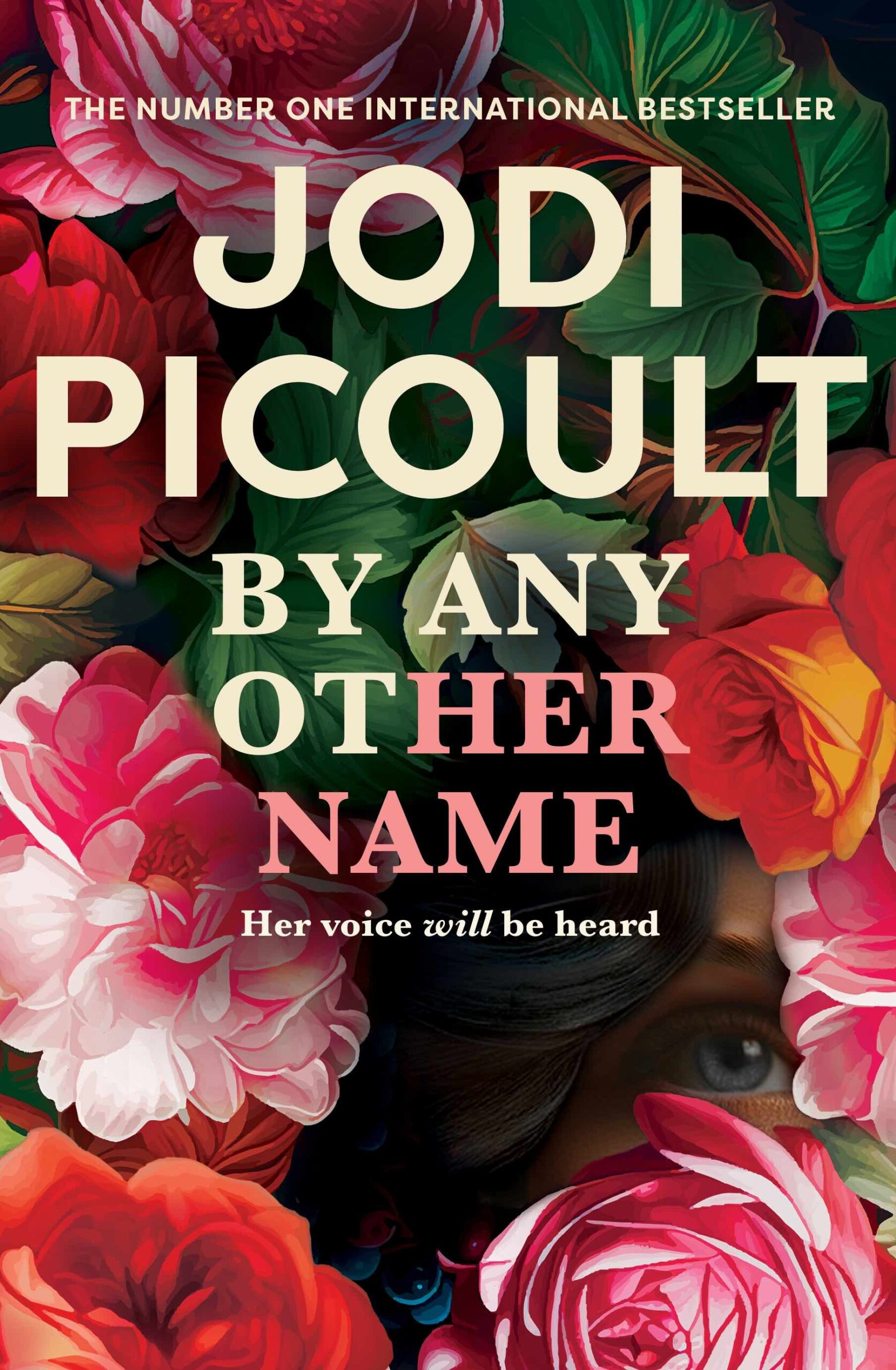
In Jodi Picoult’s latest book, By Any Other Name, we meet two women, centuries apart, one of whom is the real author of Shakespeare’s plays. Both are both forced to hide behind another name to make their voices heard.
ABOUT THE BOOK
In 1581, Emilia Bassano-like most young women of her day-is allowed no voice of her own. But as the Lord Chamberlain’s mistress, she has access to all theatre in England, and finds a way to bring her work to the stage secretly. And yet, creating some of the world’s greatest dramatic masterpieces comes at great cost: by paying a man for the use of his name, she will write her own out of history.
In the present, playwright Melina Green has just written a new work inspired by the life of her Elizabethan ancestor Emilia Bassano. Although the challenges are different four hundred years later, the playing field is still not level for women in theatre. Would Melina-like Emilia-be willing to forfeit her credit as author, just for a chance to see her work performed?
Told in intertwining narratives, this sweeping tale of ambition, courage, and desire asks what price each woman is willing to pay to see their work live on-even if it means they will be forgotten.
MELINA
July 2023
In addition to still being Melina’s best friend and roommate in Washington Heights, Andre remained her critique partner. For two years after the Jasper Tolle fiasco, she had not written anything but a grocery list. For another year after that, she had tried her hand (unsuccessfully) at poetry and had attempted a TV pilot. When she finally allowed herself to start a new play, it felt like a dam had burst. Nature, always, would win out.
She had written a handful of mediocre plays since then, and had shown them to Andre, who was working at a casting agency doing zero playwriting of his own. After college, he’d been too cowed by the lack of opportunities for Black playwrights in the ‘real world’ – so he’d convinced himself the best way into the business was by making connections through his current job. When Andre gave feedback to her, he was gentle in his comments, but he said that her writing felt both beautiful and too careful. ‘It’s like really good AI,’ he said. ‘Super polished, but without a beating heart.’ He wasn’t wrong – but that was by intent. The only personal thing she wrote, rewrote, and finessed – for years now – she had never showed to anyone.
Until Andre discovered her secret. He had burst into her bedroom one morning a few years ago, cradling her laptop, and had plopped down on the mattress. ‘Um, hello?’ he said. ‘By Any Other Name?’
The title of her play was a nod to Romeo and Juliet, to Juliet’s assertion that a label mattered less than the content. Even in her sleep-haze, Melina had snatched the laptop away from him. ‘What are you doing with my computer?’
‘Making an appointment to get a pedicure, because my phone’s dead,’ Andre said. ‘Number one, your passcode should never be your birthday. Number two, what are you doing writing a play this good and not letting me read it?’
‘I’m not done yet,’ Melina said, and then in a smaller voice: ‘You like it?’
The play was about her ancestor Emilia Bassano. In the years since her father had made her aware of the poet, she had become an armchair expert on Emilia, and the more she had learned, the more Melina became determined to give her a voice.
She couldn’t quite bring herself to complete it, though.
Because this story, Emilia’s story, was the story of Melina’s heart – the one she kept coming back to, the one she felt maybe she was destined to tell. Completing it meant a reckoning of sorts: what if, after all this time and passion, it wasn’t any good?
On the other hand, if Melina didn’t finish it, she’d never have to face that possibility.
Andre had shaken his head. ‘This is the one,’ he predicted.
Melina had rolled her eyes. ‘Let me just text my agent,’ she joked. ‘Oh right. I don’t have one.’
Thus began Andre’s campaign to get Melina to stop hiding her light, or play, under a bushel. He pestered her about submitting samples to emerging writers’ groups. He left flyers for play competitions and fringe festival submissions taped to the bathroom mirror. Sometimes, just to get him off her back, she would send off one of her plays – one whose success carried lower stakes.
Because the deeper Melina had dug while researching her ancestor, the more certain she had become that Emilia Bassano was not only the first published female poet in England and might very well have been a playwright, too.
The playwright, actually. The most famous one in history.
During a Shakespeare course in college, Melina’s professor had spent 15 minutes glossing over the fact that some scholars felt the man from Stratford might not have written his plays. He’d then sniffed and said it was elitist to think that just because Shakespeare wasn’t formally educated or rich he couldn’t be brilliant.
Melina’s first instinct was a knee-jerk response: of course Shakespeare had written his own plays. He was the Bard, the greatest playwright of all time.
She got an A in the course and promptly forgot about this controversy.
After Melina graduated, when she found herself too paralysed to write, she took temp jobs to survive. In between gigs, she would go to the New York Public Library’s Manuscripts and Archives room, which was free and air-conditioned in the summer and heated in the winter. It was there she started diving into the life of her ancestor – quickly coming to realise that Emilia Bassano deserved to be more than a footnote in someone else’s history.
Very few people had ever heard of Emilia, but if they had, it was because she was a potential answer to the mystery of the identity of the Dark Lady of Shakespeare’s sonnets: the lover to whom some of the poems were addressed. Then one day Melina read a chapter in an academic tome that suggested Emilia might not be just the subject of the sonnets – but potentially the author.
Suddenly, Melina remembered her Shakespeare professor talking about people who questioned the authorship of the plays. She discovered that the first of the anti-Stratfordians (as this group was sometimes called) was a woman – Delia Bacon – and she was joined over time by esteemed authors, Supreme Court justices, and acclaimed actors, among others. Mostly, the alternative candidates they suggested were men who were Shakespeare’s contemporaries.
Mostly. Occasionally a woman’s name was mentioned as a candidate for the ‘real’ author. Mary Sidney, Countess of Pembroke, was cited. Queen Elizabeth herself. And Emilia Bassano.
Melina struck up a friendship with a reference librarian who forwarded her links to scholarly articles and found her books about the Bassano family. Melina learned that her ancestor came from a family of musicians who performed for the Queen. She was educated by a countess, receiving instruction that was extremely rare for a young girl – especially one who was not noble. At age 13, Emilia became mistress to the Lord Chamberlain, the man who controlled all theatre in London. Later in her life, she was the first woman in England to publish a book of poetry.
So, yes. She had a more classical education than Shakespeare did – it wasn’t even known if he’d attended grammar school. Emilia had been born into a creative, musical family. She had access to and awareness of any dramatic productions that were launched through Lord Hunsdon, the Lord Chamberlain, who was responsible for vetting all theatre performed in Elizabethan England. She was an established poet at a time when no women were being published. But none of that yet proved anything.
Three years after arriving in New York City, Melina got a job as an usher at an Off-Broadway house where Hamlet was running. As she watched the show night after night, she wondered how Shakespeare had known so much about Denmark. She asked her reference librarian friend and a few days later got her answer: unclear, because there was no record that Shakespeare had left England, much less visited the Danish court.
Melina became an amateur sleuth. She learned that when Emilia was 12, the countess who’d been educating her got married. There was a short gap of time unaccounted for, before Emilia became the Lord Chamberlain’s mistress, when she was in limbo, living at the home of the Countess’s brother, a baron named Peregrine Bertie.
That baron was the ambassador to Denmark.
During a diplomatic mission he’d taken during that gap of time when Emilia was in his care, he’d met the monarchs of Denmark; he’d stayed at the castle that was the model for the one in Hamlet, and he had dined with two men named Rosencrantz and Guildenstern – characters in that play.
Shakespeare did not move in the same social circle as the Baron; it would have been highly unlikely they knew each other. On the other hand, Emilia had lived with him. She would have heard his stories of the Danish court, or – since she was a child under his protection at the time – she might have travelled to Denmark with him.
That night when Melina watched Hamlet rage and Ophelia go mad, she saw the play in a new light.
What she knew: Shakespeare was an actor, a theatre shareholder, and a businessman. There were plenty of documents to prove it. But there weren’t any documents that proved he was the writer of the plays.
What she knew: Women were not allowed to write for the stage. At the very least, playwriting could lead to scandal and ostracism for a woman’s entire family. At the worst, it could land her in jail.
What she also knew: When it came to history, absence of evidence was not evidence of absence. Just the fact that Emilia Bassano hadn’t been published under her own name until 1611 did not mean she wasn’t writing before that … as someone else.
It had been almost three years since Jasper Tolle had destroyed Melina’s self-esteem, three years since she had written a play . . . but that night, after she finished her ushering job, she took the subway home, opened her laptop, and typed: Act I Scene I: A manicured garden in Westminster.
She wrote: Emilia sits on a carved bench beneath the embrace of a lush emerald willow.

0 Comments