


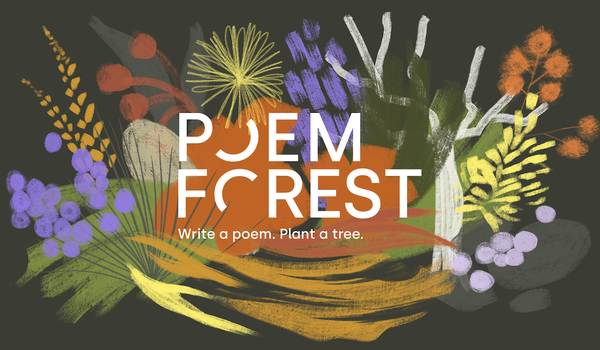
Poem Forest have announced the winning poems of the 2024 POEM FOREST prize. Selected from over 5,400 nature poems written by students and teachers across the continent, these 17 winning and highly commended works burst with creativity and care, from the finest detail in the present to imaginings of deep time.
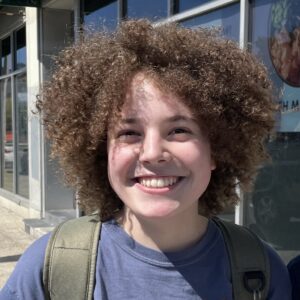
Good Reading caught up with the upper secondary winner, Rowan, about their poem ‘Remembering Birds’.
What inspired your foray into writing poetry?
 About four years ago I read a very, very beautiful story by a friend of mine. The story immediately crawled into my brain (where it still enjoys permanent residence). I have always read a lot but never connected with something on so many levels before. I needed a way to express how deeply the story resonated with me, and drawing or painting just couldn’t cut it. The story was shared among a fairly small circle, so I didn’t feel too strange about showing the resulting poems to my friend/the author. He was delighted! He read them very closely, told me his favourite lines, and generally instilled in me the confidence that I needed to keep writing.
How did you become involved with Red Room Poetry?
My English teacher in Year 8 introduced Poem Forest to the class and encouraged us all to submit something, which is where my previous poem ‘Paperbark’ came from. Thanks, Ms Kitching!
What sparked the idea behind your poem ‘Remembering Birds’?
I’ve been getting into birdwatching of late (as anyone who has spent more than five minutes in conversation with me will be able to confirm). At the end of a particular jaunt around my favourite park, I sat down by the big pond – because, just like any body of water, it’s a terrific place to birdwatch – and drafted ‘Remembering Birds’ in one sitting based on the day’s wandering and the musings provoked by being out in nature. All the birds named are ones I saw throughout the day. The jingling dog might have been a Labrador. It also might have (as many things indeed are) not been a Labrador. I don’t precisely recall.
Can you tell us a bit about your poem and its significance?
I tend to be restless and absent-minded, but watching birds briefly grants me superhuman stillness and focus. Grounded by the unmarked passage of time – ducks et al don’t have clocks, they simply meander at whatever pace they feel is right, and in watching them I must slow to match them – I can be truly present. ‘Remembering Birds’ uses the frame of that bird-fuelled focus to explore how that heightened attention lends itself, paradoxically, to deeper thought: about the land and where I stand upon it; about my people’s history and the persistent thread of placelessness; about this Country’s history, how it has shaped me, and how it feels like a part of me.
How does it feel to have won in the Upper Secondary category this year?
It feels excellent! I am going to be insufferable for a while. (More so than usual, even.) It is wonderful to be appreciated for any sort of art, but poetry feels much more subjective than painting or playing an instrument: there is no clear harmony of colour or correct tuning of pitch, just me and the words. I am very glad that the words resonate.
What are some things that influence or inform your writing?
Definitely not birds, I’ve never thought about birds. Not even once. I don’t even know what a ‘bird’ is, and am certainly not inspired by them in all avenues of creative expression. In all seriousness, though: all sorts of living things – including, but not limited to, birds. The ways creatures interact with each other and the world. Being trans, specifically nonbinary, and how that has necessitated an unpicking of truths I thought to be immovable, how liberating that is, and how every subsequent realignment of preconceptions feels easier. My dear and wonderful friend Al, who has the gall to live on the other side of the world, and how we make it work regardless. The all-encompassing reach of chronic pain in my life. The invisible threads of familiarity that run between me and others like me, whatever hat I’m wearing: birder, artist, musician, Jew, queer person, nerd, human. Folklore and mythology, especially Nordic and Celtic. I am incurably wordy, but I do try to reduce a thing to its bare essentials while still keeping it beautiful. I also think about Spock a lot, but that is incidental, and influences my ability to hold a conversation more than my writing.
Who are some of your favourite poets or writers?
Mary Oliver’s nature-inspired poetry is achingly beautiful. Leonard Nimoy only wrote a handful of poems, but that is all he needed to write: they are tender, direct, and betray an abiding love for humanity. Terry Pratchett and P.G. Wodehouse were masters of punchy, efficient prose and storytelling that still manages to hide jokes on every re-read; I strive for their economy of language. The lyrics (and singing and guitar-playing, but that is another matter) of Hozier are delightful: every word has a purpose (sometimes even two), and the product is both clear and beautiful. Certain random scraps live in my brain, also – non-exhaustively: Charles Bukowski’s ‘Bluebird’, Brooke Bolander’s ‘The Only Harmless Great Thing’, Diane Duane’s ‘The Wounded Sky’, the greater part of Billy Joel’s discography.
In what ways does writing help you make sense of the world?
Writing is a lens through which to observe myself. It is neutral ground where I can slow down, lower my guard, and examine what makes me tick. I can join cause with effect. I can lend conscious thought to otherwise subconscious actions and reactions. The final product, the poem, serves as both diary entry and atlas: the process of self-expression requires and allows me to better understand myself, while the conversion of my fleeting, indistinct thoughts into a string of words lets me file away that understanding for later reference. It is much easier to remember something I have committed to paper, digital or otherwise.
As for making the wider world: in learning enough about birds to write about them, I’ve learned more about the land itself. I am able to better appreciate the infinitely complex rhythms and interactions and cycles that shape it. I am able to see how knowing a place in all its intricacies is like knowing myself. My underlying goal to ‘say something true and beautiful’ helps me to notice beautiful things and how they exist alongside – be it because of, or in spite of – non-beautiful things.
ABOUT POEM FOREST
POEM FOREST is a free nature writing prize that breathes life back into the natural world that sustains us.
Created by Red Room Poetry, in partnership with Wollongong City Council, POEM FOREST invites students and teachers to use their words to make positive climate action. For every nature poem received a tree is planted to help heal habitats and create a POEM FOREST for future generations. Since 2021, over 17,100 poem trees have been planted.
All POEM FOREST Prize entries are published in our digital library and have the chance to win $5,000 in prizes, including $500 cash (for each category), book packs, garden tours, plants, journals and more.
Check out the 2024 winners here.
Entries will re-open in April 2025.
0 Comments