




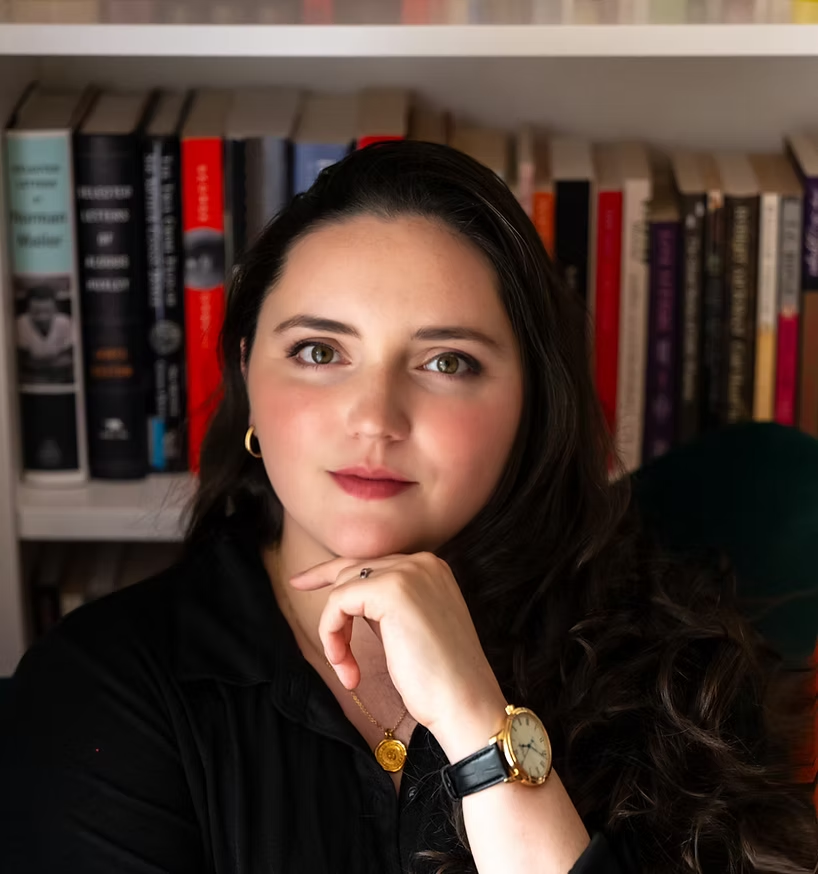
HAYLEY GELFUSO is a Chicago-based author.
Her debut novel, The Book of Lost Hours, is a blend between speculative and historical fiction and is about the power of memory, time and history.
AKINA HANSEN writes.
Finding a universally accepted definition of time is not nearly as easy as it sounds. In fact, many of the greatest scientific and philosophical minds have failed to see eye to eye. But I think what we can agree on is that memory is linked to our perception of time – particularly our ability to recall and reconstruct past events.
The Book of Lost Hours by Hayley Gelfuso delves into the interrelated nature of history and memory – especially collective memory – and emphasises the importance of preserving history.
‘I drew inspiration from the medieval books of hours, which are meticulously crafted devotional texts kept by monks that gave the novel its title. Many of these were later censored, rewritten, or repurposed by popes, monarchs and political powers to suit changing ideologies. I found that both chilling and fascinating,’ Hayley tells me.
 At the heart of The Book of Lost Hours is the time space, a library-like dimension that stores memories of the dead in books. This specific concept came to Hayley while reading The Libray: A fragile history.
‘I came across a line referencing an inscription from a library in Amsterdam. It ended with the haunting phrase: “Here it is the dead who speak to those who work.” Instantly, an image formed in my mind. A library where the dead could convene with the living and where memory itself had a voice.
‘Once I had the core concept, the rest of the world began to take shape through a blend of fantasy and real science. I was particularly inspired by spacetime theory, which frames time not as a linear path but as a dimension woven into the fabric of the universe. One temporal plane alongside three spatial ones. I became fascinated with the idea of the temporal dimension as a physical space. Not just something we move through, but somewhere we might actually go.’
This temporal dimension forms the crux of this story. Beginning in Nuremberg in 1938 where we meet 11-year-old Lisavet. We discover that her clockmaker father, Ezekiel, has the ability to travel through the folds of time. When the Gestapo arrive at their door, Ezkiel saves Lisavet from the Nazis by pushing her through a magical door that takes her to the time space. He promises to return with her brother, but he doesn’t. In turn, Lisavet becomes trapped, growing up among the stories of old memories and ghosts.
‘I’ve always been drawn to the intersection of historical and speculative fiction because together, they allow you to explore not just what happened, but what it meant. History gives us the gift of hindsight. We can look back and see how small shifts led to sweeping consequences, and how certain ideas took root. That perspective allows us to pull forward those ideas, those warnings, and re-examine them in the light of our own time.
‘In The Book of Lost Hours, the time space isn’t just a magical concept, it’s a way to ask what it would mean if memory could be preserved, erased, or manipulated at will. Blending genres lets me explore truth through both what was and what might be. History roots the story. Speculation gives it wings.’
These questions especially come to the forefront when Lisavet begins to observe people called Timekeepers entering the time space and destroying memories. She becomes determined to save them, preserving the remains of burned pages into her own book.
‘At their core, Timekeepers were meant to be stewards of memory, once tasked with preserving memories inside books, safeguarding the past for future generations. But as access to the time space shifted into government control, the role of the Timekeeper became increasingly distorted. What began as an act of preservation turned into a tool for erasure. Timekeepers, once archivists, now burn memories deemed “inconvenient”, revise histories to suit dominant narratives, and silence truths that challenge the sanctioned version of events.’
Notably, these themes of revisionism and erasure have never felt more relevant. Across the US we’re seeing a rise in censorship and book bans. And if history teaches us anything, it’s that such events rarely occur in a vacuum.
Hayley has set The Book of Lost Hours across almost three decades, jumping between pre-World War II Germany to Cold War-era America.
‘I studied history in college, particularly the post-war era, and so a lot of the foundational background was already there. What I focused on predominantly was the cultural context of the time. What were people, reading, thinking, debating? How were people here in the US reacting to what was going on globally?’
It’s within this historical period that we’re able to see just how easily power becomes corrupted when you have the means to rewrite your own narrative. Timekeepers are selectively destroying memories to rewrite their country’s history.
Considering the big themes explored in this book, I ask Hayley what she hopes the book might stir in readers.
‘I hope this story sparks conversation about who gets to tell our stories, whose memories are preserved, and what’s at stake when truth becomes malleable. We live in an era increasingly shaped by misinformation and post-truth politics. In that context, the act of remembering, not just personally, but collectively and courageously, becomes radical. I hope that The Book of Lost Hours will make people ask what it means to hold onto the truth when others are trying to rewrite it, and whether memory itself can be a form of quiet rebellion.’
This book undoubtedly poses some big and thoughtful questions about the power and fragility of memory. But it’s also a story about love. When Lisavet meets an American timekeeper called Ernest Duquesne in 1938, romance blossoms between them and the course of her life is altered. •
**********

ABOUT THE AUTHOR
Hayley Gelfuso is the author of The Book of Lost Hours. She is an author and poet who works in the environmental nonprofit sector. As a writer, she is drawn to stories of the wild and wonderful that are rooted in real world history and science.
Her poetry about her experiences working in the conservation field has been published in the Plumwood Mountain Journal.
She lives in the Chicago suburbs with her husband.
Visit Hayley Gelfuso’s website


0 Comments