




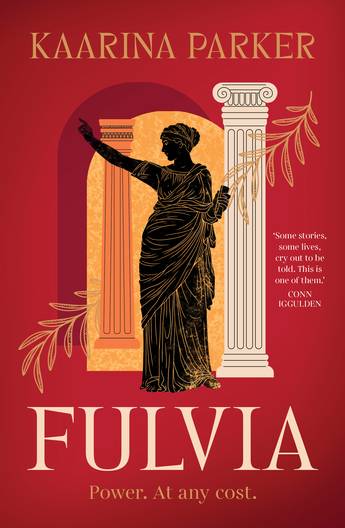
In the dying days of the Roman republic, a remarkable woman steps out of the shadows and beyond the boundaries imposed on her sex, driven by an unstoppable ambition.
Kaarina Parker’s debut novel, told in the compelling voice of this brilliant woman from history, brings Fulvia and the society in which she lived vividly to life.
Read on for an extract …
 ABOUT THE BOOK
In my life I walked among titans, emperors, generals – men whose feuds and desires shaped the landscape of Rome … Some were my friends, some of them I loved, others loathed me, and others still grew to fear me.’
Born into a wealthy but unimportant family, Fulvia is raised in the peace of the Etruscan countryside but longs for a life of excitement and influence. When her father dies and her inheritance is threatened, she makes her way to the city of Rome to secure her future.
Motivated by both passion and opportunism, Fulvia marries Clodius, a hedonistic young senator. They are perfect partners – risk takers, scornful of convention and eager for change. Although Clodius is heir to a leading aristocratic family, he has spent his life criticising the rules of his class and championing the common people. As a wife and mother, Fulvia fulfils her role in a society that denies women any influence outside the home – but she is also a ruthless political strategist, intent on seeing her husband rise through the ranks of Rome’s governing body, the senate. And, through him, wielding her own authority.
But Rome is a dangerous place, and power can become notoriety overnight. Fulvia soon learns just how high the stakes really are, and that her ambitions may come at a terrible cost.
Born into a wealthy but unimportant family, Fulvia is raised in the peace of the Etruscan countryside but longs for a life of excitement and influence. When her father dies and her inheritance is threatened, she makes her way to the city of Rome to secure her future.
Motivated by both passion and opportunism, Fulvia marries Clodius, a hedonistic young senator. They are perfect partners – risk takers, scornful of convention and eager for change. Although Clodius is heir to a leading aristocratic family, he has spent his life criticising the rules of his class and championing the common people. As a wife and mother, Fulvia fulfils her role in a society that denies women any influence outside the home – but she is also a ruthless political strategist, intent on seeing her husband rise through the ranks of Rome’s governing body, the senate. And, through him, wielding her own authority.
But Rome is a dangerous place, and power can become notoriety overnight. Fulvia soon learns just how high the stakes really are, and that her ambitions may come at a terrible cost.
**********
PROLOGUE
My enemies have told my story. They were powerful and dangerous men capable of powerful and dangerous deeds. In my life I walked among titans, emperors, generals – men whose feuds and desires shaped the landscape of Rome, brought the republic to its knees, and birthed an empire that outlived us all. Some were my friends, some of them I loved, others loathed me, and others still grew to fear me. The few who survived me worked hard to ensure that the blame for their follies fell at my grave. Yet they all walk the decaying lands of Hades with me now, shades of the legacies we left behind.
What is my legacy? A daughter of the Sempronii Tuditani? The loyal wife of the demagogue Clodius, mother to Claudia and Claudius? The leader of the Aventine gangs, vengeful murderer of Milo? The calculating wife of Antonius, mother to Marcus and Iullus, scorned by the queen Cleopatra and vanquished by the emperor Augustus? I was all of these things and so much more. I was born Fulvia Flacca Bambula, though I had other names throughout my life. I was a daughter, a wife, a sister, a mother, a leader, a politician, a general.
I was a Roman. This is my story.
PART 1 ROME
CHAPTER 1
I was eighteen years old the first time I saw Rome’s towering walls. This was the city that sat as a beating heart at the centre of everything, where people from all over the known world were drawn in search of fortune, love, power – of a better life. In the summer of my eighteenth year, I was one of them.
My family were Roman, but my father took his inheritance and ran for the rolling green hills of Etruria in the north. He had neither the countenance nor the skill for politics. He married my mother, whose dowry could have bought the entire region, and they settled into a quiet and luxurious life on a farming estate outside of Pisa. It was beautiful, nestled between the deep blue ocean in the west and the snow-capped mountains to the north, surrounded by lush verdure all year round. They were happy there. I was not.
It was a desolate landscape for adolescence. I had three older brothers, none of whom survived infancy. The only time I saw other children was when we ventured into town or stayed with friends on the coast. Otherwise, I had only my tutor Gaipor for company. He had been a wedding gift to my father, a learned Greek raised in the household of the great general Marius with a command of languages that was second to none. He taught me philosophy, history, language and art. He was endlessly patient and endured my persistent questions about his life. Gaipor had grown up among some of the most powerful men in the republic, heard their darkest secrets, watched as they made deals that shaped the lives of thousands they could never know. His words wove a tapestry rich with reverent intrigue, capable of holding even my fickle attention. ‘Slaves see everything,’ he taught me. ‘We know secrets that could ruin lives, bring empires to their knees.’ It was wisdom I would come to appreciate many years later when it saved my life.
My father had his own knowledge to impart. He told me about our family, our history. For someone so deliberately removed from the machinations of politics, he spoke with awe about the successes of his ancestors. Our family, the Fulvii, were raised from the lower orders centuries ago, elevated by our immense wealth and powerful connections. We once counted consuls and generals in our ranks. But as the republic grew fat on the spoils of war, and the senatorial benches swelled, the Fulvii fell out of prominence and eventually out of favour altogether.
‘In Rome,’ my father always said, ‘status is all that matters. Money can be made, but true power must be inherited.’
When my father died, taken by a fever in the dead of winter, I inherited nothing. With no brothers, I was left with only a large dowry and the expectation that I would marry with expedience. It was the only path available to me if I was to secure my family’s fortune, otherwise my mother’s money would go to my father’s closest living male relative, a man I did not know and did not care to make rich.
At my father’s funeral, I watched his ashes float away on the mountain breeze and wondered who would remember him when I was gone. The pyre was barely cold when my mother was presented with the first proposal of marriage. He was one of my father’s friends, a man I’d known since I was a child. He lived on the coast in comfort moderate enough that my dowry was an enticing prospect. I read his letter and saw a life yawning out before me, raising children in decadent isolation, never having reason to speak any of the three other languages I knew, dying without having ever seen the places I’d read about. A life of utter insignificance. I threw the parchment in the fire and approached my mother with a counter-proposal.
‘I should go to Rome. No man in Etruria is worthy of our name.’
‘In Rome,’ my father always said, ‘status is all that matters. Money can be made, but true power must be inherited.’
‘There is nothing for you in the city, Fulvia.’ My mother looked tired, far older than she was, her olive skin washed pallid by the deep black of her mourning veil. ‘We must settle this matter quickly. Hortensius is a good prospect, young enough still to give you children. And he will allow me to remain here.’
‘No.’
‘Fulvia.’
‘Mother, please.’ I fell at her feet, reached my hands into her lap to grasp her own. I had never begged for anything, not even from the gods. But I would beg for this. ‘We could have so much more than this. Send me to Rome and I will show you. Let me give your grandchildren a future worth having.’
This, I knew, would sway her. Though my father had no ambitions of his own, I always believed that my mother had prayed for the prosperity of her sons. That they would go to Rome and rise to power, make her own ancestors proud. But none of them lived beyond their third year. With only a daughter to her name, she’d laid her dream to rest in the tomb that housed three small bodies beside the lake on our estate. I would not do the same. I watched my mother’s resolve crumble. By the time the sun rose on a new day, she had relented. My belongings were meticulously packed, my affairs settled and arrangements made for my travel. It was seven days by carriage to reach Rome along the via Aurelia. The morning that I departed I was loaded into our family’s finest carriage, and my mother kissed me goodbye with trembling lips. She stood at the gates of our estate and waved as I rode away until she was nothing more than a spot on the horizon.
**********
 Rome was a sensory overload. Its cobbled streets crawled with life, winding between brightly coloured buildings, rising and falling with each of the seven hills. The crowds were unlike any I had ever seen before, endless streams of raucous people all in a terrible rush to get somewhere. Silence was a rare commodity – the solicitous shouting of merchants from the shade of their shopfronts, the rhythmic chanting that drifted from temples and shrines, the lewd and boisterous barking of groups of men who loitered on street corners and leered at women who passed. I was overwhelmed and enthralled from the first moment. Years later, when I was pregnant with my eldest child, the smell of Rome would become the bane of my existence, overwhelming and sickening.
I had to remain indoors for months before I could stand it again. But at first, the smell was part of its charm. The medley of incense, dirt, perfume, oil and smoke promised adventure and intrigue that could only be found there. It was the centre of the world, seven hills cradled by the winding length of the river Tiber. The water was often murky, stirred by the passage of merchant ships that sailed in from Ostia and the Tyrrhenian Sea beyond. It caught the sun from noon till dusk, its glittering surface concealing the dark and dirty depths that churned below. I saw plenty of men end up in that water over the years. Most never emerged.
Mother had written ahead to her sister, my aunt Sempronia, asking her to watch over me in the city. I had met my aunt only once before when I was much younger, but she nonetheless agreed to take me in until the matter of my engagement was settled. Her home was near the summit of the Caelian hill, high above the dirt and effluvia of the city streets. It was small but luxuriously furnished.
Only a dozen rooms branched off from a central courtyard, each one just large enough to fit the sumptuous decor that filled every corner. I came to learn that it was one of the larger homes found within the city walls, but it was quite an adjustment from the sprawling grounds I’d grown up on. The surrounding area was filled with similarly appointed homes. It was clearly a wealthy district, but still the streets were more crowded than any I had seen. I yearned to explore them. But the moment I arrived I was swept into Sempronia’s heavily perfumed embrace.
‘Oh, look at you,’ she clucked, petting at my hair and dress. ‘You have grown into a beauty. With a face and dowry like yours, we will have you married before the Quinquatria.’
My aunt Sempronia was, like her home, compact but lavishly decorated. Her thin frame creaked beneath the weight of the gold-set jewels that sat heavy on her collarbone and wrapped around her hands and fingers. Such displays of riches were common among families like mine, whose wealth was confined to material goods. True patricians needn’t bother with such ostentation – their name spoke for them. Sempronia’s husband was one such man, from one of Rome’s oldest families. He had retired from a distinguished political career and spent his years travelling the North African provinces. Sempronia would be waiting for him whenever he returned home. Their two daughters bore his name and had both married into even more prestigious lines. Their son, Decimus, had a family of his own. And so, in the city, Sempronia lived alone in her abundance. I often worried during those months that I was an imposition upon her, but I think now that she was glad of the company. All our family’s gold could not provide companionship, and there is no greater burden than loneliness.
Living with my aunt was my first window into the life I could have. We rose with the sun and took the morning meal together in her gardens. We ate freshly baked bread with honey and dried fruits in the soft morning light, the air around us filled with bees and birdsong. Then, to temple. My aunt courted the favour of three gods above all others, dividing her worship between Juno Lucina, Minerva Medica and Fortuna, though her visits to their temples were motivated less by piety, I suspected, than a desire to be seen there.
Most mornings she would visit one of the three temples, trailed by two slaves who carried whatever was to be the day’s tribute. Sempronia spent more time each morning carefully selecting her attire than she did on any sacrifice. It did not take long to understand why. Fabrics and colours were a dialect all their own among nobles. The rules were many and varied.
‘There is a stark difference between red and crimson,’ she told me once. ‘Do not confuse the two. If I ever see you out in a red stola, you will be a stranger to me.’
Crimson, a rich cool red imported from the south, was a symbol of wealth. Warmer, paler shades of red were cheap and abundant. Pure white only for brides and priestesses. Deep green for festival days. Purple stitching was acceptable, but a purple garment was arrogance personified, positively sacrilegious if worn at the wrong occasion. Pale blue was only acceptable for silks, not linen. Indigo blue was popular among Sempronia’s peers until it was seen on the wife of a disgraced general, forcing it out of favour. As a child I learned Latin, Greek and several of the Italian dialects in my studies, but this language was one of the most difficult to master.
‘I will be amazed if he makes it out of Servilia’s bed long enough to pay any attention to his new bride.’
Sempronia spent most of her time at temple in conversation. Other women of her station or higher who had arrived at the temple to present their own tribute would gather in dark corners to trade gossip in hushed whispers. Many of these women would seek my aunt out almost as soon as she stepped over the threshold. It did not take long for me to understand how well connected she was. It was partly her immense fortune that courted such attentions, but she kept a second cache of wealth in the form of information. It was this that drew the ladies of Rome to her side like flies to a carcass. She had a penchant for gossip, dispensing salacious whispers with unbridled glee and in such quantities that Mercury himself might have taken notice.
‘Cornelia’s daughter is finally to be wed. I cannot imagine her relief.’
‘It is a match worth waiting for. Gaius Julius Caesar. Such promise he has.’
‘Pompeia needs a firm hand. Already her reputation is clouded. Julius will have to keep an eye on her.’
‘I will be amazed if he makes it out of Servilia’s bed long enough to pay any attention to his new bride.’
‘I can’t imagine what she has that tempts him so. She is old enough to be his mother and far too tall.’
‘Pompeia is no great beauty herself, though she has youth and fertility. Servilia can claim neither.’
While they whispered, eyes alight with girlish glee, their slaves slit the throats of animals over the altars of the gods whose favour they courted. Wine-dark blood splashed across slabs of white marble while my aunt and her friends vivisected the personal lives of their peers. I listened avidly, trying to remember each new name, and wondered. I didn’t know anyone they spoke of then, but as the months passed and I burrowed further into high society, the true value of their idle gossip became clearer. My father had taught me the value of gold and blood, coins and fertile daughters traded between men. But there was a third currency in Rome, a wealth possessed by those forbidden from claiming any other. It was traded among women and slaves, often worth more than the lives of those who passed it on. Gossip. Information. Knowledge. These were the weapons we armed ourselves with, kept sharp in whispered huddles in the corners of temples, private dining rooms and the perfumed steam of the bathhouse.

ABOUT THE AUTHOR
Kaarina Parker was born in Aotearoa, New Zealand. She has a BA (with Honours) from the University of Melbourne in history and feminist film theory and a Master of Creative Writing from Auckland University of Technology. She has a particular love for the extraordinary, largely uncredited, women of the late Roman Republic. Kaarina also has an established career as a fashion model, and is a voice for diversity in the fashion industry in Australia and New Zealand.
Fulvia is her first novel.


0 Comments