


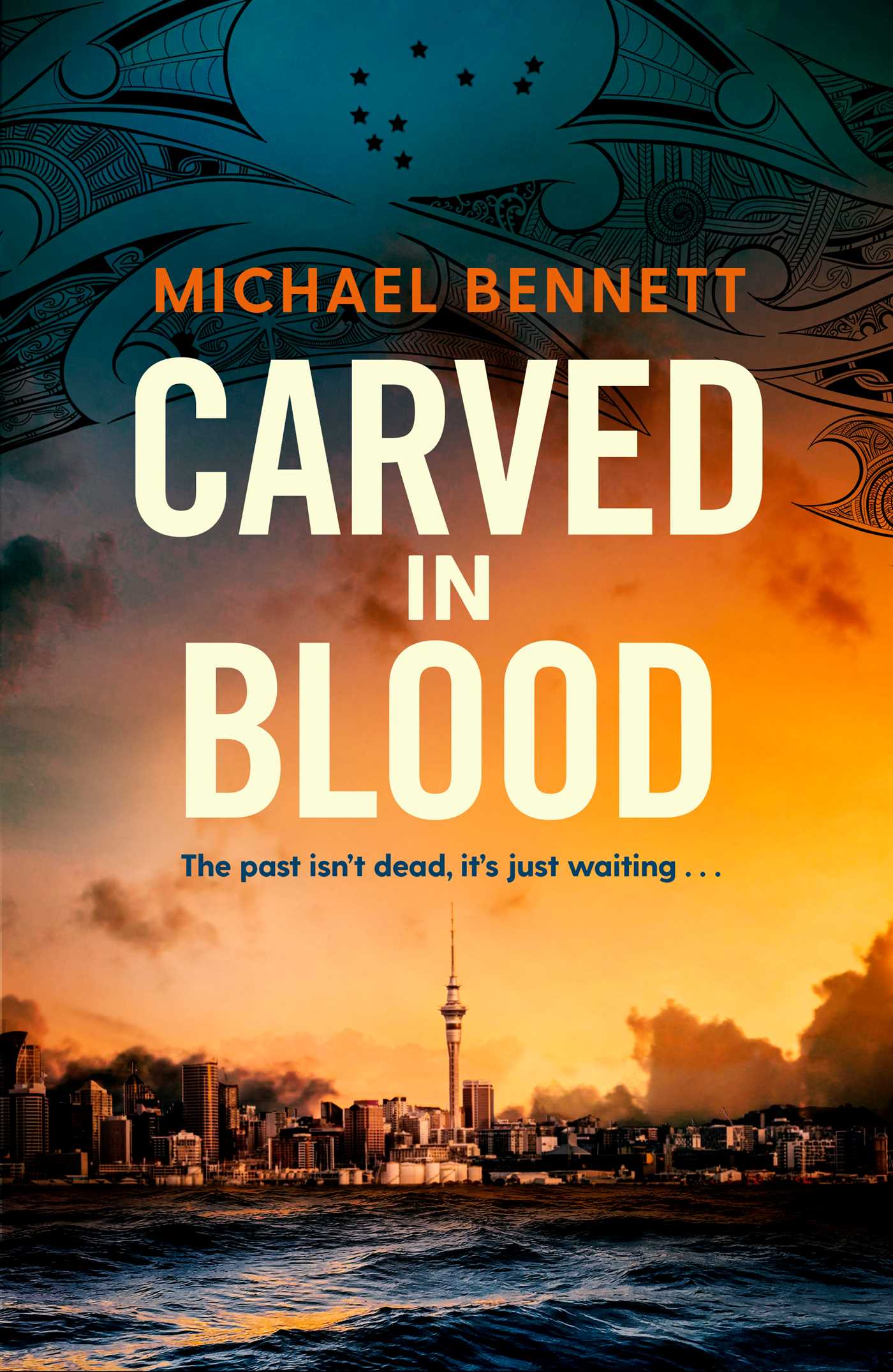
Tenacious Māori investigator Hana Westerman returns in a new thriller, Carved in Blood, from the award-winning author MICHAEL BENNETT
Read on for an extract …
ABOUT THE BOOK
It’s a chilly Auckland winter, but for Hana Westerman and her family, it is a time of excitement. Matariki is approaching – the small cluster of stars also known as the Seven Sisters is a sacred constellation in Māori culture, heralding a time of new beginnings. Hana’s daughter Addison is getting engaged and Hana’s new role within her community is going well. For once, life is good, peaceful.
But this Matariki brings unwelcome change. When Hana’s ex-husband Jaye, a high-flying Detective Inspector, is shot in what looks like a random hold-up, Hana offers her help to the senior police officer spearheading the investigation, DI Elisa Grey. With access to police intelligence, Hana makes a breakthrough that leads to a potential suspect with links to a Chinese organised-crime syndicate. But then Addison receives a phone call telling her that the police have the wrong man.
**********
1
YEE-HA
After Hana came face to face with one, she got a little obsessed with mako sharks.
It happened late summer, some months ago. She was out swimming, as part of her usual routine: a 13-km run before dawn, then into the ocean as the sun comes up over the black sand dunes of Tātā Bay. She was fifty metres offshore when she saw something flash past underneath her. She knew straight away it was a mako, with its distinctive short fins. Later, having spent far too much time googling the creature, she learned that they are very curious. This one sure was. It must have clocked her, just as she clocked it. It came back, circled her. Hana ducked underwater, eyes open in the stinging salt, deciding that if it was going to attack, she wanted to see it coming.
Turning with the shark, Hana stayed focused on the creature. Watching it, as it watched her.
The eyes. Cold. Emotionless.
She’d find out later that a mako, if it decides to attack, can almost instantly hit speeds of fifty miles an hour or more. Coming at you so fast, there’s not much you can do, even if you’re watching its every move. It was probably good she wasn’t aware of any of that at the time, she thought. The shark circled twice. Three times. Its eyes never leaving her. Then it left, disappearing into the shadows of the ocean.
Hana swam in to shore.
It’s six months later. Summer is long gone. June is the depths of the southern hemisphere winter, but Hana is still swimming every morning, unfazed by the chilly waters or the close encounter. This morning, walking up the sands as the sun rises, she looks at the nearby headland beyond the dunes. She finds herself lost in a very different memory – one from nineteen years earlier. Going down to this headland, at this same time of year, to watch the rising of the sacred stars. Matariki is the constellation that guided the waka* across the mapless oceans to New Zealand; metaphorically, the stars are the sacred celestial beings which help us chart our own lives down here on earth. When Matariki rises, it is a time for remembering the dead; a time for saying goodbye. And it is also a time for starting anew.
Hana’s daughter Addison is a Matariki baby, born near the end of June. When Addison was just a few days old, Hana brought her down from Auckland to Tātā Bay to meet her grandparents, Hana’s mum and dad. Eru and Jos wrapped their granddaughter up in every blanket they had in the house, and they all went down to the headland, where Eru blessed the newborn as the sacred stars looked down.
‘All babies are special,’ he said in te reo Māori.* ‘But I have a feeling this one might be even more special.’
Drying herself on the sands, Hana breathes deep. Ten days to go until the rising of Matariki. There’s some- thing about this time of year, even if you’re not someone who lives by the stars and the traditional calendar. Rising in the darkest days of winter, always close to the shortest day of the year, somehow the energy from that twinkling constellation over four hundred light years away seems to change the way you walk on the face of this world. The return of the stars makes it just that little bit easier to get through the frosts and rains and storms of an unpredictable New Zealand winter.
The weather is behaving today. It’s looking like it will be a fine mid-winter morning.
Hana heads for her house. It’s going to be a big day for Tātā Bay.
The police car pulls up by the rugby goalposts and Tīmoti gets out. He does a little celebration hip swivel. Flicks his carefully shaved mullet, grinning.
The police car drives around the perimeter of the rugby field. The siren is wailing, the lights are flashing. Behind the steering wheel is Tīmoti, eighteen years old, grinning like crazy. His mum, Eyes, is watching with her cousin Hana. Tīmoti has reason to smile, and it’s not just because he’s behind the steering wheel of a police car with all the emergency lights flashing. Today is driver’s licence testing day. When Hana quit the Auckland police force and moved back to Tātā Bay, she set up a scheme with her dad; a training programme to help a group of young locals earn their driver’s licences. Tātā Bay is a small place, with little work and zero educational oppor- tunities after you leave high school. A driver’s licence is a passport to a future most young people won’t be able to get in their tiny hometown.
When Hana and Eru were sure the students were as ready as they’d ever be, she applied for funding from the local council to get a testing officer from Auckland to come to Tātā Bay, so the nervous young drivers could do their practical driving tests on roads they were comfort- able with. Hana and Eru are proud as hell of the students and the programme, and so is the rest of their family. Addison and her partner PLUS 1 are down for the day and are prepping the celebration sausage sizzle over the fence at the marae,* even though Addison hasn’t actually eaten anything with legs since she figured out at five years old that sausages were the result of lambs dying.
Addison has also sweet-talked her dad Jaye, Hana’s ex, into driving down from the big city with his second wife, Marissa, and her two pre-teen daughters, Vita and Sammie. Understanding how important the day was to Hana and Eru, Jaye brought a surprise with him. He’d signed out a uniform car from Auckland’s Central Police Station, where he works. Jaye is a detective inspector, so he’d never normally be in a patrol car, but he figured that bringing the police vehicle would be a good public relations gesture. A bit of goodwill for a local commu- nity trying to do the right thing by their youth. Now each driver who successfully passes the test gets to make a couple of laps of the rugby field, sirens blaring and red and blue lights flashing.
The police car pulls up by the rugby goalposts and Tīmoti gets out. He does a little celebration hip swivel. Flicks his carefully shaved mullet, grinning. Oh yeah. Tīmoti was the second-to-last driver tested. He passed, as everyone else before him had, and the others gather around to congratulate him.
Hana watches as the testing car appears at the end of the road leading to the marae. The last driver indicates carefully, heading into the car park. She’s the same age as Tīmoti, a young woman named Maia. She’s missed quite a few lessons, and Hana’s cousin Eyes told her it’s because Maia’s grandmother is unwell, and she’s been helping care for her. When she has managed to turn up for classes, Maia has always worked hard. But of all the students, she is the one Hana is most worried about.
The car pulls up and Maia goes to join the others. ‘How’d you go?’ one of them asks.
‘I dunno. He didn’t say anything the whole way. Is that good or bad?’
No one’s quite sure.
The testing officer gets out, and as he carefully completes his checklist and heads across to where she and Eru are waiting with Maia, Hana doesn’t miss the serious look on his face.
‘I’m not quite sure how to tell you this,’ he says. Maia’s face falls, fearing the worst. ‘I can’t remember the last time I tested six people in a row and passed all of them without a single fail. Congratulations.’
He gives Maia her certificate. Eru throws his battered felt cowboy hat in the air, Maia jumps behind the steering wheel of the cop car, Jaye flicks the sirens and lights on, and the rest of the students all run around the field after the patrol vehicle, yelling and whooping.
Next to Hana, her cousin Eyes grins.
‘Nice to see a bunch of Māori kids chasing the cops instead of the other way around.’
* Marae – the communal buildings and meeting place of a tribe.
* Te reo Māori (or just ‘te reo’) – the Māori language.
* Waka – the ocean-going canoes that carried the Māori tribes to New Zealand one thousand years ago.
**********
ABOUT THE AUTHOR
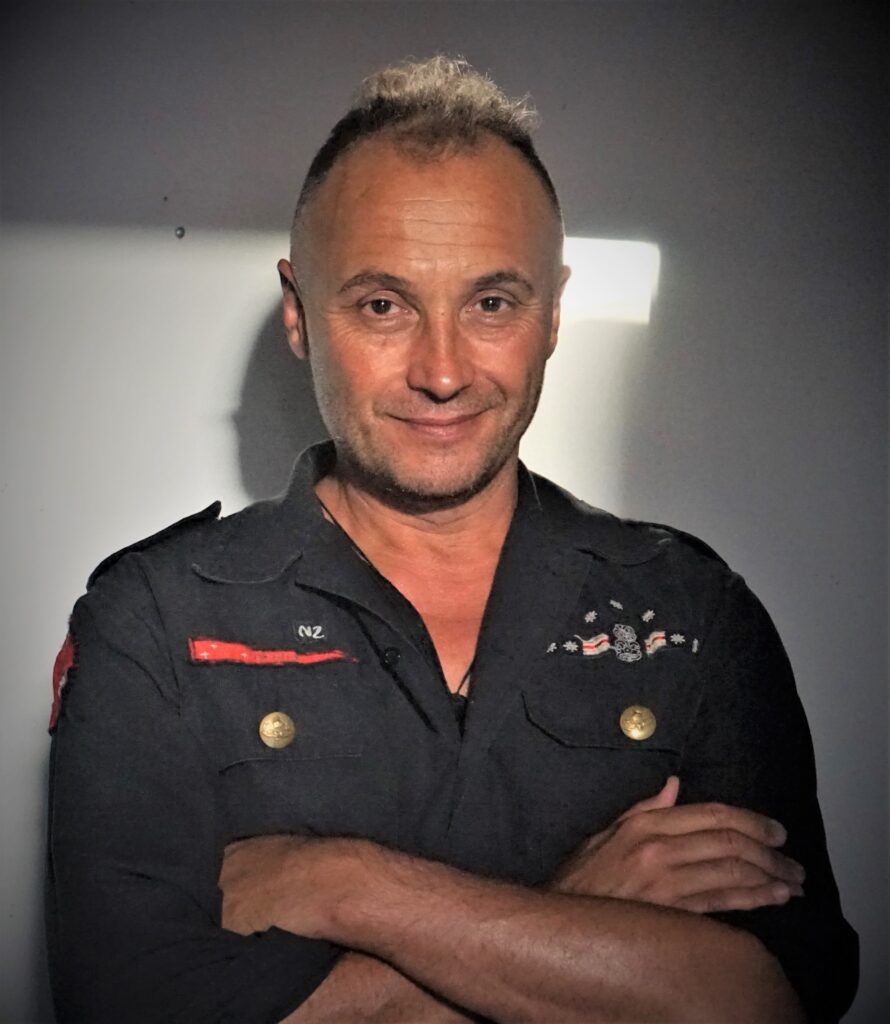 Michael Bennett (Ngati Pikiao, Ngati Whakaue) is an award-winning New Zealand screenwriter and author whose films have been selected for numerous festivals including Cannes, Berlin, Toronto and New York.
In 2008 Michael was the inaugural recipient of the Writers Award from the New Zealand Film Commission, and in 2005 he was awarded the British Council/New Zealand Writers Foundation Award. In 2011 Michael’s feature film Matariki won Best Feature Film Screenplay at the New Zealand Screenwriting Awards, and in 2013 he was awarded Best Documentary Screenplay for his documentary on the Teina Pora case, The Confessions of Prisoner T.
He went on to publish In Dark Places in 2016, which won Best Non-Fiction Book at the Ngaio Marsh Awards and Best Biography/History at the Nga Kupu Ora Awards 2017. In 2019 his graphic novel Helen and the Go-Go Ninjas, a collaboration with acclaimed artist Ant Sang, received an international White Raven Award.
Michael lives in Auckland, New Zealand, and is Head of Screenwriting at South Seas Film School.


0 Comments