


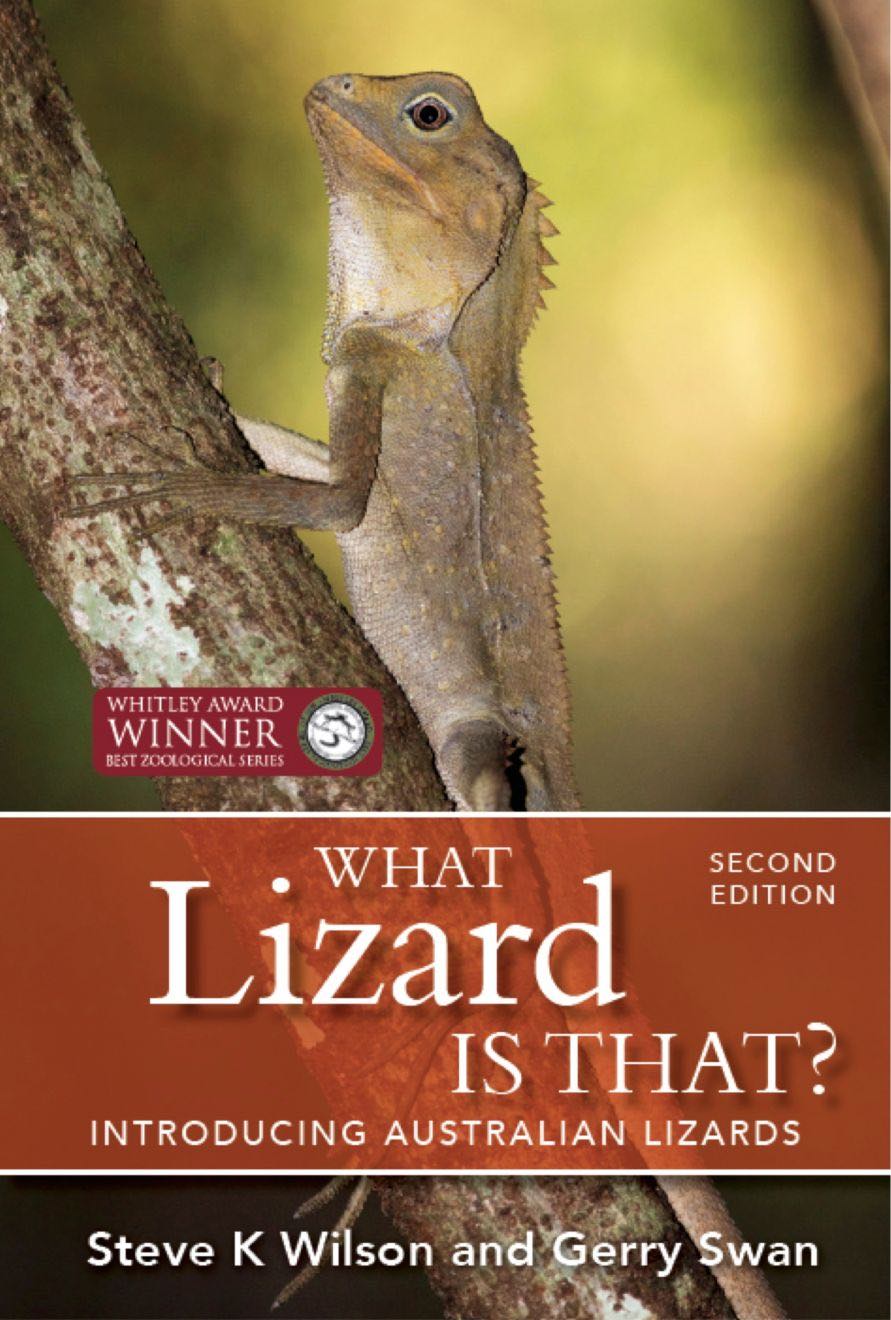
STEVE WILSON and GERRY SWAN are passionate about reptiles. They’ve written numerous books on them including What Snake is That? and A Complete Guide to Reptiles of Australia.
Australia has a unique and diverse lizard fauna with nearly 650 named species, and this list grows each year as more are discovered.
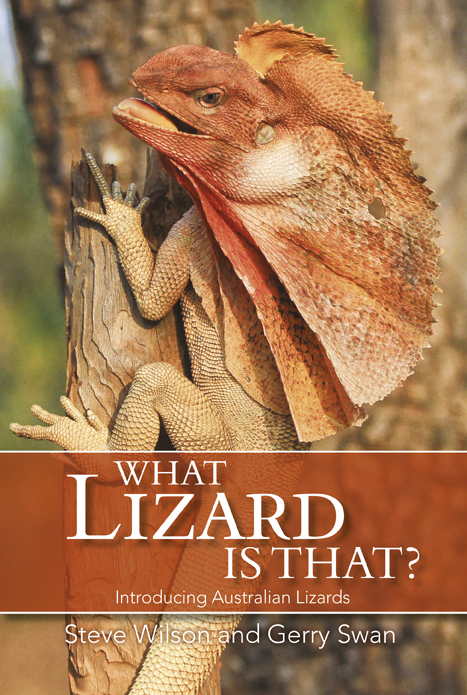
Their this new second edition of What Lizard is That? they offer a glimpse into the lifestyles and variety of these amazing Australian animals.
Illustrated with hundreds of striking photographs, it is an invaluable reference and guide for the enthusiastic amateur or keen naturalist.
In this extract we learn about the fascinating world of skinks.
Meet the skinks: an outrageous success story
If we measure success by variety of species and sheer abundance of animals, then skinks win the prize hands down. If success is defined by animals’ abilities to exploit diverse environments, and modify their physical forms to entrench themselves within all available niches, skinks triumph again.
With evolution as the sculptor and skinks the clay, these versatile lizards have been stretched and compacted, shrunk, expanded and flattened. Their scales have been polished to a high gloss or carved into spines while their limbs and digits have been lengthened, or reduced and discarded. More than any other terrestrial vertebrates, the malleable skinks have submitted their bodies to extreme makeover.
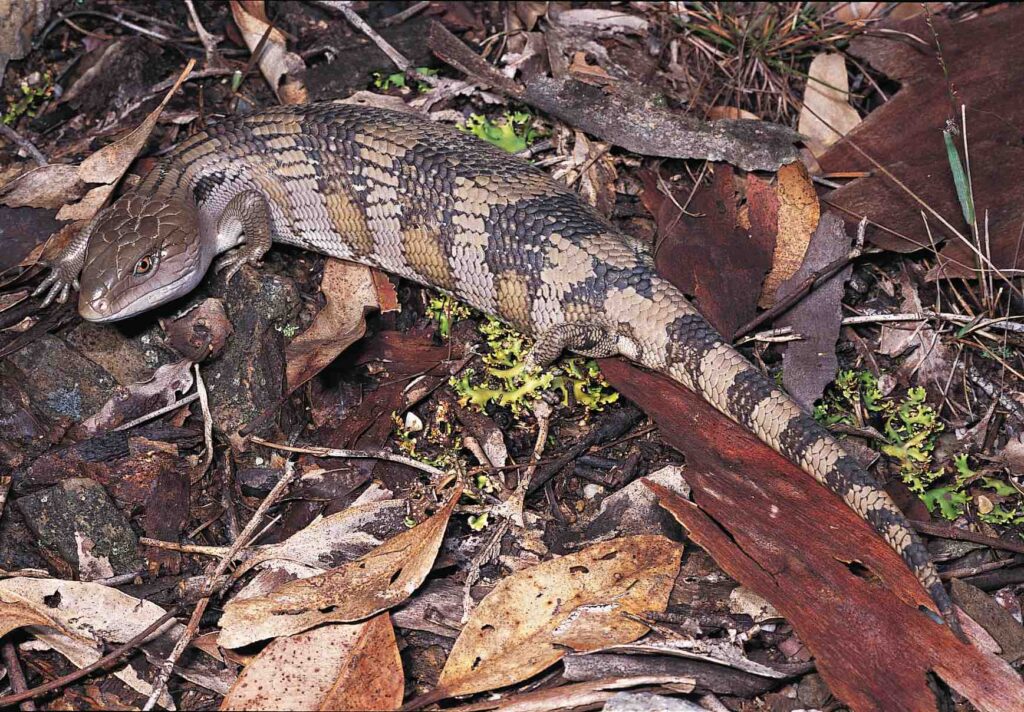
Eastern Blue-tongue Lizard
Carseldine Qld
As a result, nearly half of all Australian reptiles are skinks. More than 460 species occupy virtually every habitat from coastal rocks to alpine summits, from rainforests to highly modified inner urban areas. They include huge ponderous gluttons, secretive miniature lizards smaller than many insects, worm-like troglodytes and racy desert speedsters complete with GT stripes. Then, of course, there are the common garden lizards familiar to us all.
Typical skinks are smooth shiny lizards with four limbs and disposable tails. They feed on small insects that they seize in their jaws and swallow whole. Larger species often prey on smaller ones, while the biggest skinks tend to be omnivorous, leaning towards herbivorous. As they forage, skinks periodically flick out their broad flat tongues to seek airborne chemical cues.
Most skinks reproduce by laying soft, parchment-shelled eggs. The females of some species aggregate to lay their eggs communally. Sometimes these communal caches, containing several dozen eggs, represent the efforts of more than one species.
Some species of skinks produce very thin-shelled eggs that are retained in the body until the young are born fully developed. They are referred to as live- bearers. While this mode of reproduction occurs Australia-wide, it is particularly effective in cool climates where sun-warmed egg deposition sites are unreliable. It is a matter of benefits versus costs. The advantages of posturing and basking to warm the incubating embryos outweigh the peril that heavily pregnant females face from potentially greater predation risks.
Skinks are usually active by day, raising body temperatures by basking in the sun, and regulating them by shuttling between sun and shade. Yet some highly sensitive species shun direct sunlight, confining their activities to damp, dark places under rotting logs. Several are reported to expire from heat stress if held in the human hand. There are few hard and fast rules with skinks. With nearly limitless variety, there is so much scope for species to buck the trends and break new ground (or burrow under it). But one thing certainly holds true: Skinks are an outrageous success story!
Lumbering giants: blue-tongues and the Shingleback
The slow-moving blue-tongues are some of the largest skinks in the world, reaching a head-and-body length of up to 30 centimetres. They are among Australia’s most familiar and popular reptiles, and are frequently kept as pets. Generations of children have lovingly lavished a diet of mashed banana, meat and garden snails on their lizards.
Between them, the six Australian Tiliqua species live in virtually all Australian habitats, including home gardens within our capital cities. A seventh species occurs in New Guinea. They shelter under debris, in thick low vegetation and in the disused burrows of other animals. Blue-tongues are sun-loving lizards, often seen basking on garden paths. Unfortunately they are also fond of wandering onto roads, where traffic takes a heavy toll.
These plump, short-limbed lizards are omnivorous and generally greedy, consuming seasonal fruits, soft vegetation, flowers, birds’ eggs, insects, molluscs and even treats like litters of baby mice if they find them.
Blue-tongues rely on bluff rather than speed to avoid being eaten. By gaping their pink mouths, protruding their flat, dark blue tongues and hissing they present a fearsome spectacle to any would-be predator. And if all else fails, those powerful jaws and blunt rounded teeth can clamp shut like a vice.
All are live-bearers, with litters ranging from 18 for the Eastern Blue-tongue (Tiliqua scincoides) to one or two for the Shingleback (T. rugosa).
The Shingleback (Tiliqua rugosa) is a distinctive species with huge pine cone-like scales. It has a plethora of alternate names, so depending on where you live it may be a Stumpy-tail, Sleepy Lizard, Bobtail or Boggi. Heavily armoured, it moves slowly and ponderously through dry terrain over much of southern Australia. In some respects it can be considered Australia’s answer to a terrestrial tortoise.
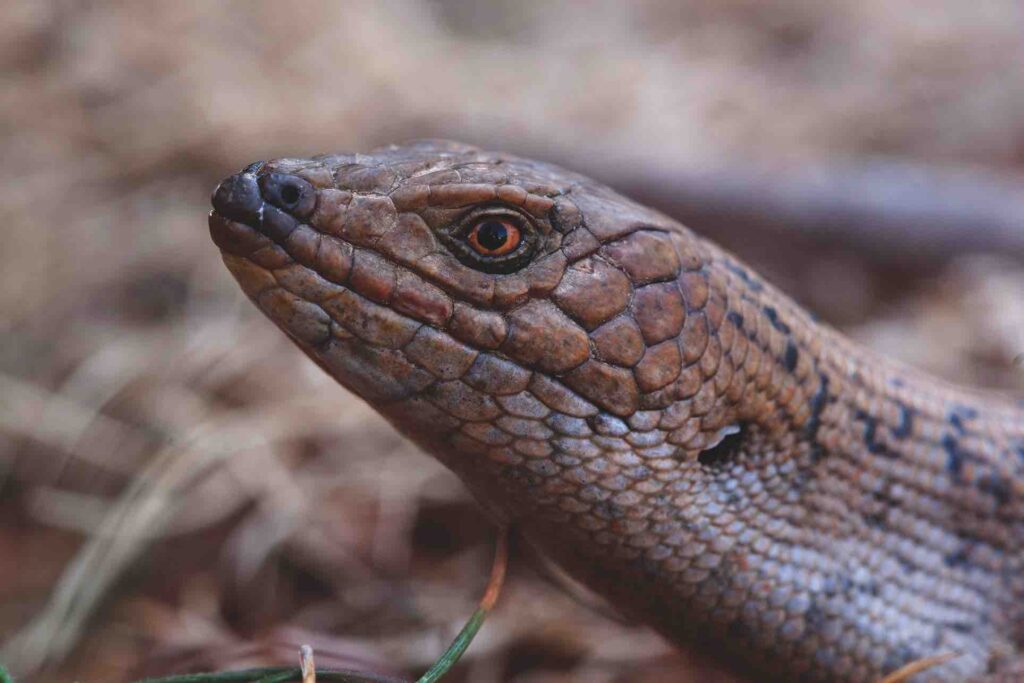
Pygmy Blue-tongue. Burra, SA
It probably consumes more vegetable material than other blue-tongues. Individuals live separate lives throughout the year, but seek out the same partner each season. During spring pairs can often be seen together, walking in tandem.
When an Eastern Brown Snake was struck and killed by a car near Burra, South Australia, in 1992 a chain of events unfolded to solve one of Australia’s great wildlife mysteries. The snake was dissected and found to contain a Pygmy Blue-tongue (Tiliqua adelaidensis), a species presumed to be extinct for over 30 years. Previous searches had all proven fruitless while populations had existed under our noses.
They were overlooked because they live where no-one had dreamt of looking – in the vertical shafts of spider-holes on treeless grassy plains and slopes. These tiny blue- tongues have a head-and-body length of only 9 centimetres. They forage infrequently, bask near their burrows and seize invertebrates that stray near the burrow entrance. Studies have since revealed healthy populations of the Pygmy Blue-tongue within a limited area of South Australia.
The Eastern Blue-tongue (Tiliqua scincoides) thrives in some of the busiest eastern Australian cities. These large lizards, with a head-and-body length of 30 centimetres or more, have been studied to investigate why they are so successful in the human environment.
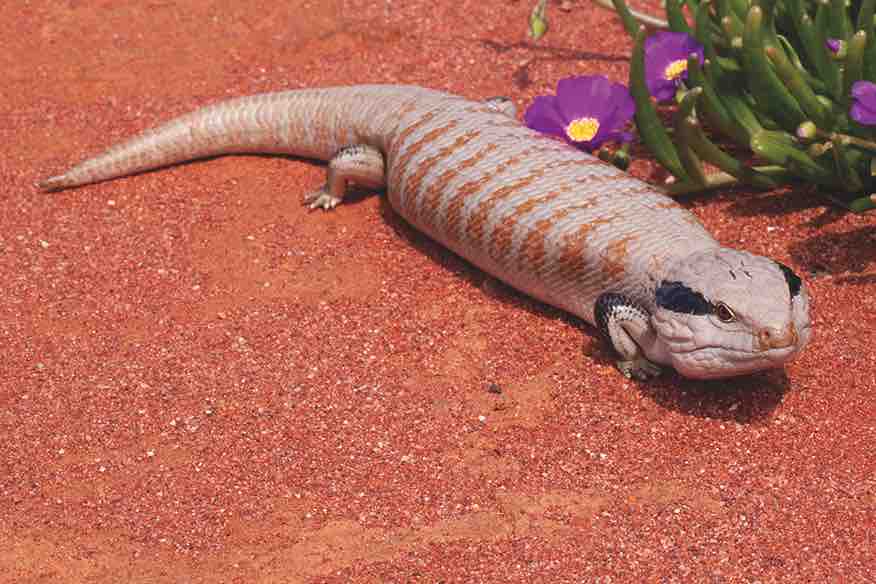
The Centralian Blue-tongue ocsurs in the central Australian desert
Females carrying young are very sedentary and less susceptible to danger than roving males; they produce large litters of young; the lizards rarely stray far from safe locations; they enjoy the artificial shelter sites we create, the gardens we grow with their attendant snails; and they grow rapidly and live for a long time. Captive Eastern Blue-tongues have been recorded to live for 30 years.
Pink-tongued Skink, she-oak skinks and slender blue-tongues
The slender blue-tongues, she-oak skinks and the Pink-tongued Skink (Cyclodomorphus) are close relatives of the true blue-tongues but they are much more slender, longer tailed and more secretive. All are nocturnal or diurnal depending on temperature. They tend to occupy dense low vegetation, wriggling through thickets in a snake-like manner with the hind limbs tucked closely to the body.
Like their larger, more robust relatives, they are live-bearing skinks that employ their tongues to deter predators. But rather than just gape a cavernous mouth and present a broad flat tongue, these lizards often rear their bodies and rapidly flicker their tongues to resemble threatening snakes.
The Pink-tongued Skink (Cyclodomorphus gerrardii) occurs in moist, subtropical to tropical parts of eastern Australia. The tongues of juveniles are dark blue, and adults acquire their distinctive tongue colour as they grow. Two main colour forms occur within any population – those with and without bands. Juveniles are always boldly banded. The long tail is partially prehensile, allowing these semi-arboreal skinks to climb among vines and rock faces.
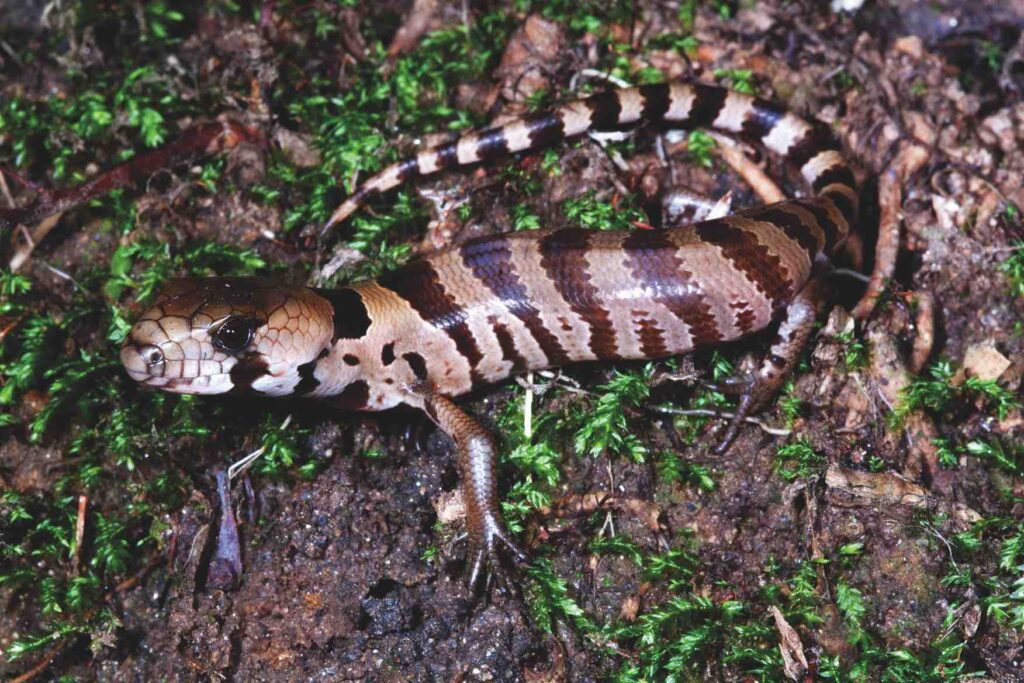
Alpine She-oak Skink, Falls Creek, Vic
Pink-tongued Skinks feed mainly on snails, cracking the shells with enlarged rounded rear teeth, manipulating the soft contents and discarding the shell fragments.
The three species of she-oak skinks are restricted to the south-east, particularly in temperate heaths. They can sometimes be seen basking among tussocks. The Alpine She-oak Skink (Cyclodomorphus prealtus) is confined to high altitude heaths, herb-fields and subalpine woodlands above 1,500 metres. Its sensitive alpine habitat is under pressure from grazing, recreation and fires. It takes a long time for the montane landscapes to recover from disturbance, so the species is listed as Critically Endangered in Victoria and Endangered in New South Wales.
The Tasmanian She-oak Skink (Cyclodomorphus casuarinae) is restricted to Tasmania but is widespread across the island. The five species of slender blue-tongues are mainly found in seasonally dry to arid habitats. The Western Slender Blue-tongue (Cyclodomorphus celatus) is common in sandy areas along the west coast, including coastal suburbs of Perth. It is often found partly buried in loose sand under debris. Slender blue-tongues feed on a variety of invertebrates, and will also take smaller lizards.
**********
ABOUT THE AUTHORS
Gerry kept geckos while at school and after moving to Australia from New Zealand in the 1960s a chance encounter with a blue tongue lizard rekindled his interest in reptiles. An Associate of the Australian Museum and past editor of the journal Herpetofauna, Gerry has written and co-authored more than nine books about reptiles; including What Snake is That, What Lizard is That, and Complete Guide to Reptiles of Australia. He also works as a reptile consultant and has a particular interest in the reptiles of the arid and semi-arid regions of New South Wales.
Steve lifelong love affair with reptiles has taken him to some of Australia most remote places. For the past 30 years he has been working to compile a comprehensive photographic documentation of Australia reptiles. He has authored/co-authored more than 5 books, including A Field Guide to Reptiles, What Snake is That, and What Lizard is That and has written many magazine articles on reptiles. For the past 20 years Steve has worked at the Queensland Museum, educating the public, identifying their specimens and (hopefully) instilling a desire to conserve our unique biological heritage.

0 Comments