



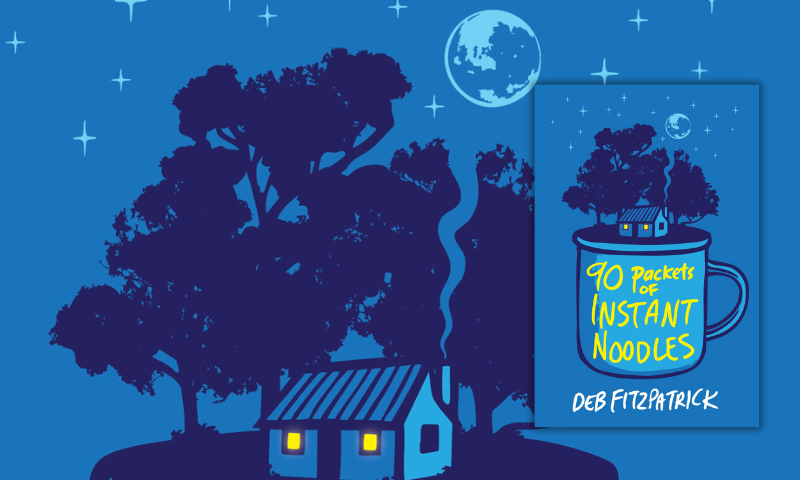
DEB FITZPATRICK’s novel 90 Packets of Instant Noodles is a moving story that speaks across generations about the challenges of being a teenager. Read on for a Q&A.
This is the second edition of 90 Packets of Instant Noodles. How has your perspective on the story changed since the first publication?
90 Packets of Instant Noodles explores 15-year-old Joel’s journey after he’s caught on the wrong side of the law with his mate Craggs. There’s a powerful loyalty between the young men, though Joel is already beginning to explore life beyond the teenage friendship, having recently fallen for Bella. While Craggs ends up in juvenile detention, Joel’s family sends him to a remote shack in the bush, 17 kms walk from the nearest town, for three months … 90 days. Joel has to present himself at the local police station each week, but beyond that, there’s not a lot of human interaction out there in the sticks. Joel has to spend time alone, and that time, and the silence and space around him, forces him to think about where he’s been and, more importantly, where he’s going. With the usual structure of his life obliterated, Joel is forced to face the consequences of his actions.
There are many things I wanted to explore in the book: loyalty and peer pressure, wilderness and exile, family and love, and the redemptive power of being given a second chance.
In the 15 years that have passed between the first edition of 90 Packets of Instant Noodles (2010) and this glorious new edition, so much has changed in the external world, yet the internal human experience remains largely unchanged, especially for teenagers. Since 90 Packets was first published, I’ve had the opportunity and privilege to write ten other books, and Joel and Craggs’s story is as raw, honest and believable today as it was when the first edition was published.
What initially inspired you to write about Joel and Craggs and their tumultuous relationship?
When I wrote Joel’s story of being sent to a shack in the remote south-west of WA, I was in the last year of four years spent living in a shack in the cloudforest of Costa Rica. (That’s a long, juicy story which I often share with students when I visit them in schools!) Put simply, I wanted to capture the many difficult and wonderful experiences of solitude and isolation in the wilderness I’d had, but transfer them onto the Australian landscape. I quickly landed on Joel’s voice and he became my expression of these experiences.
I also wanted to explore some hard things I witnessed as a teenager, and I wove those into the book, through Craggs’s story. Joel is painfully aware that Craggs doesn’t have the same kind of uncomplicated love around him Joel is able to rely on. Joel’s family support, before and after the boys are caught, is in part why he avoids the juvenile detention system. Craggs, on the other hand, suffers in an unpredictable, unsafe home and the instability that brings. These different realities feed into Joel’s loyalty to Craggs.
90 Packets of Instant Noodles was my first published book, but when I wrote it I already had two other – then unpublished – novels sitting in my bottom drawer, which were quite different in tone. I wanted to sink my teeth into something darker. I was young, feisty, determined and Joel allowed me examine the big, deep feelings; the hopes and hurts young people go through as they find their way through pain and mistakes and love.
I wrote many many drafts before landing on the published novel and am so grateful for the several excellent agents, publishers and editors who saw something in those early drafts and pushed me for more: they wanted to see more at stake, more danger, more fear! It’s a lesson I’ve revisited quite a few times in my career – I now joke to myself as I write any book: Harder, faster, darker, Deb! – and I’m just so grateful I was given the chance to develop my writing with those supportive professionals around me.
With the book being republished, what do you hope new readers will discover in 90 Packets of Instant Noodles that might resonate differently today?
Joel experiences depression in the aftermath of his actions and in his three months of imposed solitude. I think today’s readers are more comfortable talking about mental health matters and their feelings in general, which is a huge leap forward for all of us. Today, we also understand our mental wellbeing is linked to our love–hate attachment to the digital world, and new readers of 90 Packets might see the value and benefit of unshackling from that world, even for a short time. Joel doesn’t have any choice in the matter and is sent into the bush as a sort of punishment, but I hope readers recognise our deep human need to spend time in nature, and how restorative that time can be. 90 Packets of Instant Noodles celebrates the connectedness that can come with immersion in nature, even if it’s uncomfortable at first.
How do you feel about the story’s endurance over time?
It’s been incredible to watch 90 Packets of Instant Noodles be embraced by new readers every year since it was first published; that it has been in print continuously since 2010 makes me inordinately proud. I never thought my first novel would enjoy that kind of longevity! When I talk to current secondary students about the book, they are as excited and as engaged by it – and they become as attached to it – as readers did in its early days. I’m regularly told things like, ‘It’s the first book a teacher has given me that I’ve loved.’ 90 Packets has remained relevant for YA readers, with its honest, raw story, over the years.
What part of writing this book did you find most cathartic or challenging?
In my last year in the shack in Costa Rica, with all the challenges and joys living there brought, it was immensely cathartic (I laughed and I cried and I raged) to give to Joel the same sorts of practical infuriations of remote shack life I regularly experienced: water running out, power going out, and animals and insects sharing your space, among other things!
One of the other themes in 90 Packets of Instant Noodles is family violence. I found it upsetting to write those scenes, partly because family violence is frightening and it upset me to watch my characters experience it, but more because I found myself in similar situations as a child and teenager, so this brought up some difficult memories. Sadly, this is another way in which 90 Packets remains so relevant and realistic – we know that family violence is unpalatably common in Australia, that it’s often passed from one generation to another, and yet it continues to be a pervasive issue which our community is struggling to combat.
Now that the book is reaching a new audience, what are you most excited about the conversations it might spark?
I see many young people today as being clearer in their sense of self, more attuned to and accepting of their personal values and beliefs, than previous generations. This is wonderful to observe; that young people are more willing to be true to themselves, even if that means standing outside the pack for a bit, is immensely heartening. I hope 90 Packets of Instant Noodles sparks conversations about autonomy and personal courage, and embracing who we really are.
ABOUT THE AUTHOR
 Deb Fitzpatrick loves bushwalking with her family. When she can, she sneaks away to a shack in the karri forest of the south-west of Western Australia. She’s the author of 11 books for readers of all ages, some of which have received awards in Australia, been published in the US and optioned for film. Her latest is Tawny Trouble.
Deb regularly teaches creative writing to both children and adults, and has a Master of Arts in creative writing from UWA. She loves weaving stories from real life into her writing. Deb lived for several years in the cloud forest of Costa Rica, where she did a lot of hiking while toucans, three-toed sloths and spider monkeys crossed through the forest canopy above her. Deb shares her life with her lovely family and their kelpie, who is absolutely not a failed sheepdog.



0 Comments