


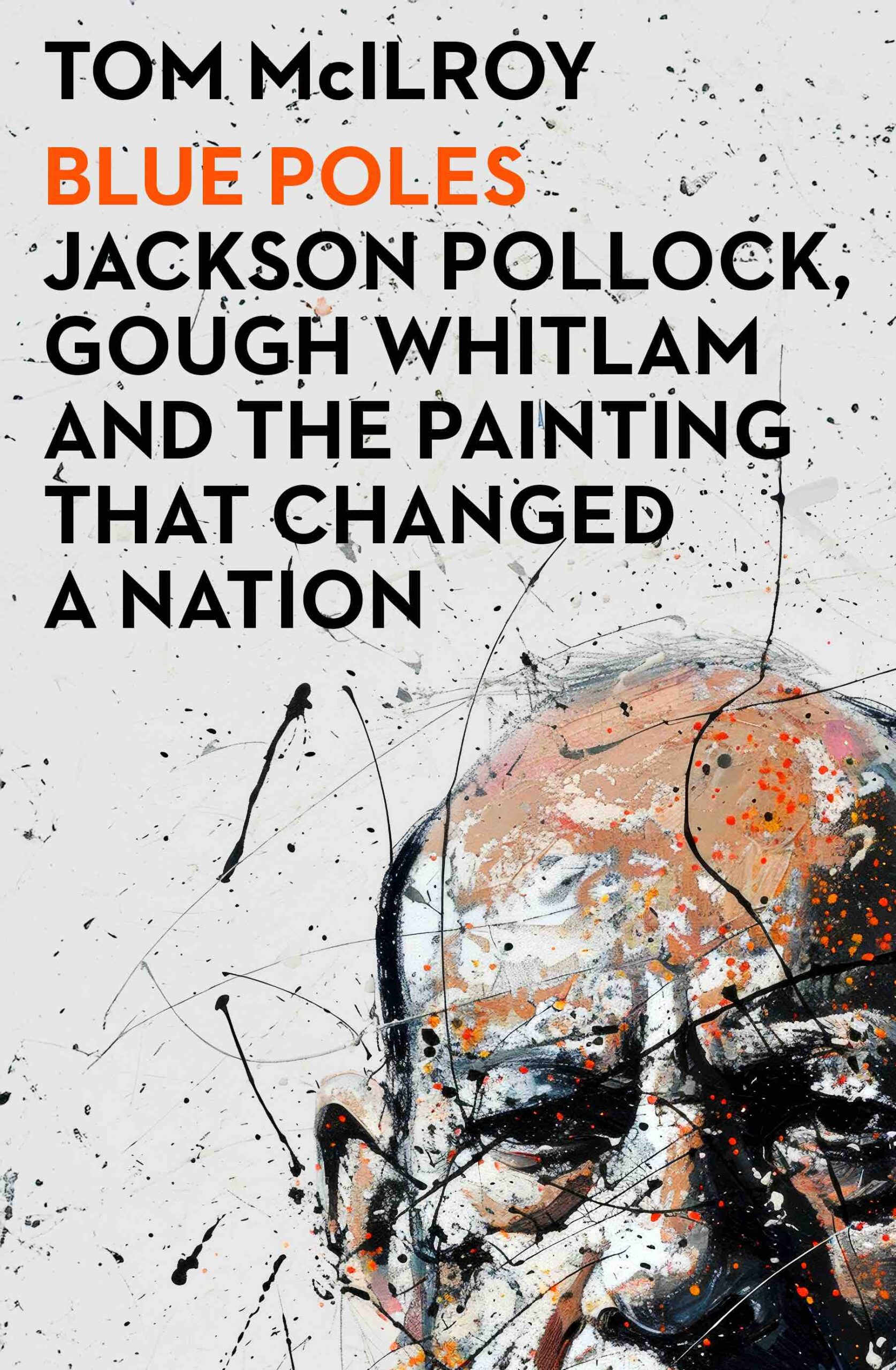
An iconic American painting. An Australian controversy. Where art and politics, myth-making and modernism intersect, there is Blue Poles by Jackson Pollock.
Now in the eye-opening Blue Poles book, journalist Tom McIlroy uncovers the fascinating story of the painter, the politics, and the national scandal that followed.
Read on for an extract …
ABOUT THE BOOK
In 1973, Blue Poles, the iconic painting by America’s great abstract expressionist Jackson Pollock, was acquired by the Australian government for A$1.4 million. This record-setting price for an artwork sparked a media sensation and controversy both in Australia and the United States.
Blue Poles: Jackson Pollock, Gough Whitlam and the painting that changed a nation details how Jackson Pollock rose to fame, the negotiations that led to the artwork’s move to the National Gallery of Australia, and the many successes and turbulent turns in between.
This story covers Pollock’s entree into an art circle which included renowned patron Peggy Guggenheim, as well as his relationship with artist Lee Krasner, and the larger-than-life accounts that surrounded his artistic practice – including questions around the creation of Blue Poles.
It was Gough Whitlam’s commitment to the arts and cultural capital that would see the painting move to another continent, where the media feasted on stories of its cost and brows were raised over its merit. The value of Blue Poles to the Australian art and museum landscape was yet to be foreseen.
Journalist Tom McIlroy tells a compelling account of one of Australia’s most prized paintings, which stirred up many storms from the time of its creation to its placement in the NGA.
EXTRACT
CHAPTER THREE
MOTHER COURAGE
Up-and-coming artist Lee Krasner was excited to learn that her work would hang alongside pieces by Picasso and Matisse in the American and French Paintings exhibition, but she had never heard of the American painter named Jackson Pollock. She discovered that they lived close by to each other, him on Eighth Street and her on Ninth, so one day in late 1941 she knocked on the door of his studio.
Though he was known to ignore visitors, this time Pollock let the stranger inside. Krasner felt his physical power. ‘He was not a big man, but he gave the impression of being big,’ she later said. ‘About five foot – average – big boned, heavy. His hands were fantastic, powerful hands.’
She soon realised they had in fact met once before. Some years earlier, he had tried to push in to dance with her at a party, an incident in which Krasner recalled Pollock ‘stepped all over my feet’. One account of the event says Pollock’s first words to Krasner were: ‘Do you like to fuck?’ She pushed him away and they didn’t speak again for years.
But now Krasner was bowled over. Seeing Pollock’s work in his studio, she said she felt the pressure of a living force. ‘I felt as if the floor was sinking when I saw those paintings,’ she remembered decades later. ‘How could there be a painter like that that I didn’t know about?’
Lee Krasner was the daughter of Russian immigrants Joseph and Anna, Orthodox Jews from Shpikov, now part of Ukraine, who sold fish and fruit and vegetables at a Brooklyn market. Family lore had it that Krasner was conceived on 14 January 1908, when Joseph and Anna were reunited in America after three years apart, him in America and her waiting in Russia. In October of that year, Lena Krassner was born; she then restyled herself as Lenore as she started high school. Later still she changed her name to Lee, thought by some to be an attempt to disguise her gender in the male-dominated New York art world. She also dropped an ‘s’ from her last name.
 As a child, Krasner was outspoken and rebellious, even questioning her family’s Jewish faith. After morning prayers one day she told her parents that she had been dismayed to discover God clearly favoured men over women.
The family was poor. Joseph and Anna sometimes struggled to provide necessities for their children and had to rely on help from friends and neighbours. But Krasner could entertain her older brother and four sisters – Isak, known as Isadore or Izzy and later changed to Irving; Ida, later changed to Edith; Esther, later changed to Estelle; Rose, who was known as Rosie; and Udel, known as Ruth. Another sister, Riva, had died as a young child in Shpikov. Krasner would copy pictures of beautifully dressed women from the newspaper, skilfully replicating their fashion and facial expressions. ‘She used to draw clothed women figures all the time,’ her sister Ruth remembered. ‘We were all aware of that – how marvellous it was to be able to put her pencil to paper and get a figure.’
As was the case for the Pollocks, there was little in Krasner’s early years that would prepare her to be an artist. Biographers note the walls of her family’s home were bare but for a cheap reproduction of a picture of Queen Isabella of Spain giving jewels to Christopher Columbus, one original depiction of which is in the Brooklyn Museum collection.
Krasner was never certain where her artistic interests were first sparked. ‘I don’t know where the word A-R-T came from,’ she said. ‘But by the time I was 13I knew I wanted to be a painter.’ When asked what her parents had contributed to her artistic career, she replied, ‘A mauve sweater.’
Moody and disengaged, her father was sometimes a remote figure to the young Krasner, but she and her siblings worshipped him. Joseph’s stories about exploring the forests near his village in Russia and riding sleighs in winter captivated their imaginations.
Krasner’s mother was a decade younger than her husband, and had married at eleven and given birth to five children before turning 20. Krasner, afraid of the dark throughout her life, inherited some of her mother’s deeply held superstitions. She remembered an incident that occurred when she was about five: alone in the hallway of the family’s house one day, she saw a creature – half man, half beast – jump down from the stairs towards her, prompting her to cry out in fear. The childhood horror of the experience re-emerged in psychoanalysis when Krasner was an adult.
After graduating from Brooklyn’s PS 72 middle school, Krasner applied for a place at Washington Irving High School in Manhattan, the only all-girls public school in New York with a curriculum tailored for the arts. Her application was rejected, temporarily derailing the young girl’s artistic ambitions, and instead she enrolled at Girls’ High in Brooklyn, where she elected law as her specialist area of study. A year later, she was offered a place at her dream school, where the technical studies curriculum was broad. Students at Washington Irving learned drawing, illustrating, embroidery, costume design, stenography, bookkeeping and newspaper writing.
Travelling to Manhattan by train each day on her own, Krasner had her first real taste of freedom and possibility. ‘Coming over the bridge was like arriving in another world,’ she said. ‘Like suddenly being in Paris in 1900. It was my salvation.’
Her formative training was not straightforward. Her unique style was too much for some of her teachers, with one giving her a passing grade in art in her final year simply to allow her to graduate and leave for the Women’s Art School of Cooper Union. Krasner then went on to the National Academy of Design, winning admission through the submission of a self-portrait painted in her parents’ garden. In the portrait, Krasner, in a blue shirt and artist’s apron, observes herself painting through a mirror nailed to a tree, the brush in her left hand instead of her right. The skill on display so impressed the selection panel that some of the judges did not believe the young artist had painted it in the manner she claimed.
She was suspended in January 1929 for painting figures without permission and one teacher wrote ‘always a bother’ in her official file.
The academy was home to some 600 students, only admitting those who intended to pursue a career in art. It promised a balanced curriculum of arts education, through practical work and theoretical instruction. Lee and her peers were required to submit an acceptable sample of work before they were permitted to take the life-drawing class. Far more conservative than the Art Students League, where Jackson Pollock studied, the academy and its culture sometimes made Krasner bristle. She was suspended in January 1929 for painting figures without permission and one teacher wrote ‘always a bother’ in her official file.
In the summer of 1928, Lee’s older sister Rose died suddenly of appendicitis. Ancient Jewish tradition dictated that the next daughter in the family line would marry Rose’s husband, William Stein, and help care for him and the couple’s two small daughters.
Despite doting on her nieces, Muriel Pearl and Bernice, Lee had long imagined a different life for herself, and she refused to marry her brother-in-law.18 Responsibility for the young family passed instead to the next sister, Ruth, then only a teenager. She never forgave Lee and later said she had not looked up to her older sister, describing the pair as having ‘nothing in common’.
It was at the National Academy of Design that Krasner met her first love. Tall and handsome, Igor Pantuhoff was a skilled portrait painter. His aristocratic family, once close to Tsar Nicholas II, had fled their native Russia and settled in Central Park West.
They were too poor to afford an apartment alone, so the family took in four boarders to pay the rent. Pantuhoff had inherited his parents’ love of art and displayed an obvious aptitude for it from a young age.
Though outwardly he might have seemed an ideal mate – attractive, talented, accomplished – Panuthoff was a heavy drinker and often treated Krasner poorly in the decade they were together: lying to her, making anti-Semitic comments, even being heard to remark that he liked ‘being with an ugly woman because it [made him] feel more handsome’. He directed Krasner to change her clothes and make-up, dictating heavy eye shadow and a new haircut to better highlight her striking facial features. He was known for carrying a $100 bill around New York, putting it forward to pay the bill at restaurants. When the waiter couldn’t give change for such a large amount, Pantuhoff and Krasner usually dined for free. Pantuhoff later lived with Krasner for about two years, sharing an apartment near the Hudson River with their friends Harold and May Rosenberg. Krasner let her parents and siblings believe the pair were married, never correcting their misapprehensions about the relationship. Meanwhile, Pantuhoff was painting portraits of wealthy women in New York, many of whom he would seduce.
Pantuhoff left without telling her early one morning in 1939, leaving Krasner bitter and broken-hearted.
Once their relationship was finally over, Krasner moved into a smaller apartment at 51 East Ninth Street to save money. It was fashionable at the time for artists to adorn the walls of their studios with poetry, and Krasner asked her friend Byron Browne to write a section of Arthur Rimbaud’s A Season in Hell across the wall. The extended poem, written in the wake of Rimbaud’s break-up with the poet Paul Verlaine, was influential among the surrealists. ‘To whom shall I hire myself out?’ read the extract on Krasner’s wall.
‘What beast must I adore? What holy image is attacked? What hearts shall I break? What lie must I maintain? – In what blood tread?’ The text was written in black, except for one line – ‘What lie must I maintain?’ – which was written in blue. Krasner said she identified especially with that fragment.

ABOUT THE AUTHOR
Tom McIlroy is a political correspondent with the Australian Financial Review, reporting from the press gallery at Parliament House. Born and raised in Melbourne, he has reported for a range of newspapers in Australia and overseas, including The Age, Sydney Morning Herald, Ballarat Courier, Canberra Times and Houston Chronicle.
A graduate of Melbourne University and RMIT University, McIlroy has been featured in a range of publications including Meanjin and Art Monthly Australasia. Based in Canberra, he writes on national politics, the arts, tax and the economy. Blue Poles is his first book.


0 Comments