


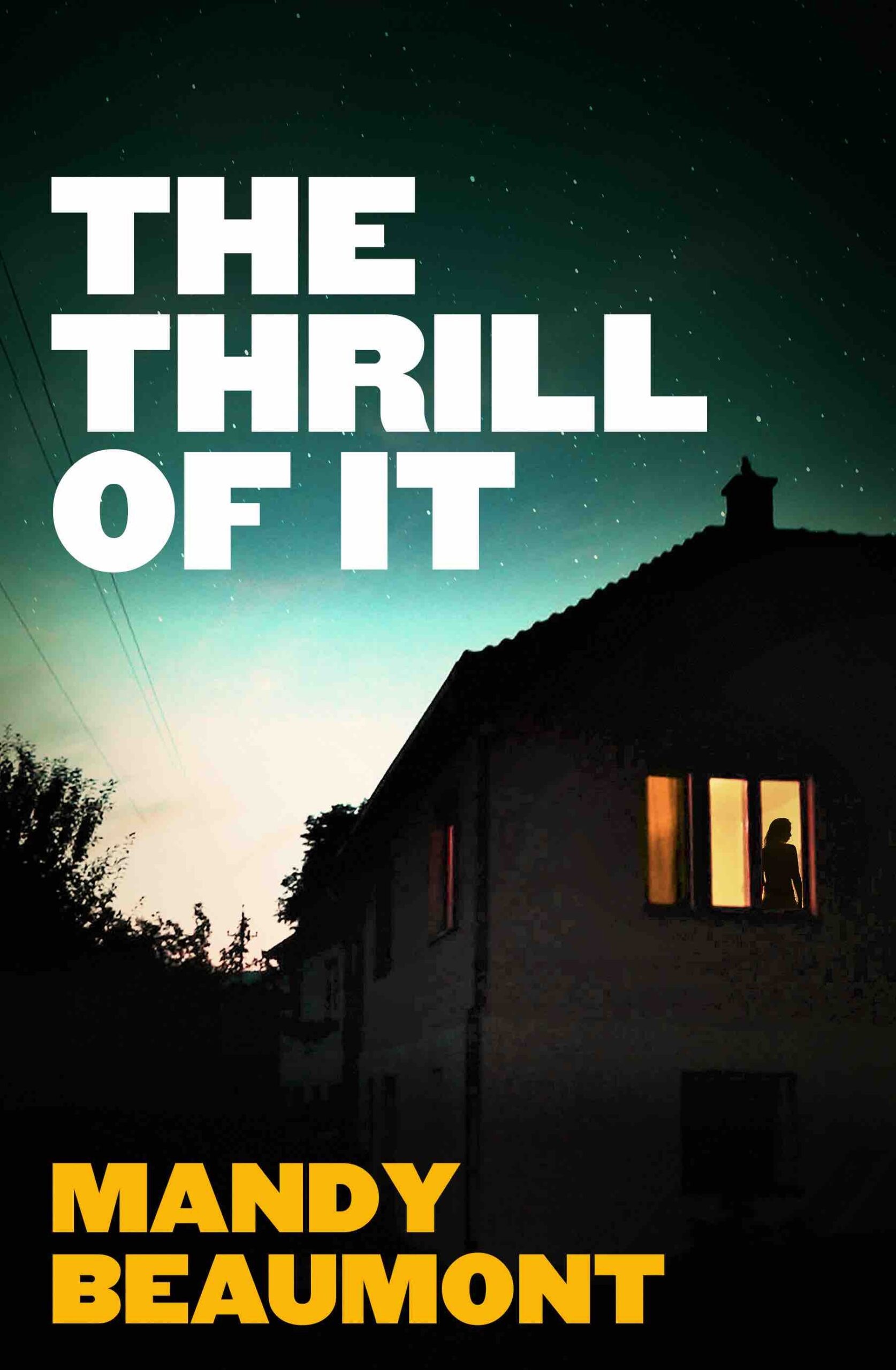
MANDY BEAUMONT’s debut novel The Furies was longlisted for the prestigious Stella Prize and shortlisted for the MUD Literary Prize as well as the Queensland Literary Awards Fiction Book of the Year. Her collection of short stories, Wild, Fearless Chests, was shortlisted for the Richell Prize and the Dorothy Hewett Award.
Her latest novel, The Thrill of It, explores the mind of a killer and the power of a granddaughter’s love.
Read on for an extract …
ABOUT THE BOOK
 That afternoon, when the police and then my mother finally arrived, they found me sitting beside Marlowe holding her hand and talking to her: about a boy I had a crush on, about the buttery yellow jumpsuit I had seen in a shop window that would look perfect on her; about those two cups of half-drunk coffee sitting on the table. Who was with you, Marlowe?
In March of 1989, Emmerson Kerr is alone.
One morning listening to her Walkman, a newsreader’s words stop her dead. ‘A warning to our listeners that this story is graphic in nature. The body of an 84-year-old woman has been found in the foyer of her apartment building on Sydney’s lower North Shore … ‘
Emmerson stood, held in place like an anchor, like a nail in wood, like the breath of a frightened woman alone in her home. She listened to the details and remembered back to that day, 12 years before, in her grandmother’s Paddington studio. The 1977 murder of Marlowe Kerr – Sydney’s art darling and socialite, a woman known for her lavish parties and her world-famous designs, but known to Emmerson as her colourful, loving grandmother – never solved.
And now, years later, a terrifying string of crimes against older women will begin, will force ageing female residents to lock themselves inside their homes. As the killer’s reign of terror escalates, and Emmerson starts to unearth her beloved grandmother’s shady past, she becomes increasingly convinced that the same person who killed Marlowe is also responsible for the depravity that is now unfolding in the city she has always called home.
***********
CHAPTER 1
MARCH 1989
It all starts up again as I walk along the track beside Taronga Zoo. My oversized Police Training Academy t-shirt sweaty, my new Reebok Pumps still clean, and the silver Walkman my mother had sent me as a gift last Christmas hooked to the elastic of my pink tracksuit pants. The Walkman had arrived about a week after Christmas Day with no note, but a cassette inside it with OSHO – Communism and Zen Fire, Zen Wind written on it. When I played it, I heard an Indian man talking about communism evolving into spiritualism, and spiritualism into anarchism. I guessed, judging by this and the postmark from India on the package, that my mother had found a new guru to follow.
I flick the button on the Walkman to the radio and Madonna’s ‘Like a Virgin’ fades out as the nine o’clock news starts. The news anchor’s voice is brash and excitable in my ears: A warning to our listeners that this story is graphic in nature. The body of an 84-year-old woman has been found in the foyer of her apartment building in Mosman on Sydney’s lower North Shore. At this stage police believe it to be a mugging gone wrong . . . And I stop. I hold in place like an anchor, like a nail in wood, like the breath of a frightened woman alone in her home. Now, standing at the corner of my street, I see the perfectly manicured hedge of the house across the road, the cement roundabout I used to ride my bike across as a child. The radio announcer’s words pound in my ears: elderly woman . . . vicious robbery . . . a grandmother bludgeoned and left to die. Stockings. Shoes. And now, only metres from the home she left to me, I am instantly back there.
As a teenager I would ride my bike from Newtown to her, leave my bike under the awning in front of the warehouse she used for a studio and hurry inside. I’d often find her in her office upstairs with her head in a book, or sketching, or doing the numbers. Sometimes she was downstairs at one of the long printing tables looking at designs and talking with her printmakers. She had masses of perfectly coiffed electric-red hair, and her nails were always expertly manicured. She wore high heels, and her outfits were, she told me, handmade by a designer whose name she would never reveal to anyone. She was the epitome of glamour. She was Marlowe Kerr. Sydney’s art darling. A woman who sounded like an English aristocrat when she talked to others, but whose broad Queensland accent emerged when we were alone. Our little secret, she’d say.
Marlowe Kerr. She sang in the Far East in the 1920s and then started a finishing school in London in the 1930s. She was constantly transforming herself: a dress designer when she returned to Australia in the 1940s, a landscape painter in the 1950s and she had saved her biggest transformation for when she turned 60 – starting her luxury wallpaper and fabric business in 1959. Her designs were printed in gold and red, in silver on dark metallic papers. She loved Japanese florals, geometric shapes, cockatoos and echidnas. Her wallpaper designs could be found on the walls of London nightclubs and Parisian cafes; her fabrics made into sheets and curtains that were sold at all the most expensive and exclusive stores.
The Paddington studio, which had once been a mechanic’s workshop, was a place for vision, for splendour. The parties she held there were legendary – full of artists and poets, beautiful young men smoking cigarettes and women in silk jumpsuits holding glasses of champagne. Marlowe’s picture was always in the social pages of the newspaper, and I’d race out to our lawn every Saturday morning to get our copy, open it up and look for her – the iconic woman who was my grandmother.
The photos that ran in the newspapers after I found her that day so many years ago, were alive with colour and movement. Words like maven and entrepreneur and exquisite were used to describe her. There was a photo of her at a cocktail party, one standing by a printing table, another behind her desk and in front of a half-finished painting, one as a young woman in China wearing an embroidered dress with feathers in her hair. The nightly news showed footage of her at art gallery openings and speaking about her business. In a news segment I saw on Channel 9 about a week after it happened, Marlowe was in the studio, standing in front of the wall of pigeonholes that held her rolled-up finished prints and talking about how nature inspired her work. Then a photo flashed up on the screen of me standing alone in the studio’s kitchen on the day that I found her. I was looking straight at the camera, and I could see the redness around my eyes from crying. I couldn’t even remember the police taking the shot and had no idea how the media could have got hold of it.
That day in 1977, I had dumped my bike at the front entrance of the warehouse as usual and walked around looking for her. I called her name as I climbed the stairs to her office on the first floor, my voice echoing in the vast space, the studio deserted at that time of the day. When I didn’t find her in her office I went back downstairs and walked the length of the studio to the kitchen. Two cups of half-drunk coffee sat on the table, a chair was turned on its side and there was an eerie silence that began to make me nervous. I called out her name again. Nothing. And so, I headed toward the one place where I hadn’t looked yet—the toilet.
At the end of the ink-dark hallway that ran behind the kitchen, I moved my right hand along the plasterboard wall and waved my left hand in the air, trying to catch the cord for the light. I pulled it down and saw the bright turquoise walls. And then I saw her. Her legs splayed out on the concrete floor. I ran to her, saying her name over and over. I dropped to my knees beside her, putting my head to her chest, my nose over her mouth. I saw the blueish-purple marks on her skin, a dark pool of dried blood under her head. Her open eyes were the most brilliant blue I’d ever seen. Her orange shoes were arranged neatly beside her right arm and her stockings had been taken off her and were folded on top of them. Her fingers were bent backward, broken.
And then I saw her. Her legs splayed out on the concrete floor.
That afternoon, when the police and then my mother finally arrived, they found me sitting beside Marlowe holding her hand and talking to her: about a boy I had a crush on; about the buttery yellow jumpsuit I had seen in a shop window that would look perfect on her; about those two cups of half-drunk coffee sitting on the table. Who was with you, Marlowe? I asked her, as my mother helped me to my feet and took me outside, where we stood together under the soft shade of the huge bottlebrush tree with its vivid red flowers. My mother smoked. I stared at my feet and cracked my neck from side to side. We did this together for a very long time, until she took me by the hand and led me back inside to the kitchen where the two detectives stood. My mother spoke softly to the one who had introduced himself as Simon. She kept speaking until he nodded his head, walked over to me, placed his hand on my shoulder and said, She lived a fantastic life, that grandmother of yours.
In Marlowe’s kitchen that day, we agreed to maintain the dignity of my high-profile grandmother—the grande dame, as my mother called her. She was a respected entrepreneur, a delightful eccentric, the glue that held the artists of Sydney’s North Shore together. (Years later, I would discover that others saw her as an opportunistic con woman, a brazen liar, a self-absorbed social butterfly who treated her staff poorly. A loss only for her family.) My mother and I watched and waited as the paramedics wheeled her body out into the cool evening, covered by a white sheet, only her feet visible; and the two coffee cups, left for someone else to wash up.
The next morning, my mother and I sat on my grandmother’s plush red-velvet couch drinking coffee and watching the news reports and interviews about Marlowe’s death. A surrealist painter who lived not far from her studio said that she would be missed. A local member of parliament shared a photograph of himself and Marlowe at one of her cocktail parties, martini glasses in their hands. Her hairdresser told an interviewer that he would miss their long chats and gossip sessions. As my mother lit a cigarette and sighed, I let out a small laugh. I knew Marlowe had hated that artist, had even once drawn a picture of him standing in a pile of his own curly hair like it was a rubbish tip.
The local MP, she had told me, was only invited to that party to ensure Marlowe’s picture would feature in the social pages. But she had loved her hairdresser with the fierceness of a mother; had sent him a birthday present only a few weeks before she was killed—a pillow with her new orchid design. She’d known he would love the soft pinks and apricot hues. And he had. I was sitting with her in the studio drinking tea when he rang to thank her. I can still hear her giggling like a schoolgirl as they spoke.
Who would have wanted to kill her? I asked my mother that first morning. Who would have wanted to kill my grandmother?
She never did answer my question, but she made me promise that I would never speak to the police again, that cops were incom- petent, rotten, profiteering; it was unlikely they would be any different in this case. She told me she would do everything in her power to ensure that they didn’t destroy Marlowe’s legacy.
***********

ABOUT THE AUTHOR
Mandy Beaumont is an award-winning writer and a researcher in creative writing. Her debut novel The Furies was long-listed for the prestigious Stella Prize and shortlisted for the MUD Literary Prize as well as the Queensland Literary Awards Fiction Book of the Year. Her collection of short stories, Wild, Fearless Chests, was shortlisted for the Richell Prize and the Dorothy Hewett Award. Stories from the collection also won the MOTH International Short Story Prize and were shortlisted for other notable awards.
She was a convenor in creative writing and communications at Griffith University for over a decade, and holds a PhD and a Research Masters in creative writing. She is also a regular feature writer for The Big Issue.


0 Comments