


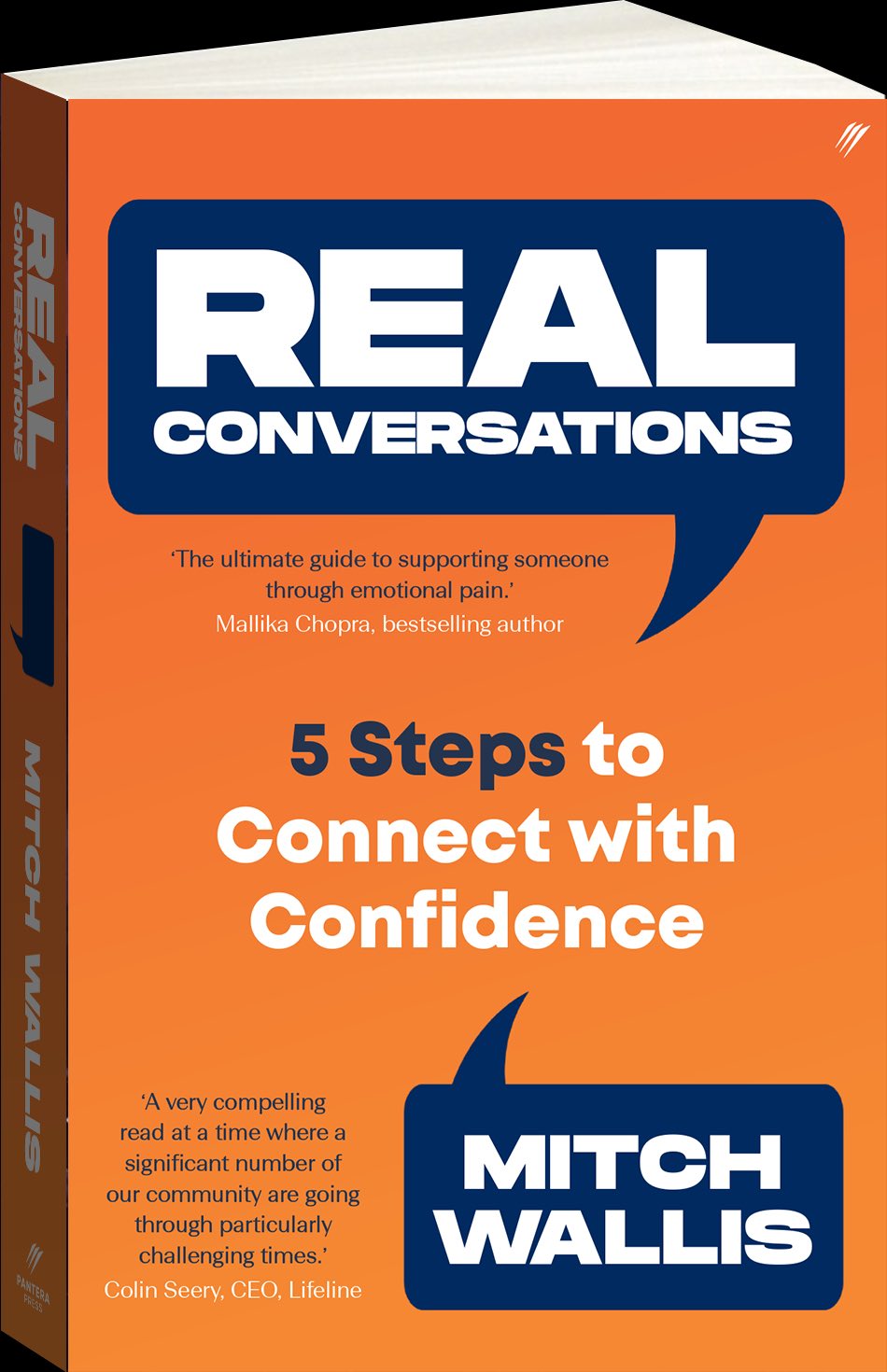
Mitch Wallis is a wellbeing educator with a mission to ‘change the way the world feels’.
His book Real Conversations is a 5-step guide for how to better connect with the people around you.
Read on for an extract,
ABOUT THE BOOK
 Healthy relationships are the heartbeat of life: research tells us the number-one thing that keeps us happy is who we have around us. The best way to improve your own life, and the lives of others, is to invest in your ability to connect. But so often, when the people around us experience emotional pain, we don’t know how to support them.
You may be a parent supporting your child with anxiety, a partner supporting your spouse with depression or addiction, a manager trying to support your employee through grief, a co-worker supporting your teammate with relationship issues, a friend supporting a loved one through financial stress or a teacher supporting a student being bullied.
If you can see yourself in any of these situations, this book is for you. Like the tens of thousands of people Mitch Wallis has trained over the years through his Real Conversations workshops, you will learn from an evidence-based 5-step framework: Engage, Listen, Safety, Action and Boundaries.
Real Conversations aims to help you to form unprecedented trust and closeness in your most important relationships, without hurting yourself in the process.
Extract
The need for Real Conversations
I would define the issue we are facing today as the global warming of the health industry. Our declining rates of mental health constitute a public health emergency. Chances are either you or someone you know well is suffering some type of emotional distress.
In any given year, 1 in 5 people in most Western cultures will experience a mental illness in any given year, and 1 in 2 people will at some point in their life. Twelve billion working days are lost every year to depression and anxiety alone. Depression and anxiety cost the global economy US$1 trillion each year, mainly from reduced productivity.
More than a quarter of us feel lonely. Lonely people have a 26% increased risk of death, and the impacts of loneliness are equivalent to smoking cigarettes or having 6 alcoholic drinks per day.12
Suicide stats are at an all-time high. In 2023, the US Surgeon General released a statement that ‘mental health is the biggest concern in the USA’, with a 57 per cent increase in youth suicide over the 10 years before the pandemic. In Australia, suicide is the leading cause of death for people between the ages of 15 to 44 (more than traffic accidents and heart disease). According to the US Center for Disease Control and Prevention, suicide was responsible for 48,183 American deaths in 2021, which is about one death every 11 minutes.14 Suicide attempts are up to 30 times more common compared to suicides,15 and 135 people are affected to some degree by every person lost to suicide.16 The number of people who think about suicide is much higher than we’d like to accept, especially in Western countries. For example, one study found that 1 in 6 Australians aged 16–85 had experienced serious thoughts about taking their own life at some point in their lives.
Helping not hindering: talking isn’t enough
A few years ago, I was in Manhattan and organised to meet up with my friend Carly for a drink while she was in town. In true New York style, we managed to find a rooftop bar overlooking the city to enjoy Friday afternoon drinks. We got on the topic of parenting and her tone seemed to change. Noticing something had shifted, I enquired a little further to see if she was OK – I could sense some kind of tension with her mother.
‘Was your mum not around much when you were younger?’ I asked. ‘She was,’ Carly replied. ‘She didn’t miss a single netball game my entire life. Dropped me off and picked me up from every party, even at 4 am when I’d snuck out as a teenager and needed a lift home. She sat on my school committees, and I still speak to her almost daily.’ I smiled with relief and said, ‘Wow, sounds like you had the most supportive parent ever.’ Carly paused for a minute. To my surprise, she replied, ‘No.’
‘What do you mean?’ I asked. Carly continued, ‘On all those car trips home, my mum never once turned to me and asked how I am. She only knew me for what I was doing.’
Supportive human relationships are nature’s strongest emotional multivitamin and antibiotic, regulating our health and warding off danger. But it appears we have lost the ability to appropriately produce and consume this powerful medicine at a time where we’ve never needed it more.
Why?
The vast majority of people who are trying to be helpful when supporting someone in emotional distress try to fix the problem instead of connect with the person.
These situations might sound familiar to you: You give advice … they don’t listen. You attempt to cheer them up … it never seems to work. You try to change their perspective … they say, ‘You don’t get it’. You encourage professional help … they don’t go.
The most common factor holding us back from being able to create deeper, healthier, safer relationships boils down to one single insight: you have the wrong definition of ‘helpful’.
 ABOUT THE AUTHOR
 ABOUT THE AUTHOR
Mitch Wallis is becoming one of the top thought leaders in psychology, with a lifelong mission to ‘change the way the world feels’.
Mitch is most well known as the founder of Heart on My Sleeve, a mental health movement that encourages people to connect through vulnerability. He is also the creator of Real Conversations, an interpersonal relationship program that builds psychological safety in workplaces, families and schools by embedding emotionally intelligent communication skills.
As an accomplished keynote speaker, Mitch has delivered talks to tens of thousands of people at companies including American Express, KPMG, Amazon and Google. He has appeared in wellbeing campaigns by the likes of Allianz and LinkedIn, and featured in media outlets including the Huffington Post and Channel 10’s The Project.
Mitch holds a master’s degree in clinical psychology from Columbia University in New York, and has over two decades of lived experience with mental ill-health, including anxiety, depression and OCD.


0 Comments