


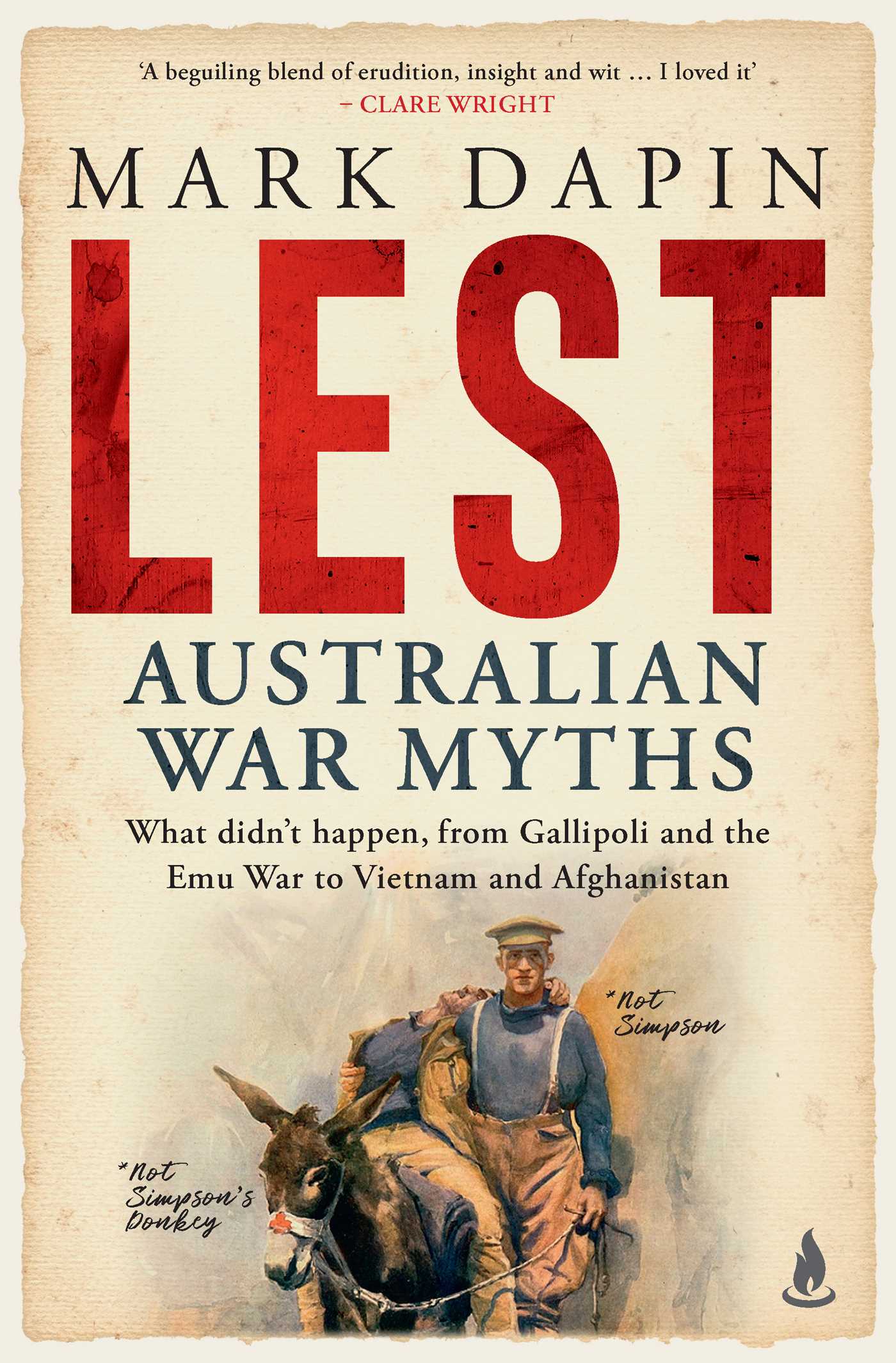
Mark Dapin’s new book, Lest, explores the events of Australian military history, telling us that some events didn’t happen the way most people think they did.
Read on for an extract.
ABOUT THE BOOK
Australia has many stories and statues ‘lest we forget’ our military past. But from Simpson’s donkey to Ben Roberts-Smith, our history is full of events that didn’t happen the way most people think they did.
The first Anzac Day, for example, was far from being a solemn march – it was a celebration where people dressed as cavemen and dinosaurs, among other things. And is it true that British officers callously dispatched Australian soldiers to their deaths in the Dardanelles, as we’ve been told? Did we really hate the soldiers returning from Vietnam? Were the white-feather women of the First World War fact or fiction?
In his inimitable style, award-winning author and historian Mark Dapin sets the record straight, showing that the reality was often completely different from the myth – and that in celebrating the wrong people we often overlook the real heroes.
EXTRACT
In February 2003, I and about 200,000 other people marched in Sydney against the looming Iraq War (so it’s good thing I had not joined the army, really). The way I saw it, a conspiracy of Saudi Arabians, Emiratis and Egyptians had attacked the US under the direction of their Saudi Arabian leader, who was hiding out in Afghanistan – so Australia planned to help invade Iraq to stop it from happening again.
John Howard’s justification for going to war for the second time in his third term in government was to deprive Iraq of its weapons of mass destruction, although he also professed concern about ‘the use of a human shredding machine as a vehicle for putting to death critics of Saddam Hussein’. I did not believe that Iraq possessed unused weapons of mass destruction, but I had no particular position on the people-eating appliance.
As far as I remember, I marched because I either hoped or believed that if enough people showed their opposition to the war, Australia would not take part. In retrospect, I am not sure how or why I imagined that marching might prevent a war. It’s possible I had absorbed prevailing ideas that the moratorium demonstrations had contributed to Australia’s withdrawal from Vietnam, but I cannot say for sure.
I was not alone: for once, I was not even in the minority. About half a million people joined anti-war marches throughout Australia. John Howard responded, ‘I don’t know that you can measure public opinion just by the number of people that turn up at demonstrations.’ However, of a dozen pre-Iraq War polls, not one showed majority support for the coming invasion: an average of only 36 per cent of respondents were in favour. Over that same weekend in February, 10-15 million people across the globe demonstrated against the war, in what Time magazine called ‘by some accounts the largest single coordinated protest in history’.
Of course, the invasion went ahead, because walking from one place to another does not make any difference to anything. I believe there were subsequent smaller demonstrations against the war but I did not take part, since if public opinion could not prevent the military from going to Iraq, it was hardly likely to bring them back.
In March, when Howard announced that Australia would commit forces to ‘action to disarm Iraq’, he added, ‘To those in the community who may not agree with me, please vent your anger against me and towards the government.’10 By this, he was not calling for a resumption of the huge anti-war demonstrations, he was attacking the Vietnam-era protesters whose memory he could never leave alone.
The idea that would-be demonstrators heeded their prime minister and shelved plans to douse themselves in red paint and charge at the SAS is perpetuated at the War Memorial. The ‘Conflicts 1945 to Today’ gallery, which was only partially open during my visit, makes the claim that during the Vietnam War, ‘some protesters’ (Nadine Jensen?) ‘directed their anger against those in uniform and their families’ which, along with ‘union strikes which delayed the arrival of mail and beer’, in turn angered the troops in Vietnam. But the good news, according to the AWM, was that ‘belated recognition by the Australian public that protests against Vietnam veterans were misdirected has helped servicemen and women serving overseas to avoid similar treatment’.
This is unproven and unprovable. It has never been suggested that there was ever the slightest danger of non-Islamist Australians harassing serving soldiers during the War on Terror. And it is unlikely that Islamist terrorists might have been deterred by a realisation that armies are simply a tool of governments, or that they might hurt the feelings of their victims’ families. One of the reasons that opposition to the wars in Afghanistan and Iraq was so muted is that almost nobody in Australia had any political sympathy for the Taliban, al Qaeda or Saddam Hussain’s Ba’athists. It is possible that events on the home front might have played out differently if sections of the left had already been coopted into unconditional support of an Islamist ideology. Little has been said about the way Australian Middle East veterans feel about watching tens of thousands of Australians demonstrating for Palestinian freedom. Just as the post-Vietnam War anti-rape protests became wartime anti-war marches in veterans’ memories, perhaps Palestinian keffiyehs will turn into Afghan shemaghs, and anti-Israel protests will become pro-Taliban rallies for another generation of returned men and women.
Maybe that will happen in the real world, too.
In Afghanistan, meanwhile, the war rekindled and then set ablaze. Australian troops were redeployed against the backdrop of a renewed Taliban insurgency in late 2005. A Reconstruction Task Force of engineers, protected by infantry, artillery and cavalry, went to Uruzgan province in September 2006. A new Special Operations Task Force, including commandos and SAS, later went out to support them. In 2009, Operational Mentoring and Liaison Teams were embedded in the Afghan National Army. Australian combat troops left Iraq in 2009, but Australians continued to play a role in Afghanistan until the last remaining forces were withdrawn in 2021, two months before the capital Kabul fell to the Taliban once again. However, the conflict rarely attracted much media coverage except when a soldier was awarded a Victoria Cross, or a man was killed.
The four Australian VCs were Mark Donaldson, Ben Roberts-Smith, Dan Keighran, and Cameron Stewart Baird (posthumous). Donaldson was awarded the VC for an action in January 2009, when his SAS patrol was ambushed by a larger Taliban force. Under a sustained bombardment of machineguns and rocket-propelled grenades, Donaldson first exposed himself to fire to draw the attackers’ attention away from wounded Australian troops, then dashed out to pick up the patrol’s wounded Afghan interpreter and carry him to cover, saving his life.
‘Mark Donaldson was paraded in front of the media,’ said Park. ‘I was in a stand-by pool of officers, and they brought me back to do Mark Donaldson’s media training, I was having to continually lift up my lower jaw to close my mouth, because I didn’t know there was so much shooting going on! And I had been working at HQ Special Operations. Mark said to me, “Every day, we’d go out of the base, and we knew we’d get shot at.” Now, that didn’t happen in my time. If someone fired a gun, it was almost going to be big news.’
Roberts-Smith received the VC for almost single-handedly attacking and destroying two Taliban machinegun positions in June 2010. The third VC, infantryman Dan Keighran, whose autobiography was later co-authored by Tony Park, fearlessly broke cover under ambush several times to draw enemy fire, allowing Australians and their Afghan allies to pinpoint Taliban positions and evacuate Australian wounded in August 2010. Baird died leading a commando raid on a Taliban compound in June 2013.
Park told me, ‘When Donaldson’s story came out and Ben Roberts-Smith’s and, to a lesser extent (because he was deceased), Cameron Baird’s, we had the protected-identity rules, where we went to great lengths to make sure no photo ever showed anybody’s face, and that no names or personal details were given. We used to burn all our mail in Afghanistan (not the letters, but the packaging and parcels that they came in) because the Yanks were saying that the Taliban had guys in Bagram going through rubbish dumps looking for people’s names and addresses, so that they could target their families back home. So, we were super-paranoid about all that – unless you kill a load of guys!
 ‘The main media events during the war were the funerals. Because once a prime minister has attended one funeral, they can’t not attend the next one. I’m the first to say that we have to honour the sacrifices of people, but it was seen by many in Defence to be turned into events – and the politicians could do that. They felt they couldn’t talk about action and what was happening in the war, but they could do this other stuff. And I think it created a feeling that we weren’t doing that well, that it wasn’t worth it.
‘Then there was nothing for months or years until we got funerals, then Dan Keighran won a VC. Strike up the band! Roll him out! What’s going on? He was in one of the biggest firefights of all time, and his mate got killed. So we had nothing, but then the tap got opened up a little bit when there was a medal winner. That comes back to the failure of PR: in everybody’s mind, Afghanistan was about Aussies getting killed, or it was about superhuman Aussies doing superhuman things.’
Ultimately, with Special Forces, at least, ‘The pendulum swung the other way,’ said Park, ‘from not wanting to be seen and wanting to hide away, they were briefing advertising companies for recruitment ads, based on some of the images that we’d shot in Afghanistan. They wanted to use the media – and even advertising – to ensure they had a flow of people.’
Eventually, media were permitted to become ‘embedded’ with Australian troops and some solid reporting came out of Afghanistan but, said Park, ‘The fault in our failure to really use the media and PR during the war was down to governments and this micromanagement. We go out of our way to protect people’s identities – except the ones that kill the most people. We put Ben Roberts-Smith on the Sunday Night program, wading through the pool with weights over his head.’
Roberts-Smith was by far the most visible of the VC recipients. Malcom Knox, who ghostwrote Mark Donaldson’s autobiography, The Crossroads, told me, ‘When I was writing it in around 2010, and even at around the time it was published, people would ask, “What’re you doing?” and I would say, “I’m ghostwriting a book for the first Australian VC winner since Vietnam.” People automatically would say, “Oh, that really big guy!” I had to explain, “No, no, there was a guy – the little guy – who won one before him.”
‘Even then,’ said Knox, ‘the notoriety of Roberts-Smith was way in excess of whatever surrounded Mark – partly, I think, because Mark is such a reserved person, but also partly because of the nature of the action in which they each won their VC. You contrast Roberts-Smith as a guy who stormed a machinegun nest with his automatic weapon and killed a bunch of bad guys, with Mark who was somebody who ran into a field where there were bullets raining down on him to rescue and save the life of a wounded Afghan interpreter. It was such a different way of displaying courage – which is also typical of Mark as a person, as opposed to Roberts-Smith, but it lent itself less to the PR myth-making of that time. What was being mythologised about the VC was the aggressive aspect of soldiering.’
While Roberts-Smith had killed the most enemy fighters in Afghanistan, he later turned out to have also killed a number of people who were not fighting and perhaps not even the enemy. He was not alone. By the time Roberts-Smith’s defamation action had failed, The Inspector-General of the Australian Defence Force Afghanistan Inquiry report (more widely known as the Brereton Report) had uncovered evidence of 23 incidents ‘in which one or more non-combatants were unlawfully killed by or at the direction of Australian Special Forces’. A total of 39 civilians were allegedly murdered, and weapons were sometimes placed with their bodies in order to make them look like enemy combatants.
In an extraordinary statement to a parliamentary committee, retired Special Forces major Heston Russell said, ‘I have watched as the reputation of our veterans and all that we achieved in Afghanistan has been raped by elements of the media, while the Department of Defence and the government at large have left veterans and our families to defend ourselves, becoming potential targets for the real threats in this world … The simple fact that the Australian public and media were left to ask if our time in Afghanistan “was worth it” is the most monumental failing of successive Australian governments, who otherwise excel at all forms of marketing spin and rhetoric – failing to educate and engage the Australian public throughout our longest conflict …’
Russell said, ‘There were over 11,000 insurgents and terrorists killed, yet our legacy has come down to accusations of illegally killing 39 civilians. That is less than 0.04 per cent of those killed during the conduct of our operations in Afghanistan, yet we hear nothing of the 99.96 per cent of those operations that saw our Australian special forces demonstrate everything it means to embody the Australian spirit and values we readily lack here [in Parliament] today.’
If the Special Operations Task Group really did kill 11,000 people in Afghanistan – and that number seems to have become widely accepted – it is not at all clear who these people might have been. The highest credible estimates count the peak wartime operational strength of the Taliban at only 60,000 core fighters, supported by about 90,000 militia and perhaps another 50,000 facilitators and support elements. If every one of the 11,000 killed by Australian Special Forces alone had been core fighters, they would have accounted for more than 18 per cent of the entire Taliban. Moreover, Australian forces were largely based in Uruzgan province, which is home to only about 2 per cent of the Afghan population.
There seems to have been a high degree of aggregation of the enemy in Afghanistan, which may have been one of the sins of Ben Roberts-Smith.
Part of the problem with the memory of Roberts-Smith lies with the pride in the hero before his fall. He is a two metres tall, born to be the stuff of statues. He already looks like a statue of himself.
A judge found Roberts-Smith to be a war criminal.15 In one incident, Roberts-Smith had machine-gunned a man with a prosthetic leg, which he souvenired as a trophy and later encouraged other soldiers to drink from. In another, he kicked a kneeling and handcuffed Afghan prisoner off a cliff and into a dry creek bed. The prisoner fell so hard that his teeth were knocked out of his mouth. He was then shot dead.
I would guess that this is the image that will survive the war – the helpless, handcuffed prisoner tumbling down the cliff. This is what people will remember. But I do not think most people will care.
ABOUT THE AUTHOR
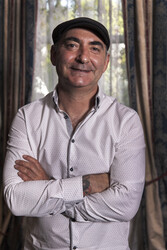 Mark Dapin is an acclaimed journalist, author, screenwriter and historian. He is the author of the novels King of the Cross, Spirit House and R&R. King of the Cross won the Ned Kelly Award for Best First Fiction, and Spirit House was longlisted for the Miles Franklin Literary Award, and shortlisted for the Age Book of the Year and the Royal Society for Literature’s Ondaatje Prize.
R&R was shortlisted for a Ned Kelly Award. Mark holds a doctorate in military history. His history book The Nashos’ War was shortlisted for the NSW Premier’s Literary Award for Non-Fiction, and won the NIB People’s Choice Award and an Alex Buzo Shortlist Award.
He has also written three books of true crime: Public Enemies (shortlisted for a Ned Kelly Award), Prison Break and Carnage. He worked as consultant producer on Network Seven TV show Armed and Dangerous, and as screenwriter on Stan’s Wolf Creek 2.


0 Comments