


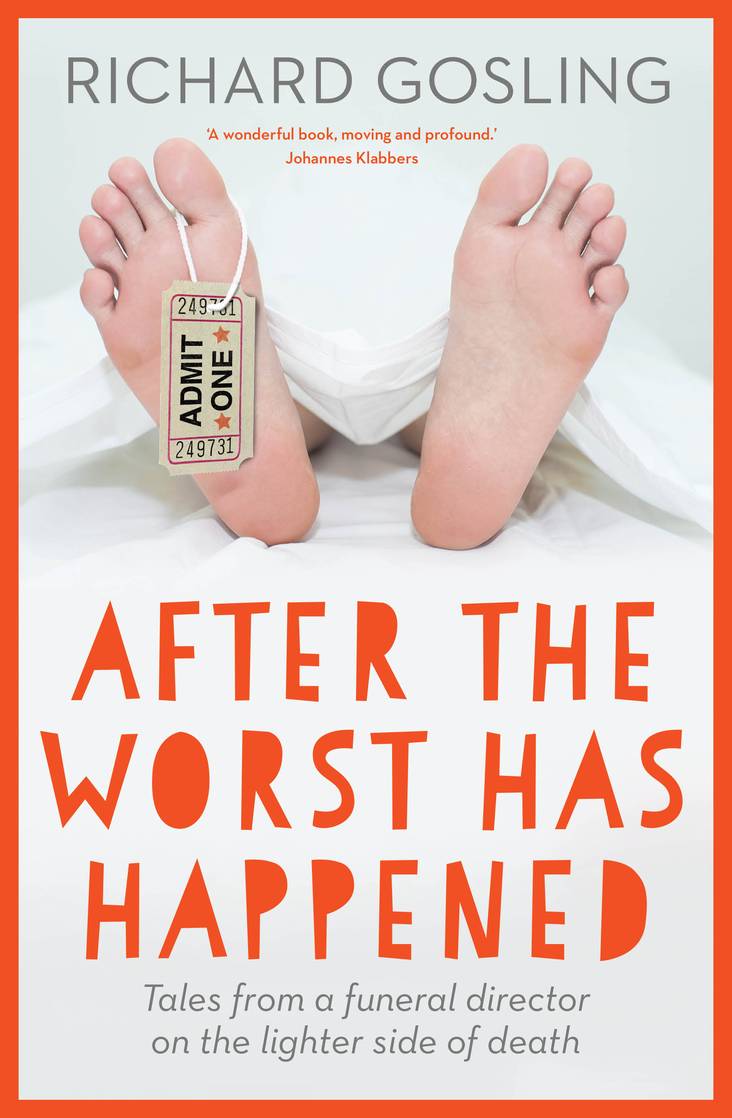
When Richard Gosling’s young daughter faced emergency surgery, a colleague carelessly asked what would happen if she died. In that moment, Richard was forced to picture his own daughter’s funeral, and the people who are there to help families after the worst has happened.
Read on for an extract from his book, After the Worst Has Happened by Richard Gosling.
ABOUT THE BOOK
When Richard Gosling’s young daughter faced emergency surgery, a colleague carelessly asked what would happen if she died. In that moment, Richard was forced to picture his own daughter’s funeral, and the people who are there to help families after the worst has happened.
Aged 40, Richard left his job in the public service and started preparing coffins, driving hearses, assisting in the mortuary and bringing in the deceased from hospitals and nursing homes, slowly working his way up to become operations manager of a venerable Sydney funeral home.
After the Worst Has Happened lifts the curtain on a world we all try to avoid but must pass through. It shows the lighter side of death amid all its other facets, as Richard steers families through heartbreak, anger and grief while holding space for love and acceptance. Ultimately, it’s about how extraordinarily beautiful it can be to spend a daily life surrounded by our final rite of passage.
******************
Teaching Florists
After the hearse, we move back inside and open the floor up to questions. Any questions, I say. I promise you won’t shock us.
They don’t burn the coffin, do they?
Yes, they do. If they didn’t, I say to them, imagine what it would be like for the poor staff at the crematorium placing bodies directly into the cremator. They’d be in therapy every day. The coffin is cremated, leaving a trace of coffin in the ashes.
Is it true that pacemakers can explode?
 They do, and you never want to be the funeral home that caused an explosion at the crematorium. Great care is taken to determine if there is a pacemaker – families are asked, doctors confirm, and our mortuary attendant visually checks.
Do you – you know – really dress the dead? Don’t you just throw the clothing in when it’s a closed casket?
No, we dress everybody for whom we are given clothing. If no clothing is provided, then we wash the clothing the person came to us in and redress them in that, or we place a cover over them that ensures that, from the neck down, they have full dignity. Right up until the very last second, you can ask to see them – after all, they are yours. Yes, it’s unusual, dressing the dead, but it’s also peaceful, methodical and strangely satisfying once they are fully clothed, with tie knotted and shoes laced.
Hair keeps growing after death, doesn’t it?
No, I’m afraid not. After we die, we dehydrate, and our hair and fingernails just appear to be longer because our skin retracts slightly.
Are you scared of dying?
No. Interestingly, most people list public speaking as more terrifying than dying, so in that sense, you’d all rather be there in the coffin than standing here talking to a bunch of terrifying florists. Seriously, though, no – I’m not afraid. I’m afraid of pain, of sudden events or drowning or calamity, as we all are. The idea of death, though, honestly, I find it quite reassuring. I’d rather it waited a good long time, but once the lights go out, I don’t think I am afraid of that. Life is the longest thing that we do; it makes sense to me that it has to have an ending. It would terrify me if it didn’t.
Have you ever, you know, seen a ghost?
This is where my wife’s voice says, ‘Of course you haven’t.’ But she’s not here right now, so … One Saturday I was in the old office on my own, sorting some work. It’s not unusual to come in on a weekend if you’re on call. Sometimes it’s easier to just chip away at this or take care of that. I was working through something when I heard a door behind me click.
I called out ‘Hi’, as a few of my colleagues lived above the funeral home.
No one answered.
The nearest door was the door to the viewing room, where families would sit with their loved ones. I glanced up to see the door still closed, but then in front of it, for maybe a second or six, there was and there wasn’t an outline or a solid figure of a man in a hat and coat with a full beard, walking slowly but staying in the same place, his head slowly turning, and his arms and legs moving. He was solidly there but stubbornly not there. And then he absolutely wasn’t there. He wasn’t there because he was just ripples of sunlight on the white wall, and he wasn’t there because Mel would tell me he wasn’t there. I don’t believe he was there at all, but I saw him.
I don’t tell the florists this. I tell them our mortician sometimes talks of the radio skipping around one day, finding the same song on different channels for the duration of the time she was working on a body. They’re generally happy with that version of a ghost story.
Do you lay coins on the eyes of the dead?
No. One body I was putting away after a viewing had the most furious look on his face. The family had said he had seemed so at peace, but to me he seemed irate, as though he was about to burst into invective and berate me. As I closed the coffin, I honestly expected something to happen, the face was so contorted into rage. I don’t tell them this, though. I tell them we put fake money in or on the coffin sometimes.
Once, at a graveside, a family had fake money, paper clothing, paper hats and paper telephones, all of which they dropped onto the coffin. Joyous handfuls of decorative money spiralling down to the coffin.
Is it creepy here at night?
No, I don’t think so. I’ve been here at night quite a few times, and it’s only creepy if you start telling yourself it should be. The ticks and clicks and taps and groans are just the building being old. If you start thinking about it, though, then yes, it becomes creepy. Anywhere does, though, doesn’t it? At night anything familiar can take on a malevolence all of its own.
What does embalming mean?
Technically, it means to preserve from decay. I’ve watched a few embalms now and it’s quite fascinating, if your mind looks at it that way. It’s not my place to describe the process, and I would only get it wrong if I did. Suffice it to say that the times I have seen it done, it has been done with skill, care, patience and almost artistry. The human body is quite amazing. For the period that it is our own, I think we forget quite how complex and astonishing we are.
Can I have a ride in a hearse?
Every time we have ever run the class someone asks this. The only answer I can give is that you can have a ride in a hearse, no problem – just not today. One day, though, one day you will.
Have you ever seen someone die?
No, I haven’t. I’ve arrived not long after and found people still warm in their bed, looking for all the world like they are asleep. But no, I have not been there as the last breath was drawn in. The last breath coming out, though, I’ve felt that on my cheek many times.
ABOUT THE AUTHOR
 Richard Gosling is a husband, father and funeral director. His time is devoted either to his work, at which he clocks way more hours than he should, or to his children and the occasional book in the back garden.
Born in the UK, Richard moved to Sydney 20 years ago after marrying his Australian wife.


0 Comments