



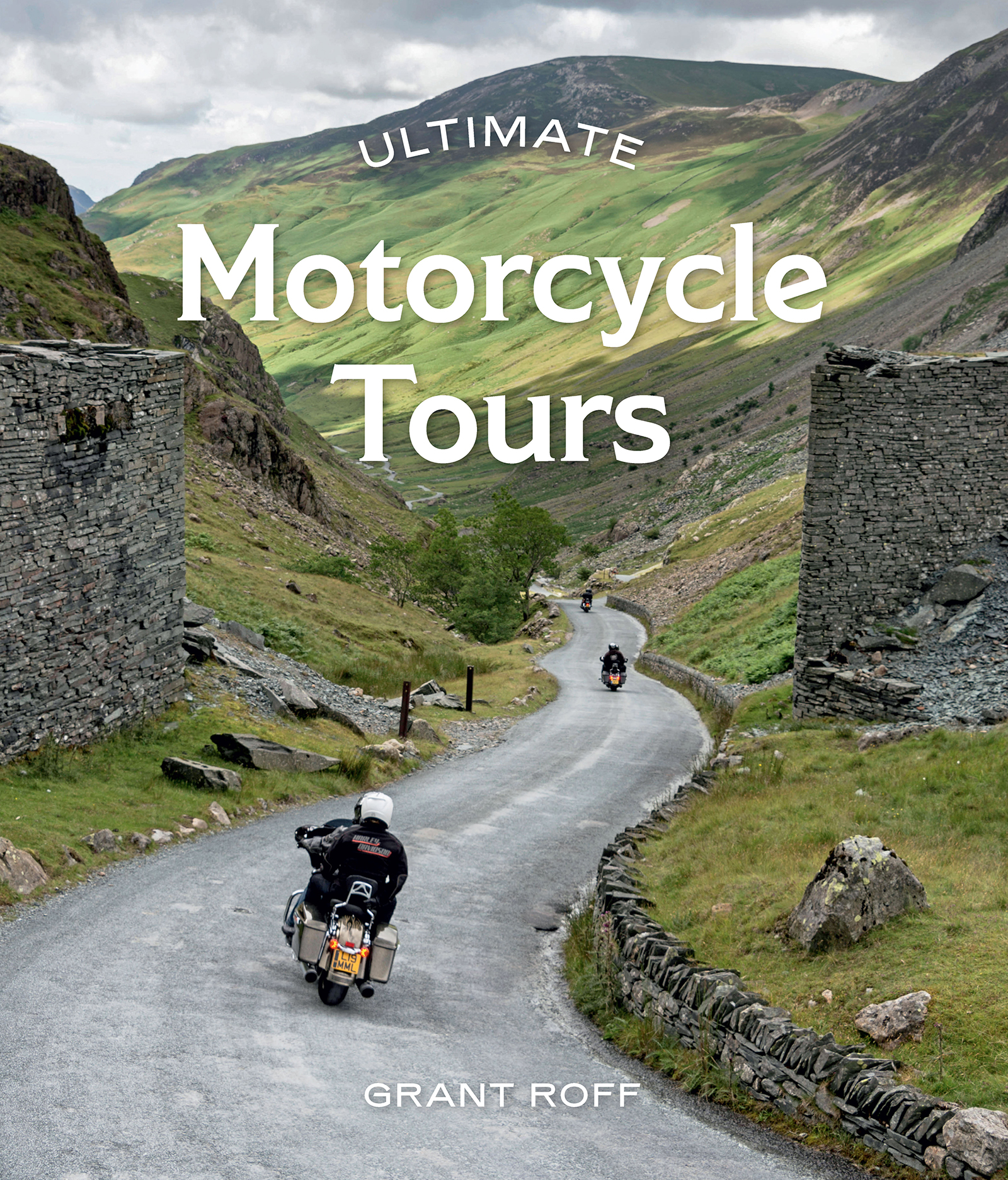
In a new book in the ‘Ultimate’ book series, Ultimate Motorcycle Tours covers 20 of the best motorcycle rides from around the world, including rides in Canada, the United States, the United Kingdom, Australia, New Zealand, India and Vietnam.
Perfect for casual motorcycle riders (not just hardcore adventurers), all routes included are on made, public roads with only average skill levels required for those inspired to recreate the rides.
In this extract we take a ride around the spectacular South Island of New Zealand.
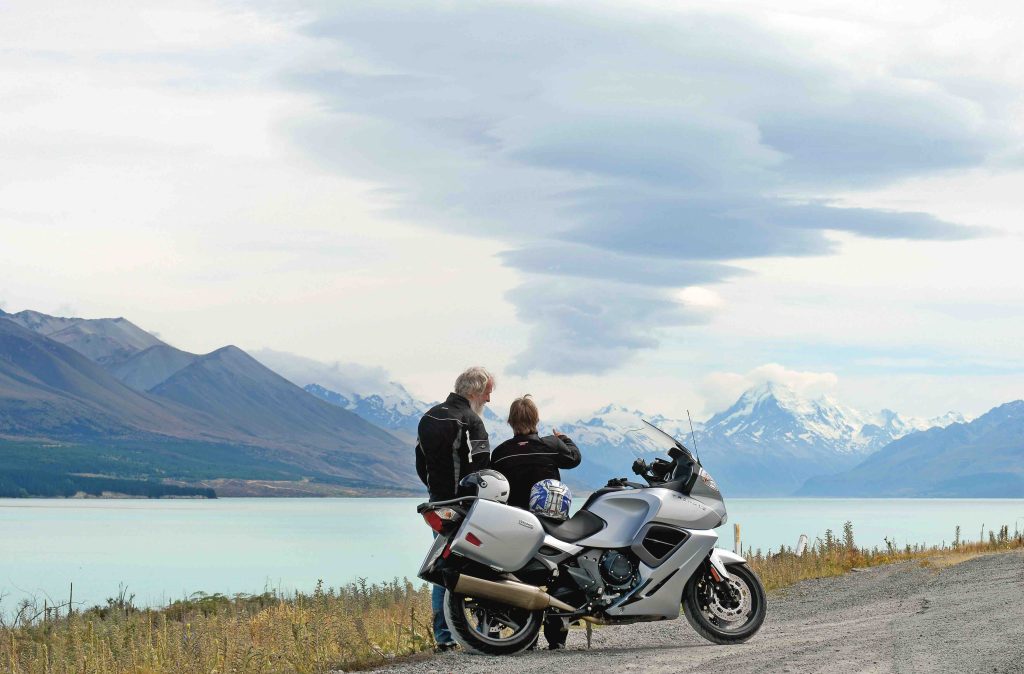
Mount Cook – Sometimes it’s hard to tell as the beautiful scenery constantly replicates itself
South Island: Aotearoa/ New Zealand
Aotearoa/New Zealand’s physical beauty and deep mystery is well captured in Peter Jackson’s Lord of the Rings. The South Island looks spectacular on the big screen but there’s nothing like the real thing.
How long?
Give yourself 10 days to two weeks to fully enjoy it, although it’s possible to ride it in three days.
When to go
December to March provides the best weather for riding. Most motorcycle-related activities take place during this period.
Need to know
- Ride on the left-hand side of the road.
- Hire car crashes are common on the South Island as many tourists aren’t used to the open spaces, narrow roads and the need to park safely if they want to take photos.
Ride rating
Easy. Roads are clearly defined, well sealed and not chopped up by heavy vehicle movement. The only issue is both the roads and bridges can be narrow.
Distances
- The big loop is around 1700km (1056 miles) but allow for a bit extra for deviations
Temperatures
- December: 10°C to 21°C (50°F to 70°F)
- March: 10°C to 17°C (50°F to 63°F)
Screenshot
SNAPSHOT
The South Island of Aotearoa/New Zealand is one of the most contained, beautiful rides in the world. Narrow roads and bridges mean there’s not much heavy industry to clog up the roads with trucks. The enchantment of the scenery never seems to stop and New Zealanders are among the nicest people you’ll ever meet.
Do you know what a Tuatara is? Probably not. It’s a beak-headed reptile that has been extinct for somewhere between 60 and 100 million years everywhere else in the world except Aotearoa/New Zealand. It survived here because it is one of the last large, habitable places in the world to be populated and settled.
The country is located in the extreme southwestern part of Polynesia and is 1600km (1000 miles) southeast of its nearest neighbour, Australia. It’s slightly smaller than Colorado in the US and slightly larger than the United Kingdom. It’s also one of the world’s great motorcycle destinations.
Maori arrived in the 1300s from other parts of Polynesia, but not in great numbers – probably due to the arduous nature of the canoe journey required to get there. When Abel Tasman saw it for the first time in 1642 and James Cook followed up in 1769, it’s estimated the Maori population was around 100,000. This declined to around 42,000 by 1896 as a result of European diseases (to which the Maori had no resistance) along with both inter-tribal warfare and clashes with the largely British colonisers.
New Zealand (Aotearoa in the Maori language) was annexed by Great Britain in 1840. The Treaty of Waitangi was signed in 1840 between the British Crown and around 540 Maori chiefs. Differences of interpretation eventually emerged in the languages of the agreement. Regardless, the treaty facilitated European settlement as it ensured the Europeans could buy land from the Maori.
The relatively short period of human occupation in NZ (around 700 years) enabled a unique physical environment. Two-thirds of it is covered by mixed, evergreen forests and nine-tenths of its indigenous plants only exist on this island.
The ride to Paradise
There’s actually a location in NZ called Paradise and we’ll get to it eventually but, first, we have to decide on which of the two parts of the country we’re going to ride: the North Island or the South. All of NZ is worthy of your interest but the South Island is a rider’s dream due to its great roads, sparse population and phenomenal scenery.
We’re starting from Christchurch (population: 399,700), which is the largest city on the South Island and home to an international airport, making it relatively easy to get to. It’s also home to many bike hire companies, so there’s no problem getting a bike and hitting one of the world’s great road networks.
Christchurch itself is worth a few days of inspection. It was severely damaged by an earthquake (not uncommon in NZ) in 2011, which killed 185 people and there are still parts of what used to be the central business district that have an unsettling silence. A promenade along Brockworth St with all its attractions revives the spirits and a gondola ride up to Mt Cavendish will introduce you to the spectacular scenery you’ll be exposed to once you ride out of the city limits.
It’s also always worth checking what’s going on at Ruapuna Park (Euromarque Motorsport Park) while you’re in Christchurch as there are frequent motorcycle race events there.
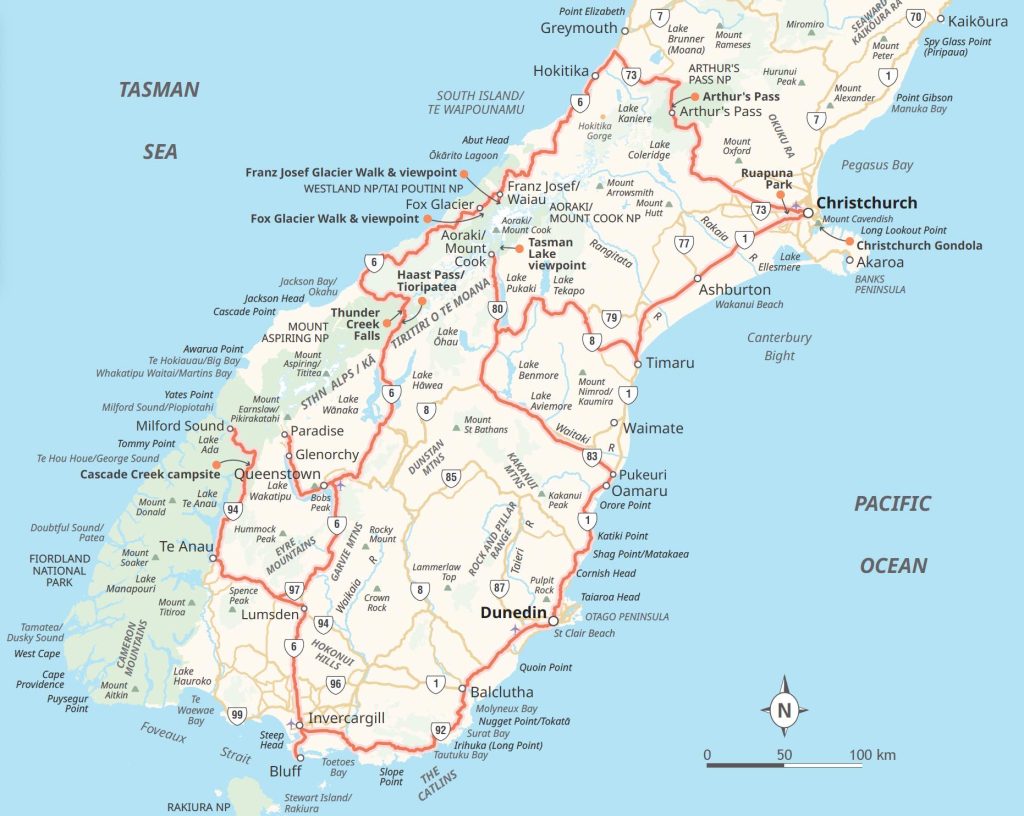
Our ride loop is around 1700km and the start requires you to ride 380km across the Island to the Franz Josef Glacier. The best part of this is crossing Arthur’s Pass with its viaducts, gorged rivers, bridges and waterfalls. The lack of heavy industries on the South Island means most of the two-lane roads are in very good condition and well suited to spirited riding. The pass takes you up to 900m and by the time you get to Franz Joseph Glacier you’ll be a little disorientated from the hundreds of corners and will appreciate a rest.
Put your walking shoes on and take the one hour (return) trail to the Franz Joseph Glacier viewpoint. New Zealand, because of its location, has a reduced impact of climate change but its glaciers are receding. Franz Joseph has lost over 2km in the past 10 years but it’s still well worth the walk. After your exercise, climb into the natural hot pools in the town and think about the 350km you’ll be doing the next day to get to Queenstown.
Closer to the South Pole
Depending on how much time you have, breaking up the ride to Queenstown isn’t a bad idea in that it will give you more time to take in the spectacle of the Fox Glacier and the Haast Pass. There’s a one hour walk on a viewpoint trail at the Fox Glacier, which is enchanting but, if you can afford it, a half-hour helicopter flight over Fox Glacier and Aoraki/Mt Cook is something you won’t forget in a hurry. It costs less than NZ$400 in a six-seat chopper and, weather permitting, you actually land on the upper reaches of the glacier for a short walk on its surface. Magic.
Haast Pass is just as energising as Arthur’s Pass with myriad corners and a good road surface along with great views. Thunder Creek Falls is on this road and is just a five minute walk from the highway.
Something to keep in mind on the passes is that NZ attracts tourists from many countries that drive on the right-hand side of the road. Recent figures indicate that foreign tourists were responsible or partly responsible for up to 80% of crashes on the South Island. Many are unaccustomed to the open driving conditions and are prone to stop in inappropriate spots to take photographs. Ride with this in mind.
Town of queens
Queenstown (population: 15,800) is a highlight of the South Island loop. On the surface it shouldn’t be, as it looks like a typical tourist trap but its concentration on physical activities means it’s usually full of young, fit adventurers and their energy electrifies the surroundings.
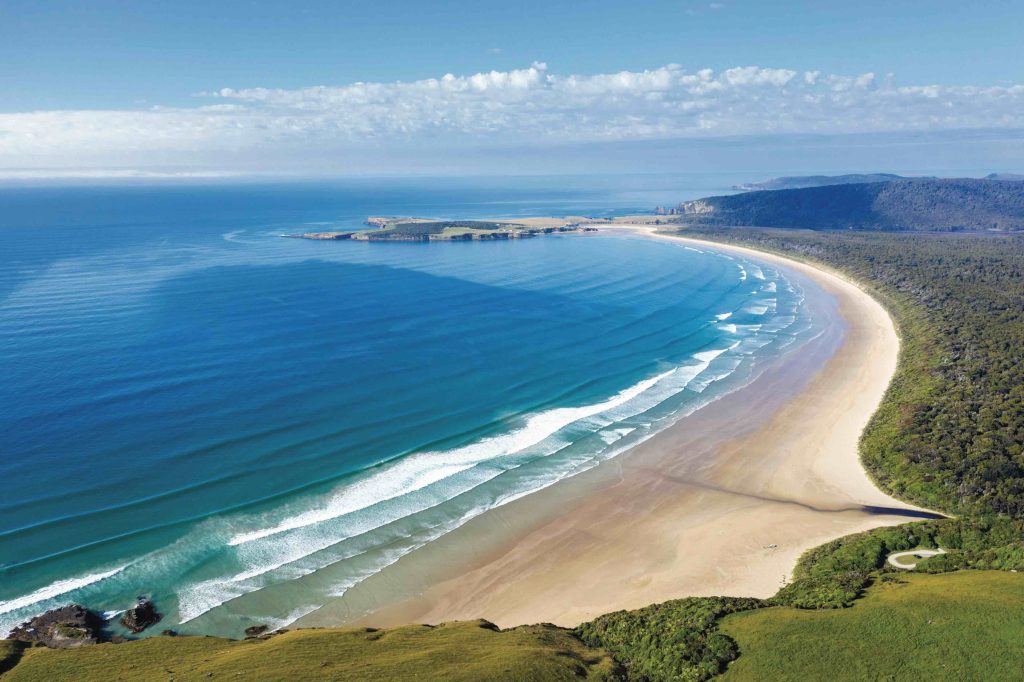
Florence Hill Lookout on the Southern Scenic Route
Punching above weight
New Zealand is by any definition a remote country. Keep it in mind if you need to emigrate before the nuclear holocaust. Despite it’s relatively tiny population of 5.5 million (New York alone has 8.5 million), NZ has produced a well-above average list of stellar international performers.
Ernest Rutherford (1871–1937) practically invented atomic and nuclear physics. Kate Sheppard (1848–1934) was instrumental in NZ being the first country in the world in which women could vote (1893). Edmund Hillary (1919–2008) along with Tenzing Norgay was the first up Mt Everest in 1953. Peter Jackson (Lord of the Rings director) and Russell Crowe
(Gladiator) are New Zealanders, so was the late Denny Hulme and 2023 rookie Liam Lawson (F1 drivers) and musicians Neil and Tim Finn from Split Enz and Crowded House.
You already know about Burt Munro, but what about Hugh Anderson (four times motorcycle world champion) and Graeme Crosby (legendary racer)?
Then, of course, there’s the All Blacks. This tiny nation has absolutely dominated world rugby to the point where there’s an expectation they’ll always win, no matter who they’re playing. Remember, they draw from a population of 5.5 million, while Great Britain, where the game was invented, has 68 million.
Jet boating, canyon swings, bungy jumping, skydiving, luge – you imagine it and it’s probably there along with more sedate pastimes like lake cruises and bushwalking. Taking the gondola up to Bob’s Peak will let you get some perspective on your surroundings, but if you’re going to spend some time there, get on your bike and ride alongside Lake Wakatipu to Glenorchy (46km). This isn’t a famous road and nobody talks about it much because, despite its stunning nature, its glory is masked by all the other stunning roads you’ve already been on to get there. If it was in any other part of the world, you’d be paying an admission fee to ride it.
Paradise (the village, not the state of mind; population: 6443) is a little farther past Glenorchy and is beautiful but some of the road to it is unsealed. It was used as a location for both the Lord of the Rings and Hobbit films.
Back in Queenstown, book yourself into the -5 Degrees Ice Bar for an hour. They’ll give you a warm coat at the door so you don’t freeze to death and you can drink cocktails from ice glasses while sitting on ice furniture. Afterwards, join the queue in Shotover St waiting to order a Fernburger. It’s a Queenstown institution and is as good as burgers get.
Okay, enough mucking around in tourist town. Fire up your bike and head to the exquisite Milford Sound. It’s 288km from Queenstown via Te Anau and its natural beauty is unmatched by any other location in Aotearoa. The ride on the Te Anau/Milford Sound section is wild and twisty with an excellent, grippy surface and plenty vision in its open spaces. Perfect.
You’re going to Milford Sound both for the ride and for the views, and the best way to enjoy the latter is on a boat cruise. Leave Queenstown early as buses packed with tourists are also going to be visiting on the same day. You’ll enjoy an early morning (or late afternoon) cruise as it won’t be as crowded. Waterfalls, myriad wildlife and a bar – what more could you wish for?
There’s only one accommodation option: Milford Sound Lodge. It has choices from dorms to upper-end suites. If you’re travelling with a tent, nearby Cascade Creek campsite is cheap but it can’t be booked in advance and can fill up in the summer season. There’s a handful of other campsites on the road from Te Anue and you could consider staying in Te Anue itself, which has more accommodation options and is within easy riding distance to Milford Sound.
You need to backtrack on the same road to Milford Sound (94) but it’s no burden as you’ll enjoy the ride just as much going the other way. You’re heading to Lumsden where you’ll link up with Hwy 6 to take you down to Invercargill. One thing you’ll have noticed by now is how narrow the frequent bridges are on the South Island – some are one lane only. It’s one of the reasons the roads are so lightly trafficked: the narrow bridges and twisty roads aren’t suited to transporting goods by truck. It limits the potential commercial growth of the Island but makes it all the better for riding.
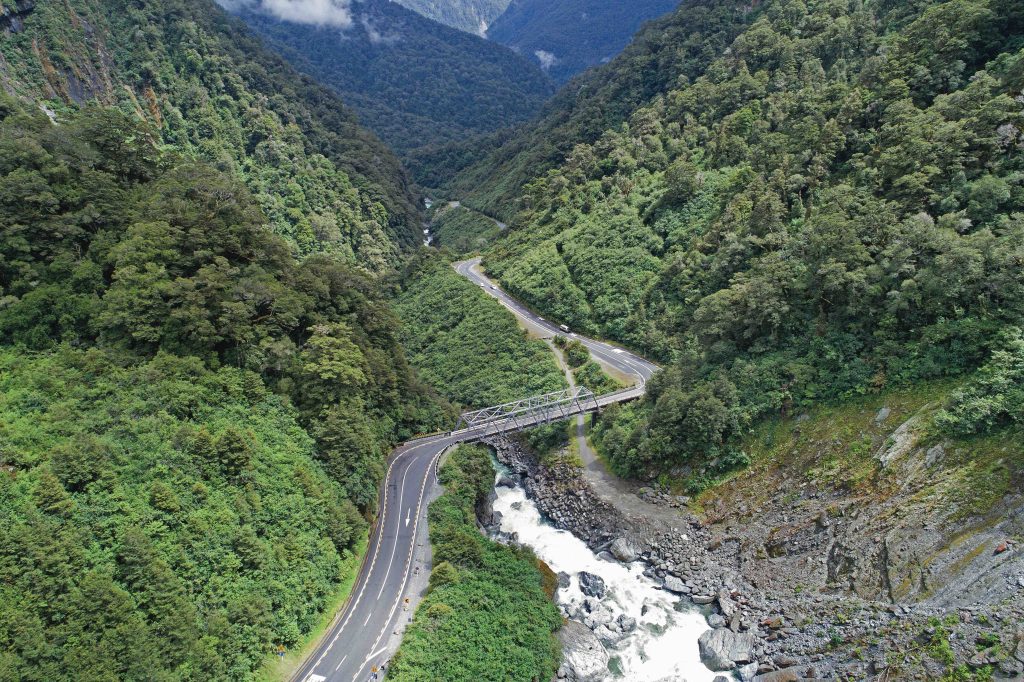
Road design is determined by the location of the surrounding mountains – Ultimate Motorcycle Tours.
Start your engines
Invercargill (population: 57,100) is the unlikeliest town to be a focus for motorcyclists but it is and it’s largely down to one man: Burt Munro (1899–1978). Burt’s story was told in the movie World’s Fastest Indian and it brought international attention to someone who had always been a national hero.
The movie uses a bit of dramatic license (as all movies do) but the framework is an absolutely true story. An impoverished Bert developed his 1920, 600cc Indian Scout with a standard top speed of 90km/h into a fire-breathing 950cc monster that set a world record for bikes under 1000cc at the Bonneville Salt Flats in 1967 topping 296km/h (184mph). Burt was 68 at the time and his bike was 47 years old. He died in 1978 and is buried in his hometown cemetery.
His bikes and memorabilia are on display in E Hayes’ hardware store in Invercargill and the town comes alive each February for the Burt Monro Challenge, a festival of motorcycle sport that includes a hill climb, beach races, sprints, speedway and street racing. If the planets align for you, your New Zealand trip should coincide with this event. It’s an absolute hoot.
Also in Invercargill is the Classic Motorcycle Mecca Museum with 300 bikes on display, including four examples of the legendary Britten – a superbike designed and built in NZ by John Britten, which, among other things, set four world speed records and won the Daytona Battle of the Twins in 1994. John only built 10 of these bikes so having four in the one place is indeed special.
It’s slightly out of the way but 25km south of Invercargill is Bluff (population: 1840), home of the world famous Bluff oysters. These come from the pristine Foveaux Strait and are widely considered to be the best oysters in the world.
Once you’ve exhausted Invercargill, stay on the coast on 92 until it links up with Hwy 1 at Balclutha and proceed to Dunedin. This takes you through the Catlins region, which is the leafy, undulating land between the sea and the start of the inland ranges. It’s called the ‘Southern Scenic Route’, which has a little irony in it – show me a part of the South Island that isn’t scenic. If waterfalls are your thing, there are plenty of them, all well signposted, as you start heading north. Keep your eyes open for fur seals, sea lions, elephant seals, dolphins and yellow-eyed penguins.
Dunedin (population: 114,347) is the second largest town on the South Island and has architecture that reflects the influence of the many Scots who settled the area. It’s also home to the main campus of NZ’s oldest university: Otago. This makes it very much a student town with all the attendant cheap bars and restaurants. St Clair beach is a go-to haunt for excellent seafood.
Oh, and if you’re after a little exercise, Baldwin St in Dunedin holds the current Guinness Book of Record for being the steepest street in the world.
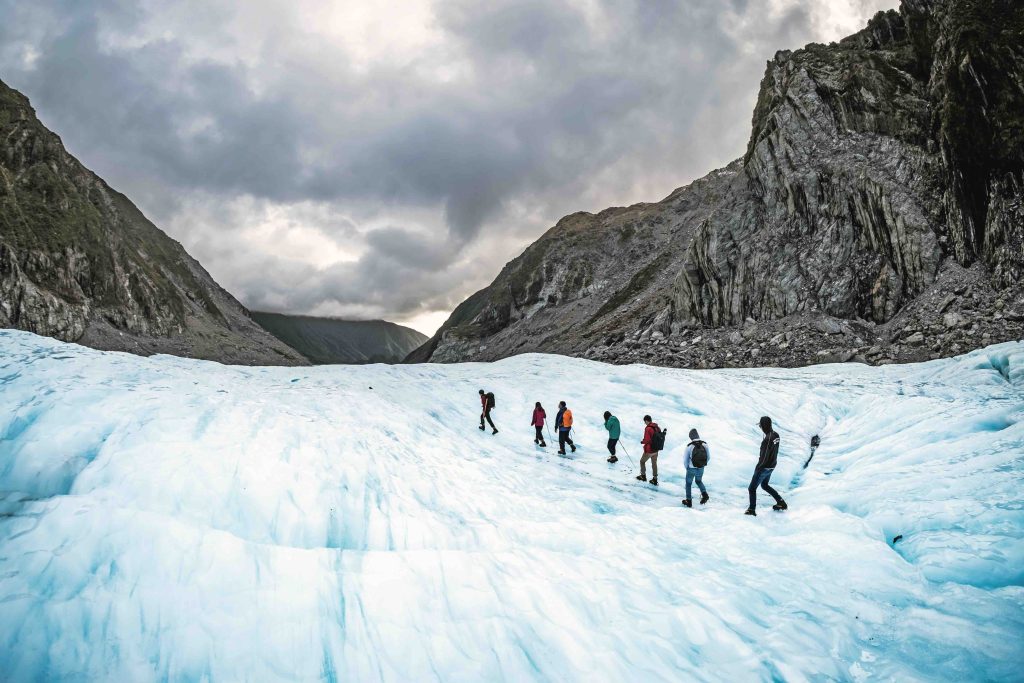
NEW ZEALAND, FOX GLACIER – MAY 2016: Hikers and travelers walking on ice in Fox Glacier, New Zealand. Breathtaking guided glacier walk onto the world-famous Fox Glacier.
Onwards and upwards
Staying on Hwy 1 from Dunedin, we’re sticking to the coast until we get to just above Oamaru at Pukeuri Junction, where we turn left onto 83 and follow the Waitaki River up to where 83 meets Hwy 8. Here we turn right, heading to Lake Pukaki. Another left onto Hwy 80 takes us alongside the lake to Aoraki/Mount Cook Village, a total distance of 317km.
Aotearoa has a number of blue lakes but Lake Pukaki is by far the bluest. As you twist and wind along 80 you’ll get very clear views of Aotearoa’s highest mountain, Aoraki/Mt Cook. It’s a very popular destination for locals and visitors, so if your intention is to stay there you need to book well in advance. It’s full of great walks that can be matched to your level of fitness.
The beautiful Mueller Hut walk is seven hours return (you can stay the night there but, if it’s summer, you need to book) but the Tasman Lake viewpoint is less than a kilometre return.
You’ll need to follow Hwy 80 in the opposite direction to get back onto Hwy 8 and head north again past Lake Tekapo on your way back to Christchurch. Highway 8 rejoins Hwy 1 at Timaru. The trip back to Christchurch is scenic but you’ll be so overwhelmed by the physical beauty of the roads you’ve travelled so far that ‘scenic’ will no longer be enough. You’ll have to be dragged kicking and screaming to your seat on your flight home.
If you’re like thousands of other riders, New Zealand/Aotearoa will become your stock answer to the perennial question: ‘Where would you live if you had to leave your home country?’
Being there
The New Zealand accent takes some getting used to if you’re not actually from there. Nominally, the language is English but with enough influences from outside it sometimes makes it hard to follow. The main intonation feature is the high, rising terminal that makes most statements end up sounding like questions. Australians do it as well.
Then there’s the slang – different words for things you already know.
‘Fish and chips’ sounds like ‘fush ‘nd chups’ and ‘six’ sounds either like ‘sux’ or ‘sex’.
All is lost in the South in places like Dunedin where the accent is heavily contaminated by Scottish ancestry. It can sound like a completely foreign language.
I flew into New Zealand when it was possible in COVID-19 times and was put through the third degree at the arrival counter and the immigration desk. Understandably, they wanted to know where I’d really come from, what was I doing there and when would I be leaving. After 30 minutes of this I was finally standing in front of what I thought was the last line of questioning.
‘What do you want me to do now?’
The tourist visa clerk fixed me with his steely glare and said, ‘Sing Auld Lang Syne for me’. In the split second I had to think about this, I decided he wanted me to make a cultural gesture to prove that I really was from where it said on my passport. So as I began to sing he looked suitably astounded. ‘What are you doing’
“Didn’t you ask me to sing ‘Auld Lang Syne’?”
‘No, I said, “See that line behind me?”’
He let me in, regardless, but he’s probably still telling his friends about it at dinner parties.
BEST EATS
Buccleugh’s on High, Greymouth
This is a restaurant at the Recreation Hotel on High St, Greymouth, and it’s an opportunity to sample one of the secret pleasures of locals: whitebait fritters. Whitebait is immature native freshwater fish, usually about an inch long and prevalent from August to November. The fritters are made from a combination of whitebait and eggs fried in butter and coated with salt and white pepper. Tradition has it that it’s served as a sandwich. Buccleugh’s other local options include venison and blue cod.
Bunrunners Cafe, Christchurch
The Scottish influence in NZ extends to the Southland Cheese Roll. It’s simple and cheap: a slice of white bread spread with a cheese mixture, rolled up, grilled and then coated with butter. Be still my beating heart! You’ll also find a variety of other Scottish-inspired items on its menu.
Captain’s Steak and Seafood Restaurant and Bar, Queenstown
You’ve spent all that money to get to Queenstown so don’t sweat spending a bit more on an upmarket local dining experience. Captain’s is in the middle of Queenstown Mall and has an extensive menu featuring all the things for which NZ is famous: mussels, oysters, crayfish and, of course, lamb. Enjoy.
BEST SLEEPS
Jailhouse Accommodation, Christchurch
Yep, it’s an actual old jail but very tastefully converted into inexpensive accommodation. It’s a 20 minute walk to the arts centre, museum and botanical gardens. It has dorms but also well-priced private rooms. It’s also got parking for motorcycles and all the other features you expect from a hostel. There are plenty of other hostel options in Christchurch, too.
Tasman Holiday Park, Te Anau
There’s an argument for staying in Te Anau if you plan to visit Milford Sound. It’s a 120km ride, you beat the buses from Queenstown and it’s much cheaper with a lot more accommodation options than Milford Sound itself.
Tasman Holiday Park is adjacent to Lake Te Anau, and is a five minute walk to restaurants and shops, and offers a range of accommodation options along with secure bike parking. It’s also got a hot tub and sauna to soothe away the aches after a hard ride. Go for the deluxe queen studio but there are also tent spaces if you’re camping.
www.tasmanholidayparks.com/nz/te-anau/accommodation
Tower Lodge Motel, Invercargill
Okay, this place is a motel but it’s a very good one and it’s in the heart of Invercargill. Its rooms have kitchenettes and satellite TVs in case MotoGP is on. It’s also modestly priced and has free motorcycle parking. It’s one of a hundred accommodation options but the price and location make it a winner.


0 Comments