


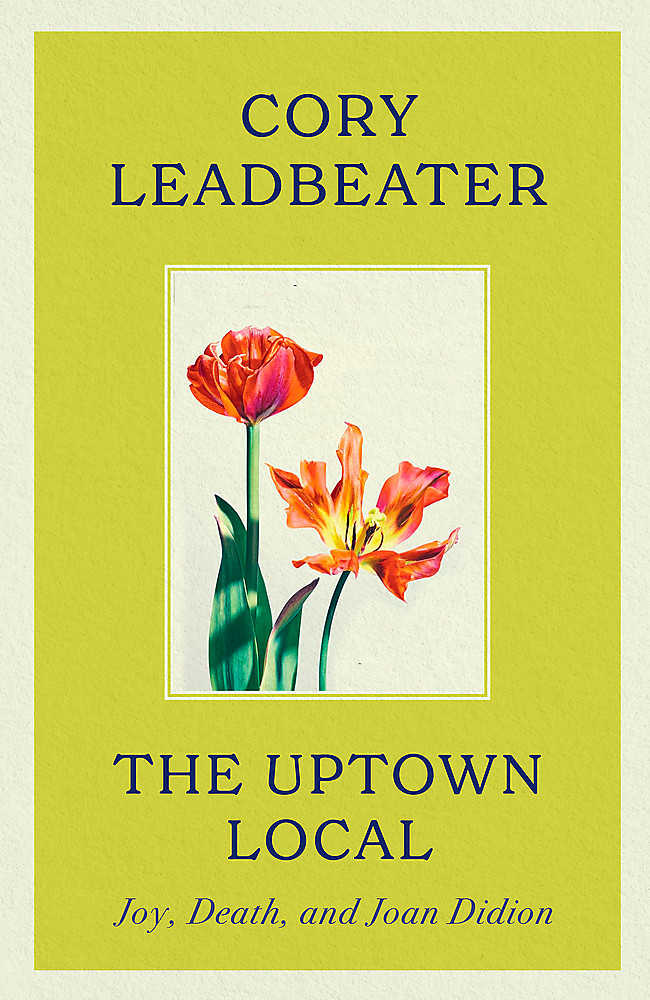
As an aspiring novelist in his early 20s, CORY LEADBEATER was presented with an opportunity to work for a well-known writer whose identity was kept confidential. Since the tumultuous days of childhood, Cory had sought refuge from the rougher parts of life in the pages of books. Suddenly, he found himself the personal assistant to a titan of literature: Joan Didion.
In the nine years that followed, Cory shared Joan’s rarefied world, transformed not only by her blazing intellect but by her generous friendship and mentorship. Together they recited poetry in the mornings, dined with Supreme Court justices, attended art openings, smoked a single cigarette before bed
But secretly, Cory was spiraling. He reeled from the death of a close friend. He spent his weekends at a federal prison, visiting his father as he served time for fraud. He struggled day after day to write the novel that would validate him as a real writer. And meanwhile, the forces of addiction and depression loomed large.
In hypnotic prose that pulses with life and longing, The Uptown Local explores the fault lines of class, family, loss, and creativity. It is a love letter to a cultural icon – and a moving testament to the relationships that sustain us in the eternal pursuit of a life worth living.
Read on for an extract.
************************
Orange tulips at the cross walks on park Avenue in spring, rustling from the force of passing taxis causing the blacktop to shake. Yellow roses beneath the back table of the dark bar, gifted to me in secret by an older woman who was engaged to another man. It was because my father had grown up on a gas station, where his father beat him so badly that he left home at 16, and one generation on, he was in prison while I lived rent-free on 71st Street with Joan, where she taught me about fish and the New York Review and love.
The magic was that I could afford cabs, that I had stumbled sideways into history, that I felt accepted and momentarily freed; the magic was reading the Times with a cigarette and a coffee in the early morning on a bench on 116th Street as cabbies changed shifts, or else huddling over drinks in the back room on Rivington while I waited for Billy Silvers to tell me what to do next; I fed birds with Carianne, I wrote poems to Margret Ann, I fell in and out of love with Frank and wrote four books that were rejected, one book that was accepted, a book that was bound to sell and many, many books that never sold; the magic of this period was, finally, the protective web Joan cast over me, the feelings of acceptance and validation, a buoy against an ocean of indifference, which drowns the deserving and the undeserving alike, and which has rules known only to itself.
There was also, to an almost equal extent, a creeping terror: for long stretches I was untying my shoelaces and crossing 72nd Street against traffic, hoping against hope that I would trip and fall beneath a delivery truck’s wheels; I would stand on subway platforms and listen to the train wailing near, the noise building, the squeal and rumble and gargantuan thrust just ahead, and I would listen with hope and feel myself shake and I would pray for the courage to at last leap out and kiss the 6.
Every three weeks, I would wake at 3 a.m. and drive three hours into Pennsylvania, through winding river valleys and thick tree-lined stretches of farmland, to visit my father in prison; Conor was dead and staying that way, Billy Silvers had alienated everyone I loved, Padraic needed a new kidney, Ben and Terry and Jerry had been arrested, Aleks was depressed, my mother was alone, Hannah left New York and moved to California.
And Joan, too – Joan still alive, Joan still decently well, but not thriving; each day we sat together and listened to Chopin or the Andrews Sisters or Nina, we read Auden and Stevens and Merwin, we sat at our Fifth Avenue bench just outside the Park while she gripped my hand, she smiled brightly at me, but she knew and I knew that at some point she would have to leave. We’d had a blissful period of eating dinners alone together, of smoking cigarettes and having wine alone together, but by then, those days were behind us. Everything was harder now for her, harder now for me, too. Will you believe me here if I tell you that I loved her? Will you believe me if I tell you that she loved me and it kept me alive?
I lived with Joan the first many years I worked for her, and moved out only when I met Liz, with whom I now have a child. Nine years. The nine years she was my boss – a job that was supposed to last six months. It was sometime in those first two years when she fell and gripped my hand and made me promise not to leave her; I did promise; I did not leave her. I had grown up with the belt and my father’s fury, with coupon clipping on Sundays and Rush Limbaugh on Mondays and hell to pay if we did not take the garbage out on Tuesdays, but Joan’s world was meant to have wiped my slate clean of all that.
How do I take stock now of what and who I became because of her; can I begin to reclaim a self that I negated over and over, of- ten times fractured beyond recognition, because of my time in her world? Others knew her longer, or in more productive periods, but during this time, and for reasons I still cannot see, it was me, I was the lucky one. I had grown up lonely and lower- middle-class, I had grown up with a ferocious father and a quiet mother and brothers I was vicious toward, I had grown up only with Dickens and Austen and Frost for fellowship, but for nine years, miraculously, I sat with Joan at the centre of a world I had dreamed of all my life.
I had thought I might eventually find myself healed there, but alone in her apartment three days after she died, I took down her Christmas tree through tears. The tears were because the metaphor was so obvious that it was just the kind of thing we would have laughed about together. You don’t picture her laughing, but I tell you: she laughed constantly.
ABOUT THE AUTHOR
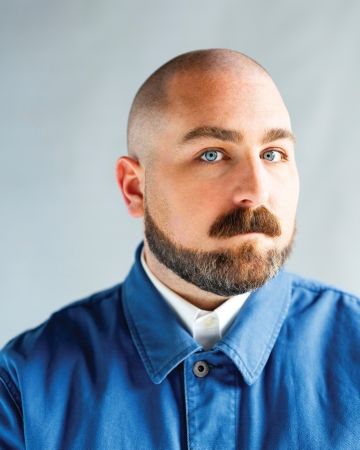 Cory Leadbeater received his MFA in fiction from Columbia in 2014, where he was the recipient of the Jacob P. Waletzky Fellowship. Before that, he attended Trinity College, where he was the recipient of the Fred Pfeil Memorial Prize in Creative Writing, the John Curtis Underwood Memorial Prize in Poetry, and the Ruel Crompton Tuttle Prize in Scholarship. He lives in New Jersey with his family.


0 Comments