


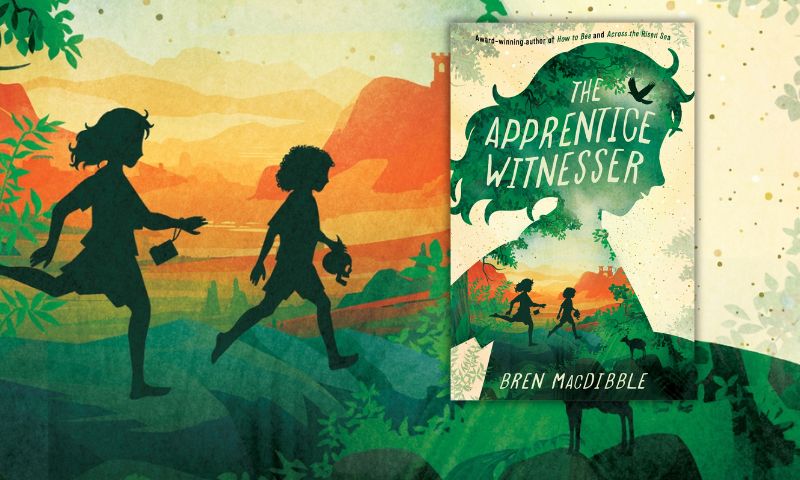
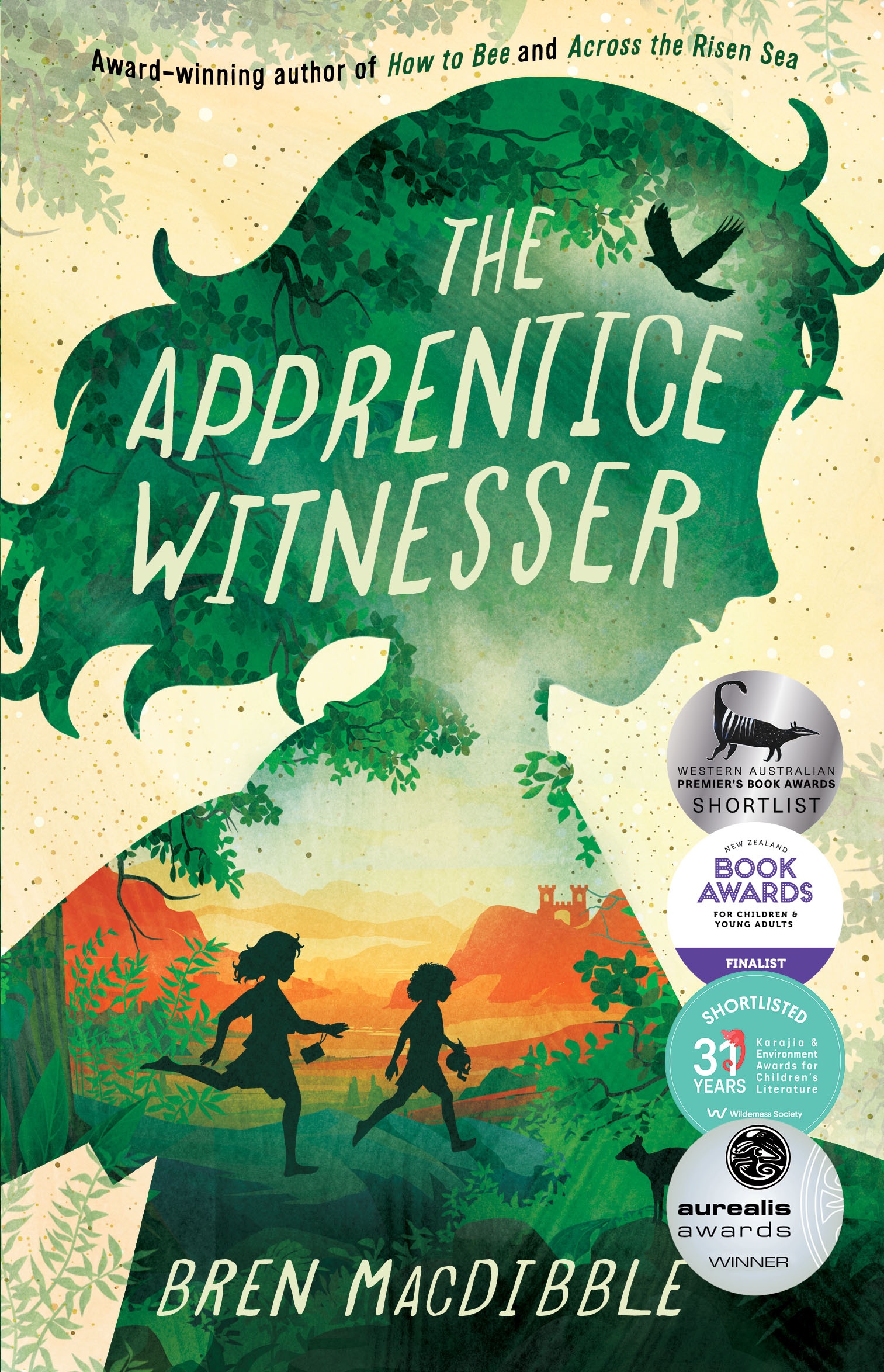
BREN MACDIBBLE’s book The Apprentice Witnesser follows almost 12-year-old Batienne Scull, an apprentice to the Witnesser of Miracles in a small village mostly populated by women and girls.
We caught up with Bren to ask her what she likes about writing and her latest novel.
Tell us where you live and what it’s like there?
I live in Kalbarri on the west coast of Australia. If you look at a map of Australia and see the sticky out bit half way up the west coast, I live just below that. It’s a very quiet part of the world. The town sits on a river mouth looking out at the Indian Ocean. It’s all blue sea, white sand, low scrub and rugged red rocks. It’s very simple and very beautiful. It’s warm all year, except when it’s too hot and it hardly ever rains. It can be very windy. Whales and dolphins are nearly always swimming past in the sea, kangaroo and emu roam the streets, lizards are everywhere, there’s lots of surfers and there’s lots of amazing hiking and rock climbing in the river gorge. I love it. I feel like I’ve left the world behind!
As a child, what did you think you’d be when you grew up?
I wanted to be a horseback performer or a writer when I was a child but I didn’t think I was smart enough. I was adventurous and broke a lot of bones and the radiologists, the people who work the x-ray machines, were always so nice, so I thought I should be like them. Then in high school, I didn’t do well at maths even though I excelled at biology so I gave up that idea too. Turns out I was just really good at giving up on stuff that I can actually do. The secret is practice. If you want to do anything you can practice your way into doing it. I didn’t practice maths but I did practice writing. My first books were terrible. But they were practice novels where I tried all the things I wanted to read in books.
What do you like most about writing stories?
I like to explore the future and what happens if something goes wrong. As a child I worried about the future a lot. I wanted to know what life might be like if the worst happened. And now that’s what I like to write. Futures where everything we hope won’t happen actually happens. Some people say that’s too scary for kids but I say it’s empowering because even though everything changes young people can still survive and thrive. I like to write adventures that hop along at a good pace with lots of thrills where I can really make the reader feel like they’re in the head of the main character, that the story is a real thing full of real emotions.
Tell us a bit about what you see around you as you write. Do you have a window to look out? A dog beside you?
I like to write at the kitchen table. The window there looks up a rugged and unpopulated coastline where Dutch ships wrecked themselves in times gone by. It’s perfect for day dreaming. I have a dog but all he wants me to do is finish writing and come play with him. Sometimes I’m so busy in a story that when I look down there’s 10 dog toys at my feet that my poor dog has tried to tempt me away from the story with. So he’s not a good helper. He believes in exercise, not sitting around! Maybe he knows humans need to move more?
What is your new book about?
It’s about an orphan named Bastienne who wants to help the woman she lives with mend her broken heart caused by the loss of her whole family. She is a strong and glamorous woman who has a show telling miracles in the night market. Bastienne is a very small girl but she is learning to travel around and collect and tell miracles too. The town they live in is mostly populated by women and children. Men go away to live in the hills to avoid a terrible sickness that mostly kills men. One day they are both called to travel to a neighbouring town and they discover something that changes their lives forever.
What inspired this story?
A lot of ideas inspire each story. I love the miracles of nature, obviously. One idea arrived early on in the covid outbreak, a doctor noted that men had weaker T-cells than women and children. T-cells help fight off infections and cancer and are part of the immune system. This made me wonder what would happen if all the men suddenly left the world. Another idea was the yearning young women around the world feel to live and travel safely alone as young men do. A simple thing but there has never been a time in history where this happened. I hope one day the world will be a kinder, safer place for everyone.
Your stories often include themes of the environment and the future. Why is this important to you and what do you hope as readers we take from your stories?
I hope my stories let readers explore ideas about what we want from the future, and empower them to talk about the things that can go wrong.
The future can be a scary place and adults have a terrible habit of turning away from things that look scary, pretending it will never happen, but how can we create the future we want or change if we can’t talk about it without fear?
Of course terrible things are happening to the environment, to the creatures and animals who live here, to people as well and most of that is man-made. If we made it bad, we can make it better. But only if we talk about it and share ideas without fear.
If young readers are talking about fictional stories, they can talk about their ideas in a safe space. They can build good thinking muscles. They might read this book and think of ideas for getting rid of plastics, making the world safer for all people, how to live more sustainably, and what humans really need out of life to be happy.
I don’t know what the future holds but I want young people to approach it with strong minds and good hearts. I hope my stories can help with that.
Download Teachers’ Resource – The Apprentice Witnesser
ABOUT THE AUTHOR
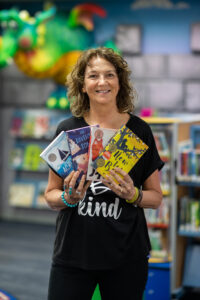 Bren MacDibble was raised on farms all over New Zealand, backpacked the world in her twenties, stopped off in Australia on the way home and stayed. She lived in Melbourne for 20 years, then travelled Australia living and working in a bus, and now runs holiday villas on the stunning coral coast of Western Australia. In 2018, How to Bee – her first novel for younger readers – won the Children’s Book Council Book of the Year Award for Younger Readers, the New South Wales Premier’s Literary Award Patricia Wrightson Prize for Children’s Literature, and the New Zealand Book Awards Wright Family Foundation Esther Glen Award for Junior Fiction. In 2019 The Dog Runner won the New Zealand Book Awards Wright Family Foundation Esther Glen Award for Junior Fiction. Across the Risen Sea (2020) was shortlisted for multiple awards and nominated for a CILIP Carnegie medal. The Raven’s Song (2022), co-written with Zana Fraillon, was an Honour Book for the CBCA Award for Younger Readers. Bren also writes for young adults under the name Cally Black.

0 Comments