



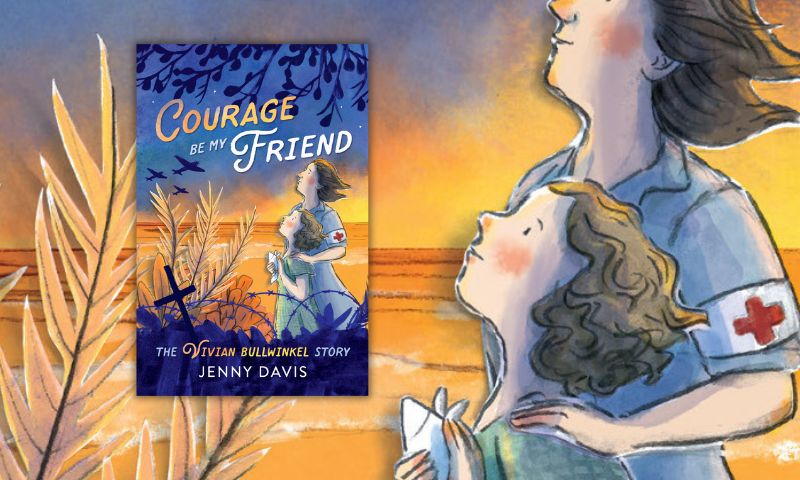
JENNY DAVIS’s book Courage Be My Friend is a moving retelling of the story of Sister Vivian Bullwinkel, through the eyes of 15-year-old Edith ‘Edie’ Kenneison.
We caught up with Jenny to ask about the real-life events that inspired her story.
Courage Be My Friend is set during WWII – can you tell us about the real-life events that influenced your story?
 In 1941 during World War II, Sister Vivian Bullwinkel joined the Australian Army nursing corps and was sent to a hospital in Singapore, in those days a British outpost where Australians were fighting alongside the British. The Japanese army was swooping through Malaya, but it was felt that Singapore was impregnable. Soon, however, Vivian and the other nurses were caring for wounded soldiers brought in from fighting the Japanese in the jungle, and in February 1942 the nurses were forced to evacuate in the face of the advancing enemy, and Singapore fell into Japanese hands. The last 65 nurses left as Singapore was being heavily bombed on a small British ship, The Vyner Brooke, along with escaping civilians, but it was really too late, since the Japanese had control of not just the land but also the sea and air. The ship was bombed and sunk. Some drowned, but after many hours in the water on life rafts or clinging to wreckage, remaining nurses and civilians made it to shore on Bangka Island in Indonesia.
Bangka was already in the hands of the enemy and most of the surviving nurses and civilians surrendered to the Japanese army and were now in captivity. Twenty-two nurses, including Vivian, stayed on Radji Beach to look after the wounded British soldiers, expecting the Japanese to arrive and escort them to a prison camp.
When the enemy soldiers did arrive, however, their officer ordered them to bayonet all the wounded British men. Then they forced the nurses to walk into the water and machine gunned them from behind. All died there in the water, except Vivian. She was wounded but the bullet missed her vital organs and she lay in the water until the Japanese had gone and then dragged herself into the jungle. There she found a British soldier still alive but wounded by the bayonets. For 2 weeks they managed to hide in the jungle with a little help of food from some women in a local village, but they knew they must surrender if they wanted any chance of surviving, so they managed to walk along the road until they were picked up and taken to the first of several prison camps where Vivian and the surviving nurses spent 3 years until the end of the war.
The conditions in the camps were dreadful and some died of starvation, fever and exhaustion. Vivian promised herself that after the war she would tell the world about the war crime on the beach, and all her life she worked to make sure those nurses were remembered.
Your story follows a real woman called Sister Vivian Bullwinkel – what can you tell us about her? And why did you want to write about her?
Vivian is inspiring in so many ways. Her courage and endurance in the face of such peril make her a worthy heroine, but also her entire life was dedicated to serving others and she worked hard to improve the nursing profession and mentor young nurses. All who knew her spoke of her gentle but commanding presence, her kindness, generosity and cheerful manner. I really wanted to help ensure that her legacy and the very moving story of the nurses on the beach and in the camps lives on and reaches a wide audience.
What are some of the biggest challenges Vivian faces in your story?
Vivian faces death more than once, survives drowning, suffers a painful wound without any medications, nearly starves and is at one point near death with fever and dysentery. One of her biggest challenges, however, is retaining hope, keeping up her own spirits and encouraging others to also keep hopeful. Another is her survivor guilt, why was she spared on the beach? A sense of purpose assists her: helping others and a passionate desire that those who died should not be forgotten.
Can you tell us about the relationship between Vivian and Eddie?
In the camps Vivian meets and befriends Edie, a lonely young girl of 15. She helps Edie survive, not just by nursing her through fever but by teaching her resilience and to find beauty in the world around her even at the darkest times. She gives Edie such strength that the young girl is also able to help Vivian when she needs it. The bond of friendship forged in those incredibly difficult and dangerous times remains of great importance throughout their lives.
What kind of research did you do for this novel?
I was fortunate that there are many accounts written and books published about the camps, some by the internees themselves, including a couple of nurses. There are also filmed interviews with nurses and Edie in historical archives, and there is Vivian’s own account of what happened on the beach, given at the War Crimes Tribunal after the war. I was also extremely fortunate to be able to interview some of the families of the nurses, both in WA and interstate. And, of course, there is a very great deal of background information about all aspects of the war available, so that reading widely and watching documentaries is always accessible to a writer on this topic.
What do you hope readers take away from your story?
I particularly hope that the reader will recognise the relationship between friendship and courage in this story, that the love and support of your friends helps provide courage in adversity, and that assisting and serving others, not just living for yourself, is a key to happiness and even survival. And I hope that readers are moved and inspired by the resilience of the human spirit.
ABOUT THE AUTHOR
Born in Surrey, England, Jenny lives in Perth with her husband and has had a 40-year theatrical career, appearing in many leading roles for all the major theatre companies in Perth, as well as productions touring around Australia, New Zealand and Brazil.
In 1993, Jenny founded Agelink Theatre – now THEATRE 180 – and has written many plays for them, including the original concept for The Lighthouse Girl Saga, combining stage and cinema screen. She has also been an acclaimed director for the stage for more than 30 years for many theatre companies, with some productions touring nationally and internationally, including her own plays, Dear Heart and Cis and Barbiche.
Jenny’s book Dear Heart (Allen & Unwin) was published in Australia and the UK.
She has appeared in many ABC radio dramas, was artistic director of the WA Youth Theatre for 10 years and writer for ABC schools’ radio for a decade. She has worked to bring generations together in theatre projects, inspired by the seniors in her life and her own children and grandchildren.


0 Comments