


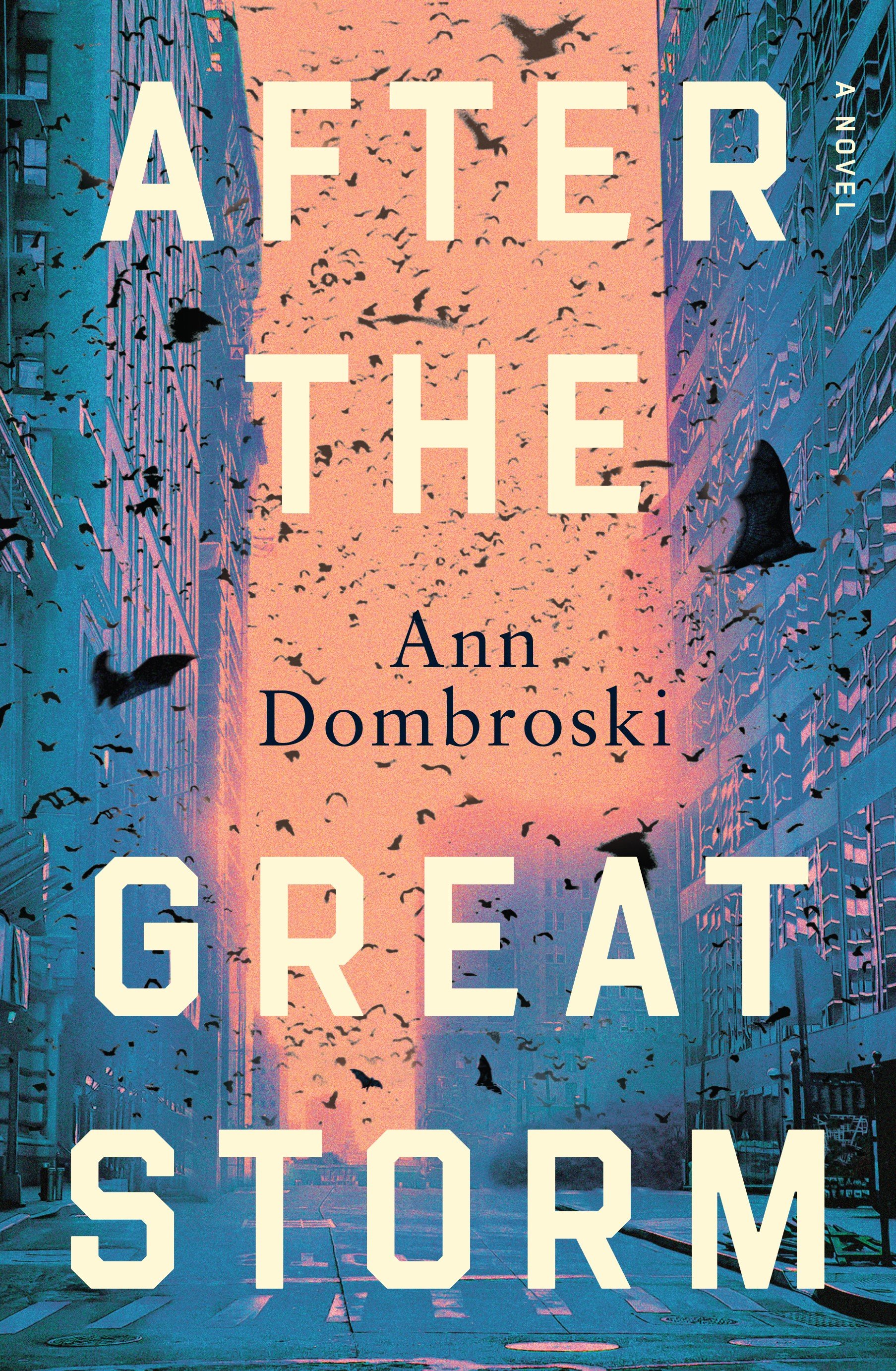
Sydney in 2075 looks, feels and works very differently to now – climate change has wreaked havoc; there are multiple technological advances, but morally and ethically, the city has regressed. Alice Kaczmarek is 40 and still yearning for a child. She’s on a trial for an anti-ageing drug and has embryos stored, but her partner, Daniel, is in prison serving a life sentence.
Alice works at a medical facility making patient-specific implants. Her work is prized by the surgeon, Dr Wu. She stays back at work during the fifth great storm, but cyclonic winds threaten to topple the building. She finally makes it home, only to find a dark shape on her doorstep. The ‘shape’ is a hybrid human: a female called ‘T’ who has had the wings of a flying fox experimentally attached to her in place of hands. She’s ill and wants Alice’s help.
Meanwhile, Daniel hints that there is evidence that will clear his name, and Alice needs to find it. Behind the running of the prison and the lab is a clandestine company willing to silence Alice, Daniel and T. While she finds the evidence to clear Daniel, her grandmother and T become gravely ill. Alice runs into financial difficulty with medical, legal and housing expenses. She finds money through questionable means and now is in even more danger.
Dombroski’s excellent writing ensures that her concept of Sydney 50 years from now is entirely credible. Her futuristic neologisms are note-perfect. Medical and engineering terms have solid etymological bases and read as if they already should exist. This is a beautiful story
of ethics, morality and love in its many forms.
Reviewed by Bob Moore
 ABOUT THE AUTHOR
 ABOUT THE AUTHOR
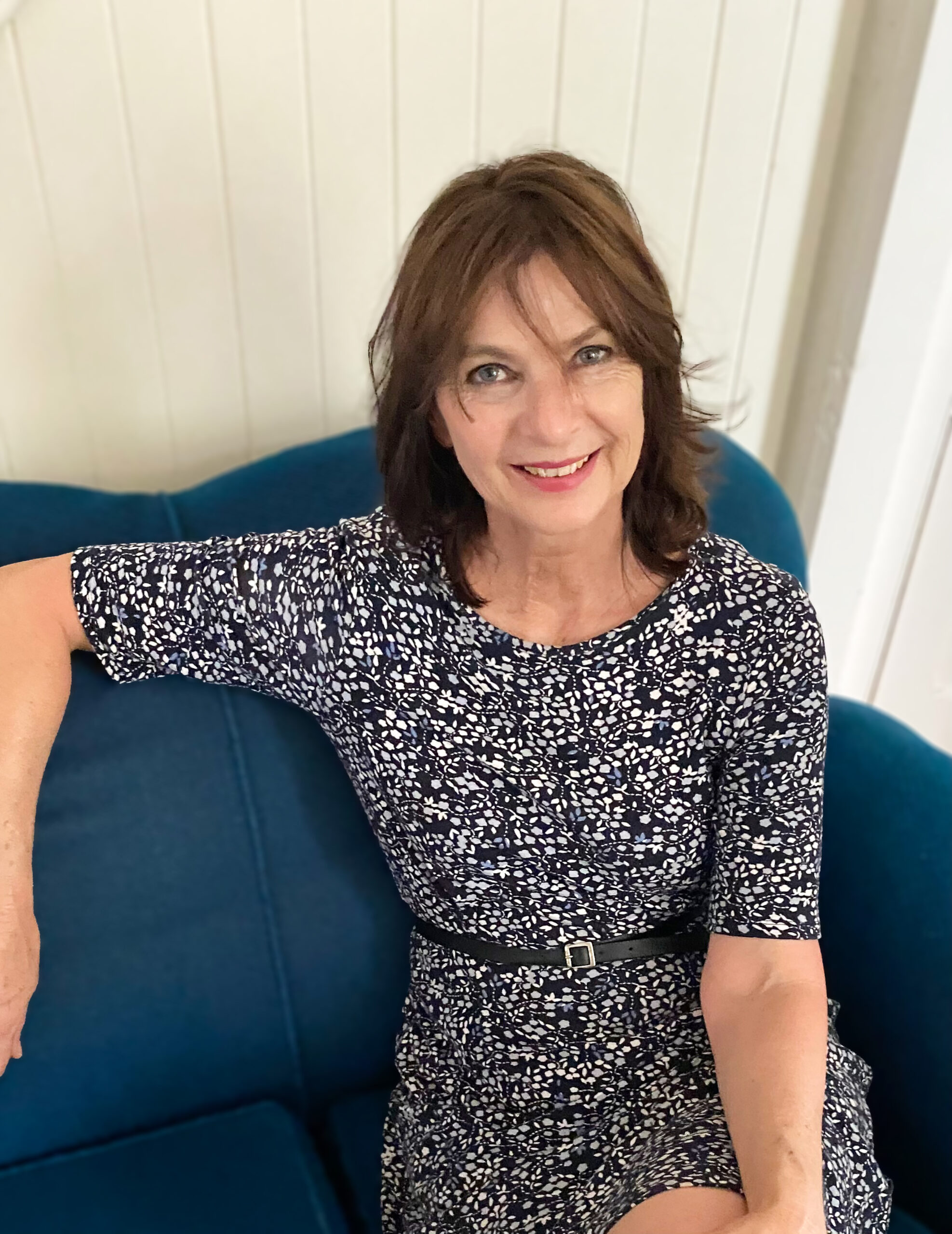
Ann Dombroski was born in Wollongong. She has worked as a teacher of English as a foreign language and as a teacher trainer in Australia and overseas. Her prize-winning short fiction has appeared in literary journals and anthologies. She was the recipient of a Varuna Fellowship and an Australia Council grant. She lives in Sydney’s inner west with her partner and has one son.
Read our reader’s reviews here
(4/5)
The book is set 50 years in the future and I found this novel quite compelling. Things written about in this book that are different to today include transport and food, however the human relationships and behaviours remain the same, bringing a sense of realism.
I particularly liked that the author constantly tells us what the characters are thinking, leading to more honest and abrupt feelings making themselves known.
The ‘Social Housing for the Elderly Without Accommodation’ is stark and reminds us to take care of our family.
The pace of the writing is constantly fast with no dithering.
(4/5)
This literary speculative novel is set in a near future world. We get a strong sense of the feel of this world, without any of the details of how we got here. We get some hints in the background. The story opens during the “Fifth Great Storm,” but we don’t need to know about the other four. There’s new technologies and importantly for our story, new diseases and medical advances.
Alice is a hospital employee, with a lot going on. She is trying to get her husband out of prison, get access to use her stored embryos for IVF, and then some monstrous creature – an “uninvited guest” – slouches up to her door.
It’s not a plot driven book, but the foreboding sense keeps you turning pages. The writing is dripping with evocative biological terminology. Words like “viscous”, “membranes”, “webbing” and “skin-suit” create a visceral sense of dread.
The magic wore off a little in the second half, as the story lost some of its urgency. But I still highly recommend this to readers who enjoy something beautifully written, that is strange and new.
(2/5)
It felt like the book started in the middle of the story. I could not connect with the story or Alice at all.
(1/5)
I stopped reading it. The characters didn’t grab me from the start, but more importantly I felt the start didn’t give me insight into what year this was, where was this set, to the point where about 17 pages in I had to read the back of the book for the description again. I thought to myself isn’t this meant to be a psychological thriller but it was coming across as a sci-fi book, something set in the future/in a different time judging by the T character, the names of some characters, the sliders.
I just felt I couldn’t connect to the characters to want to keep reading to find out what it was about because I needed more at the start. I flicked through to some later pages to see if there was anything that gave me some interest of what’s to come and it didn’t.
(4/5)
After the Great Storm by Ann Dombroski has an original premise that grapples with interesting ethical issues. Alice wants a baby by her husband who is serving time in prison. She’s convinced his conviction was wrongful but orchestrating Daniel’s release is only one of her options. In the meantime, she also meets T, the subject of a medical experiment who has a connection to Daniel.
An important theme in the book is medical ethics. Trust and corruption are others. I enjoyed the world-building and found it an interesting story, the style of which made an unusual world very realistic. T’s situation, I felt more strongly about than Alice’s and Daniel’s. It was an interesting and imaginative world created with real issues in a somewhat unreal setting.
The story is well and plainly written. I felt the dialogue was smooth and realistic. There are plenty of opportunities to get inside Alice’s head which is important as all the dilemmas are for her. However, for some reason, I felt there was a lack of urgency surrounding Alice’s dilemmas which would have made the story more compelling.
(3/5)
Set in the near future, this novel offers a thought-provoking look at how innate human components (love, morality, ethics) clash within dystopian societies.
With her husband locked up for a crime he (allegedly) didn’t commit, a biological clock ticking into overdrive, a human experiment taking refuge in her house, and ever-increasing debt, Alice is caught up in a maelstrom of emotion and intrigue. With questionable solutions being offered by various people she thought she could trust, Alice will need to decide how far she is willing to go and how much she’s willing to pay for what she wants.
I found this book thoroughly enjoyable and quite thought-provoking. It was easy to believe the dystopian future portrayed as we are already seeing elements of it in its early stages being played out now. By basing a lot of the conflict on emotional states, the author makes this book relatable to all readers as it is easy for us to contemplate what we would do if faced with the same situation and options. The only downside is that all the loose ends were tied up a tad too conveniently and orderly.
(4/5)
An easy read that could be a sneak peak into our not-so-distant future. I’m not usually a fan of anything sci-fi but this felt different – it was somewhat realistic and provided a slightly scary insight into what our country may look like in 50 years. I could barely put the novel down and felt an attachment to many of the characters. I felt like the ending rounded out the story well.
(5/5)
Wow – such a delight to read! Lots of twist and turns. At first I was concerned it was going to be far-fetched. The main character Alice has a lot to get through, without giving the plot away, she is a joy to read about. Ann Dombroski, congratulations on the book! I will definitely recommend to everyone.
(3/5)
This story is set in Sydney about 100 years from now. It is the story of Alice who is trying to get pregnant whilst her partner, Daniel, who is serving a life sentence in a maximum security jail for the death of passengers on Sydney’s’ new transport system he tried to prove was faulty, and the relationship between Alice, Daniel and a person named T who had a xenograft with a flying fox.
Alice soon learns that no one can be trusted, and has to work things out for herself, and try to keep her morals.
Whilst this story is very readable and involves you, there are moments of hope and sadness in this book, I found the plot very unbelievable, even if it is set in the future, I do like plausibility in my stories.
To tell any more of the plot would spoil reading it for you.
(3/5)
This book, set 50 years in the future, failed to engage me. I found that the characters were not well developed, and I really wished the editor had cut some of the irrelevant details. There were numerous undeveloped storylines, including a woman longing for a baby, a misguided star who believed that submitting to grotesque surgery would allow her to fly, a corrupt medical system, and a future where the elderly poor were sent to remote locations to fend for themselves. Nothing truly connected. Although this is not a genre I would normally read, I still cannot recommend this book due to its disjointed themes. The concept of societal corruption is a strong one, but I feel this book ultimately failed to deliver on that promise.
(2/5)
Usually a book can hook me by page 2 but this book was a slog to read. The so called intrigue by hinting at what happened and that her husband was innocent of something major did nothing for me. If I could have put it down I would have.
The dystopian future was blah and there was not enough interest in the “deepening” mystery for me to invest. I found the protagonist boring and more than a little one dimensional. The ending was mundane and bland as the rest of the story.
(4/5)
I started reading Ann Dombroski’s debut novel After the Great Storm, on a truly stormy night. I was struck by her great skill in describing the first and the subsequent storms; feeling their intensity, and fear each one.
Yet the peaceful closing scene is equally well written; evocatively, serenely, and with charm.
Her style is easy and projects immediacy. The pacing is fast, through the short chapters.
The dialogues are crisp; interlaced with her own thoughts, in italics. It highlights her desperation, at her lack of authenticity; because of her, and her much-loved husband, Daniel’s, mutual goal. Her moral campus fluctuates by necessity; she realises the necessity for compromise.
The author cleverly sets Alice’s ‘minor’ misdemeanours against the backdrop of the totally reprehensible behaviour; of a corrupt medical world.
The storm is also a metaphor for the storms in Alice’s life; blow after blow…
Alice, herself, admits; … she tried to compartmentalise her problems,….
– a new lawyer for Daniel, palliative care for T, the embryo transfer, a robot for Vinnie – but all the solutions boiled down to a singe issue: money.
The unusual storyline may, at first, appear to be fantastical, but the author successfully builds it on pillars of reality, with great imagination.
(4/5)
After the Great Storm by Ann Dombroski is a psychological thriller that takes unexpected turns.
The novel is set in Australia in the year 2075. Alice, a hospital employee, is forty-years-old. Alice’s husband, Daniel, is in prison serving a life sentence for causing an accident on Sydney’s transport system. She believes Daniel is innocent.
The book is engaging from the beginning. The story unfolds gradually and I became more and more invested in Alice as the plot rolled along.
After T, the subject of medical experimentation, turns up at Alice’s house it seems to her that everyone is corrupt. Plus, she learns of a connection between T and Daniel.
The novel tackles many interesting ethical issues. And makes you wonder where we are heading today.
After the Great Storm isn’t my preferred genre but I still enjoyed this book. It is an unusual story which fans of psychological thrillers will love.
(4/5)
After the Great Storm by Ann Dombroski is certainly not a book I would have chosen to read, by just having read the back cover description. I usually enjoy psychological novels, but this one deals with threat, intrigue, darkness, and light.
The novel is set in 2075, and all around, people, their jobs, buildings, EVERYTHING is quite unfamiliar to what we are used to now, today, all around us. I became quite anxious in parts as I was reading.
The main character, Alice, lives alone and her husband has been incarcerated for a life sentence in Maximum Security of which he has pleaded not guilty. They didn’t have the money for a good lawyer and Daniel is now counting on his wife to do what she can to get him justice and freedom. The world she lives in is corrupt and murky.
As I have mentioned before, this is not my usual choice of book selection but I am pleased that I persevered to finish it — it challenged me. I needed to see whether when corruption becomes endemic, how can we save our own moral code?
(2/5)
I struggled with reading After The Great Storm. While I appreciated the future timeline that Ann Dombroski crafted, I felt the narrative lacked a focused depth, especially in the way Alice’s story was told. I found that Alice’s story had too many elements happening simultaneously which prevented any one aspect from being deeply explored, instead, these were merely a ‘scratching of the surface’. This didn’t allow me to form any real connection with Alice and her story and the short and sharp chapters contributed to this. There were a few sections that I found had no overall bearing on the story itself and could have been omitted without any material impact on Alice’s journey.
I would have preferred fewer elements allowing for a deeper exploration of the story.
The premise of the story was good, however I feel the execution could have been done better.
(4/5)
I found After the Great Storm to be an enjoyable and compelling read. The storyline had me hooked very quickly, and I really wanted to keep reading to find out what happened and how it would all come together. The future presented by Ann Dombroski in the story, whilst a little bleak, was very believable and I found the possibilities quite clever. Overall, I would have liked a little more closure, but definitely a book I’d recommend reading.
(4/5)
A very futuristic read set in 2075 with loads of AI, robots, self-automated gadgets, a concrete jungle hardly any greenery in the city, human experimentation, greed, love, lust, power, and numerous underlying emotions.
Alice and Daniel are the two main characters facing two different realities; Alice is free though Daniel is in prison. The system Alice has to go through to see him is very technologically advanced: airopods for transport, full hand scanning, and more.
Alice wants a baby so is trying IVF and at the same time is trying to prove Daniel’s innocence of crime while he is in jail.
Alice has an unexpected guest arrive on her doorstep which sets off many unusual events.
I thoroughly enjoyed the book.
(3/5)
Alice is facing quite a few challenges in her life, her partner Daniel in jail, the appearance of an uninvited “guest” turning up on her doorstep, and medical dilemmas and issues.
The world that you’re taken into is one in the future, with advanced technologies, no houses, just towering apartment blocks, and a world where each “great storm” is potentially worse than the last.
Alice faces a lot throughout the book and in some parts it had me thinking why is this being told or why didn’t we get more information on that, but ultimately the last few chapters start to come together and everything starts making sense.
After The Great Storm wouldn’t normally be a book that I would choose for myself, but in the end I’m glad I read it.
(5/5)
At first, I didn’t know if I’d like this book, but I ended up really enjoying it. The writing is strong, the storyline is original, and the characters are very believable – especially Alice, with whom I felt a connection. I don’t often write a review online, so it shows how much I enjoyed reading After the Great Storm. I would definitely recommend this book.
(5/5)
What is refreshing in this literary, near-future novel is that you find yourself immediately plunged into Alice’s world… an imaginatively realised world, where things are both familiar and strange. There is no awkward exposition mediating between you and this world nor is there a pre-conceived ideology. You just take the ride with Alice, share her scientist’s dispassionate curiosity, and you find yourself in fascinating territory.
Interesting questions arise such as: How do we recognise humanness? Can a computer be a real friend to an autistic boy? Can you continue to love someone who is morally suspect?
The relationship between “T” and Alice is especially intriguing, with “T”’s entrance visceral and astonishing.
In fact images of “T” remain, housed, for later contemplation, in some liminal space in my mind …
(5/5)
A great read. What a ride! Highly recommend
(5/5)
If you’re looking for a story that captures the resilience and creativity of the human spirit, After the Great Storm, is is on your reading list. It manages to be both heartbreaking and profound. It avoids clichés, opting instead for an honest look at how communities rebuild when everything they knew from previous generations is being washed away.
You’ll find yourself deeply invested in the journey; feeling every setback and celebrating every small, hard-won victory.
It will linger in your mind long after the final page..