

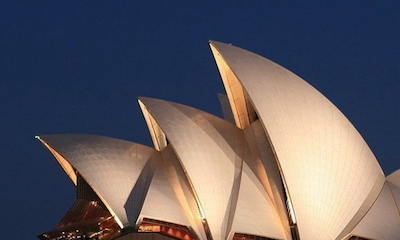
A bitter feud between politicians, Sydneysiders, Alan Jones and the Opera House has raged over the weekend. As the NSW government forces the heritage-listed building to agree to project a horse race ad onto its iconic sails.
The House did agree to project the colours of the jockeys in the race onto the building. However, they refused to go as far as projecting horses’ names and the event logo.
But the government has forced the Opera House to comply with the promoters of the race and project the full advertisement.
Punters from all corners of Australia have weighed in on the fracas. Alan Jones lambasted Opera House manager, Louise Herron, for her reluctance to let the full projection play out on the sails. Whilst also calling for her sacking. Prime Minister Scott Morrison said controversially: ‘Why not put [the advertisement] on the biggest billboard we have?’
Conversely, a change.org petition has gathered over 130,000 signatures from Australians dismayed at the idea. Protesters are planning to gather around the Opera House and shine torches onto the building, with the hopes of cancelling out the projection.
Author Kristina Olsson remembers the initial controversy of the Opera House as the country quarrels. A building, which was known as a construction never to be completed. She recalls how the construction brought Sydney-siders of all stripes together.
‘The men working on the Opera House, especially the migrants, so many of them loved it from the very beginning,’ Kristina told Good Reading.
Last week Kristina launched Shell, her novel set in the mid-1960s around the construction of the House. The novel investigates the era of protest and our changing cultural identity. Kristina says, as politicians sought to foster fear and division by sending conscripted young men to war in Vietnam, the Opera House was a uniting force for many ordinary Australians.

‘There was division being engineered between different groups of people. The Opera House represented the opposite of that. Because here are these people, of all different nationalities. Who 20 years before had been shooting at each other, and were now forging not just work-day acquaintances, but friendships. They’d left that war behind and somehow been able to recreate themselves in this place.’
The Opera House is the centre of her novel as a symbol of a changing Australia, and the construction of a building that put Sydney on the world map.
‘Why would you come to Australia in the 60s? Kangaroos I suppose. But you wouldn’t ever say in the 60s that you came for a cultural experience. You’d come for drinking beer and lying on the beach. The Opera House changed all that.
‘Even if you don’t ever go inside and hear an opera or see a piece of theatre, it’s a cultural moment when you feel something around that building.’