



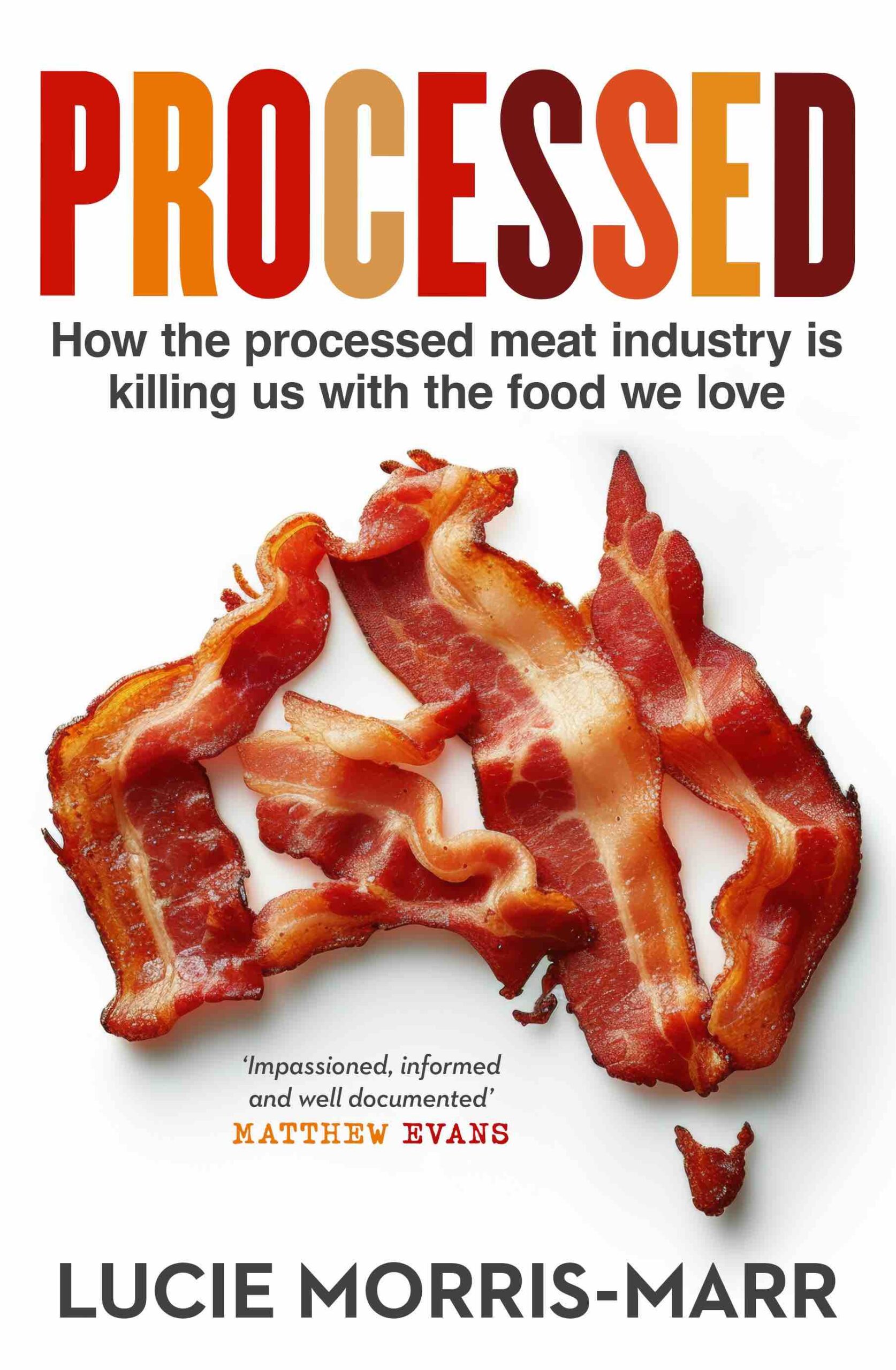
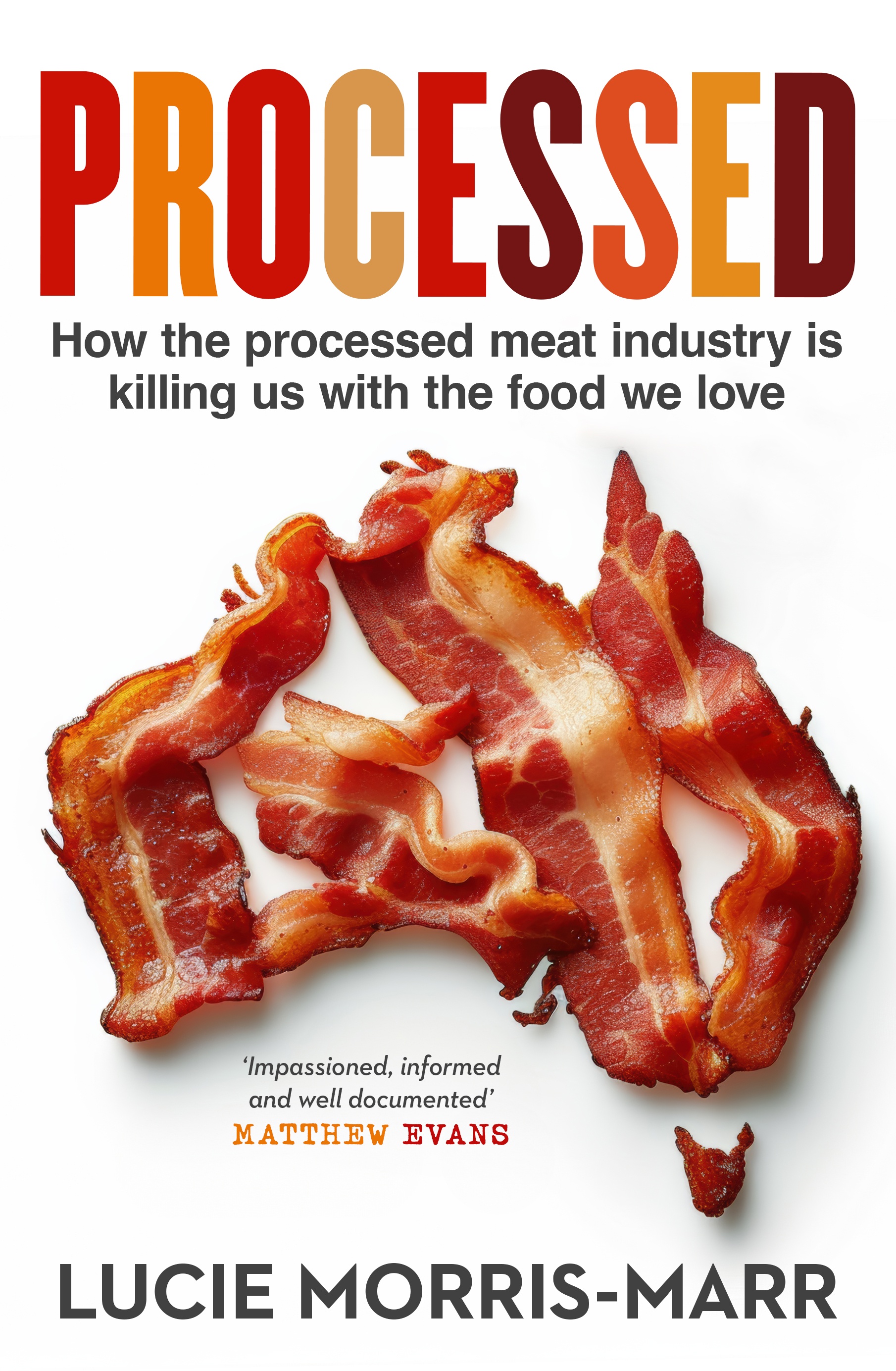
They’re totally delicious. We love crispy bacon with our eggs for breakfast, ham sandwiches for lunch and snags on election day. Lucie Morris-Marr’s family was no different, ordering pepperoni pizzas on Friday nights and putting salami on their summer picnic platters.
Read on for an extract from Lucie’s eye-opening new book, Processed.
ABOUT THE BOOK
When the Walkley Award-winning investigative journalist was diagnosed with advanced bowel cancer, she learned the chilling truth about our love affair with processed meats.
As Lucie fights for her life, she takes us on a jaw-dropping ride, uncovering the scientific evidence linking our deli favourites with cancer and other serious conditions. She shatters the strange silence enjoyed by the billion-dollar industry that profits from our health risks. Armed with interviews from local and international experts, she asks tough questions about controversial preservatives, fast food, cooking methods and just how processed meats became so embedded in our lives.
With tips on making the transition to healthier foods, Processed is essential reading for anyone who cares about their health.
**********
TAKE AWAY THIS
Apparently, our Italian @mcdonalds fans loved the Crispy McBacon so much that they’re getting tattoos of it . . . that’s a true sign of approval!
Chris Kempczinski, CEO, McDonald’s, 14 July 2023
TOO HOT TO HANDLE
Deep in the Okavango Delta in Botswana, I reached for a stick to stoke the smouldering branches on the fire as darkness drew in.
The flames went up briefly, the smoke lingering in the balmy night air. My friend and I had already cooked our supper of rice and beans in a small pan over the flames, sharing it with our magnificent local guide. The father of three was leading us on an incredible canoe safari through the annually flooded terrain of this extraordinary and unique part of Africa. It was an experience so vivid, so intense, that it has remained clear in my memory nearly twenty years later.
We had no running water, no showers and no access to cooking facilities. In fact, we didn’t even see another human being in five days.
This romantic and somewhat daring adventure also had a twist of danger in its midst—our guide had to keep the fire going all through the night to ward off African wildlife, including lions and herds of elephants. I spent much of the latter part of the trip fearing for my life after an enraged hippo had lunged towards us on our canoe and nearly attacked us when we ventured too close to its offspring . . . but that’s another story.
The only reason we didn’t have to sleep high up in the trees with the monkeys and baboons each night was the fire. It enabled us to sleep at ground level in small canvas tents. It also gave us warmth, the ability to prepare hot food, and a sense of comfort and safety.
The first stage of human interaction with fire is a point often argued among experts but it’s generally considered to have occurred as early as 1.5 million years ago in Africa. It’s also likely to have been opportunistic, by all accounts.
 While our closest living relatives, the chimpanzees, live on a diet of foods such as fibrous and bitter leaves, grubs, fruit, raw monkey meat and brains, humans have an almost endless list of food options.2 We also have techniques for changing their composition through the use of heat – cooking – which have propelled us towards our modern addiction to processed meat.
When we cook food, more energy is extracted from it, so our bodies don’t need to expend so much energy in digestion. In meat, heat breaks down collagen, its connective tissue, and cooking plants softens the cell walls to release their starch and fat. Cooking also kills off parasites and bacteria in our food.
There were certainly other advantages to cooking over an open flame: it starts the process of breaking down protein and makes nutrients more readily available, after all, the expanding hominin brain needed all the help it could get.
By releasing the potential in meat by roasting it, early hominins were able to feed their growing brains—the body part that uses up to 20 per cent of our calories.
Fire would also have been useful for light, for warmth at night, and for frightening off predatory animals – just as I had experienced firsthand in Botswana. Early humans could then sleep safely on the ground. Smoke, too, proved to be useful, keeping insects away, just as it does in campsites across Australia today as families try to combat mosquitoes.
As geologist Andrew C. Scott wrote in Time magazine, ‘This ability to “stretch” fire was a novel feat, only developed by humans.’
Evidence shows that food then started to be cooked on hot stones in this early phase, according to Guy Crosby, an adjunct professor of nutrition, in his book Cook, Taste, Learn.
Around 30,000 years ago ‘earth ovens’ were then developed in Central Europe, Crosby says, to cook a wide array of beasts including large mammoths.
‘This was clearly an improvement over rapidly roasting meat by fire, as slow cooking gives time for the collagen in tough connective tissue to break down to gelatin’, which ‘makes the meat easier to chew and digest’, the author wrote.
Indeed, it’s clear fire didn’t just make meat more digestible; it also brought people together to eat, laying the foundations of human society. And cooking meat over a flame has been bonding us ever since, from elaborate feasts to Sunday roasts and casual barbecues. In short, we discovered the flame and there was no turning back.
Thanks to the chemical process known as the Maillard reaction, our meat went from raw and chewy to crispy, tender, and far easier to eat and digest. It’s a reaction that produces an utterly addictive result, argues Marta Zaraska in her book Meathooked. She says it’s the marriage between ‘carbohydrates and amino acids in a slightly moist, hot environment (between 300 and 500 degrees Fahrenheit), which produces aromas so delightful they make us go weak at the knees’.7
But here’s the problem with heat, flames and meat: the combination can in certain circumstances cause cancerous end products which are linked to cancer, as it turns out. For example, you might not be aware that fried bacon contains more of the carcinogenic substances called heterocyclic amines (HCAs) than any other cooked meat. It also contains high levels of advanced glycation end products (AGEs), another group of substances linked to cancer.
Both HCAs and AGEs are produced by the Maillard reaction. The reaction causes browning, so cooking methods that involve little browning also usually result in fewer HCAs and AGEs. ‘So your cancer risk could depend on how you cook your bacon,’ writes nutritionist and lecturer Richard Hoffman – and how you cook other processed meats such as sausages. Lightly cooked and ‘lightly browned bacon has only one-tenth the HCAs of well-cooked bacon’. Grilling under a naked flame may also be a bad idea, as the drying effect and the high temperature also increase HCA formation.
These are the sort of vibe-killing facts that would send those bacon addicts on Facebook into a full-scale frenzy. Especially when it’s likely that the dreaded microwaved bacon has far lower levels of AGEs than fried bacon.
Sadly, bacon – the meat capable of turning vegans into meat- eaters from its aroma alone – is just not coming out of this well, is it?
Australia’s Cancer Council gives a clear warning to the public about charred meats in particular. ‘Heating meats at high temperatures may result in the formation of mutagenic chemicals, thus consumption increases the risk of cancer. Cancer Council recommends as a precaution avoiding charring food while cooking.’ Eating grilled or barbecued meat and fish has also been associated with a possible increased risk of stomach cancer.
While I applaud major charities giving out this advice, the Australian Government and the meat industry have been well aware for some time that the public may be causing themselves harm, due to the way they cook items after purchasing them.
Buried in that explosive 2020 CSIRO report, the one jointly funded by Meat & Livestock Australia and the government, which suggested ideas to replace nitro-preservatives in processed meats, they also note there could be ways of cooking which could reduce cancer risks.
‘. . . studies have shown that boiling (lower heat) or micro- wave (indirect heat) produces fewer n-nitroso-compounds than direct heat application by deep-frying and pan-frying of dry-cured raw sausages,’ the report states.
This came out nearly half a decade ago now, so where are the advisory or warning labels? Has more research and develop- ment taken place? Don’t worry, they’ll be getting a deep-fried missive from me soon enough.
But it’s not just high temperatures and charring that increase the risk. There is a particular new trend that is also causing alarm.
SMOKE SIGNALS
Look, I get it. I do. There’s nothing like the smell of smoked meats. Barbecue smokers are currently a huge and growing backyard trend all over the world, a common Father’s Day gift for the man who has everything. At Bunnings stores they range from as low as $50 for a simple version to $1400 for one of the most elaborate types: the Oklahoma Joe’s® Longhorn Combo Charcoal/Gas Smoker and Grill.
‘Equipped with both a charcoal and gas grill chamber and an attached offset firebox, this multi-purpose smoker and grill allows you to barbecue your way,’ says the description on the Bunnings website. ‘Built with durability in mind, porcelain-coated cast-iron grates and heavy-gauge steel construction ensure easy cooks and delicious food every time.’
The reason these contraptions are so popular is that meat can be preserved by ‘smoking’. If the smoke is hot enough to slow-cook the meat, this will also keep it tender.
Of course smoking helps seal the outer layer of the meat making it more difficult for bacteria to enter and can be done in combination with other preserving methods such as salting.
There are multiple smoking styles including cold smoking, hot smoking and smoke roasting (pit barbecuing). But put down that pork belly: there are some serious health concerns you should know about before planning your next smoky feast. Smoking meats also renders them ‘processed’ – and, yes, that means there are health risks too.
In a rather confronting article published in 2022, dietician Gillian Culbertson states the case against smoked meats in rather blunt terms.12 Culbertson works at Cleveland Clinic, a well-respected medical and academic centre with branches around the US and globally.
Smoked meat, the article begins, is ‘contaminated meat’. ‘The smoke itself is a source of contaminants that can be harmful,’ Culbertson explains, forming HCAs – which we know from the Maillard reaction – and polycyclic aromatic hydrocarbons (PAHs). Both are harmful by putting you at risk of cancer, forming when meat is cooked at high temperatures.
Though grilled and pan-fried meats can also lead to the formation of PAHs and HCAs, during the smoking process, the smoke creates both these substances, carrying them onto the surface of the meat. Certain wood types, such as beech, acacia and eucalyptus, may be less risky but it also depends on temperatures and moisture content as to whether PAHs are formed.
‘High exposure to these compounds can lead to increased risk of cancer of the intestinal tract, notably colon and stomach cancer,’ Culbertson says. ‘Some recent research also suggests that red and processed meats, including smoked meats, may increase your risk of breast and prostate cancer.’
As an interesting side note, it’s not just smoking meat which has got experts concerned; fears also extend to smoked cheeses and smoked fish too, which is a blow personally as smoked salmon has been my bacon replacement at brunch now for a few years.
A 2022 review by fisheries researchers at Ege University, Turkey, reported that during the process of smoking fish, carcinogenic PAH compounds can be formed. ‘Reducing the temperature in the smoking oven and using a special filter system . . . also reduces the formation of these components,’ the authors wrote.
I’m afraid the news isn’t any better for those who enjoy the distinct flavour profile of smoked meats of any kind; in April 2024 eight types of smoke flavourings were banned for use in the EU, following scientific assessments by the European Food Safety Authority. They had ‘genotoxicity’ (the risk of a chemical agent to change DNA and lead to cancer) concerns over the flavourings, which can be added to a wide range of foods including smoked cheeses and smoky bacon flavoured chips but also processed meats such as hugely popular smoked sausages.
The smoked meats industry in the EU now faces a very precarious balancing act of meeting consumer demand, while also making sure ingredients are safe and adhere to the safety of its ingredients in line with the new rules. Businesses will have to seek safe, more natural alternatives, yet whether this ruling will influence Australian or New Zealand food processing methods is yet to be seen. That revealing 2020 CSIRO report admits PAH content is ‘not something that appears on a retail label’, because the amount, ‘if any’, depends on several factors.
Some readers may well be aware however of news reports on the risks of smoked products, nitro-additives and cooking at high temperatures. But based on the many conversations I’ve had with friends and contacts, there seems to be a gigantic gap in awareness around most meat-related health risks.
And one thing is certain: if there’s one market constantly expanding in Australia, and all over the world, that is heavily influencing our consumption of processed meats, it’s the fast- food industry. It’s something which, as the mother of two teenagers, I have come to know well.
 ABOUT THE AUTHOR
 ABOUT THE AUTHOR
Lucie Morris-Marr is a Walkley Award-winning investigative journalist, and she was twice highly commended as Young Journalist of the Year at the British Press Awards. After moving to Australia as Associate Editor of Marie Claire, she went on to report for the Herald Sun and The New Daily. She is the author of Fallen: The inside story of the secret trial and conviction of Cardinal George Pell. She is also a bowel cancer advocate and patient mentor. She lives in Melbourne with her family.


0 Comments