


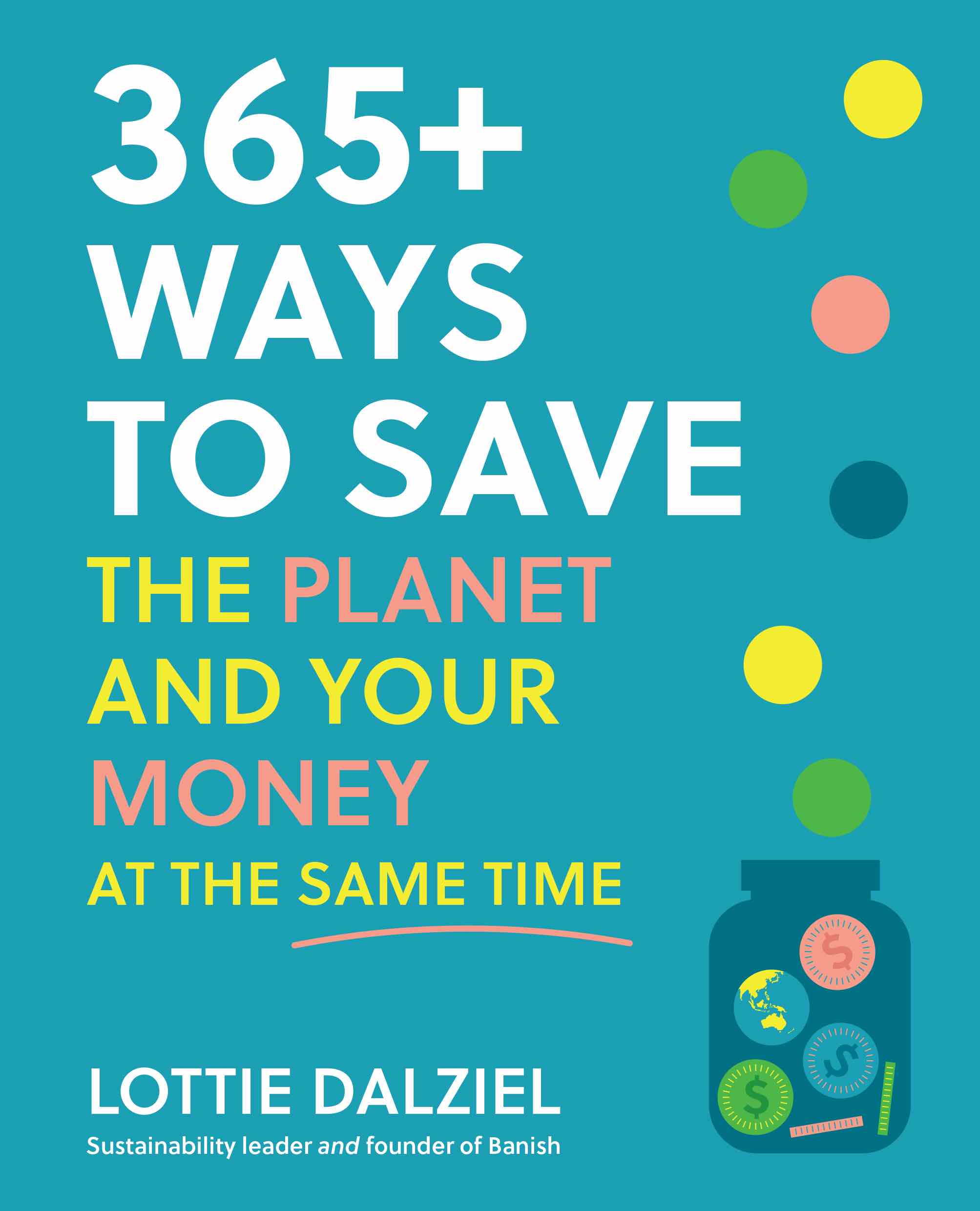
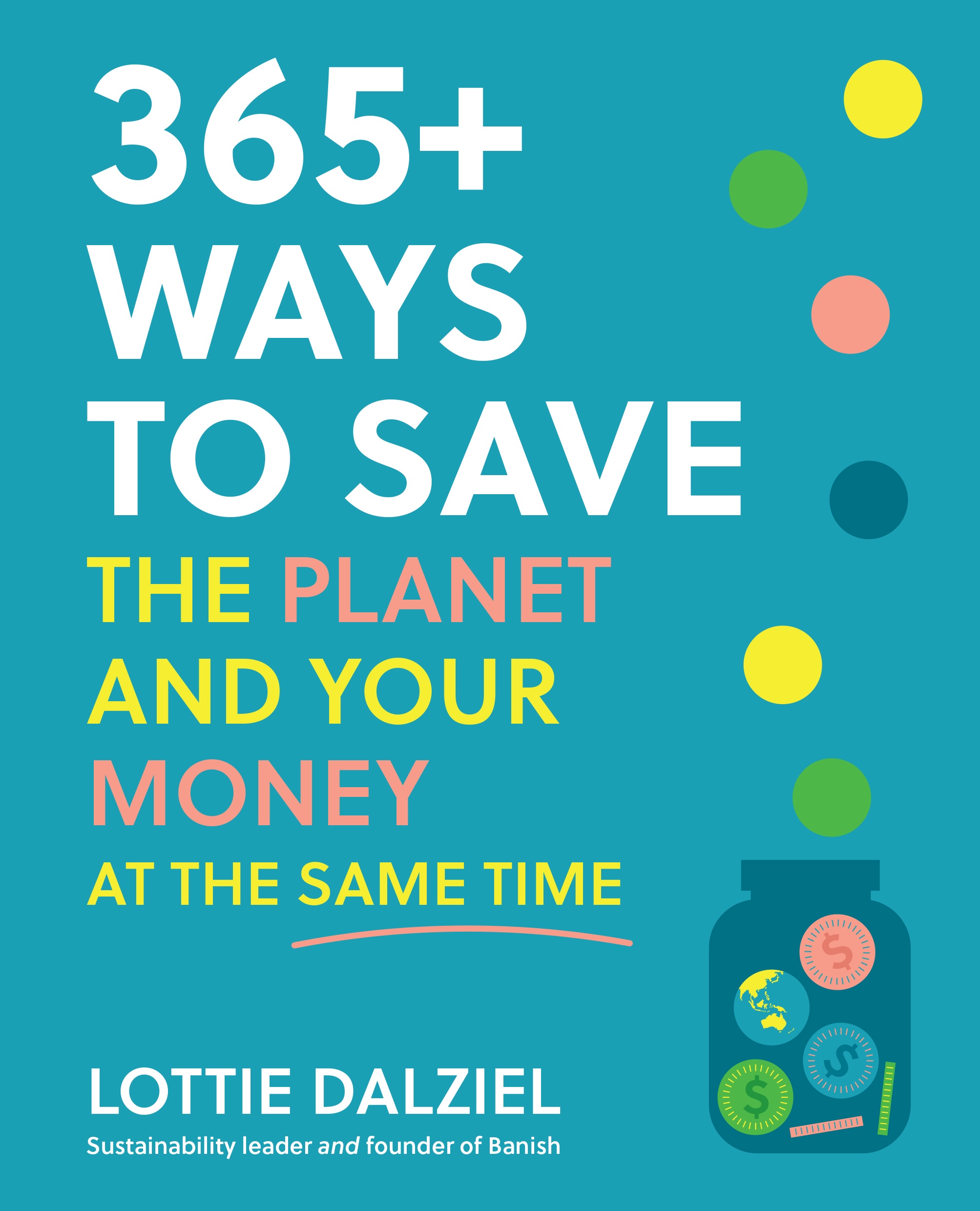
In 365+ Ways to Save the Planet and Your Money at the Same Time sustainability expert Lottie Dalziel aims to help us live our best sustainable life and spend less doing it.
How much can you save? Read on …

Have you heard?
*Australians throw away one in every five shopping bags.
*The average Australian household throws away between
$2000–$2500 worth of food each year.
*If global food waste was a country, it would be the world’s third‑biggest carbon emitter after China and the US.
*The total global greenhouse gas emissions from food waste are greater than flying, plastic pollution and oil extraction combined.
*One‑third of food produced globally goes unsold or uneaten.
*There is enough food produced around the world to feed everyone.
*The US throws away 80 billion kilograms of food each year.
**********
Food waste sucks, both for the planet and for your wallet. I mean, you’re paying for a lot of food that’s just going to end up in the bin. Sounds pretty silly, doesn’t it?
There are lots of reasons why food waste is such a huge problem.
Our culture of constant consumerism means we often buy more than we need, don’t plan before going shopping, and tend to have quite a disposable attitude to food. But even though something will break down in landfill, it doesn’t mean you should waste it.
And the environmental impacts of food waste are more dire than you might think.
It’s estimated that one-third of all food produced is not consumed. This is a shocking waste of resources, energy and money, especially when you consider everything that goes into growing that food: think water, energy, land management and transport. Food production alone is responsible for 37 per cent of the world’s greenhouse gas emissions. So, if one-third of all food produced is wasted, then 12 per cent of all global greenhouse gas emissions have been created producing food that doesn’t even get eaten! All of that work – and environmental cost – is literally for nothing.
 Before we start pointing the finger at restaurants and supermarkets throwing away rotten, left-over or out-of-date produce, know that a staggering 41 per cent of all food waste is created inside the home.
But, the damage doesn’t stop there. Once food arrives in landfill, it sits there and ‘cooks’, creating a lethal greenhouse gas called methane, which is thirty-two times more potent than carbon dioxide. Think of methane as a thick smog that smothers the globe, trapping heat and causing global temperatures to rise (aka global warming). And it just goes on and on; more food waste means more landfill sites. In fact, it’s such a monumental issue that in Australia, the UK and the US, governments have set national targets to halve food waste by 2030.
Food waste has a huge impact at a personal level, too, starting with a loss of between $2000–$2500 per household each year.
That’s your hard-earned money that you’re quite literally tossing in the bin. Spending money on food that you don’t eat doesn’t make sense. Yes, it’s terrible for the planet, but it is also the biggest waste of money there is. Making changes to reduce food waste makes both financial and planetary sense.
Now, I wish I could tell you that the project of reducing food waste was a straightforward one, but unfortunately that’s not the case. Saying that, I don’t want you to down tools and walk away from the task just yet! There are so many meaningful and actionable steps you can take that, added up, create enormous positive environmental and economic change.
In this chapter, I’m going to walk you through how to plan, how to shop and how to store your food so that you can maximise its lifespan. I’ve got great recipes that make the most of your produce, and hacks and tips for better meal planning so you can mount a multi-pronged attack on food waste. Really, a lot of what I’m pushing for here is a return to (or adoption of) old-world skills and a simpler attitude to food that we’ve all become alienated from – basically, the way our grandparents used to do things: buying only what they needed, what was in season, and preserving it to avoid waste.
While researching and writing this book, food waste was a problem that came up over and over again. It’s the most pressing sustainability issue we are facing, and it’s one that is shared by everyone, which is why it must be a core part of your planet- and money-saving quest.
No matter how vigilant you are about using up the food you buy, I can guarantee there’s something lurking in your fridge that you’ve forgotten about. I just checked my own and I found one sad, wrinkly cucumber and a jar of pasta sauce that’s starting to resemble a snow leopard. So, this is on all of us. In fact, Project Drawdown, a science-led resource on climate change, has revealed that individuals reducing their food waste is the third-best way to address climate change. Let me show you how.
I want to start with the most common culprits. According to OzHarvest, one of Australia’s largest food-rescue organisations who work with industries and the government to drive policy change, the most commonly wasted foods are:

Step one of the plan is to make a plan
One of my biggest hacks when it comes to reducing food waste is pretty simple: I plan my meals ahead of time. I don’t just mean making a list of ingredients, I mean performing an audit of what I already have so I can see what I actually need.
Look in your pantry and fridge to see what’s still in date and plan meals around those things, or see how you can work them in. You’ve gotta get into a ‘waste not want not’ mindset here, like your grandparents had. I promise, you’ll be surprised at how much you already have, and the simple act of only buying what’s absolutely necessary will save you major bucks.
Start by listing what you’ve already got in categories: vegetables, meat, pantry items, freezer. Then write down what you need to go with them, and don’t forget to note the exact quantities. You might think you’re saving money by going in for the two-for-one specials, but who is actually going to use 1 kilogram (21/4 pounds) of polenta?
Shopping
First rule of thumb: never go shopping hungry. It has been proven time and time again that a hungry shop is an expensive, overindulgent shop. Stick to your list and purchase only what you need – no extra-large bags or bundle buys.
And while we’re talking bags, don’t forget yours! Not just the bags you use at the checkout but a couple of smaller ones for produce, too. You can buy dedicated shopping bags, but I seem to accumulate canvas drawstring bags and totes at a break-neck pace, so I just use these. Once you’ve got your plan and your bags, you’re off to the shops!
ABOUT THE AUTHOR
Lottie Dalziel is an award-winning sustainability advocate and the founder of Banish, a marketplace designed to help Australians live more eco-friendly lives. Since its inception in 2018, Banish has become a trusted source for sustainable products, and Lottie has been recognised for her efforts with several prestigious awards. In 2023, she was named NSW Young Australian of The Year, a testament to her impact in driving sustainability awareness and change in Australia. She has also been listed in Forbes’ 30 Under 30 for her contributions to sustainability and entrepreneurship.
In addition to her work with Banish, Lottie has shared her insights on the global stage, delivering a TEDx talk titled “The power of community in fighting climate change”, further cementing her role as a thought leader in the environmental space. These talks have inspired individuals and businesses alike to rethink their relationship with waste and the planet.
Lottie’s dedication to educating and empowering others also shines through her podcast, Sustainability Further, and her corporate workshops, where she helps businesses integrate sustainable practices. With her strong background in media and communication, Lottie is a compelling storyteller and advocate for a greener future.
Through Banish and her many educational efforts, Lottie continues to lead the charge for sustainability in Australia.
0 Comments