


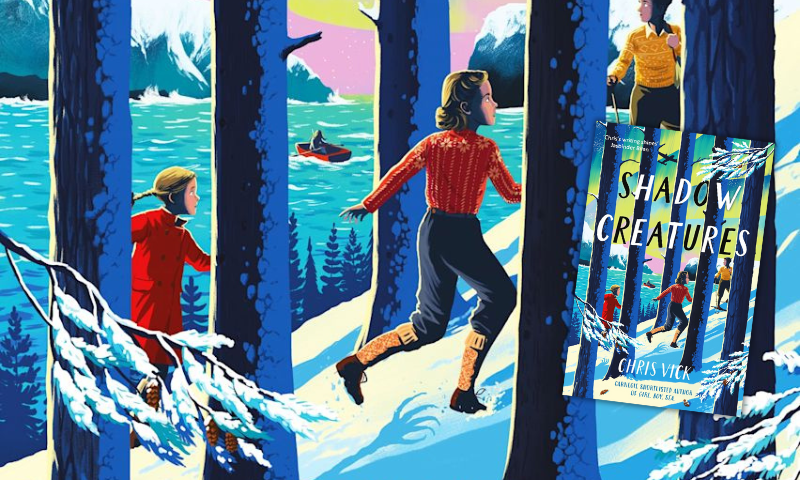
CHRIS VICK’s Shadow Creatures is a middle grade story of bravery, resilience, rivalries and shadow creatures in the night. Read on for an extract.
ABOUT THE BOOK
Mose and her daughter Agna are incomers in the village, treated with suspicion. But young Liva, left out of the secrets her sister Tove and brother Hakken share, idolises Agna and follows her everywhere. Unwittingly, they lead the German soldiers to a perfect island. Once a haven for picnics and story-telling under the midnight sun, it is transformed into a grim POW camp. This is an unlikely place to find buried treasure, but it’s there.
Friendships are made and broken, family trust is turned upside down and lives change forever as Tove and Liva recall their childhood experiences of living through WW2 in a story that moves from light to darkness to light again.
EXTRACT
The Invaders
Spring 1940
Liva
I was nine. Short and skinny as a ferret. Everyone said I was young for my age in every way. It was true, though I would never admit it.
The men were home after long months in Antarctica. The whaling had been good and for once all the families had money. There were still patches of snow here and there, the days were cold before the sun came up, but winter was over. Fish were biting, berry bushes sprouting leaves, the bees going crazy. When the wind blew, cherry blossom covered everything. We called it spring snow. There was a lot of it that day. A fresh wind was starting up, roughing the sea, disturbing the trees.
It should have been a joyful time in the village – which is a grand name for our huddle of old pinewood houses and a rotting dock. Anyway, we gathered at Mose and Agna’s house. It was fancy compared to our glorified huts. The father was dead, but he had been a fishing boat captain from the far north, and he left Agna and her mor, Mose, money.
We went there when anything important happened, because they had a radio. It was usually for the king’s birthday or Christmas carols, that sort of thing. This was different.
There had been a lot of to and fro to Mose’s house and a lot of time with the radio for days before. Sometimes a few grown-ups, sometimes many. Afterwards there was much talk and us being told, ‘There’s nothing to worry about.’ No one seemed happy, though, only in that forced way grown-ups have. A mask any child can see through. I hid and listened to whispers. Germans. Quisling. Nazis. I had heard these words before. I had also been told, ‘Norway is neutral. We are safe. No soldiers are coming here.’
But I still needed Mor to comfort me in the night, because I had nightmares of trolls, waiting under bridges and in caves to come and get me. Those nights and days were strange.
I asked Agna what was going on. Tove told me nothing, because Pappa told her not to. I thought Agna would tell, because she never cared what anybody else did. She was tight-lipped too.
Anyhow, this day all the adults and all the older children went to Mose’s, and shut the windows against the wind. We youngsters were told to play on the common where we tied the goats, and were promised waffles, jam and yoghurt if we didn’t bother the grown-ups.
A useless bribe. We gathered behind a garden wall next door to Mose’s to escape the cold wind, and chose Greta to be our spy.
As if she was stalking a deer, she crept and crawled across Mose’s precious lawn – the only lawn in the village – and crouched under the window, with her ear pressed to a hole in the wood, while we waited.
Greta frowned, frozen like a statue with all the concentrating. And we were going crazy, first with curiosity, then boredom, then cold, so I sneaked across the lawn too, determined to know what was making everyone so on edge and secretive.
I peeped through the window. Everyone was gathered around the radio, apart from Agna, who stood looking out of the window, straight at me. My heart boomed, but she didn’t do anything, as though I was glass and she was looking through me.
I couldn’t hear a thing and Greta put a finger to her lips, so I went back to the others. We stood behind the fence, watching Greta to see if there was any change. After a time, we sat down and no one talked. There was only the silence of the trees and the hills. The wind calmed for a few minutes. It may be too poetic, but it felt that in that moment Norway held its breath.
Then the door opened and Agna ran to us, panting, as if she’d run a race, not across the lawn.
‘Germans are coming!’ ‘Here?’ I gasped.
‘Yes. Now. Today, tomorrow, day after at the latest.’ ‘Why?’
‘They are taking all of Norway. And you’d better hide anything valuable!’ She pointed her finger at me. ‘Or they’ll take that too.’ Agna never added sugar to her words.
I thought of Rabbit, and my christening brooch and necklace with the silver cross. Things which Pappa kept safe, but which were mine only.
‘It won’t h … h … happen,’ Little Lars said. He was breathing fast, on the brink of crying or screaming, and couldn’t get his words out. ‘The … the … k … k … king will st … stop them.’
‘Nu-uh.’ Agna folded her arms and said it plain. ‘The king fled. He left Oslo and headed north.’
It seemed a strange story Agna told us, but I knew it was real. Agna had our attention. Just like when she told us ghost stories.
‘Huge boats up the Oslo fjord, thousands of soldiers!’ she said with wide eyes, waving her arms about. ‘Those fools weren’t expecting a fight so they sailed up without battleships to protect them, only our boys fired the single big gun we have guarding the fjord, and sank their biggest boat and killed hundreds of their best soldiers. A regiment called the SS. So, those that have landed aren’t in a good mood!’
Then the adults filed out of Mose’s, like on Sunday from church and not a smile between them. There were no secrets or hiding things then. Everything Agna told us was true.
Each family marched silently home, including us Eriksens: Mor, Pappa, Haakon, Tove and me. Gathering valuables didn’t take long. We hadn’t much and only three rooms to rummage through. Mor and Pappa’s room, the main living room which was also a kitchen and our bedroom. You see, Haakon was thirteen, Tove twelve and I was only nine, so at night me and Tove had our bedroom and Haakon slept in the living room. The long drop toilet was outside by the store hut. When I think about it now, it wasn’t an easy life. We washed in the stream.
Mor and Pappa went through the cupboards and Pappa climbed up in the attic. We had some rings and necklaces, from weddings and christenings over generations. Oh, and some gold and silver coins. We kept them for a ‘rainy day’. But even when days were very rainy, nobody sold heirlooms.
I had never seen it all together before. It was put on the floor on a large piece of linen. A troll’s hoard.
I kept running outside looking for Germans, but there was only the forest and the hills. Pappa wrapped our treasures up and tied the parcel with string. Then he left without a word. It happened quickly.
We followed Pappa, and Mor did not stop us. I thought he was going back to Mose’s, but he went down to the jetty, and by the time we arrived most of the village was there.
Eirik, who was eighteen or nineteen, sat in a rowboat, and one after the other the parents leaned down off the jetty and handed him their boxes or packages like ours. The bottom of the boat was piled with treasure. There was a spade too.
‘Where are you going, Eirik?’ I said. ‘To the islands, to hide what is ours.’ ‘When will you be back?’
‘Soon.’
‘Set off now,’ Pappa said, ‘before the wind gets even worse. This isn’t weather for rowing.’
‘What about Mose?’ Mor said. Minutes seemed like hours, and we waited, stamping our feet, watching the waves get rougher and bigger.
Tove was sent to hurry them up and when she came back with them, we saw why they were last.
Mose and Agna carried a small chest between them. Tove carried a large carpet bag. I imagined them full of gold and the necklaces and earrings they were always wearing. And this was added to the already weighed-down boat.
Pappa nodded to Eirik. He nodded back, then rowed, fast and strong. But it was difficult. The oars creaked in the locks and the blades splashed in the frothing sea. He made slow progress because the boat was heavy. Wind-lashed waves washed over the bow, salt spray whipped our cheeks. It was as if the sea too had woken and was now at war.
No one spoke. Nobody dared break the silence.
Eventually, Eirik rounded the headland and we lost sight of him.
Then, we heard a new sound. A lot of tiny thuds, like a woodpecker. Faraway, past the lowland hills, from the mountains. I did not know what the sound was. I saw fear on the grown-ups’ faces, though. I found out later it was machine-gun fire, but it didn’t sound like it does in the movies.
‘Home. Now,’ Pappa said. I thought he was only speaking to us Eriksens, but everyone went.
***
Once we were indoors, Pappa told us to stay put and not leave other than to go to the outhouse if we needed a pee. He hugged us all, even Haakon.
‘You have to be a man now.’ Haakon nodded.
‘Tove, you are the anchor for this family. The calm, sensible one. You must keep these lunatics in order.’ He pointed at me and Haakon, and tried to laugh. We tried to laugh with him.
I was last. He held me the longest. So tight, I could barely breathe.
‘Pappa, where are you going?’ I said. ‘I don’t know, Litenmus.’
‘How long will you be away?’
‘I don’t know that either. You must be brave now, and not the little mouse any more.’
‘I won’t be. I’m Liva, not Litenmus. When will you be back?’
He would not say. He could not say. No matter how many times I asked.
Then he grabbed Mor and squeezed her and kissed her hard, on the lips like he did at Christmas after too many aquavits. She was trembling and holding back tears.
Then he left.
We never saw Eirik again.
The Germans arrived next day. With their dogs.
ABOUT THE BOOK
 Chris Vick is a graduate of the Bath Spa MA in Writing for Young People. In between writing and teaching, Chris works for a whale and dolphin conservation charity and is a member of Authors4Oceans. He lives near Bath with his wife and daughter. Girl. Boy. Sea. (Zephyr) was shortlisted for the 2020 CILIP Carnegie Medal.
Visit Chris Vick’s website here


0 Comments