


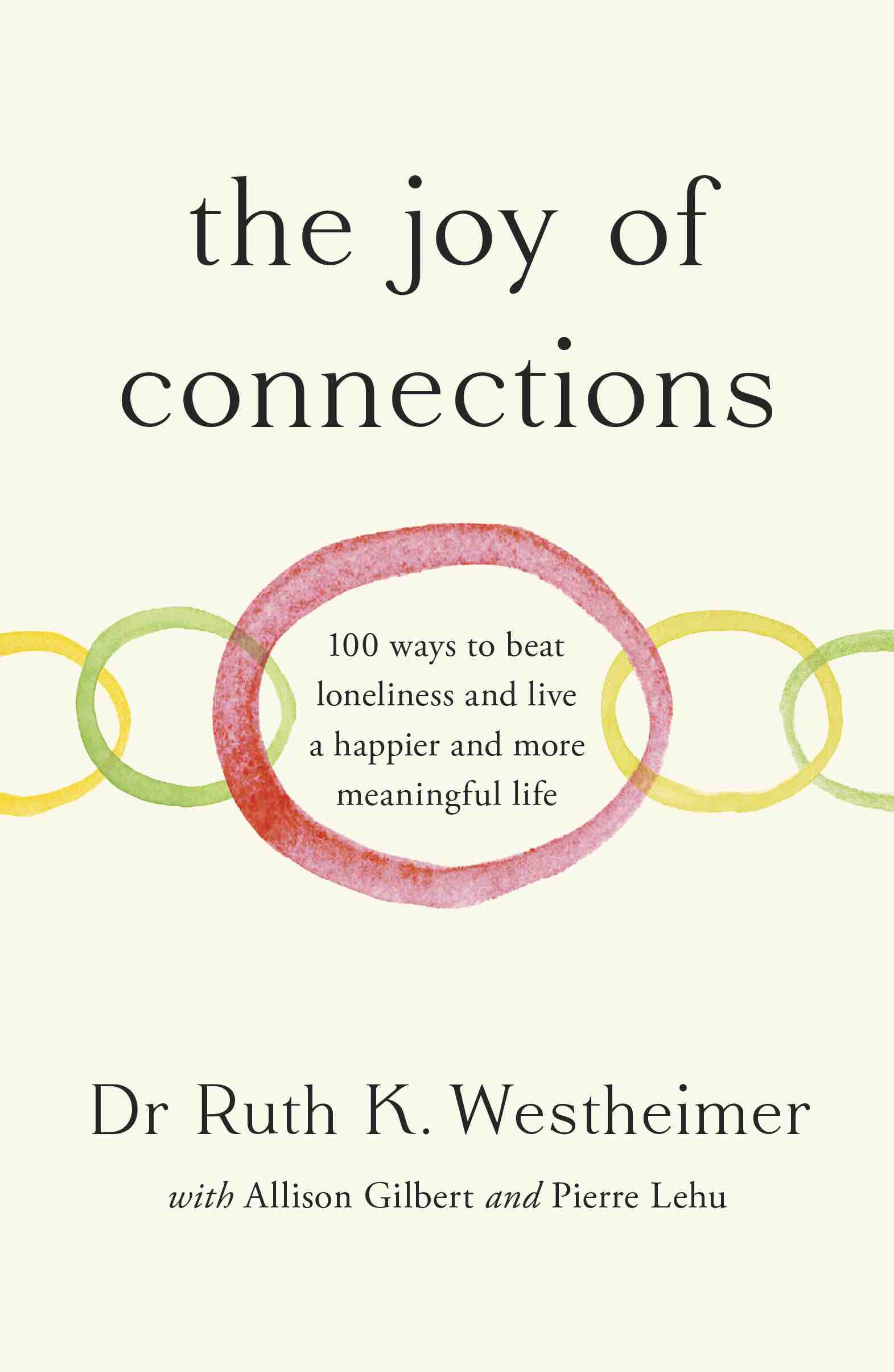
Trusted therapist Dr Ruth K Westheimer has made it her mission to shine a light on the problem of loneliness and help us break out of the box of isolation.
We are social animals. We are not meant to live in solitude. We have a shared desire to connect and create lasting bonds with the people around us. But the heaviness of loneliness can make this feel impossible. In tackling this problem with compassion and her trademark no-nonsense approach to therapy, Dr Ruth provides practical, sincere strategies for finding companionship, community, and intimacy.
her book, The Joy of Connections, includes tips on navigating family, finding friends and lovers, and using technology in healthy ways, you will find wisdom and help here, whether you’ve been struggling with loneliness for years or only recently.
Read on for an extract of her introduction.
**********
Loneliness is about the quality of connections in your life, not the quantity.
Unlike solitude, which can be sought-after and peaceful, loneliness stems from a sense of social isolation. You might be surrounded by people from morning to night, but if you feel invisible to them, like you don’t matter, you will likely feel alone. Similarly, if you believe that you have nobody to call in an emergency or to water your plants when you go on vacation, you might feel particularly adrift and disconnected.
The reason loneliness is painful is that human beings are social creatures by nature and our health depends on these relationships. When we’re lonely, serious health conditions may arise. Loneliness is associated with an increased risk of stroke, confusion and memory loss, and cardiovascular disease. It may shorten our lives, as much as smoking up to 15 cigarettes a day, and is even more harmful than being sedentary and significantly overweight.
But loneliness is subjective. It’s a feeling. And because it’s a feeling, there’s plenty we can do to alleviate it.
You can make the decision that being lonely is no longer an option. You can pursue relationships that make you feel special and appreciated. I want you to know that it’s possible to choose a fuller, richer path right now.
I know this is true from my work and my life. And it’s why at age 96 I couldn’t sit idly by when so many are suffering. If you’ve sunk into the swamp of loneliness, you may feel like it’s impossible to get out. Take my hand. Let me pull you out of the muck.
When New York State governor Kathy Hochul appointed me Ambassador to Loneliness, the first such position in the United States, she couldn’t have chosen someone with better credentials. I’ve been sleeping with loneliness my entire life.
I’ve known the loneliness of being separated from my family at the age of 10, becoming a refugee, and never seeing my parents or grandparents again. I’ve known the loneliness of illness and disability, the kind that crashes over you when your body has been pierced by shrapnel and you’ve been severely wounded in a bomb blast, have lost part of your foot, and are sure you’re about to die. I’ve also known the loneliness of feeling unchangeably other. While my four-foot-seven height has always been a punch line on late-night television, and while being shorter than most everyone else has surely helped me stand out professionally, it’s also been profoundly isolating. I often thought that no man would ever want me and that I’d never get married. But I did manage to get married, three times, in fact. The first two marriages ended in divorce and the third, to Fred Westheimer, lasted 35 years, until he passed away; he was the love of my life.
I’ll let you in on a little secret: My personal experiences with loneliness aren’t the only reasons I was named Ambassador to Loneliness. The appointment happened because I lobbied for it. I pushed for the role because I knew that my background as a sex therapist made me uniquely qualified to help people overcome loneliness. Sexual dysfunction and loneliness both carry stigma. Nobody is excited to admit they’re having difficulty in the bedroom. Nobody is thrilled to confess they have too few reliable friends. Shame is the thread that connects them both, and shame is what I’ve always tried to help people overcome. Think back to the 1980s. The humiliation gay people felt during the AIDS crisis was wholly avoidable. It’s why I always spoke so openly about homosexuality, embracing all expressions of love. I tried hard to change the conversation about sex and belonging during that epidemic, and I know that if we talk openly about loneliness—unapologetically and without euphemisms—those who are feeling painfully disconnected will feel less alone, too.
That loneliness is now an epidemic is widely known. Studies have been done and books have been written. Media coverage has exposed the vastness of the problem. I applaud all those who’ve undertaken this reporting and research. But, as I’ve mentioned, I offer a different and much-needed perspective. This is not a book about how society has arrived at such a tender and precarious place. This is not a book that examines the government’s efforts to resolve the crisis (though at the end of this book US Surgeon General Dr. Vivek Murthy offers important strategies for feeling more socially connected).
My training is as a behavioural therapist. When I saw clients in my office, I didn’t spend time delving into their past, trying to figure out the root cause of their sexual problems. I left that to the psychologists and psychiatrists. My work was much more direct and fast- moving. I simply helped anyone who came to see me – or listened to me on the radio or watched me on TV – have better sex by modifying how they engaged in sex. And this is the approach that I am taking with The Joy of Connections. If you are lonely, what you need is practical advice on beating back this scourge, and this is what I am going to provide.
The Joy of Connections offers a straightforward road map for overcoming loneliness – 100 concrete ideas and opportunities that can be acted upon immediately. The guidance is based on tactics I’ve used myself and in my private practice, some with clients who were quite lonely. I also include lessons from organisational psychologist and Wharton professor Adam Grant; founding director of the MIT Initiative on Technology and Self, Sherry Turkle; bestselling author and Happier podcast host Gretchen Rubin; and others.
But I’m not only giving you advice. I’m going to do the best I can to push you into taking my advice.
I’m going to be a cheerleader, a coach, and a drill sergeant, all rolled into one. Everyone who knows me quickly finds out that when I want something, I want it now, maybe even yesterday. Of course, some things you have to wait for, but in my life, I’ve found that waiting patiently often means that you don’t get what you want. And since having some chutzpah is what it takes to make it in this world, we must apply this same type of agency to the problem of loneliness. Because while loneliness is a terrible thing, as I can attest to, it’s also a condition that can be beaten back. And while I would never say that it will be easy, I will absolutely state that it’s possible.

ABOUT THE AUTHOR
Dr Ruth Westheimer broke stigmas for more than forty years, beginning in the 1980s with her nationally syndicated US radio show Sexually Speaking. She authoured or co-authoured 46 books on many topics, and was named New York’s Ambassador to Loneliness, the first such position in the United States.
A beloved therapist known to millions as ‘Dr Ruth’, she died in July 2024.


0 Comments