


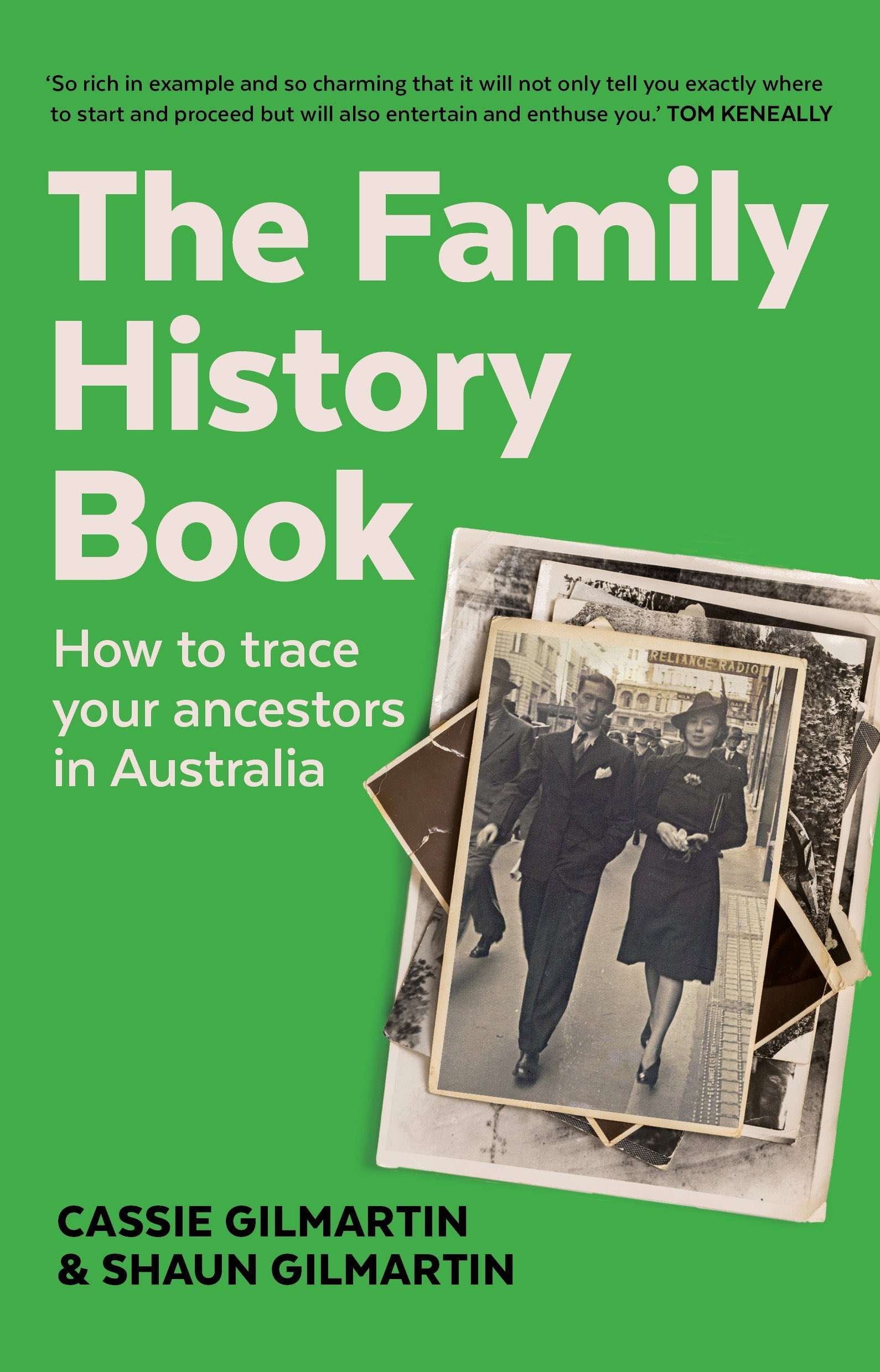
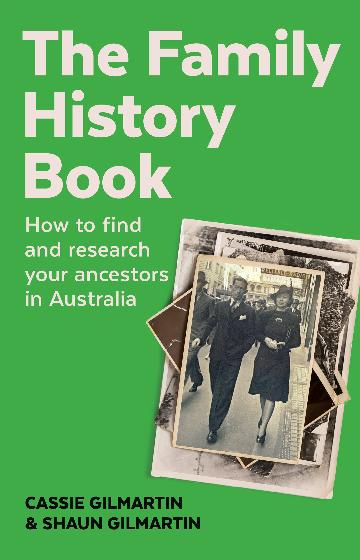
Do you wonder if that family legend your grandparents told was true? Or have you never known much about your family history and would like to find out more? Cassie and Shaun Gilmartin
Cassie and Shaun Gilmartin’s The Family History Book is full of tools, tips and tricks, and features interviews with experts in the field,
It takes you through the steps of researching and building a family tree, finding records of births, deaths and marriages, looking up newspaper archives and probate records, researching immigration and shipping, examining military records, as well as discovering your story through DNA testing. Whether you’re just beginning or have already made a start, this book guides you through all the places you can learn about genealogy in Australia.
CHAPTER 1
How to start in three easy steps
AT A GLANCE: Researching your family history can be overwhelming. So we’ll break it down into three easy steps to help you get going.
1 Start with what you know
The secret to starting a family history? Start with the present and work backwards. We’ll show you what this means.
2 Talk to family members
We’ll discuss how to become an interviewer, and what to ask family members to discover more about your family tree.
3 Define your goals
There is a bewildering amount of information out there and if you don’t have definitive goals to frame your research, then it’s very easy to be put off and give up. We will discuss what sort of goals to aim for and how to make them accessible so that you keep going and find out more about your ancestors.
COMMON TERMS YOU’LL COME ACROSS
Ancestor: These are the people who lived before you. The term usually refers to anyone born before your grandparents.
Ancestors also include those who are not directly from the same line, such as aunts, uncles and cousins.
Antecedent: The people before you, including your parents and grandparents. You are a descendant of your parents, while your parents are your antecedents.
Bachelor: A man who has never been married.
Descendant: Someone who comes after a particular ancestor.
Children, grandchildren and so on are descendants.
Family tree vs pedigree chart: A family tree lists your direct ancestors as well as indirect ancestors such as aunts, uncles and cousins. A pedigree chart lists only your direct family – parents, grandparents, great-grandparents and so on.
Genealogy: A line of descent that can be traced continuously from an ancestor. The terms ‘genealogy’ and ‘family history’ are used interchangeably, but genealogy is the more technical term, referring to the process of research and sources to document a family history.
Maiden or birth name: The surname a woman is born with.
Maternal line: The line of ancestry that follows from your mother’s side.
Paternal line: The line of ancestry that follows from your father’s side.
Spinster: An unmarried woman, often someone older who is considered unlikely to marry.
‘I always ask the celebrity at the outset to have an open mind and an open heart. Because we never know what we’ll uncover in our research.’
Maxine Gray, executive producer,Who Do You Think You Are? Australia
Chances are you’re reading this because you’re curious. Curious about who you are, and about those who came before you. Curious about what sort of lives they led, and how that’s influenced yours – not only from a genetic point of view, but their life experiences and the decisions they made. This is, after all, the story of you.
In our introduction we talked about how we fell in love with family history, and why we’re encouraging everyone to trace their family tree. But it’s not just the satisfaction, and the thrill of hunting for ancestors. There are tangible benefits to researching your family history – here are five of them.
You’re preserving your family’s history
An obvious reason to start with, of course. But in our experience there’s often one person in a family who gets the genealogy bug and becomes the keeper of the family photographs, knows the exact relationship between great-uncle Alfred and cousin Clarence, or says that your handwriting is exactly like Yiayia’s. If that’s going to be you (or already is you) then be proud. You’re allowing your ancestors to live on by documenting their stories. You’re building a patchwork of information that will be cherished by future generations.
And remember, you’re about to meet family you never knew existed. Because when you’re building your family tree, you will no doubt meet extended branches of the family to swap research with. Sometimes these family members are closer than you think, geographically speaking. We kid you not – we’ve met people who’ve told us that they started researching their family tree only to find a previously unknown cousin living in the next street. Or the neighbouring suburb. True stories. Family history really is amazing at bringing strangers together.
 You’ll feel part of a community
There’s a real community spirit among family historians. We’ve seen, and been the recipients of, strangers swapping information and offering advice to smash through brick walls. We’ve heard people say, ‘Oh I live near that cemetery, I’ll drop by this week and search for your ancestor’s grave’. People are incredibly generous with their time and knowledge, and you’ll find yourself reciprocating that. Case in point – all our experts interviewed for this book took time out from their busy schedules to willingly share their research experiences. You’ll also understand more about the local and social context of your ancestor’s life and the area in which they lived.
You’ll become an ace detective
Family history is all about looking for clues that will help you solve a mystery. It could be trying to find where an ancestor is buried, or why someone moved to the other side of the world to marry, leaving their entire family behind. Whatever the circumstances, it’s your job to look for the breadcrumbs in the historical records. Family history demands sharp investigative skills, backed up with finding enough evidence to prove (or discard) your theory. It uses logic, computer skills, problem-solving, mathematics and intuition. It’ll teach you to double- and even triple-check everything you find. Keep investigating and you’ll be as sharp as Hercule Poirot in no time.
Family history can make you smarter
Here’s the really cool part. In 2010, research published in the European Journal of Social Psychology showed that thinking about our ancestors can boost our performance on intelligence tests. The researchers called this the ‘ancestor effect’. They proved their theory by asking undergraduate students to either think about their ancestors for five minutes or think about a recent shopping trip. The groups who thought about their ancestors were more confident afterwards in their abilities to pass exams, and attempted to answer more questions. Three further studies showed that thinking or writing about their recent or distant ancestors led students to actually perform better on a range of intelligence tests, including verbal and spatial tasks.
Their conclusion? That ‘normally, our ancestors managed to overcome a multitude of personal and society problems, such as severe illnesses, wars, loss of loved ones or severe economic declines. So, when we think about them, we are reminded that humans who are genetically similar to us can successfully overcome a multitude of problems and adversities’.
It’ll get personal
Learning about your ancestors can help you discover more about yourself. After all, it’s their blood coursing through your veins. As we’ve already mentioned, discovering how our ancestors overcame adversity gives you a stronger sense of identity and resilience. One of Cassie’s convict ancestors, the brothel madam Jane Maher, was transported on the Britannia, arriving in Sydney in 1797. It was dubbed a ‘hell ship’ due to the sadistic nature of the ship’s captain, who was paranoid about an Irish mutiny occurring during the voyage. He withheld rations from the convicts, wouldn’t let them exercise on deck, and had at least one convict flogged to death. Two women committed suicide by jumping overboard. Jane survived that ordeal and went on to start a bakery at the Rocks within a year of her arrival. We like to think her resilience shines right through the generations to the present day.
These are some of the reasons why so many are getting hooked on family history. You may think that researching ancestors who lived 100, 200 or 300 years ago won’t really affect you – these people who you’ve never met, and who are names on a historical record. But when you see their photographs, read their handwriting on a document, and piece together their lives, you’ll realise that they don’t feel so far away at all.
This last point about things getting personal was mentioned by every expert we interviewed for this book as a particularly important one: researching someone with a strong connection to you can be rewarding, but also confronting. Especially so with Indigenous family history. Melissa Jackson, a librarian at the State Library of New South Wales (SLNSW) and a Bundjalung woman, has been helping people research their Indigenous family history for three decades and has seen this first hand. ‘You never know when a record is going to be confronting. For example, I was looking at Aborigines Welfare Board letters that (I thought) my grandfather had written. And so I jokingly looked at them and thought, “Oh, no, that’s my grandmother’s handwriting”. And then it just hit me: That’s my grandmother’s handwriting. And it was about a loan to build a house. They got knocked back in the end, but it really rammed home that my grandfather didn’t have an education; that my grandmother had to write these letters. And they had to go cap in hand to the Welfare Board saying can you give us a loan. So inadvertently, you come across these confronting personal records.’
Melissa’s advice in this situation is to have family members with you when you are researching or reading a document. ‘Don’t go alone. If you are strong enough to do that, more power to you, but try and have family members with you so that you can leave the room and go outside. Ground yourself, have a hug, have a cry, that type of thing.
‘As a professional – except if it relates to my family, then I’m weepy, I’m just weepy – but as a professional, I try and look beyond the words and look at the substance of the record. So what does that record tell me? The birth, the death, the marriage: if it has words that offend in the record – words such as quadroon or half-caste, those types of quantitative things – I try and look beyond the record. When I do information requests on behalf of other people, I always speak about that. Before I share the record, I always say this record has this type of word or these type of words in there and what we have to focus on is that this tells us a little bit more about the person. Oftentimes it is the innocuous record that will be confronting, so have somebody with you so you can step back. Make sure your cultural safety is okay. Ground yourself and then go back in.’
ABOUT THE AUTHORS
 .
. 
Cassie Gilmartin has 20 years of experience in writing and editing family history, including eight years as the publisher and editor of the award-winning magazine Inside History. She is co-host and producer of the Portrait Detective podcast in collaboration with Margot Riley from the State Library of New South Wales. Cassie’s fascination with family history started when her mum told her she was descended from an Irish highwayman and a madam of a brothel, of the Lower Sort.
Shaun Gilmartin has specialised in history and science programming as a TV executive producer and writer for more than two decades, working for broadcasters across the globe. His documentaries have won awards in the UK, the US and Europe. It has taken him all these years to discover more about his father, who died when he was just two.
Find out more about the authors
0 Comments