



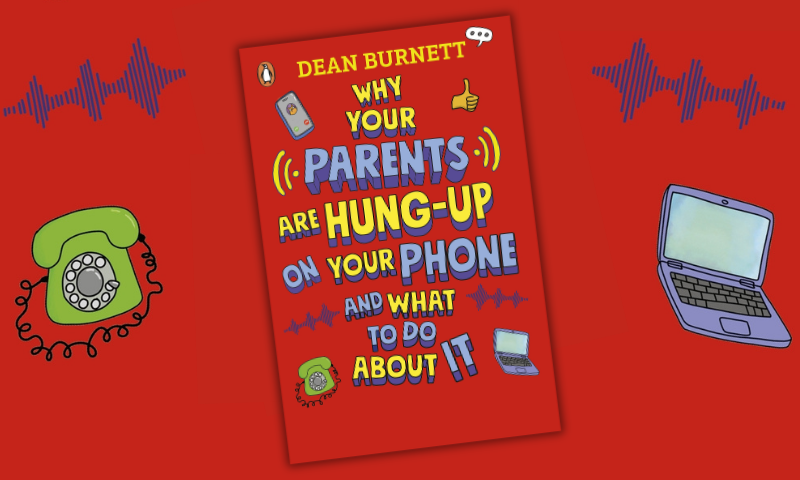
We caught up with DEAN BURNETT to discuss his book Why Your Parents Are Hung-Up on Your Phone and What To Do About It, a book about phones every adolescent should read.
What inspired you to write this book?
Initially, it was inspired by the success of my first kids book, Why Your Parents Are Driving You Up The Wall And What To Do About It, a sort of reverse parenting book, which explained to younger readers why their parents are so annoying, confusing etc.
It proved a hit with both younger readers and their parents, surprisingly. So much so, I really wanted to revisit the format.
And one of the areas covered in the original book, that kept being brought up by those who’d read it, was the impact of technology (specifically, phones, the internet, social media etc) on the parent/child dynamic. It was one of many subjects addressed, but presumably it caught attention because it’s a ‘newer’ element of parent/child relationships, so there’s not much accepted wisdom about it.
This, coupled with the fact that the mainstream discourse around phones, social media, and how they affect children specifically, has really ramped up since publication of the original book. And so much of the discourse seemed worryingly detached from scientific understanding.
Also, despite being nearly 100% about children and teens, contributions from such young people seemed to make up 0% of the discussion.
This struck me (and still does) as an unhealthy and unhelpful approach to addressing the issue of phones and how they affect young people. So, all these things together led me to want to write the new book. To include young people in the conversation, to explain why their parents are concerned, and why these reasons are often not quite valid, to give them the tools and insight required to navigate the modern world, without scaremongering or judgement.
That’s what I’ve attempted to do, anyway. Time will tell if I’ve succeeded. It’s only been out a few months.
What was the most surprising fact you learned about the impact of phones?
There were actually a lot of surprising things I found in my research, but I think the most shocking was realising just how far removed the ‘accepted facts’ about phones are from the actual scientific evidence. It’s so common to hear people say ‘Phones are addictive’, ‘Your phone/social media damages your mental health’, ‘phones ruin your attention’, ‘phones stunt your development’. And these things are said as if they’re cast iron facts.
But if you look into the actual data, even minimally, none of these things are true. There’s no reliable evidence that phones or social media do any of these things.
This isn’t to say they can’t or never have negative effects on people, particularly young people. They can, but there are so many other factors that need to come into play. It’s not just a matter of ‘Looking at a phone = bad for you’.
It’s quite alarming though, just how significantly the mainstream understanding of phones, and their impact, is being led by suspicions and accusations, rather than actual data. On a more positive note, it was also quite surprising to uncover so many mental health benefits of phones. Because there are a quite a lot. And some are counterintuitive.
E.g. In the UK, we’ve had many campaigns aimed at encouraging kids to ‘put the phone down and actually go outside’, or words to that effect. But the evidence shows that children being outdoors less is an issue that long predates the arrival of smartphones, and seems to be primarily driven by parents being over-cautious and worried.
But that trend, of kids going outdoors less and less year after year, has gone into reverse in recent years, meaning young people are spending more time outdoors than in recent decades. What changed? The answer seems to be … phone! Kids now have smartphones, so worried parents are more willing to let them roam further afield, because they are contactable/trackable, which assuages their concerns.
This logically means that campaigns telling kids to ‘put the phone down and go outside’ are self-defeating. But this sort of thing is never mentioned or brought up in the mainstream discussions, and that’s not a great place to be for anyone involved.
In what ways can TikTok affect us?
This is an interesting question, because there are a few ways of looking at it. To simplify; there’s a difference between TikTok the overall platform/format, and what TikTok exposes you to.
While there have been some concerns expressed about TikTok ruining attention spans and ‘corrupting young minds’ etc, much of this is based on suspicions and paranoia, not anything tangible. The human brain is a lot more robust than that. It takes more than some prolonged exposure to a short video app to permanently disrupt neurological networks and processes that have evolved over millions of years. So, such concerns are, at the very least, premature.
The actual concern is that TikTok seems to be genuinely very engaging, to an almost worrying degree. Because of how the human brain works, we are usually most susceptible to information provided by other people. While we can perceive and understand information delivered via text or sound etc, our brains are most engaged by other people, by face-to-face communication.
Until now, most social media content didn’t have the same impact as real-world interactions. But TikTok probably comes the closest, as it’s primarily audio-visual, and is mostly people speaking to the camera. So, if you’re a young person still figuring out how things work and exploring your identity, you’d be likely to be more responsive to a TikTok influencer than school textbooks or resource material.
This isn’t necessarily bad or good in isolation, but the issue with TikTok (and social media in general) is that there are very few, if any, checks and balances against what information people share. A typical influencer may have the best intentions, but if they’re talking about important matters like mental health or body image or whatever, they could still be totally wrong, or actively harmful, via the content they’re providing. And they’d have no idea about this. And they could be doing genuine harm to younger people consuming their content, and being influenced by them.
See the TikTok tics phenomenon, where young people consumed the content of influencers with Tourette’s syndrome, and started developing tics of their own, without any of the usual criteria for Tourette’s.
It’s an interesting, if slightly worrying, new phenomenon, that requires much research. Unfortunately, most of the concerns being raised about TikTok (and other social media) are looking in the wrong direction, focusing mostly on assumptions and paranoid conclusions, rather than evidence-based ones. This itself is also potentially harmful.
What are some of the benefits of video games?
It’s far more common for people to flag up the flaws and dangers of video games (often in the absence of actual evidence, as often happens), but science suggests there are a number of benefits to video games that often go overlooked or unnoticed.
For one, they seem to improve certain types of memory and learning. Or spatial awareness, or hand-eye coordination. Basically, the abilities and skills you need to play most video games (depending on the genre), they improve if you play a lot of video games, just like how constantly practicing a particular sport gradually makes you better at that sport, and the particular abilities/actions those involve.
But when you take the advanced, sophisticated nature of modern gaming into account, it widens the scope. Things like Minecraft, Fortnite etc, they provide open fields and ample scope to build, create, and design. So, they encourage creativity and playful experimentation. The idea that such behaviours can only be expressed in the realm of physical play is a very old-fashioned notion, one that no longer holds in the modern world.
And if you look at the multiplayer, collaborative nature of many modern games, they’re even more useful. Young people and teens playing together, and communicating in real time, was one of the only ways they were able to stay in touch and engaged with social groups during the pandemic and lockdown.
On a similar note, so many young people struggle with social anxiety, or access to public spaces and communities, and online gaming can often end up being a vital lifeline, if not the whole basis of their social life.
Basically, there are many benefits of video games, particularly in the modern era.
Is it important to have time restrictions on devices? Why? Why not?
This is something that ultimately boils down to a judgement call on behalf of parents, and hopefully their kids too. If a child genuinely does struggle with resisting using their phone/device, to the extent where it proves disruptive or problematic, then an automatic time restriction would be helpful here.
But if that isn’t the case, and it’s more to do with pre-emptively addressing the concerns of parents, they can potentially make things worse. It tells the child/teen that they are not trusted, and it robs them of autonomy, two things that younger people are very sensitive to, and which could easily lead to resentment and friction in their relationship with parents.
There’s also the fact that many young people are more tech-savvy than their parents, meaning they could find a way around imposed time restrictions, which would serve to reinforce deceiving their parents, and undermine parental authority even more.
But the whole notion of time restrictions is itself, arguably, misguided. It relies on the common assumption that screentime is the main issue with phones and what damage they (supposedly) do. But as ever, there’s no real evidence to support this. The amount of time a child (or anyone) spends looking at a screen seems to be a completely arbitrary measure.
Screens are just too widespread and diverse for time spent looking at them to be a useful measure of anything. It’s the content, or what is being looked at on the screen, that’s the real issue (in the cases where there is an issue).
For instance, spending several hours reading an eBook is fine, spending minutes looking at a toxic influencers output, or hardcore sexual material that you’re way too young for, that will cause issues for wellbeing and mental health down the line. But the screen time in the latter is much less.
Ultimately, device time restrictions may be useful in some cases, but a lot of the time, they’re addressing a problem that isn’t actually there. At worst, they can lead to the creation of other issues.
What are some of the key takeaways from your book?
- The things most people (parents and other adults) believe about the harms and dangers of phones are really different to what the actual science says.
- Kids and teens think about phones (and the internet etc.) very differently to their parents, and a lot of this can be traced to how their brains work differently, thanks to their respective ages.
- Parents worrying about ‘new technology’ harming their children is a phenomenon that goes back over 2000 years.
- Phones aren’t some creeping menace, but a significant part of modern life. Dealing with the reality of them is a far healthier approach than demonising and banning them, for both parents and their children.
- There are so many aspects to the online world that can impact young people (in good or bad ways), and considering the specifics of all these will make understanding easier for everyone.
- Children and teens are smart, insightful, and very aware of the things that are said about them by hand-wringing adults. By including them in the conversation around phones, and getting their insight, what problems do exist will be much easier to anticipate and manage.
ABOUT THE AUTHOR
 Doctor Dean Burnett is a neuroscientist, lecturer, author, blogger, podcaster, pundit, science communicator, comedian and numerous other things, depending on who’s asking and what they need.
Previously employed as a psychiatry tutor and lecturer at the Cardiff University Centre for Medical Education, Dean is currently an honorary research fellow at Cardiff Psychology School, and previously a Visiting Industry Fellow at Birmingham City University.
However, Dean is currently a full-time author, previously best known for his satirical science column ‘Brain Flapping‘ at the Guardian, which ran from 2012 to 2018. This led to his internationally acclaimed bestselling debut book ‘The Idiot Brain‘, which has resulted in several further books and even more interesting brain stuff.


0 Comments