


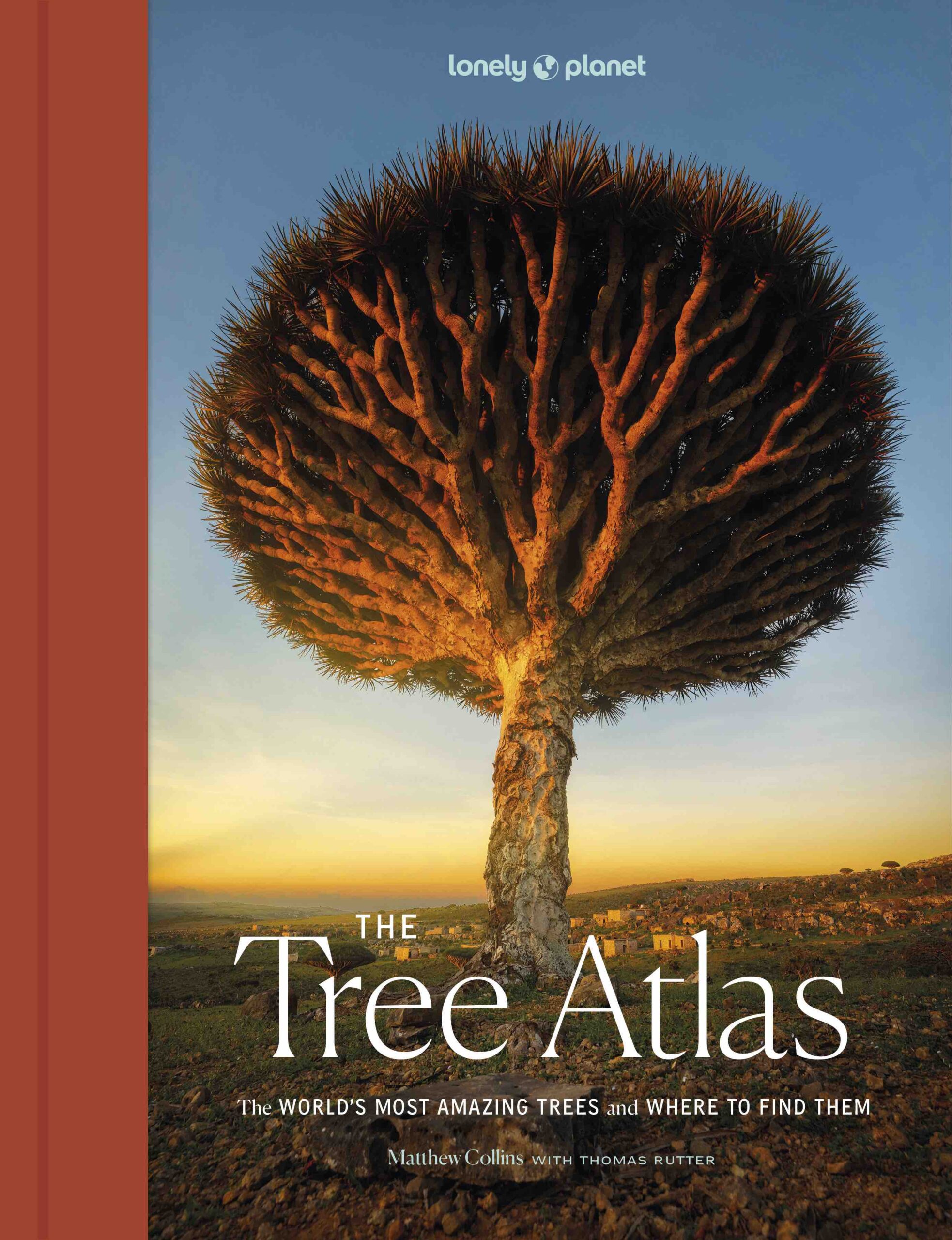
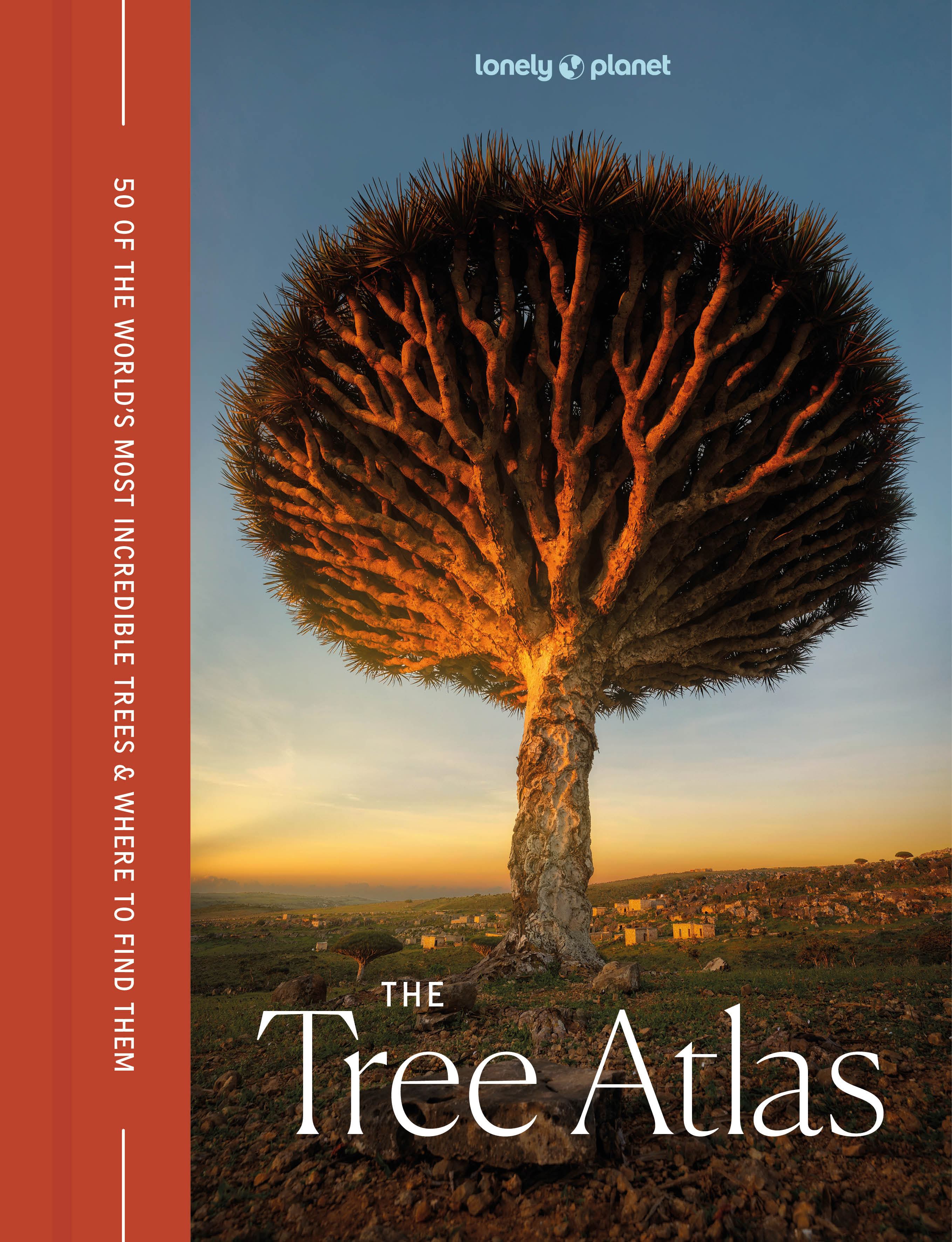
The Tree Atlas introduces us to 50 of the world’s most magnificent trees for travellers and nature lovers to enjoy from the comfort of our armchair or to seek and behold in the wild.
Whether taking in the beautiful cherry blossoms of Japan or a beech forest’s seasonal hues in France, The Tree Atlas has us discovering our planet’s most amazing species of tree, as well as better understanding their role in our ever changing ecosystem, and appreciating the restorative effects of visiting these natural wonders in the flesh.
Take a sneak peek inside with the video and read an extract below
EXTRACT
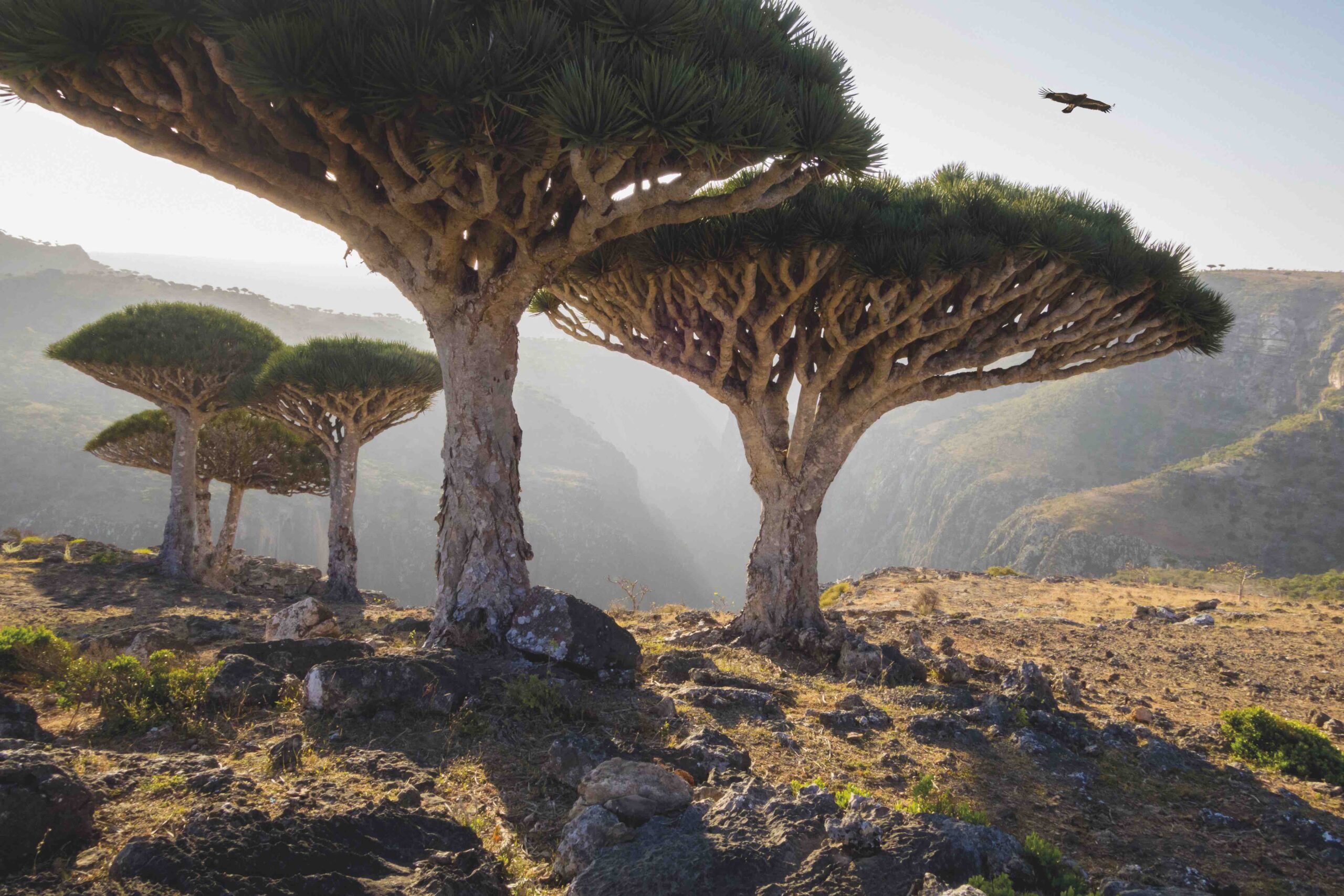
Dragon blood trees in rocky landscape, Homhil Protected Area, Socotra, Yemen
Dragon’s Blood Tree
Dracaena cinnabari
VITALS
R A N G E
Socotra Archipelago, Republic of Yemen
STATUS
Vulnerable
LIFESPAN
<600 years
AVERAGE HEIGHT
20ft-30ft (6m-9m)
The national tree of Yemen is the lifeblood of its environment, shrouded in myth and legend Archipelagos and their associated islands are a constant fascination for naturalists, owing to the unique development of their resident flora and fauna in isolation from the continental mainland. Finches endemic to the Galápagos Islands propelled Darwin towards his theories of evolution; on the rocky Socotra Archipelago – a Unesco World Heritage Site – it is a rare tree species that enchants the world. Like a grassy hillock raised on an ivory podium, the strange figure of the dragon’s blood tree – Dracaena cinnabari – is found only here, on a sunny archipelago in the Arabian Sea, between the Arabian Peninsula and the Horn of Africa.
As is common in botanical nomenclature, the species name of the dragon’s blood highlights a key physical attribute. ‘Cinnabari’ references the deep-red resin within the tree’s living wood and berries, a colour likened to that of cinnabar, the scarlet mineral from which vermillion pigment is derived. When cut, the bark appears to bleed, which has led to centuries of both local and widespread legend and folkloric myth: a tree thought to have sprouted from the blood of a feuding dragon and elephant; in Greek mythology, a tree sprung from a hundred-headed dragon slain by Heracles. Bestowed with super- natural and healing qualities, the ‘dragon’s blood’ resin has long been valued as a cure-all for many bodily ailments.
In the provision of habitat, however, the tree is a vital component of the Socotra landscape: its dense canopy provides shade and even channels moisture down to the soil beneath, irrigating other plant life at its base. As such, the declining numbers and poor regeneration of Socotra’s dragon’s blood trees is a significant conservation concern.
HOW TO SEE
WHERE
The dragon’s blood tree looks like something you’d find etched onto the margins of a medieval manuscript, straddling the boundary between what sailors really saw and the ramblings of their salt-soaked imaginations. Its range fits that idea perfectly, given the Yemeni island of Socotra was the real-life inspiration for tales of Sinbad the Sailor.
Despite turbulent times in Yemen, trips to Socotra are still possible – usually flying directly to the island on the once- or twice-weekly Air Arabia flight from Abu Dhabi. However, infrastructure is limited, with few hotels and little in the way of public transport, so almost everyone joins a camping tour arranged from overseas.
Hiking through the silence of the desert to see dragon’s blood trees is a key part of a Socotra tour.
The Diksam Plateau is the best spot on the island for close-up encounters; depending on the tour, you might stop for lunch under the umbrella-like canopy of a dragon’s blood tree, or camp amidst a whole forest of them at Firmihin in the centre of the island.
WHEN
Socotra is a place to visit from February to May, when the monsoon winds die down. From June to October, the southwest monsoon brings flying clouds of grit and dust; from November to January, the northeast monsoon brings grey skies and occasional rain.
HOW TO IDENTIFY
Neatly umbrella-shaped in form, the dragon’s blood tree’s mushroom-like crown is strikingly distinctive. This is formed by a thicket of repeatedly branching stems, exposed on their underside and raised on a grey-white trunk. The tough, tapering and somewhat glaucous-green leaves are similarly densely packed, arranged in rosettes at the end of the young stems.
Creamy white flowers are borne in clusters at the stem terminals, producing dark berries that mature an orange-red colour.
**********
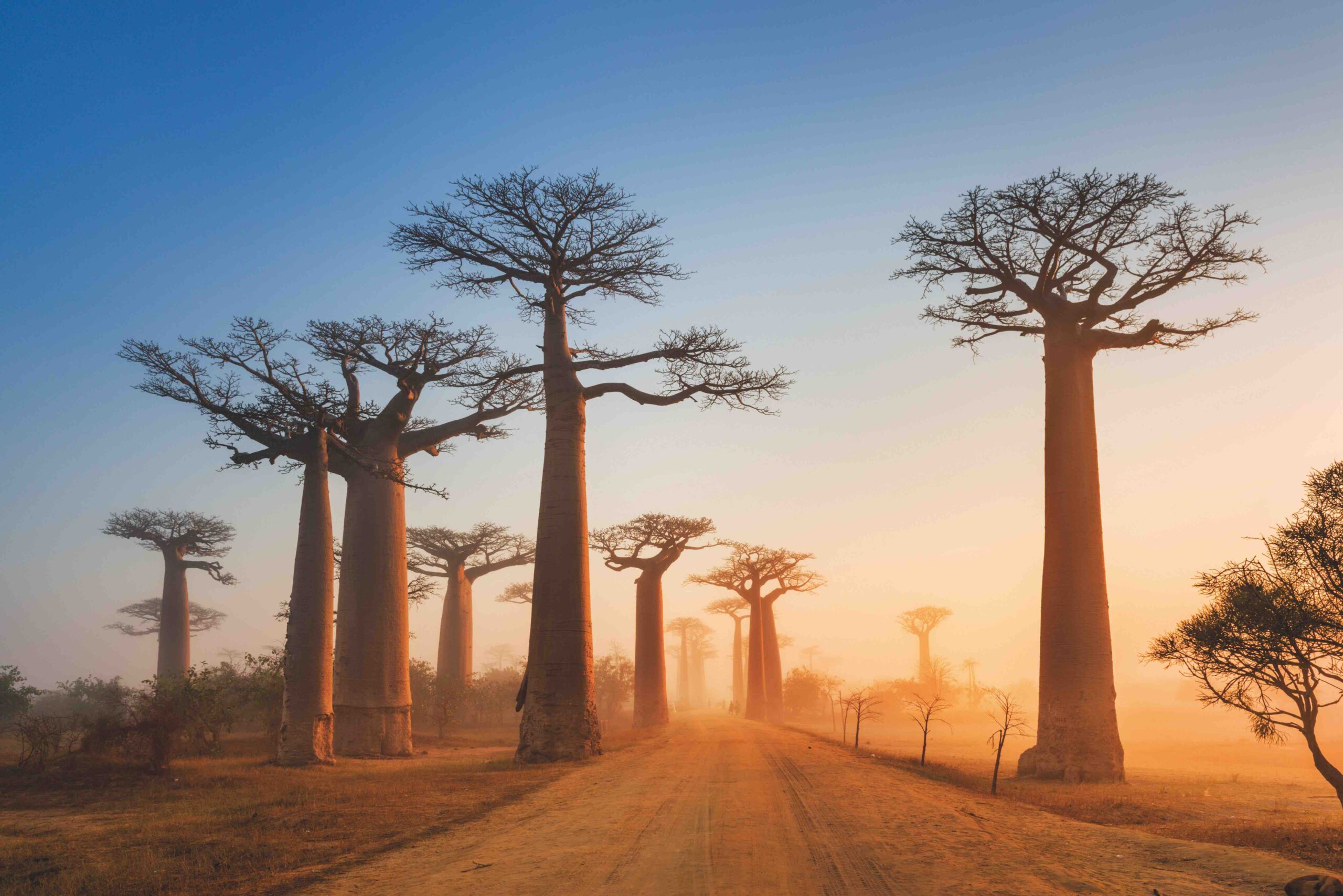
Avenue of the Baobabs, Morondava, Madagascar
Grandidier’s Baobab
Adansonia grandidieri
VITALS
RANGE
Southwest Madagascar
STATUS
Endangered
LIFESPAN
<2000 years
AVERAGE HEIGHT
70ft-90ft (21m-27m)
Endemic to an island of staggering biodiversity, the baobabs are among Madagascar’s most esteemed treasures.
Among the eight species of baobab, a singular representative stands proud: a curious, isolated figure with an enormous bloated torso, and stubby branches more akin to the roots of an upturned sugar beet than a tree. Though neither the most common nor the most ancient baobab species, A grandidieri, the Grandidier’s or giant baobab (named after French botanist Alfred Grandidier), joins the lemur as a pillar of Madagascar’s uniquely enchanting wildlife – a tree like no other, in the case of its trunk. And this is indeed something to shout about, for in a world that values its trees in measures of height, age and floral spectacle, it is rare that a trunk should find itself the centre of attention – it is the baobab’s secret to success.
Native to southwestern Madagascar, the giant baobab is found grouped in sparse stands, savannah remnants of a formerly rich ecosystem that has fallen to agricultural clearance over the years. The extreme fluctuation of rainfall in this low-lying region – where a short wet season is followed by months of arid conditions – accounts for the tree’s strange morphology. Like the boojum of Mexico (see page 93),
it is drought-deciduous, shedding its attractively palmate leaves in the dry months to reduce transpiration. But the trunk is its ultimate safety net, a vast water tank of swollen and spongy wood, capable of storing upwards of 16,660 gallons (75,738L). This distinction is not singular to the giant baobab, rather a uniting factor among all baobab species.
Nonetheless, the giants of southwestern Madagascar are an unrivalled landmark, their elephant-skin torsos rising like the columns of an imperial ruin.
HOW TO SEE
WHERE
Various species of baobab thrive in sub-Saharan Africa, but the big daddy of the baobab world – the giant baobab – is native to southwestern Madagascar, particularly in the area between Lac Ihotry and Beroboka. In fact, we should probably say ‘big mummy’ considering the tree’s Malagasy name, reny ala, meaning ‘mother of the forest’.
Giant baobabs were once found in dense forests, but because of woodland loss – and the limited usefulness of baobab wood for construction or firewood – these mighty trees are now more
Various species of baobab thrive in sub-Saharan Africa, but the big daddy of the baobab world – the giant baobab – is native to southwestern Madagascar, particularly in the area between Lac Ihotry and Beroboka. In fact, we should probably say ‘big mummy’ considering the tree’s Malagasy name, reny ala, meaning ‘mother of the forest’.
Giant baobabs were once found in dense forests, but because of woodland loss – and the limited usefulness of baobab wood for construction or firewood – these mighty trees are now more
WHEN
Try to reach the Avenue of the Baobabs earlier in the afternoon, before groups arrive to watch the sunset. Given the patchy state of Madagascar’s roads, spotting giant baobabs is a dry-season activity; during the January to March wet season, dirt roads turn to quagmires.
HOW TO IDENTIFY
You’ll have no difficulty recognising a baobab, but the Grandidier’s is notable for its comparatively elongated trunk, which is smooth and rust-grey in colour, and can reach almost 10ft (3m) in diameter. The crown is compact and often flat-topped, the leaves palmate with defined leaflets.
Summer flowers (May to July) are large, off-white and epheMeral, each blooming for a single day before the formation of its edible hanging fruits, velvety-green and oval-shaped.
**********
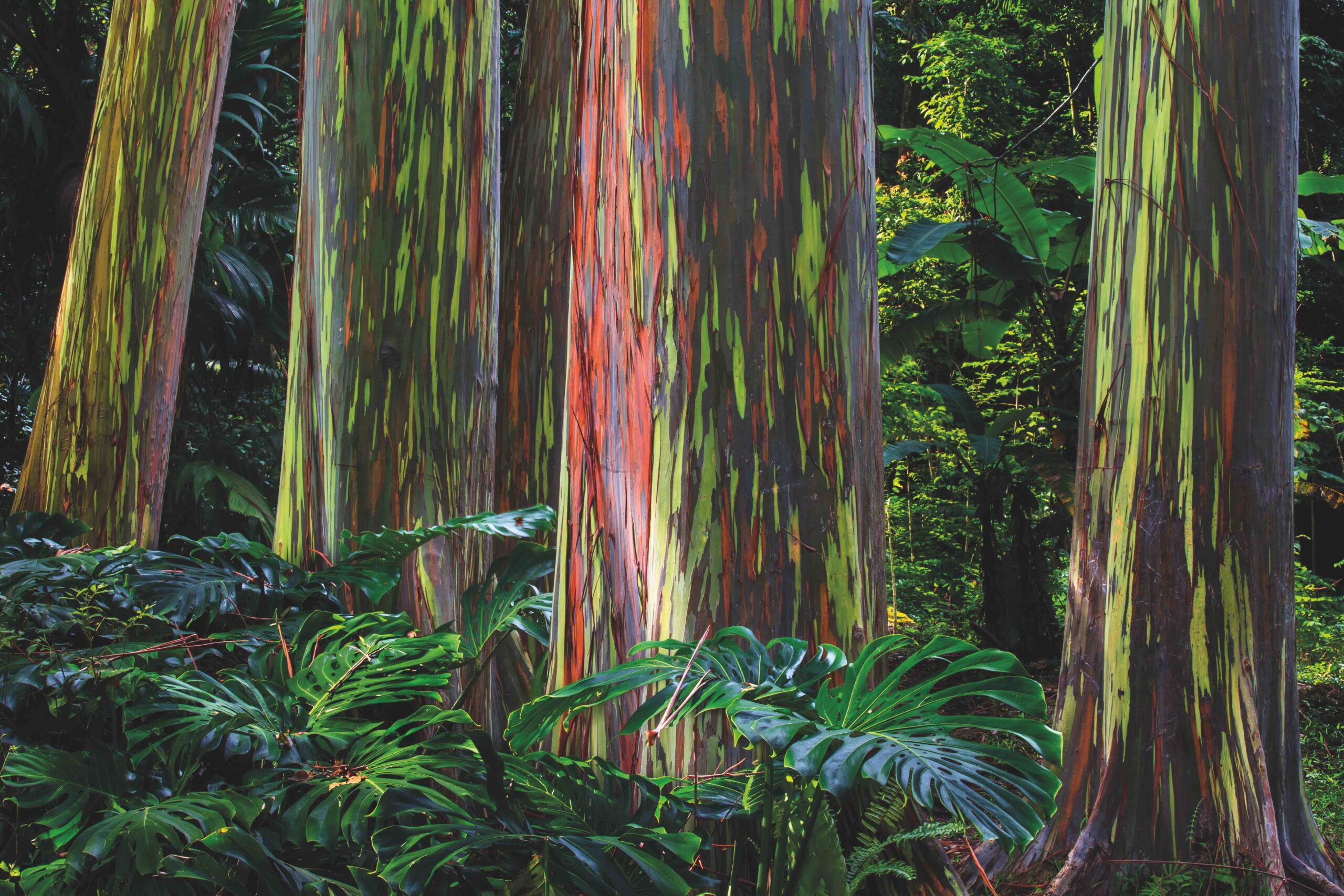
A grove of colourful Rainbow Eucalyptus trees at the Ke’anae Arboretum on Maui’s famous Road to Hana, Hawaii, USA.
Rainbow Eucalyptus
Eucalyptus deglupta
Vitals
RANGE
Philippines, Indonesia and Papua New Guinea
STATUS
Vulnerable
LIFESPAN
<100 years
AVERAGE HEIGHT
197ft-246ft (60m-75m)
This curious tree has long captivated observers with its striking and otherworldly multicoloured bark
It might sound fanciful, but there is such a thing as a multicoloured tree. E deglupta, commonly referred to as the rainbow eucalyptus, grows in tropical rainforests within equatorial regions of the Philippines, Indonesia and Papua New Guinea, and is the only species of eucalyptus that’s native to both the northern and southern hemispheres.
Unsurprisingly, the rainbow tree was named for its multicoloured appearance, which seems almost unreal on first inspection. Its kaleidoscopic trunk and limbs appear painted in a variegated display of browns, purples, oranges, greens and yellows. The bark sheds in thin layers, revealing a neon-green layer beneath, and as it ages and weathers, different pigments are produced, resulting in the distinctive spectrum of colours. It is supposed that these pigments help to shield the inner layers from excessive sunlight and UV radiation, which can cause damage to the tree’s tissues, particularly in the tropics. The patterns that form on the surface of the trunk appear to be almost brush-like, as if an artist of some abstract persuasion was seeking to create something surreal. Over time, the bark will gradually return to a brown colour, and at this stage, the shedding process is almost ready to begin once again.
While the rainbow eucalyptus has now been grown and planted in different countries across the world, its kaleidoscopic colouring is best seen where the tree thrives in its native tropical climate, where ideal growing conditions contribute to rapid growth and intensify the rainbow display.
HOW TO SEE
Although not native to the Pacific islands, rainbow trees are arguably easier to see in the well-maintained botanical gardens of Hawai‘i – there are some much-photographed rainbow gums on the 1-mile (1.6km)
Ke’anae Arboretum Trail in the Ke’anae Arboretum on Maui, while the Keahua Arboretum on Kaua‘i has the short Rainbow Eucalyptus trail, passing some colourful mature specimens.
Finding rainbow trees in the wild requires a little effort. In Papua New Guinea, the trees grow from close to sea level up to 8200ft (2500m), but there are no trails dedicated specifically to spotting this colourful species, so you’ll have to keep your eyes peeled on rainforest hikes. Try your luck on trails at lower elevations, such as the challenging Kapa Kapa Trail from Gabagaba village on the island’s southern coast.
WHERE
Imagine an Impressionist painting manifested as a tree. That’s E deglupta, more commonly known as the rainbow eucalyptus. The only eucalypt evolved to thrive in a rainforest habitat, this striking tree has a limited natural range, restricted to Papua New Guinea and areas of the Philippines and Indonesia, but its multicoloured bark makes it a favourite of botanical gardens worldwide.
WHEN
June to October is the driest time of year in Papua New Guinea, and the best time for rainforest hikes, before trails turn to quagmires during the rains. March to September brings good walking weather to Hawai‘i.
HOW TO IDENTIFY
The trunk of the rainbow tree appears multicoloured, with shedding bark revealing irregular, vibrant patches of brown, purple, orange, green and yellow. The elongated green leaves typically measure 3in to 6in (8cm to 15cm), and are glossy to the touch. As a eucalypt, the foliage is aromatic when crushed. Buttress roots can often reach over 10ft high (3m), typical of the shallow-rooted trees that are found in the tropical regions.
**********
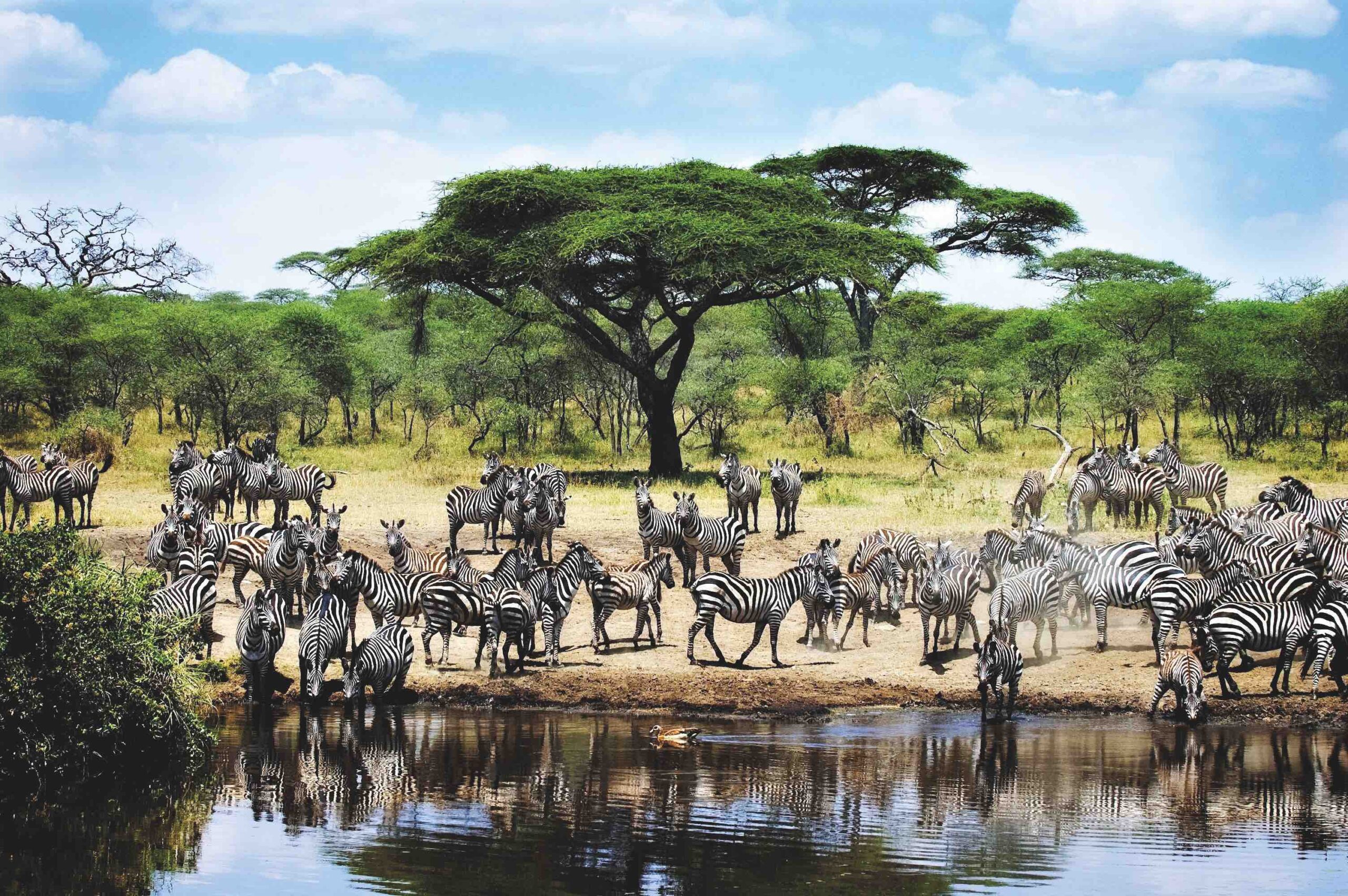
Burchell zebras drinking under an Umbrella Thorn, Acacia Vachellia tortilis
Umbrella Thorn Acacia
Vachellia tortilis
Vitals
RANGE
Africa, Arabian Peninsula
STATUS
Least Concern
LIFESPAN
<650 years
AVERAGE HEIGHT
20ft-30ft (6m-9m)
The lone silhouette of the acacia is one of Africa’s best-loved landmarks, a staple of the open savannah
If the savannah is iconic of Africa, the acacia would be its flagship emblem, the tree perhaps most symbolic of the continent as a whole.
In the sweeping grass of its celebrated reserves and national parks – from the Serengeti and Masai Mara in the east to the Kalahari and Kruger in the south – the acacia’s distinctive, easily recognised canopy stands alone, a refuge for diverse wildlife (from elephants down to ants), tap-rooted into the sunbaked soil.
There are many species of acacia native to Africa, but one of the more widespread is the umbrella thorn acacia; indeed, there are few African countries in which it does not naturally occur, namely those of the Congo River Basin in tropical Central Africa. As the name suggests, the umbrella thorn is characterised by a lightly domed and sometimes flat-topped crown, and the sharp, needle-like thorns that run in pairs along its stems.
Besides casting an attractive figure in the landscape, the umbrella thorn is of unparalleled environmental importance. Its root networks help stabilise the loose and often sandy ground in which the tree thrives, alleviating erosion, while nitrogen-fixing nodules at the root tips add valuable nutrients into the soil, as is common among the plants of the Fabaceae (pea) family. Above ground, its foliage and fruit-pods provide forage for visiting mammals – famously, the giraffe’s elongated neck can reach the acacia’s raised canopy, but its lengthened tongue and thickened lips also allow the animal to strip leaves away from the thorns. Remarkably, acacias have developed to combat this, releasing unpalatable tannins into the leaves when munched by hungry herbivores.
HOW TO SEE
WHERE
The signature tree of the African plains, the acacia conjures up images of sheltering elephants, zebras and giraffes, or of watching the sun set against its silhouetted crown as the bush comes alive with night-time sounds. These drought-adapted trees grow prodigiously in almost every African country, and in tropical zones worldwide – including Australia, where two-thirds of the world’s acacia species are found.
But if we had to pick one location to marvel at majestic silhouettes of mature acacias spread out across the grasslands, it would be the interlinked national park of the Serengeti in Tanzania and Kenya’s Masai Mara. During the annual wildlife migration from the Serengeti to the Masai Mara, you’re pretty much guaranteed photos of rush-hour herds and umbrella-shaped acacias framed against the dust-red African sun.
Safaris to the Masai Mara are easy to arrange in Nairobi, and to the Serengeti in Dar e Salaam. In either case, it will take most of a day to reach the reserves and most of a day to get back, so factor in the travel time when choosing a safari. Budget trips typically involve atmospheric stays under canvas; pricier safaris come with comfier accommodation in semi-permanent tented camps or game lodges.
WHEN
The great migration across the Serengeti begins in April. By July and August, the herds reach the Masai Mara.
HOW TO IDENTIFY
The umbrella thorn acacia ranges greatly in size, but can reach over 60ft (18m) when mature. Its trunk is grey-black in colour with fissures running in long vertical strips. Along the stems, thorns are arranged in pairs, regularly alternating between a shorter hooked thorn and a long straight thorn. Leaves are compound with opposite leaflets and can be somewhat blue-tinted. The aromatic yet modest flowers are yellow-white and clustered like balls of cotton.
**********


0 Comments