


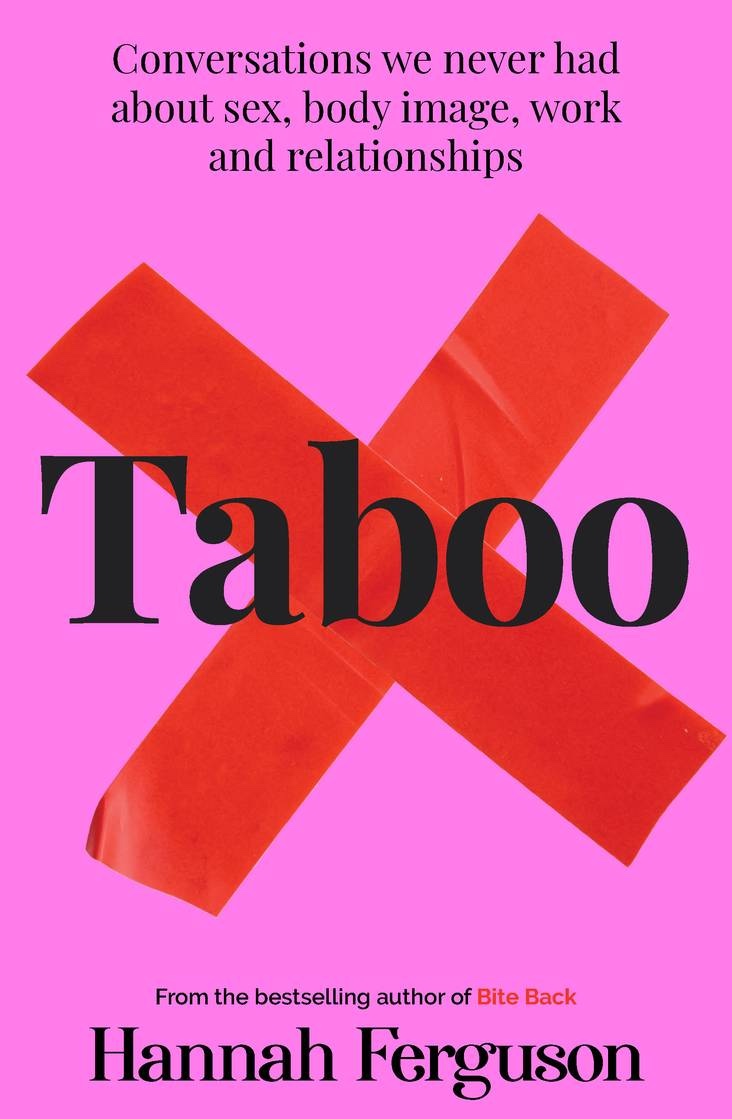
Taboo: Conversations we never had about sex, body image, work and relationships by Hannah Ferguson is a vulnerable exploration of modern womanhood that weaves deeply personal stories with opinions and advice on sex, friendship, family, career and beyond.
This part memoir, part feminist manifesto meets women where they are and as they are. Hannah exposes and celebrates the messy, honest and insular parts of ourselves in a book designed to feel like a late-night conversation with your best friend – one that will make you laugh, cry and that you’ll never want to end.
EXTRACT
The first time I heard anyone talk about female masturbation was when I was fifteen. Yes, that is the first sentence of this book. I was at a birthday party, and the year was 2014. I was in grade 10 and a group of girls in my year went for lunch at the Hog’s Breath Cafe in town. We dressed up to take heavily filtered sepia-toned Instagram photos over the chocolate cake topped with sparklers. Sixteen of them. The Snapchat puppy dog filter was in, and Taylor Swift was about to release 1989, the album that would catapult her to an entirely new tier of superstardom. Hog’s Breath was a staple birthday venue in our regional New South Wales town, Orange. I try to black out most of those years of my life, but two things I will never forget are (1) this story and (2) the $12.50 chicken caesar wraps and curly fries meal deal during the two-hour lunch session.
On this particular rainy Saturday, 12 of us piled around one of the long wooden tables towards the front of the restaurant, which was decorated in what I would describe as a shed-chic aesthetic. Pinterest has never seen anything like it. After an hour and a half of debating which of our teachers was the creepiest, sharing screenshots of messages from boys we liked and checking who was listed as the top three best friends on every person’s Snapchat, we landed on the topic of masturbation. I had never done it, and I had never talked about it before. I remember looking down at my ankle boots, gold-zippered and scuffed, not wanting to make eye contact with any of the giggling friends who were offering up their thoughts in hushed voices. My cheeks began to burn as I dipped a chip in aioli, careful to chew for as long as I could and avoid eyes assessing my response. It was the first time in my life I had shut the fuck up.
These girls were some of my closest friends. We knew boys in our grade did it, because they talked about it. They shared porn videos and blasted moaning noises through their phones and couldn’t make it through even one of our health and physical education lessons without being sent out, when all we were instructed to do was complete a worksheet matching contraceptives to their definitions. Boys would laugh or mock any mention of pads and tampons, but some encouraged each other to circulate nude images they had been sent by a girl they were talking to, or on one occasion a video that was non-consensually taken of their girlfriend performing a blowjob. These images made the girl ‘slutty’ in the eyes of many students and teachers. The boys who shared them were slapped on the wrist. Then the police were brought in to give a legal talk and that was that. I’m sure this was the cycle at many schools.
I wish I was about to describe a defining moment in friendship, one where girls who went to a conservative religious school that controlled every element of our uniform – from mandating knee-high socks, to teachers conducting random makeup-wipe swipes throughout the day, to compulsory calf-length skirts and attempting a ban on wearing hair ties on our wrists – had an open conversation about pleasure and our bodies. If I’d had the emotional maturity, this could have pivoted my entire perception of my body and my sexual understanding. But, of course, that isn’t what happened. Instead at least 70 per cent of the party attendants ostracised the two girls who had disclosed their experiences of masturbation to us. I honestly can’t remember if we decided to ostracise them in the moment, or privately afterwards. Regardless, we judged them and shamed them; I know I did. I nervously giggled that I would NEVER do that. Picking up the remnants of my wrap, shoving it into my face, I texted my mum that I would be ready to go in fifteen.
I went home and thought about the conversation for weeks. It prompted me to try masturbating for the first time. I learned more about my body in those weeks than in the years of lacklustre, uncomfortable sex ed my school offered; but those learnings didn’t stop me from telling my other friends, who hadn’t been invited to Hog’s Breath, about the conversation. I was not just shaming the two girls who had told me it was normal to want to feel pleasure; I was imposing that same stigma on others by spreading a lie I told myself day in day out: that masturbation was not normal. This is one of those stories that keeps me up at night, sitting with the realisation that the child in me hurt other children who were actually just so far ahead of me. The openness of those girls on that day was something I can still learn and benefit from even now. Children can be so mean. Mostly, we learn it from adults.
The truth about high school is that every person wants to be the cool one having sex, the ‘experienced’ and ‘awakened’ person who’s started early. They were the experts in something I couldn’t even fathom. As I walked my colour-coordinated binders to school, desperate to be just like them, to know the secrets they knew, I also remember thinking there was something boy-obsessed about it, something precious and clean that they had ruined. I felt inferior to them, and my internalised misogyny worked in overdrive to make me superior once more.
At this birthday party, which should have been a safe space for friends to share, we were so afraid to admit that we’d humped a pillow, listened to Michael Bublé on a plane (this was my sexual awakening at the age of nine – I cried because I was scared of that tingly feeling I didn’t understand), or used the tap in the bath to feel something.
For most of us at the table, instead of opening ourselves up to a new idea, our fear operated as a strong all-encompassing defence mechanism. My nervous system was activated, and I felt myself shut down. Heart racing, conversation closing. Collectively, we attempted to impose a standard on the girls who were unencumbered by this taboo. Our fear tried to work others into submission.
Shame is an infection that the most insecure, the fearful, are all too desperate to share. Sometimes I wonder how having these conversations with my friends earlier could have helped me. I wonder how the girls who were brave enough to share felt after that moment. I reflect on all the shame-fuelled things I may have said that I cannot recall, of all the people I hurt when I didn’t know better than to shame girls and hate myself. In those moments my friends were not heard, seen or known. They were made to feel perverse, slutty, horny. These are the worst things women can be told they are.
Now, I look back and wish I got to be one of the girls who touched themselves. What would it mean for me now if I had been open and able to explore, feel and pleasure myself from a younger age? I do not know these women any more, but I hope it set them up to learn more about their own sexuality. I hope they will not look at me now and despise my current openness. It would be fair if they did. The fact is: they helped me progress at, perhaps, a significant cost to themselves.
A few years later, when I was 21, I started to engage in a pattern of getting really drunk and talking to everyone at parties and in club toilets about vibrators. I was an absolute menace. I should have printed pamphlets and business cards because, for a period of time, it was what I became known for. Watch out for Three-Drink Ferg: you’ll have a clit-sucking orgasm machine added to your cart in less than sixty seconds. I didn’t discriminate, either; men would have their card tapped for a partner’s gift and women would be exploring what to add to their collections in equal measure. It was like a Tupperware party no one had asked to attend. People mocked me and said that I should have been given an affiliate discount code, so succinct and consistent was my pitch. It wasn’t just because I was more compelling than a shopping channel infomercial presenter trying to sell you a bedazzled casket before 8am. I think the only time I witnessed women and men having open conversations about pleasure was when alcohol was involved.
But I hadn’t escaped my inner 15-year-old self entirely. I would wake the next day and be so ashamed of myself that I would regularly not leave my bed until 7 or 8pm. I would sit down in the shower and call myself a pervert. I would tell myself I was disgusting. It was genuinely that bad for at least two years. I used alcohol consumption as a way to let go of control. As an intense, highly strung eldest child who dedicated much of her life to being impressive on paper and receiving applause, drinking was a way to my authentic self without the limitations of shame and fear. My bodily response when the effects wore off was the chemical restoration of those anxieties: it was shame in overdrive. I had ripped off the boundaries of a taboo like a bandaid, and when I came to, the discomfort tripled.
I was trying desperately to be vulnerable, but without doing it authentically. I was being forcibly, overly open without boundaries, not respecting myself enough to do so unless I was inebriated. I was having conversations when other people were drunk and who may not have wanted to hear about the thirteen settings the palm vibrator on my bookshelf had.
The positives of my openness were clear, in spite of this. Now I think more kindly about what I actually did: get groups of women to talk about and invest in their own sexual pleasure. I ultilised the comfort and safety and permission of lowered inhibitions to share what I had learned in my own life: that pleasure can change your relationship with your body, with sex and with yourself. I wanted to tell my friends, but I just couldn’t do it without getting drunk.
These conversations led to people I love feeling safe to disclose their abortions for the first time. The men in my life were able to ask how to incorporate vibrators into their partnered sex lives. I hated myself for what I said and did, yet the response I was getting showed me I needed to do this sober – that sex and pleasure were things people wanted to talk about, and that they were excited to have a space where they could explore the subjects free from judgement.
Fast forward four years and I’ve made my own vibrator. I have helped develop an accessible sex toy and a set of intimacy cards for destigmatising conversations between sexual partners, and to use during solo pleasure. I went from denying, to talking, to owning, to promoting, to reviewing, to producing a product. It took me seven years to go from shaming someone to feeling shame to destigmatising it. I don’t want people to have to go through this process. I want women to be born into comfort. My sister, who is seven years younger than me, got her first vibrator before she was even the same age as me when I attended that fateful birthday lunch at the elegant Hog’s Breath. She called me to do an unboxing, holding it up to the speaker so I could listen to the different settings. That is the disintegration of taboo.
Shame is a lie I tell myself, one I believe. That I am bad. That I am unworthy of love. That a thought or a behaviour or a belief or an action makes me fundamentally wrong. When we fail to challenge these beliefs, we submit to a rulebook written for us but not for our benefit.
Writing this book, I hope, will allow me to invalidate the lies I have believed about my body, my relationships and my work to date. I hope that you too identify the narratives you tell the world each and every day and begin rewriting them as needed. I want to explore what the world could be like for women if we didn’t feel smothered by the hand of patriarchy – if we were not so worn down by opposition that we became agreeable and began to believe in our own inferiority.
What I’m describing is exhausting: fighting the language and the shame and the undermining at every turn. A taboo is, in many ways, a failed connection. It is rejecting a bid for conversation because of discomfort. Every time you say how you feel, you are dismantling a stigma that’s working to dehumanise you. I’m inviting you instead to sit in discomfort and consider the small ways we, as women, have allowed ourselves to be shamed out of joy and honesty. Because we are the taboo. Our experience is what is being regulated. According to patriarchy, stating the problem makes you the problem. I have built a career from explaining to people how the media utilises language to distort our understanding of politics, law and power. But how has the language of womanhood, and the absence of it, defined and slowed the fight for equality?



0 Comments