


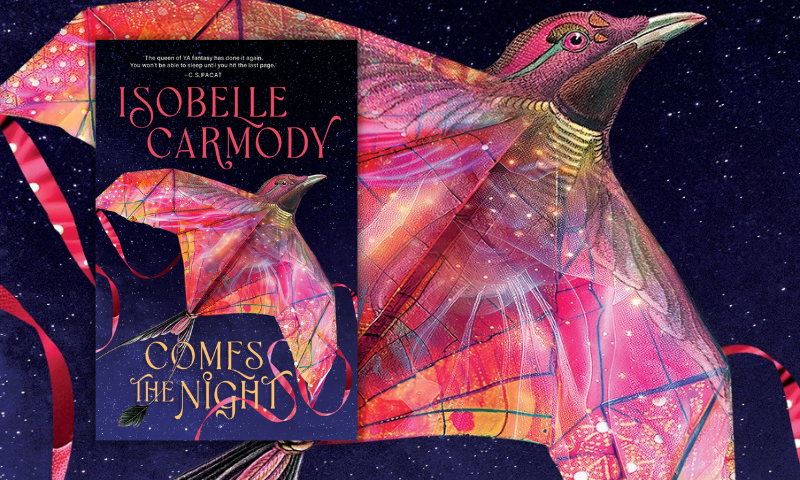
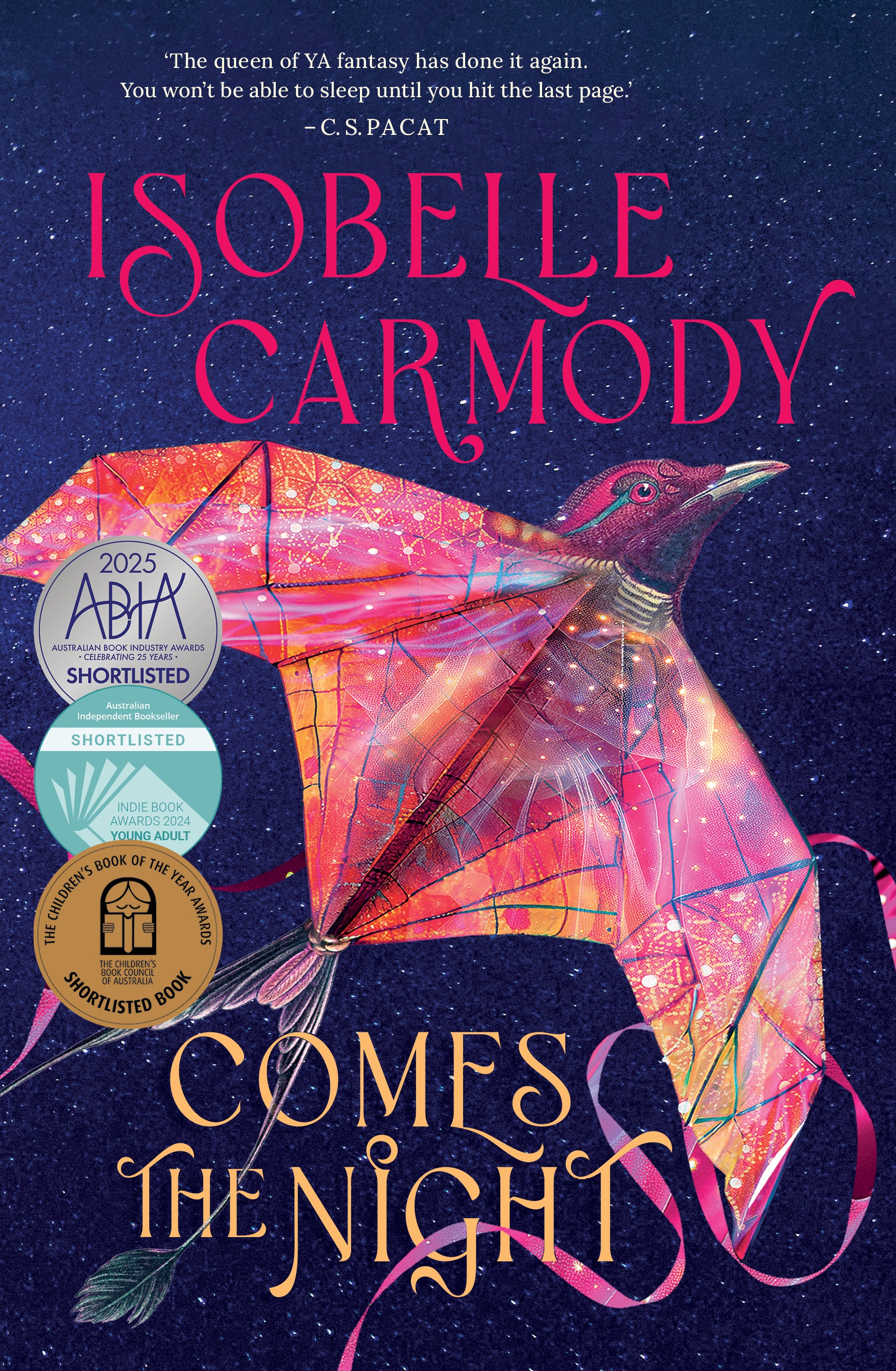
ISOBELLE CARMODY’S Comes the Night is a YA fantasy set in the near future, full of secrets, high stakes, peril, deceptions and dreamwalker.
Read on for an extract.
ABOUT THE BOOK
Will slipped on the left glove and twitched a finger to establish a link to the kite tronics. A shiver of electric energy ran through his hands as they synched to his nerves through the gloves.
Will lives with his father in a future domed Canberra where citizens are safe from extreme weather events, dangerous solar radiation and civil unrest. He does not question his carefully controlled existence until the recurrence of an old nightmare propels him on a dangerous quest.
Gradually Will discovers his dreams hold cryptic clues that lead him into a shadowy alternate dimension. Here he must grapple with dark forces that operate in both worlds, with the help of his best friend Ender, her brilliant but difficult twin sister Magda, and a mysterious gift from his uncle.
Comes the Night is a thrilling new novel from the internationally bestselling author of the Obernewtyn Chronicles.
EXTRACT
Part One
The Waking World
CHAPTER ONE
Will stepped from a white-hot dazzle of sunlight into the shadowed lane between two long, high brick walls. The sudden coolness made him dizzy. He squatted and put his head between his knees, wondering if something had gone wrong with the weather metrics. As his eyes adjusted to the shade, he noticed dense moss growing in the cracks of the broken pavement. He touched it with his forefinger. It was soft and cool, like a green pelt.
Somehow the WasteCo workers whose job it was to repair paths and spray for weeds had missed this shaggy little sliver of the suburb. WasteCo didn’t own all of Fyshwick and this lane was hardly more than a crack between two empty factories, but as the company bought up and transformed more and more older homes into worker residences in the spreading subdivision around the huge complex, it had taken over maintenance of Fyshwick Dome – and it was nothing if not efficient. Originally the area had been industrial land, Da said, but it had been rezoned as residential when refugees from the drowning coastal cities began to move inland.
Will loved all the contrasting bits of Fyshwick: the old residential streets and houses, the reclaimed green zones, even WasteCo’s gleaming towers. But what he liked best were the industrial areas, where you might find a garden of weeds inside a half-shell of brick, golden beams of sunlight slanting down through the dusty windows of a vacant warehouse, or a narrow lane where moss grew unchecked through broken cement.
He only wished there was graffiti. If he had any guts, he would do some.
He glanced up warily at the lane of perfect blue sky overhead, though he had done nothing wrong. Not that you would see a watch drone even if one was right above. They were small and built to fly quiet and high, to cause the least possible public discomfort and aesthetic disruption. You could assume one would pass over at least every half-hour, because they were programmed to constantly overfly in a grid pattern, getting random captures. The chance of a drone happening to be overhead just as he was cutting through the lane seemed unlikely, but you never knew.
Someone is always watching.
That was Ender’s motto. She meant CCTV cameras and drones were always watching, not people, though it was people who built and programmed them. She thought watch drones were especially dangerous, because although they were only supposed to be programmed to overfly public spaces, they had been spotted hovering above private yards or outside apartment windows. She believed watch drones were designed small and flew high so people wouldn’t realise how much their lives were under scrutiny.
Besides being Will’s best friend, and super smart, Ender was paranoid. Will always wondered if that was another side effect of the XD serum her mother had taken when she was pregnant with Ender and her twin sister, Magda.
The XD drug had been designed to produce brilliant children, and it had done that, but there were a lot of side effects that no one had expected, good and bad. Fortunately, Ender’s personality was within the acceptable range, so there was no question of her being quenched.
Will shook his head, puzzled at the way his thoughts were wandering in the middle of a hunt.
‘Door to the sky.’ He said the final clue aloud, firmly. Straightening, he moved further into the lane. He had lost time because of his dizzy spell, and it was impossible to know how much, because he wasn’t wearing a navwatch. He didn’t need one to navigate Fyshwick, and he didn’t wear one a lot of the time anyway – Adam said people needed to figure stuff out for themselves using only their own brain as much as possible, just to be sure it was still working. Not that his uncle was a tech-phobe. Adam had every electronic gadget ever invented in his apartment. But he also did stuff by hand or without tech whenever he could. Going old school, he called it, saying they’d better be able to do everything old school, come the zombie apocalypse.
That was a very antique allusion to the pre-dome era when half the world seemed to be obsessed with zombies, at least as their entertainment. Ender had this theory the zombie apocalypse craze had been a combination of frontier nostalgia and survivalism in a time when the whole world seemed on the verge of jittering apart. Weird people had somehow got into positions of authority in some powerful countries, and the Doomsday Clock that signalled how close the world was to nuclear war had reached a second before midnight. There had been lots of marches by people who were scared about that. Just last week, in class, Will had seen historic eco-anarchy march holovids of that time and had marvelled that people were allowed to gather in the streets, shouting and waving placards, blocking the traffic.
Ender had piped up after the screening to say the eco activists had been right, hadn’t they? About plastic and climate change and non-renewable energies. About damaging the atmosphere and poisoning the air. The teacher said they had been right about the importance of those events, but that disrupting business and commerce was absolutely the wrong way to go about fixing those problems. What was needed was a government – governments – with power enough to impose peace so they could come up with solutions.
‘Imposed peace is oppression,’ Ender had muttered, but Will thought the teacher had a point. The eco activist marches had led to the Millennium riots. A lot of innocent people had died, and all sorts of property had been damaged or destroyed. And the rioters hadn’t prevented the poisoning and rise of the oceans, the destruction of natural environments, the catastrophic die-off of animal species – though Will knew Ender would say it would have been a lot worse if they hadn’t made a fuss. The teacher had concluded triumphantly that Australia was one of the most advanced countries in the world because the army had been called out to stop the uprisings, and new anti-assembly laws established, producing order that had allowed doming to proceed.
Australia had successfully domed the first city in the world, and now every capital city and most regional cities in the country were domed. Other countries had domed too, but nowhere else had it happened so smoothly. The teacher said this was because construction in Australia was not continually disrupted by war or protests or civil discord. In some countries there was so much internal strife there was no possibility of re-building cities that had been destroyed, let alone doming even parts of them.
The only countries that had formally voted not to dome were those in the Scandi Confederation. Their central governing council had responded to the vote by providing body, home and vehicle armour for all citizens. No matter how many times this decision came up for discussion in class and in the Government Bulletin, Will could not understand why the Scandian people had rejected doming, which surely had to be the easiest way for people to protect themselves from the damaged environment.
Anyway, the main reason he was not wearing a navwatch now was because Adam banned the use of tech on hunts. Will had an ophone on him in case of an emergency, but he was not supposed to use it. He could not even look at the screen to check the time, because the second he unrolled it the map app would announce his location. You couldn’t disable locational apps, which were hardwired in all devices by law, though only the government could track you if you turned your ophone off.
But why he was thinking about navwatches and ophones? He should be concentrating on finding the next clue.
You must be careful, his mother said inside his mind.
He grimaced, imagining Klare’s reaction to him hurrying along a lane between derelict factories after having almost passed out. She would immediately worry about him falling, gashing his knees, opening a way into his body for an army of deadly ancient germs. She hated anything old; in her mind, it equalled germs. Her apartment in Sydney’s Elizabeth Dome was an arctic wasteland, all pale shining surfaces with nothing on them. Zero tolerance for germs.
That was part of what she’d disliked about their house – it was old, and the garden unruly. She especially hated the fallen jacaranda blossoms at the end of spring. That she saw a carpet of blue blossoms as a mess told you everything that you needed to know about the woman. She never went anywhere old if she could help it. Will had only discovered the greater abandonment of the industrial areas because of the hunt, invented by Adam to distract a grieving kid from the separation of his parents.
The week after Klare left, 10-year-old Will had been sitting with his father on the front step of their house in the dappled shadow of the jacaranda tree when Adam drove up in his sleek electrocar. His uncle had loped up the path looking super fit and cool as ever in grey pants, black jacket and slickboots. He removed the sunglasses Will’s mother called an affectation since no one in a dome needed sunglasses, and handed an envelope to Will.
His uncle was famous for exciting and unusual presents, but the envelope was perfectly ordinary, with his SRI work logo and address on the flap. Will had opened it to find a pencilled list.
‘Those are clues,’ Adam had told him. ‘You need to work out each one in order. No one can help you and you can’t use a navwatch or ophone.’
‘Is this something for Olitron?’ Will asked. Sometimes Adam had him and his father test tech he was developing for the game company he worked for as a side hustle. He called it his hobby job.
Adam had shaken his head. ‘I created it just for you. I call it the Wilful Hunt.’
‘Is there a prize?’ Will had wanted to know, not much impressed with a game that seemed to be no more than a typed list.
‘You’ll find out,’ Adam answered, waggling his eyebrows. ‘Start now, and you have until sundown. If you’re not up to the last clue by then, you lose.’
A wave of grief crashed over Will, which was odd, because he no longer felt the anguish his younger self had suffered over his parents’ split. Half the kids in class had parents who were not married to one another anymore, either because they had split or because their short-term marriage contracts had ended. Nor had his life changed much after the separation. He saw a little less of his mother than when she had been living with them in Canberra, flying every other day to Sydney or one of the other cities. His father was still home most of the time, cooking and helping Will with his homework. He still taught history, though less than he had once done, and he drank more. Not that Will would ever have said as much to his mother. She would have had him enrolled at some fancy school in Sydney in the blink of an eye if he gave her reason. If he was worried about Padraig, Will called Adam. But mostly there was no need, because since his mother’s departure, Adam visited at least once a week.
Adam noticed everything. Not just poetic stuff like a spider web blowing in the wind, or an ancient bit of graffiti like Will’s father would notice, but inside unspoken stuff too. He had told Will that he’d trained himself to be alert to everything around him, paying attention with all his senses. Thinking of this, Will looked around, bringing his attention into the moment as Adam did. He spotted a small squarish window high up in one wall, and grinned in triumph – from the inside, a window was a door to the sky.
Overhead great clots of black were now scudding along the blue sky lane, and he wondered if a storm was brewing outside the dome. It was rare there was a storm inside. Usually, it was designed to accompany some big event and was announced in the Government Bulletin so citizens could be prepared.
All at once the dizziness returned and Will staggered against the wall, feeling so nauseous that he thought he might throw up. The sickness faded immediately, as before, but his chest felt tight, and he wondered if he should use the ophone to call Adam.
As a little kid, Will had suffered a mysterious night illness. His temperature would rise as he slept, and occasionally he would sleepwalk and shout nonsense to people who were not there. He would be like that for a couple of days, never quite waking, and when he did wake at last, he would be dizzy and nauseous for a bit, then it would be over. An attack was often preceded by a bout of asthma, which the doctors said appeared to be one of the symptoms of whatever was wrong with him. They had been unable to diagnose it, saying it was likely a genetic variation since Adam had experienced similar fevers as a kid. He had grown out of them, and Will had too. Mostly.
Sensitive, his mother’s voice said in his mind, and Will grimaced.
That was what Adam had told him the first time Will complained about his parents. It was during one of the after-hunt talks that were the true prize for a successful hunt, though he had not realised it until he was older.
‘Paddy is a poet. He uses words to make art. He could no more fight with them than throw a Ming vase at the wall. Your mother is a warrior with words. She uses them like a sword, hacking and stabbing, going for the kill. You have her blood, so you can match her, though words are not your weapon of choice.’
There had been such genuine admiration in Adam’s voice when he talked of Will’s mother that it had diverted Will from asking what his weapon was, if not words.
I’ll ask him today, Will resolved.
His chest was still tight, but he set off, resisting the temptation to pull the puffnode from his pack – using it would trigger a ping to both his parents. Instead, Will relaxed his neck and shoulders and drew long, deep breaths as he walked, picturing Adam waiting at the end of the hunt, leaning against the car with his sleepy, pleased grin. If he was right about the window being the door to the sky, Will would find something inside to tell him where Adam was waiting.
Will felt a spit of rain and realised the storm was inside the dome. He looked up to see the sky overhead was now completely clogged with cloud. Any scheduled rain would be light given it was daytime, but the final hunt direction was often chalked on a wall. If the factory roof leaked, any message might be washed away and he would fail the hunt.
Again, Will felt a great stab of sorrow, which confused him – it was not as if this would be the first hunt he had failed.
Several more drops of rain fell, then it began to rain hard. Startled, Will was about to turn back to find shelter when he spotted grey, splintered double doors in the factory wall just ahead, on the side of the sky window. He ran to them. The doorhandles were chained, but the rusted hinges were broken – he could push through the gap.
It was too dark inside to see anything, so he stopped, blinking rain from his eyes and wondering who had authorised such a heavy downpour. The clatter of drops rattling down on the metal roof was deafening, but the air felt dry. As his eyes adjusted to the dimness, Will saw the factory was empty but for a few rusting machines lined up against the opposite wall.
There was a skylight down the end of the building in the direction of the window he had seen from the lane. If he were Adam, he would chalk the final direction on the floor under it, close to the final clue. As he moved towards it, a section of the corrugated roof gave way, sagging to release a little flood of water. A bird fluttered up from metal steps at the far end of the factory to vanish into a shadowed niche.
Glancing up through the torn opening in the roof, Will saw lightning flickering on the underside of the thunderheads. It was only a holo illusion to go with the rain, but it looked amazingly real. He heard a footfall, and Adam stepped into the grainy brightness falling through the skylight.
‘Hey!’ Will said, grinning.
‘Go back,’ Adam said. He was not smiling. ‘Wh . . . what?’ Will asked, confused.
He heard a low growl behind him and turned to see a black dog with an enormous misshapen head. Long fur bristled in a stiff mane around its thick neck as it came towards him. It opened its mouth in a snarl that revealed yellow teeth and a throat like a red tunnel, and razor tusks slid out either side of the beast’s maw.
Impossible, Will thought.
‘Run!’ Adam yelled, but he sounded distant. When Will glanced back, he saw with a shock that his uncle had gone.
‘He left me,’ he whispered in disbelief.
The monster dog was watching him with its tiny, baleful red eyes, drool hanging in glistening strands from its teeth. To his horror, it gathered itself and sprang. Before Will could move, it hit him like a truck. As he fell beneath the weight, its tusks cut into his gut, opening him up.
A terrible pain savaged Will, and he remembered. Adam had left. He had left in the worst possible way. He had died.
ABOUT THE AUTHOR
 Isobelle Carmody is one of Australia’s most highly acclaimed authors of fantasy. At fourteen, she began Obernewtyn, the first book in her much-loved ‘Obernewtyn’ Chronicles, and she has since written many works in this genre. Her novel The Gathering won the 1993 Children’s Literature Peace Prize and was joint winner of the 1994 CBCA Book of the Year Award. Greylands was joint winner of the 1997 Aurealis Award for Excellence in Speculative Fiction (Young Adult category), and was named a White Raven at the 1998 Bologna Children’s Book Fair. Isobelle’s work for younger readers includes her two series, ‘The Legend of Little Fur’ and ‘The Kingdom of the Lost’, the first book of which, The Red Wind, won the CBCA Book of the Year Award for Younger Readers in 2011. She has also written several picture books as well as collections of short stories for children, young adults and adults, and is currently working on Darkbane, the final book in ‘The Legendsong’ series.
After living in Europe for more than a decade, these days Isobelle divides her time in Australia between her home on the Great Ocean Road in Victoria, and Brisbane, where she completed a PhD at the University of Queensland, and has been conducting postgraduate research.
Visit Isobelle Carmody’s website

0 Comments