


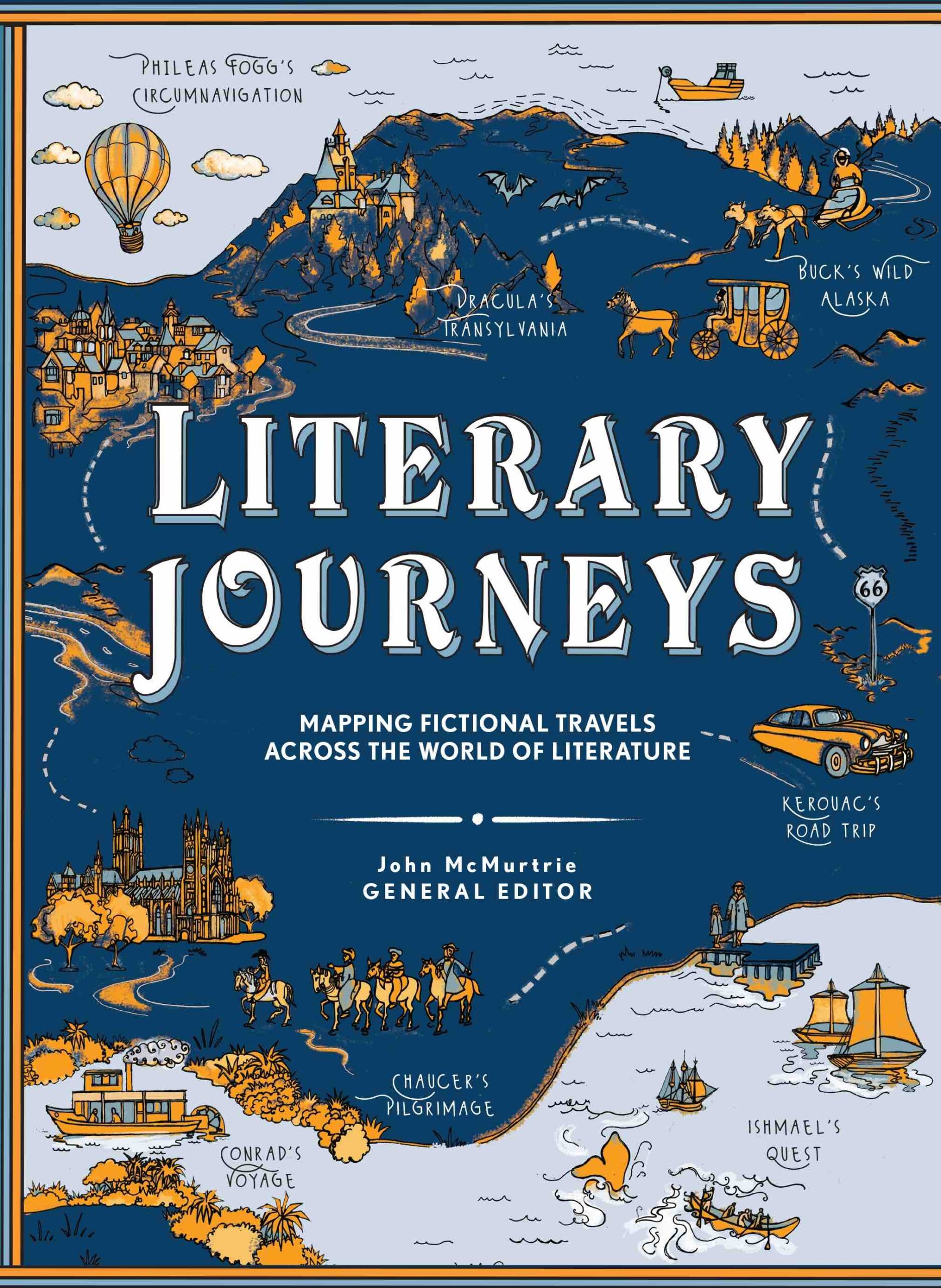
Literary Journeys will take you on the most important journeys in literature, over eight centuries and across over 30 countries.
From Chaucer’s The Canterbury Tales to Kerouac’s On the Road, Cervante’s Don Quixote to Whitehead’s The Underground Railroad, the journey has long been an archetypal story. The genre’s inherent escapism is the perfect vehicle for fuelling dreams of being outlaws and romantics, for taking us outside of our own lives and across the world. From the comforts and confines of our homes, this book brings to life some of the most significant, exciting, dangerous, tragic and uplifting journeys ever written about.
Tracing the chronological growth of the journey as a literary device Literary Journeys showcases the breadth of different authors’ grapples with this narrative structure.
ABOUT THE CONTRIBUTORS
An team of 55 expert contributors includes literary critics, academics and authors such as John Sutherland, Maya Jaggi, Robert McCrum, Kimberly Fain and Alan Taylor.
EXTRACT
KINGSTON-UPON-THAMES TO OXFORD
JEROME K JEROME
THREE MEN IN A BOAT (1889)
Inspired by a real trip, Jerome K Jerome’s comic novel recounts the journey three men (and a dog) take in a rowing boat from London to Oxford.
Jerome K. Jerome married Georgina (known as Ettie) in June 1888, just nine days after she had divorced her first husband. Their honeymoon in a little boat on the River Thames inspired the comic novel Three Men in a Boat (To Say Nothing of the Dog), which Jerome wrote as soon as they got home. In it, Jerome becomes J, the narrator, and his fictional companions are George and Harris, based on real-life friends of Jerome. Together with Montmorency the (invented) dog, they start from Kingston-upon-Thames, ten miles southwest of central London, and row a rented boat to Oxford, 90 miles upstream; they start to row their way back in the rain before deciding to catch the train to London, where they dine out and toast “old Father Thames.”
The story starts in J’s London flat with the three friends discussing their health, feeling they need a vacation and deciding to “go up the river.” Boating on the Thames had become an especially popular pastime in the late nineteenth century as middle-class Londoners made use of their proximity to the great river. The number of registered boats on the Thames increased sharply from 8,000 in 1888 to 12,000 in 1889. No doubt the journey he recounts is one that would have been taken by many of his readers.
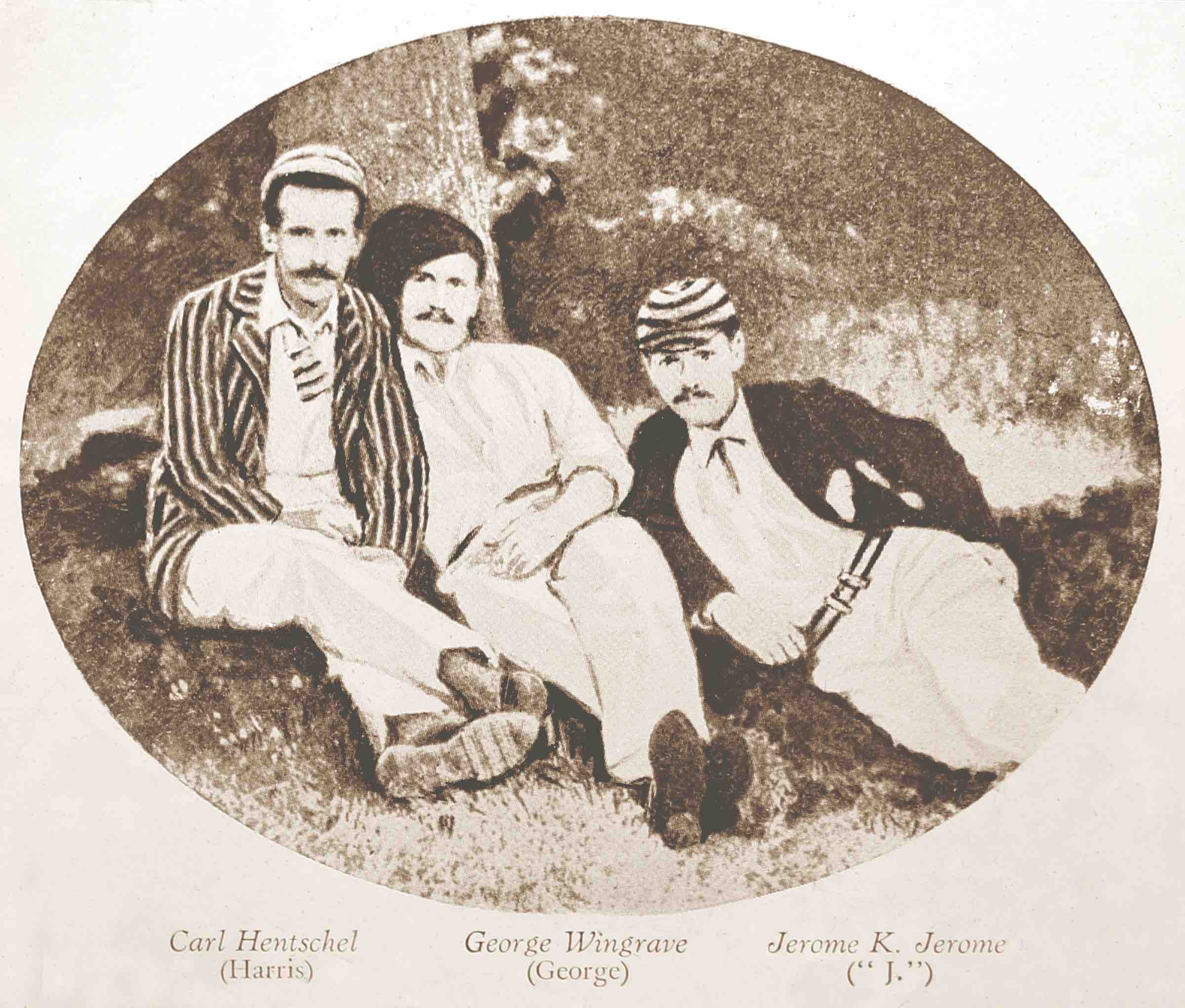
The real ‘three men in a boat’: Carl Hentschel, George Wingrave, and Jerome K Jerome
The three friends’ planning and packing trigger reminiscences about Uncle Podger’s catastrophic DIY, smelly cheeses, lost toothbrushes, and misleading weather forecasts. There is a timeless universal comedy in these tales of life in late Victorian England. And it is unexpectedly moving when one chapter ends seriously, with a pseudo-medieval allegory about encountering a vision of joy while lost in the dark forest of Sorrow.
Kingston, the busy market town where J and Harris set off by boat, is the first of nearly 40 riverside locations mentioned in the novel. It still has ‘quaint back-streets and a station on the South Western Railway. Henley Regatta, the world’s most famous rowing festival, began in 1839 and still runs almost every year. When J and George wander into Henley for a drink, the town is preparing for the annual event and is ‘full of bustle’. Jerome is cheerfully subjective in his accounts of the places on their route: the town of Reading is ‘hideous’ while the village of Sonning is the ‘most fairylike little nook on the whole river’.
The travellers pass Hampton Court Palace, which prompts a story about Harris getting lost in the maze, and trespass into Kempton Park for a picnic, leading to a couple of virtuoso anecdotes about comic songs. The real journey described in the novel, with its glimpses of the riverside history and classic English scenery, is a springboard for the stories that have become the immortal laugh-out-loud legacy of Three Men in a Boat.
‘I did not intend to write a funny book, at first,’ Jerome later confessed. He set out to write a travel guide, taking advantage of the late Victorian fashion for river trips and leisure tourism. The book was originally commissioned as a series of magazine features on ‘The Story of the Thames’. In some of the remaining bits of historical info, Jerome playfully subverts the genre: ‘Henry VIII stole it from someone or the other, I forget whom now,’ he writes of one passing stately home.
 Much of Jerome’s humour lies in juxtaposing different registers: poetic digressions with plain-spoken realism, archaisms with slang, or mock-useful travel-guide-style sections with hilariously subjective asides. After a long lyrical passage near the start on the joys of camping (‘lulled by the lapping water and the rustling trees’), Harris asks ‘What about when it rained?’ Digressing on Elizabeth I’s connections with the Thames and its waterside inns, Jerome comments: ‘She was nuts on public-houses, was England’s Virgin Queen.’
Details of the trip itself provide some of the funniest moments: cooking “Irish stew” over a campfire or searching for the elusive perfect hotel with honeysuckle over the door. Everyday objects take on lives of their own, like the tea kettle that will only boil if you studiously ignore it or the unopenable can of pineapple with its ‘mocking grin’. In capturing its hilarious banalities, Three Men in a Boat celebrates everyday life, its trials and its triumphs in all their humorous profundity.


0 Comments