


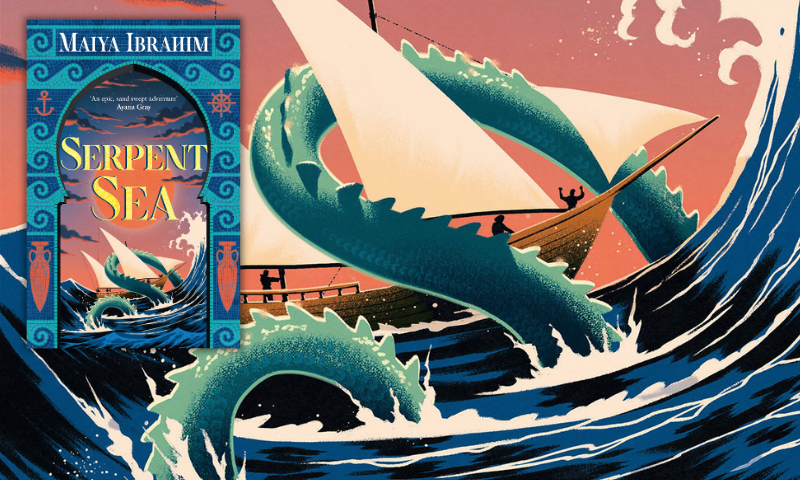
Good Reading for Young Adults caught up with author MAYA IBRAHIM to discuss Serpent Sea, the sequel to her bestselling Arabian-inspired YA fantasy, Spice Road.
When did you discover your love of writing?
I started writing when I was in Year 4. Getting a computer at home was a big deal for me in that regard – I’d open up Notepad and bang away at the keyboard after school any chance I’d get. I didn’t wholly understand what it meant to be an author then. I just knew that I liked writing stories as much as I enjoyed reading them (and I did a lot of that – the library was my second home.)
Imani is back in your latest novel, Serpent Sea. What’s new for her since the last book?
So much! She was reunited with her brother at the end of Spice Road, but it was a bittersweet reunion because it also came with the revelation that the Harrowland Empire knows about their people’s secret homeland and magic. The threat of invasion has suddenly become very real. Imani must contend with that now, along with rebuilding her worldview, which was quite unceremoniously torn down in Spice Road. Of course, there’s also the shake up in her personal relationships. Serpent Sea is very much about her trying to figure out who she can trust with her heart.
What sparked the idea for the world of Serpent Sea?
I have a deep interest in early and medieval English and French history, and I already knew in Spice Road that with the introduction of the Harrowlanders, there would need to be a closer examination of their society in the future, or else I ran the risk of framing them as cartoonish villains. Some events in Spice Road show Imani that no society is a monolith, and the concerns of inequality, poverty, and oppression are universal. Serpent Sea felt like the perfect opportunity to build upon these themes and give the Harrowlanders some depth, and what better way to do that than to visit the Empire’s capital.
In what ways did you draw from your own life to create the fantasy world of your book?
Many aspects of Imani’s homeland and the neighbouring kingdom of Alqibah are inspired by my Arab and Levantine background, including the way people look, and the architecture, customs, clothing, food, and place names. The same goes for the discussion in Serpent Sea around colonisation, invasion, and war.
What role does setting play in your story?
Setting is a character with its own things to say. I’m of the belief that an individual is a product of their environment, and their environment is a product of wider society, and this belief definitely influenced the role that setting plays in Serpent Sea. I am a worldbuilding enthusiast, so I try to put thought into every aspect of a setting. For that reason, the places in Serpent Sea act as living mirrors that reflect not only the interests, aspirations, and concerns of the people who inhabit them, but also tell us about their politics, religion, economy, technology, and their natural world. Setting is an emotional motivation for the characters as well – their actions are largely driven by a desire to protect their homes.
What can you tell us about Qayn?
Aside from the fact that the handsome djinni is a fan favourite (unsurprisingly), he gets much more page time in Serpent Sea and for very good reason. I wish I could say more, but I don’t want to spoil anything!
What inspired the magical elements in your novel?
The monsters and beasts that appear in Serpent Sea have their basis in Arab and Middle Eastern myths and beliefs, while the idea for spiced tea magic came to me after I read some historical accounts about Arab spice traders. To protect their lucrative trade, they would spread rumours that their spices grew in remote places guarded by magical creatures. I started envisioning a distant, secretive land where monsters and mythical beasts roamed, and a spice grew that could grant you magical powers when ingested. I chose to have it ingested through tea because tea is such an important and recognisable part of Arab culture.
What did you find most challenging or rewarding about writing this novel?
Serpent Sea is ultimately a book about colonialism, imperialism and war. I was working on it when the conflict started in Gaza – it’s hard enough writing about things that have affected the Arab world and the Middle East historically; it’s another to do it when those things are threatening your loved ones and their loved ones right now. I don’t know how to put this in a better or more coherent way. Writing this novel was just a very difficult experience. But I am glad that I did write it, and I’m grateful that my thoughts on these issues will reach many people, particularly young people. It’s my hope that stories like Serpent Sea will help to shape a more peaceful future.
ABOUT THE AUTHOR
 Maiya Ibrahim graduated with a Bachelor of Laws from the University of Technology Sydney. When she isn’t writing, reading, or spending time with her family, she enjoys video games, gardening, and expanding her collection of rare trading cards. She lives in Sydney, Australia.


0 Comments