


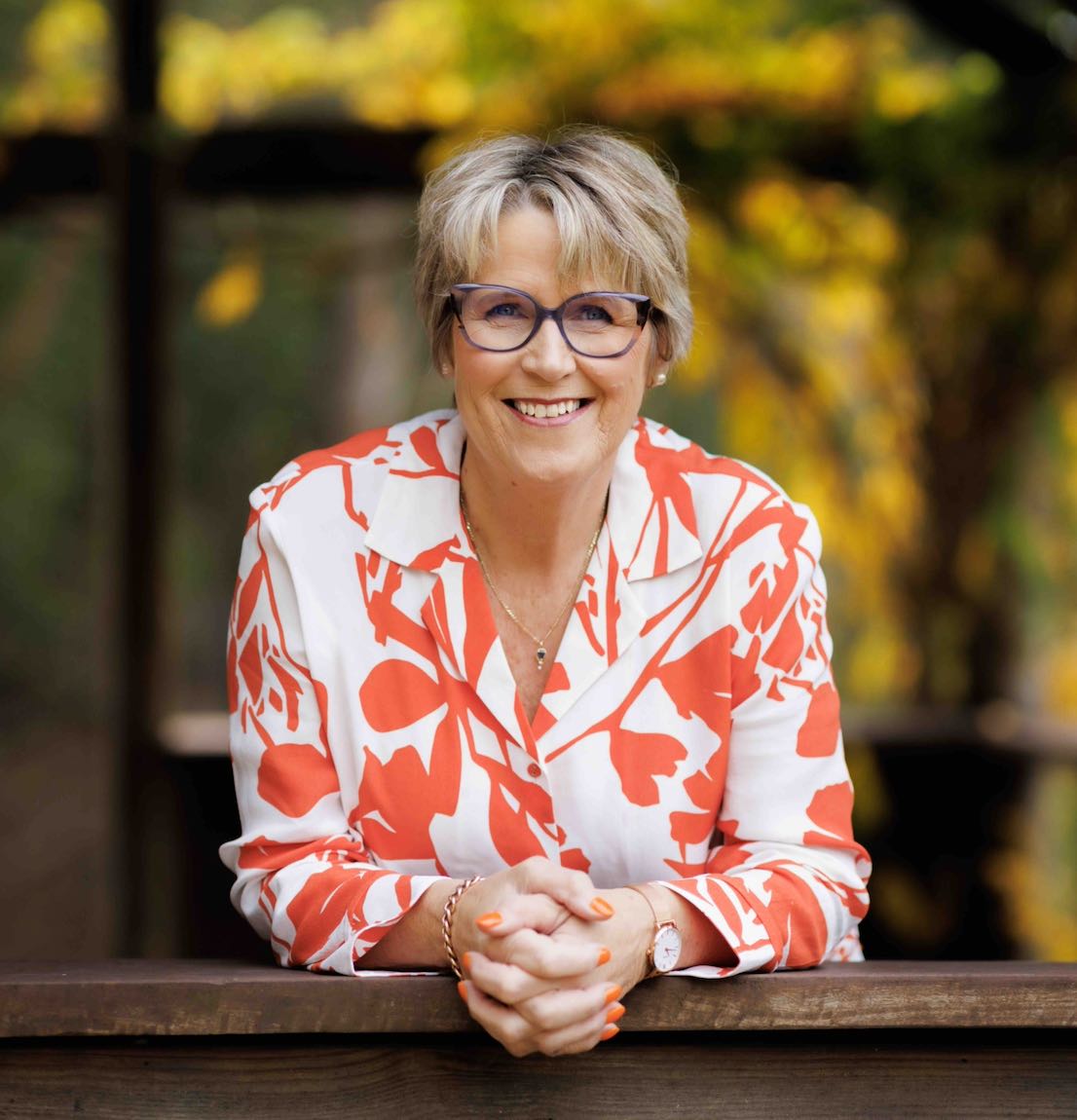
TRICIA STRINGER is a bestselling and multiple award-winning author. Her books include Back on Track, Keeping Up Appearances, Birds of a Feather, The Family Inheritance, The Model Wife, Table for Eight, seven rural romances and a historical saga set in the unforgiving landscape of 19th-century Flinders Ranges.
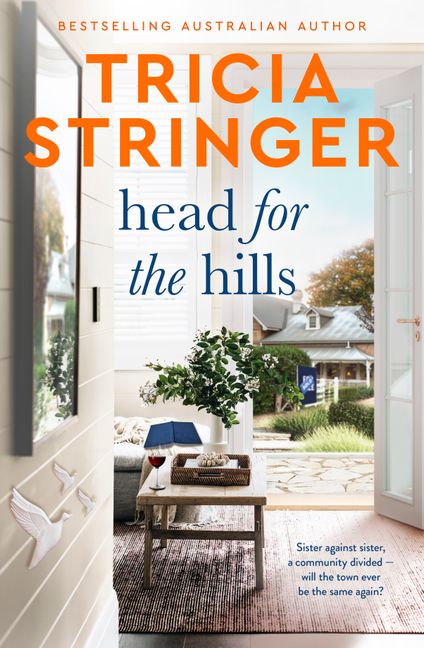
As her latest book, Head for the Hills, was about to be released we chatted to Tricia about growing up on a farm in country South Australia and a character she can’t let go of.
ABOUT THE BOOK
Margot and her sister Roslyn have lived side by side in a little town in the Adelaide Hills most of their lives, supporting each other through thick and thin.
Then their neighbour Gunter dies. Surprisingly, his will asks that his house and vineyard be sold and that Roslyn donate the money to a charity of her choice. When a developer wants to buy the land and create a hotel just over Margot’s fence, Margot is outraged and decides to stand for Mayor and fight the development. But Roslyn feels differently. Her awareness of family violence and homelessness is sparked by the arrival in town of a young pregnant woman, who is escaping abuse and sleeping in her car. Determined to do some good, Roslyn supports the sale – she has found her charitable cause and the money will go to the homeless.
Suddenly the sisters are on opposite sides of the fence, literally and figuratively. As the row heats up, their local community is divided between those pro-development and those against, and battle lines are drawn, neighbours eyeing each other angrily either side. As vandalism erupts, bitter words are hurled and pots are stirred. Will the town – and the sisters – ever recover their community spirit? Will anything ever be the same again?
Q & A with TRICIA STRINGER
What was the name of the street you lived in as a child?
I lived on a farm on Eyre Peninsula, South Australia and there was a dirt road that passed our front gate. If I turned right the road led to my school five and a half kilometres away and if I turned left it led to the nearest very small town 12 kilometres in the other direction. I don’t remember it having a name back then but now it’s called Mount Hill Road.
What are your fondest memories of growing up there?
I’m the youngest of three by 10 years so I spent a lot of time amusing myself. It was the best childhood. So much freedom. I played a lot of imaginary games, climbed trees, looked after animals, drove cars and tractors, built cubbies and generally roamed free. Books and reading were also a huge part of my life but one of my fondest memories is pedalling Mum’s pianola and belting out songs as I ‘played’. In my head I was a famous pianist and singer. Neither of which came to be but I remember the joy of pretending.
What did you like doing most at school?
I went to a one teacher rural school. There used to be around 16 of us and for my first two years the other 15 were boys. I had one year at an area school (students from Reception to Year12) where there were over forty students in my year seven class and then I went to an all-girls boarding school. I enjoyed school and if I had to pick I’d say English was what I liked the most.
What was your first job?
My parents moved to a seaside town and when I came home for breaks from teacher’s college I worked in a local café. We could eat as many hot chips as we liked!
In some ways you began your career writing as a teacher writing for the children in your class. What prompted this and what did you write?
I moved with my husband and three young children to Yorke Peninsula where I worked as a teacher and a librarian in an area school. Our region is called the Copper Coast because it was a big copper mining area. Every two years we celebrate that with our Kernewek Lowender (Cornish Festival) and I realised there was a gap in stories that my year four/five class could relate to about this part of our history. I thought I’d write one. That’s when I discovered how little I knew about the actual process of writing a book. I did a children’s writing course and wrote several stories for children before turning my attention to writing for adults.
Do you remember the moment your first kernel of an idea came to you for your first book?
I remember my first adult story idea. There was a short story competition that had a rural theme and it sparked an idea to write a story that showcased country life. At 30,000 words I checked the comp rules. The limit was 3000. I kept writing. Needless to say I’m not a short story writer. I take my hat off to the talents of those who are.
Which writers inspired you to write stories like they did?
I had been dabbling with writing for adults for a while when I read Monica McInerney’s first book, A Taste for It. I loved the way she brought the setting and her characters to life with warmth and humour. It was the writing style I wanted to emulate.
 What inspired the plot of your latest book, Head for the Hills?
In the last few years there have been several instances of proposed developments in South Australian country areas from mining to radioactive waste storage to hotel complexes. In each instance they’ve led to division in the local community. There are valid arguments both for and against and people become very invested in their position. I wanted to explore that further.
No matter where people live they can be fiercely divided when they feel strongly about an issue and disagree. Your book focuses on this with division between sisters and development in a small community. Have you had experience of this and do you think rural communities can heal, even though they are small and so tight knit?
I haven’t experienced it myself but I’ve lived in rural communities most of my life and I can imagine the damage division causes. I believe rural communities can heal when there’s a common goal but fiercely divisive issues are tough to come back from. It’s harder to be invisible and it’s harder to sit on the fence when everyone has an opinion that’s discussed everywhere from the aisles of the supermarket to the front bar of the hotel.
You grew up on a farm in SA and your books focus on rural stories, mostly with a touch of romance. This genre has become very popular over the last years. What do you think draws readers to romantic stories set in rural communities in particular?
I started out writing rural romance and my fascination with small-towns and communities, rural or otherwise, has continued into the family focused and women-centred fiction of my last seven books. I think this fascination with small towns is true for writers of all descriptions. From the days of We of the Never-Never by Jeannie Gunn to A Town Like Alice by Nevil Shute to contemporary novels such as The Dry by Jane Harper and The Lost Flowers of Alice Hart by Holly Ringland we’re enthralled by rural life. I think it’s the close knit nature of the community which throws characters into each other’s paths, and the rich details of the landscape that allow the setting to be almost another character that work together to draw readers to it.
Is there a character you have created that you can’t seem to let go of completely and is prompting to be written into another novel?
Yes there’s Ketty Clift who first made an appearance in Table for Eight when she went on a cruise and again in my 2023 book, Back on Track, when she travelled on our legendary Ghan. Ketty is a couture dressmaker from Sydney who loves to travel and has a gift for bringing people together. Travel and relationships are the perfect combination for stories so I’m hopeful there’s another Ketty adventure in my future.
What do you think to yourself when you back at your writing journey?
How fortunate am I to be doing something that, even though it’s work, I love. The journey has taught me so much and while at times it’s been a tough learning curve it has also brought me immense pleasure.
What are you reading now?
I’m lucky enough to have an advance reading copy of Tea Cooper’s, The Golden Thread.
Best books you’ve read recently?
Storm Child by Michael Robotham, Every Last Suspect by Nicola Moriarty, The Radio Hour by Victoria Purman and Lessons in Chemistry by Bonnie Garmus.
ABOUT THE AUTHOR
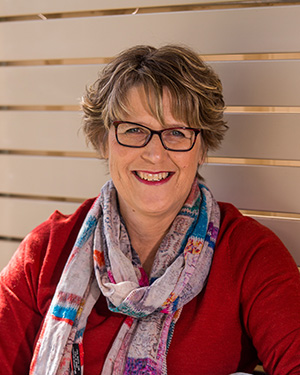 Tricia Stringer grew up on a farm in country South Australia and has spent most of her life in rural communities. She is the mother of three talented children and their partners and is lucky enough to be a nanna.
Tricia has spent many years in education as a teacher, a librarian and an IT coordinator, owned a post office and bookshop and worked part-time in another bookshop – stories have been a part of her life for as long as she can remember.
It was a yearning to write stories to bring local history alive for children that started Tricia on the journey to develop her writing skills and begin to write for younger readers, a path that led to writing adult stories.
Tricia is now the bestselling author of five women’s fiction titles, Table for Eight, The Model Wife, The Family Inheritance, Birds of a Feather and Keeping Up Appearances, three historical books set in South Australia’s Flinders Ranges and seven rural romances. Queen of the Road won the Romance Writers of Australia Romantic Book of the Year award in 2013. Riverboat Point was shortlisted for the same award in 2015 and Between the Vines in 2016. Her latest release for October 2023 is Back on Track. Delving into life experiences, our relationships with family and friends, and what makes us the people we are, is a topic she finds delicious.
Tricia and her husband, Daryl, live on the traditional lands of the Narungga people in the beautiful Copper Coast region. She loves to walk on the beach and travel to and across Australia’s vast array of communities and landscapes as well as to overseas destinations. A sense of place in her stories is very important. There’s always another tale to be written…she’s working on her next manuscript as you read this.

(4/5)
Head for the hills by Tricia Stringer is a great read. Tricia’s writing stye is excellent, drawing the reader into each chapter and left wanting more.
Head for the hills is set in the beautiful Adelaide Hills district in a small country town. The characters are all someone we can relate to as each character battles their own issues in life.
Margot and her sister, Rosyln are close but don’t see eye to eye on many things. Amber is a young lady, down on her luck and all alone, looking to find peace for herself. Their lives become entwined in a story of hardship, determination and loneliness. The small town in which they live, becomes divided and the once happy town, is no longer the happy community it once was.
Head for the Hills is an easy read, great to curl up on the lounge with or a story to lose yourself in on a holiday.
Tricia Stringer is the master of storytelling. She never disappoints and leaves the reader wanting more.
(4/5)
I have to quote from the author herself in her book about attending book club. She suggested ‘brilliant description’, ‘wonderfully written’ and ‘superbly drawn characters’. All these words can describe the book itself. It is an ‘easy’ read but thought provoking and could be described as Small Town Australia 2024! I came to this book not having read any of her previous works and on the strength of ‘Head for the Hills’ I would recommend this author to other readers, particularly city dwellers who live isolated lives. My wish for the author is that she perhaps makes this into a series as it would be very well able to ‘live on’ and explore the relationships between characters.
(4/5)
Sisters Roslyn and Margot have lived their whole lives in the small town of Jesserton in the Adelaide Hills. They have always been close, living and raising their families side by side, supporting each other through everything that life has thrown at them. But when family friend and neighbour Gunther dies, the legacy he leaves threatens to divide not only the sisters, but also the whole town.
This is a great book for anyone who likes slice of life, character driven stories. The well written and engrossing narrative tells the story from three main points of view, sisters Margot and Roslyn and a runaway pregnant young woman named Amber. The characters were all realistic and interesting to follow, even if you get frustrated with their thoughts and decisions at times. I really enjoyed the depth of the relationships amongst the characters.
The author was able to paint a realistic picture of the good and bad of life in a small Australian country town.
Overall I found this story to be heartwarming and even funny at times. With its strong focus on family, friendships and community it emphasises the importance of the relationships in our lives.
(5/5)
In a small town in the Adelaide hills, sisters Roslyn and Margot and families, live beside Gunter’s vineyard. His death changes everything. Roslyn has been quietly charged with overseeing proceeds of the estate for the good of the town. Margot, desperately wanting the property, is devastated when a developer secures the land for a boutique hotel, so stands for mayor to stop the project. The town is divided on the proposal and on choice of mayor.
The differing characters of the two sisters, as they struggle with their own problems, are well drawn and create rising tension. Other characters are authentic including newcomer, Amber, rough, pregnant and homeless who is taken in by Roslyn. Interactions across the community show how easily situations can escalate, how family feuds and opinions are skewed by careless and impetuous comments.
The plot moves easily and readers will take sides in the arguments and issues arising because of the evolving situation.
The conclusion is thoughtful, moving through the chaos and struggles facing families and communities.
Tricia Stringer writes with a great affinity and warmth.
(4/5)
Tricia Stringer is an author that I have not read before but her book Head for the Hills has tempted me to try more of her books.
The book involves a close family with individual personalities that need to find a way through a difficult and opposing situation without losing their own belief in what they consider is right.
It is certainly what I consider a cosy story, a very easy read with enough bite to keep your interest. I found the two sisters quite believable but the young girl that is offered help, less so.
I would have liked a more detailed account in some areas but understand that the storyline required a suspension of belief to some degree.
The family members, I found, were rather shadowy people, nice and necessary to round out the family but had little impact on the story.
Overall an enjoyable read, particularly outside on a warm day with a glass of wine. My star rating is based on what I believe readers expect of this genre.
(5/5)
Small town issues in the beautiful Adelaide Hills, where wine, food family and tourism all come together in this wonderful tale from Tricia Stringer.
The warmth of kindness, caring and compassionate friendships can come between two sisters that already have a complex relationship.
It’s easy to sit, read and join the residents ofJesserton, as they ponder and manoeuvre change in their town. Can the strength of Family love, and friendship hold this town together.
Tricia just writes it how she sees it. A great read, and certainly a 5 star rating from me.
(5/5)
Thank you for the arc of this wonderful book. I have read all of Tricia Stringer’s books and loved them all, and I really enjoyed this one.
I felt it was a little slow at the beginning, but it certainly got moving about a sixth of the way through. It was about family, conflicts, social issues, and helping others. Lots of food and wine chat as well.
A great story which I read in a few days. There were lot’s of different characters, but maybe 5 or 6 main ones which made the story very interesting. I was happy with the way the story ended, but was sad to see it ending as I was very immersed with the characters in the book! I loved it and I look forward to next year’s book now.
(5/5)
This was such an enjoyable read for me. Great characters, locations, a believable story. Sometimes I find everything so exaggerated in a novel so that I can’t relate at all but in “Head for the Hills” I felt that I could roll up to a family dinner and know everyone instantly.
I’d even have ideas about my culinary contribution, gluten free or not.
Conversations were natural and emotions within relationships described beautifully, the ups, the downs and the compromises we make to maintain our family and social networks. The small town conflict caused by a proposed hotel development and the arrival of a young girl in need of assistance add complications.
I look forward to reading more of Tricia Stringer while sipping on a cuppa or (more likely) a cold glass of South Australian wine. Thanks to Good Reading magazine and Harper Collins for the advance copy and I leave this review with pleasure.
(4/5)
Stringer has woven a tapestry of family drama and small-town politics. The family ties are complicated, often historic and diverse, as are the characteristics of each member. Regardless, the threads holding the web together remain strong despite being pulled in various directions.
We become aware of the various interests of the town folk as their community is threatened by change. The longest friendships and placid personalities can erupt, causing fissures in the thinking and actions of the people, when their own interests are at stake.
Stringer is not afraid to address the issues of homelessness, domestic violence and limited opportunities of marginalised members of society as well as the everyday relationships of families, friends and the larger community.
The story is well written, has timely progression and relatable. The uniqueness of Australian country towns is portrayed with clarity and compassion for the inhabitants. Another good read from Australia’s own Trisha Stringer.
(5/5)
Head For the Hills is a thoroughly enjoyable novel about families, small towns, and change. Margot and her sister Roslyn live next door to each other in the Adelaide Hills. There is a gate in the fence between their houses, and they and their families eat together once a week. But then their neighbour, owner of the vineyard next door to Margot, dies, having nominated Roslyn as the (sworn-to-secrecy) executor of that property, where a real estate developer wants to build a hotel overlooking Margot’s house.
I found it very hard to put this book down. The main characters are well written and interesting, and I loved the Greek chorus of the village Facebook group, with the (older) person who always uses capital letters, the people always promoting their business, and the people with opposing views about what the proposed hotel resort will do for their small town. Apart from family relationships, an underlying thread illustrates the effects of potential change on different characters, some of whom see possibilities and one in particular who refuses to.
(4/5)
Vineyard owner Gunter dies and developers want to buy and build a grand hotel on his property.
The hotel plans divide the loyalties of the small town including sisters Roslyn and Margot.
The prose is easy to read – although the small town cast-of-many was initially confusing – and the story develops effortlessly.
Stringer describes the idiosyncrasies and feel of a small town well. Having come from a reasonably small town myself, I could relate to many of the descriptions, personalities and beliefs of these townspeople.
Stringer writes with humour; there are some sweet and funny exchanges between grandchildren and grandparents.
However, the sister protagonists Roslyn and Margot are not particularly likeable, nor is another prominent character Amber. At times, I struggled to care what happened to them. However, as the story developed, Stringer’s story compelled me to read on and the characters grew on me.
This is the first Tricia Stringer book that I have read and I will check out her back catalogue to read more.
(5/5)
I have only read one other book of hers and I thoroughly enjoyed it so I knew I would love this one too. I wasn’t disappointed.
When a hotel is planned to be built in a small town in the Adelaide Hills the town is divided. Even the two sisters, Roslyn and Margot cannot see eye to eye. Margot even goes so far as to run for mayor to oppose the hotel.
This easy to read book had lovable and not so lovable characters, contained humour and the importance of humanity.
(3/5)
Roslyn and Margot are two sisters who live next to each other in a little regional town in the Adelaide Hills. They are as close as sisters can be even though they lead very different lives.
Roslyn is a widow who had a career as an anaesthetist, she has one son who lives in Japan with his family. Margot has a small business in town and is the matriarch of her family who all live close by.
Margot’s neighbour’s property is on the market after he passed away and she is desperate to buy it. Roslyn, meanwhile is appointed as caretaker of that property in the will. Once the buyer is revealed to be a big company with plans to build a boutique hotel, the town is up in arms and divided between those for and against the hotel.
Neighbours against neighbours, friends against friends and even sisters against sisters. Throw in some family drama, a homeless pregnant girl and council elections and you have a perfect small-town drama.
I would recommend this book for people who like stories set in regional Australia with modern social issues and family dynamics.
(4/5)
Tricia Stringer’s new book “ Head for the Hills” is one to read on a warm balmy Summer’s day, outside on the patio under the grape vines, with an ice cold drink on a table next to you.
Set in a fictional town in the beautiful Adelaide hills, Head for the Hills has a strong focus on the importance of families, friendship and communities and the angst caused when these are divided.
When Gunter, a well known identity as well as friend and neighbour of sister Rosalyn and Margot, dies he leaves a property to be auctioned off and the proceeds to be used for charity of Rosalyns choosing. Margot wants to buy the property for her children. It is, however, sold to a large developer who plans to build a boutique hotel.
This divides both the sisters and the community into two camps, those who can see the benefits of the development with an increase in both employment and tourism and those that want the status quo to remain.
Then add Amber, a young struggling unmarried pregnant woman, fleeing an abusive relationship and the discrimination she faces. With little money she is working at the local hotel but sleeping in her car. A chance encounter sees Rosalyn offer her temporary accommodation.
This is a warm fuzzy read, offering no surprises in the plot and the ending is easy to guess
That said I did enjoy the book, characters are developed well as the story progresses. It portrays the wine growing region of the Adelaide hills well.
My favourite character was Amber, she is a fighter who knows what it is like to struggle against poverty and prejudice, and yet doesn’t give up, wanting only a better life for her and her baby.
A good holiday read.
(4/5)
This book was an easy-to-read narrative that captured the everyday lives and problems of a close knit family of lovable, relatable characters living in a small country community. I loved the natural conversations and reactions between the characters, and found it hard to take a side on the debate of whether or not that hotel should be built! Similar to other books by this author, the reader is quickly swept up and into the setting of the story. Having visited the Adelaide Hills area I found it very easy to picture the buildings, homes, streets and gardens that were at the centre of this story. A simple, almost formulaic storyline with several happy endings made this book a great holiday read for me.
(4/5)
A great summer read!
The story is woven around the interactions of a family and the community they live in when change is on the horizon, the good, the bad and the ugly.
The main two characters, sisters Roslyn and Margo, have their personalities and values very well illustrated by the way they act and react when a neighbouring property becomes earmarked for development following the death of the owner. Who could possibly want a boutique hotel in their backyard in a village in the beautiful Adelaide Hills? I found I had sympathy for both points of view.
Margot, the younger sister, feels she has always been in the shadow of Roslyn, a professional woman, now widowed and retired, as she has been a stay-at-home mum while her children were young and did not have an independent career. Margo is now part owner of a successful cafe in the village and a silent partner in her husband’s business. She has been active in village life, including a term on Council.
Roslyn is quietly managing her own health and family issues while Margot is busy deciding what is the best course of action for all, her family, her business, her community and her sister, not necessarily in their best interests, without all the information. She seems to be convinced she knows what is best for everyone – not my favourite character.
The author maintained my interest while collecting these threads into a satisfying conclusion.
(3/5)
Head for the Hills is my first read from Tricia Stringer, and I found it a bit hard to get into. It’s a slow-paced novel, more suited for people who prefer a leisurely story. The book is not a fast read, but it’s engaging enough to keep you turning the pages, especially if you enjoy stories set in regional Australian towns dealing with community issues and family dramas.
Margot, in particular, stood out as an unlikeable character—outspoken and often careless about the feelings of others. On the other hand, I found Roslyn to be more likeable, with her more subdued and considerate personality offering a nice contrast.
Despite these character challenges, the storyline itself is engaging and touches on familiar themes of small-town life. If you enjoy books that explore the dynamics of rural communities and family tensions, this could be an easy read for you.
(3/5)
The author made me work too hard with this book. Although I was initially curious and eager to explore the seemingly exciting storyline, I was not given the groundwork for following what turned out to be a complex and somewhat convoluted and interwoven tale. I had, for example, difficulty working out the physical layout of the sister’s and neighbour’s properties. If the sisters lived side by side, how could they both be either Gunter’s neighbour, or directly affected by an over-the-back-fence connection to Gunter’s land? Did his property wrap around the two sisters’ plots? Probably, but I wasn’t told, and had to leave the story, mid-sentence, to consider the layout. Similarly, the respective family heirarchies were left undefined, and I again had to leave the scene, and try and work out who was whose child/husband/son-in-law, etc.
In the same way I struggled with the patchy, unfinished descriptions of scene and players, I found the storyline itself stilted, jerky and insufficient, not flowing smoothly from one richly described scene to the next. At times, I had to check who was doing the talking, as it wasn’t at all clear. It is a pity to have been so continually distracted, as the plot was an excellent one, had it been written to be understood by the armchair reader, and held an enormous potential to be both engrossing and entertaining.
In essence, I seemed to be spending as much time trying to decipher what I was looking at, as being the happily unseen observer. This annoyed me to the point where it was an effort to continue reading at all. Had I not been asked to review, I would have given up after the first few chapters, and donated the book to the local library.
(5/5)
I was very excited to receive the opportunity to review this book. It is not my usual genre but it was an entertaining read.
The story is about two sisters, Roslyn and Margot. Roslyn is the eldest, retired and happy to live her life quietly on her parcel of land. Margot is a café owner and active member of the community.
When Gunther dies leaving his land that abuts onto Roslyn and Margot’s land to his sons, they put the land on the market and this is the start of a turbulent time for the sisters and the town. Battle lines are drawn when the land is sold to a developer, some support the development and other want to keep their way of life. This pits the sister against each other as Roslyn wants to support the homeless and those escaping domestic violence. Margot want to keep everything the same and she is unhappy that their bid was not accepted on the land.
This all leads to an entertaining story line, told in a captivating manner.