


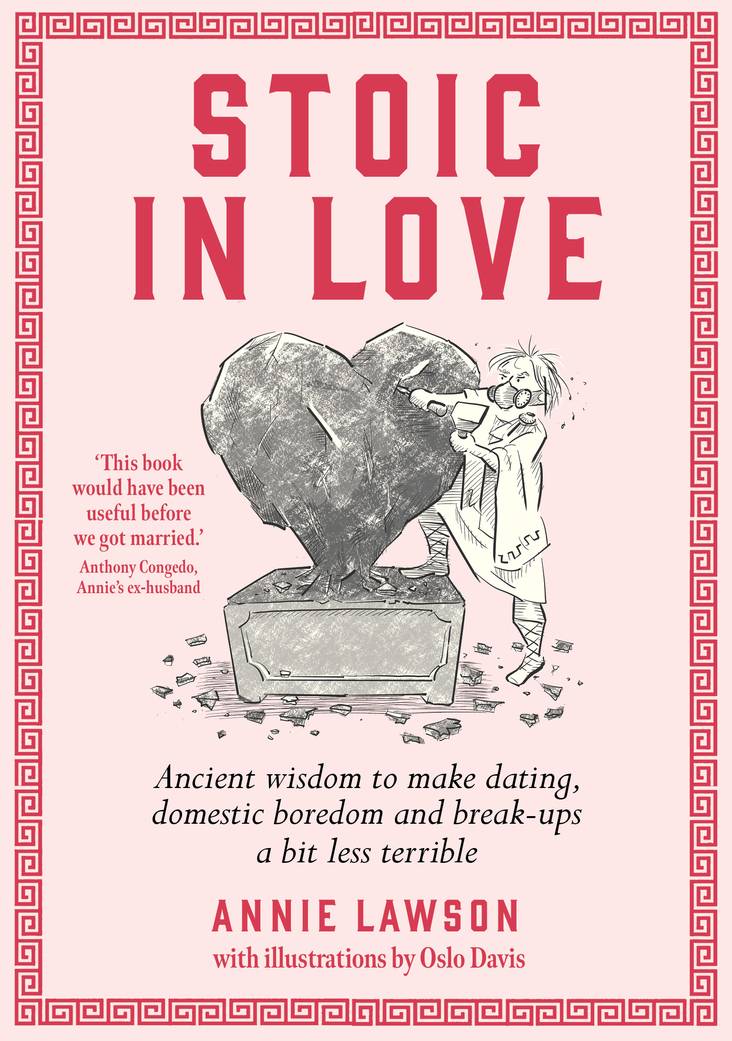
Romance and its rocky pursuit often sucks but, fortunately, not always. ANNIE LAWSON’s book Stoic in Love uses 45 rules to help us realise that we can all use a little assistance getting together, staying together, or moving on.
Read on to find out Rule Number 1.
 ABOUT THE BOOK
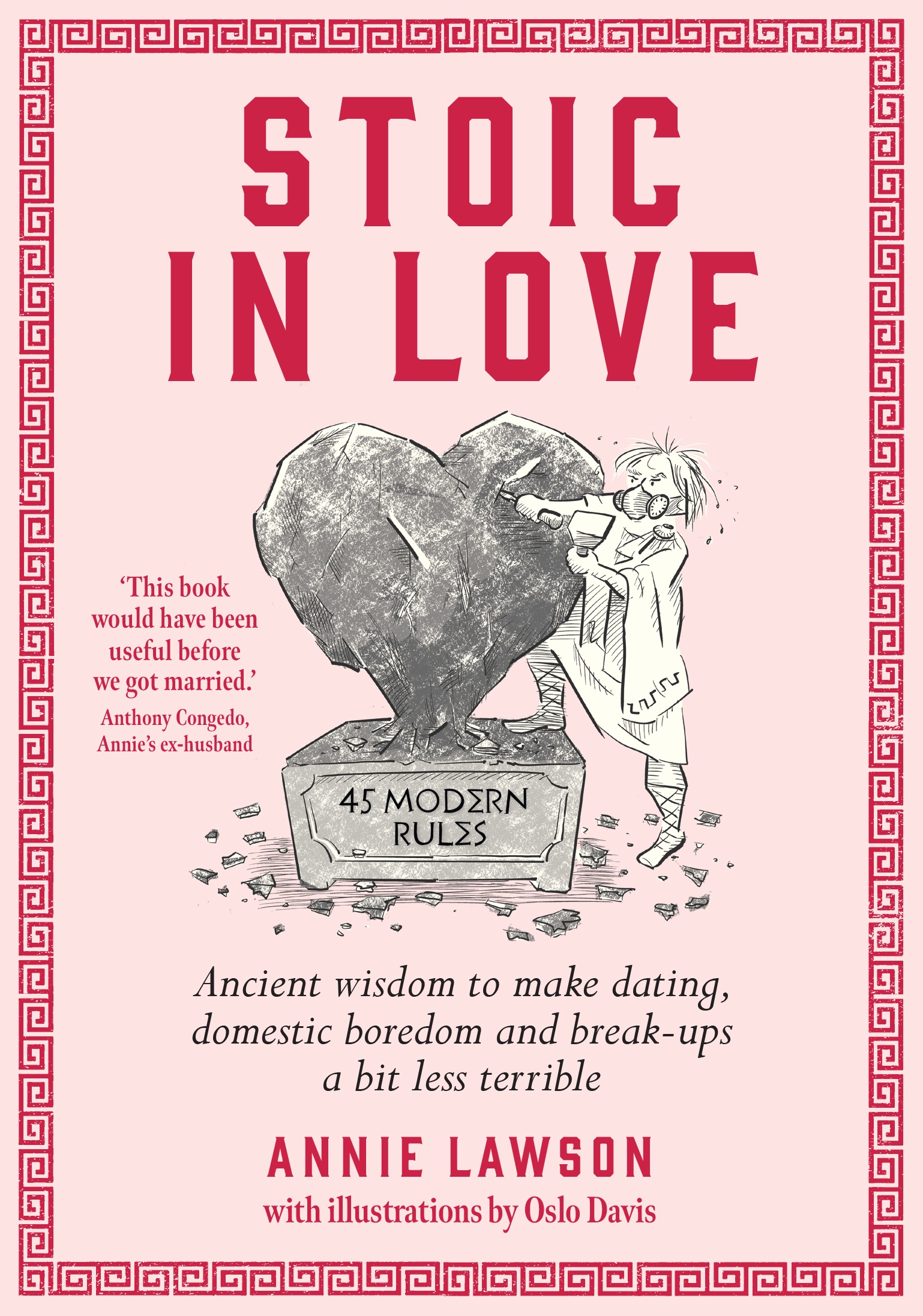
You’re on date #17 since your last relationship ended in flames, and within a nanosecond of meeting Doug at a bar you realise you’ve made a huge mistake. You head to the bathroom to text your mate Lizzy and complain about how your date says aaaahh after every sip of beer, seems to style himself after Donald Trump, and definitely sniffed your hair. Ten seconds later, you realise you accidentally texted this to Doug. You sit frozen on the loo, wondering if there’s a back exit, or if you should fake your own death.
The philosophy of the Stoics can help us all navigate the life cycles of love, whether it’s dating someone wearing horns and a kaftan, a relationship where blobs of toothpaste are left smeared in the bathroom sink, or being dumped via text with just one word – enough! Across 45 rules, from dating tips like Do your due diligence to relationship advice like Don’t tell your partner to calm down to break-up wisdoms like Resist putting your foot in your mouth, Annie Lawson applies ancient wisdom to the modern world of being in love, out of love, lovesick, love-bombed or just love-tired.
Romance and its rocky pursuit often sucks but, fortunately, not always, and Stoic in Love helps us realise that we can all use a little help getting together, staying together, or moving on.
**********
RULE 1 – Give love a chance
‘Love can create universes. Love and wisdom are equal.’ Agni Yoga, Leaves of Morya’s Garden
You need look no further than the TV franchises Love Is Blind and Married at First Sight, where people get engaged or marry on their first date, to see that there are many – often dubious – paths to love.
Finding love is a bit like Frodo’s quest in The Lord of the Rings, as there are plenty of virtual and real-life orcs, Gollums and Sarumans. The idea is to find a Gandalf, an Arwen or an Aragorn (yes, please). Gone are the serendipitous hook-ups and authentic connections we made in the workplace, or through friends of friends, or randomly in a queue for a kebab. Relationships that blossom from our phones are prefaced by a flurry of texting.
As journalist Elle Hunt noted, every stage of the dating and relationship life cycle can now be conducted virtually – ‘from early butterflies, to getting to know each other, to one or the other pulling away, to our eventual break-up’. Matching, messaging and eventually meeting is like an unfulfilling second job for which you never get paid. Sometimes the message thread goes quiet just before a meet-up, signalling that your future spouse has lost interest and found another match. Some people are brutal and include instructions on their profile such as ‘swipe left if you have thin lips’, helpfully giving scrollers a strong signpost of dickheadery. Decoding the hidden meaning behind texts that are seen but not responded to is exhausting. People who use dating apps hate them because of the administrative and spiritual toll. Even people who do not use dating apps hate them. But they have removed social and geographical boundaries, and dramatically widened our pool of prospective partners. The trick is to distinguish between a potential love match, a complete psychopath and a bot. (Though at least you never have to live with the bot and argue over whose turn it is to stack the dishwasher.)
Dating apps try to be helpful by suggesting potential matches, which is fine until they throw up your best friend’s husband or your uncle. We all look for certain attributes in people that are non-negotiable. No criminal record, nice breath and well-plucked nasal hair. But look out for any misrepresentation – the kind who photoshops out his double chin and man boobs, or poses with a labrador even though he dislikes dogs. I am not likely to post the photo that shows my own double chin, an unhealthy amount of gum and bird’s-nest hair.
Once you do meet in the real world, how can you tell if someone likes you? And when is it appropriate to deploy a playful tap on the arm to initiate a frisson-charged exchange? How do you read the right signals to gauge interest? Flirting builds excitement but does not necessarily culminate in romance. Apparently, we mirror the gestures of others we are attracted to. According to the BBC, it takes between 90 seconds and four minutes for us to determine whether we find someone attractive. Some 55 per cent of messages signalling attraction come through body language, 38 per cent through the tone and speed of our voice, and 7 per cent from conversation. Playing hard to get apparently does not work, but we like people who are easy for us to get but tricky for others.
What do the Stoics say?
Ancient dating algorithms openly favoured sibling matches. The Roman census during the first to the third centuries CE indicated that more than 16 per cent of documented marriages had some degree of kinship. While not all were perhaps biological brothers and sisters, avoiding siblings on dates was clearly not easy. In the modern dating world, there is a much wider pool of non-relatives to choose from. Where do we begin? Embracing the Stoic virtues of courage, patience, temperance and justice is a good start. Unfortunately, dating apps do not make a feature of these virtues. The incessant scrolling and targeted algorithms measure success not through a love connection but how long people spend on the apps. This means the desired outcome is for users to have a relationship with technology that lasts longer than any romantic liaison.
The focus is on what we are lacking rather than what we have. Seneca said that instead of wallowing in the absence of love, we should take charge of our own happiness. That means adopting an indifferent mindset to dating outcomes, and not anticipating too much. ‘[I]f day and night your soul keeps its even and unswerving course, upright and content with itself,’ he wrote, ‘then you have attained to the greatest good that mortals can possess.’ Of course, this is unrealistic, but it is something to strive towards.
A FINAL WORD FROM THE STOICS
‘But having determined in your mind that every thing which shall turn out [result] is indifferent, and does not concern you, and whatever it may be, for it will be in your power to use it well.’
Epictetus, Discourses
**********
 ABOUT THE AUTHOR
 ABOUT THE AUTHOR
Annie Lawson is a former journalist who has had a diverse career, from wrangling a clown on roller skates on a live television show and interviewing Kiss legend Gene Simmons to writing about China, technology and climate change for corporations and advocacy groups. Even though the work differed, Annie found some common threads, whether it be people who are annoying, meetings that are pointless and language that makes no sense.
She consulted friends who worked in travel, health, resources, technology, emergency services, retail and financial services for inspiration and combined their advice with the ancient wisdom of Stoic philosopher and Roman Emperor Marcus Aurelius.
Follow Annie Lawson on Instagram

0 Comments